Our arrival in Buenos Aires was eventful, to put it mildly. After a monumental flight delay – eventful enough that it earned its own article about how we claimed back €1,200 from Turkish Airlines – we finally landed in the Argentine capital in the small hours. The first, already-short chapter of our month-long Patagonia and Antarctica trip therefore started in a hurry: we reached our Airbnb at 5 am, and by 10 am we were sipping our first coffee and plotting the route from Palermo to the Congress building. Three days is not much, and we intended to use every minute of it.
Our previous Buenos Aires article was a general introduction to the city – where to stay, what the neighborhoods are like, how getting cash works in Argentina, and other practical matters. This one is about what we actually did with our three days: what we saw, where we ate, and what we tried. At the end, we break down exactly what the whole stay cost us.
Let’s dive in.
How to Spend 3 Days in Buenos Aires: A Quick Overview
Three days is not a lot of time – not just in Buenos Aires, but pretty much anywhere. Since our schedule was packed with Antarctica and Patagonia, we tried to squeeze the most out of what we had.
In practice, that meant a walking tour every day – some free, one paid – each covering a different part of the city. We stayed in Palermo, and over the three days we covered the historic center, Recoleta and Retiro, and half a day in La Boca, with a tango show fitted into one of the evenings. It worked out to a surprisingly complete first impression of the city.
Day 1: From Palermo to Plaza de Mayo
We had spent more than twenty hours in a Turkish Airlines A350, so after a short sleep, the day started slowly. Andrea’s iced flat white run to a café near our Palermo Airbnb was a lifesaver. We drank it fast, went for a proper breakfast, and then made a decision that turned out to be one of the best of the trip: instead of taking the subte, we would walk from Palermo all the way to the Congress building, where our pre-booked free walking tour started.
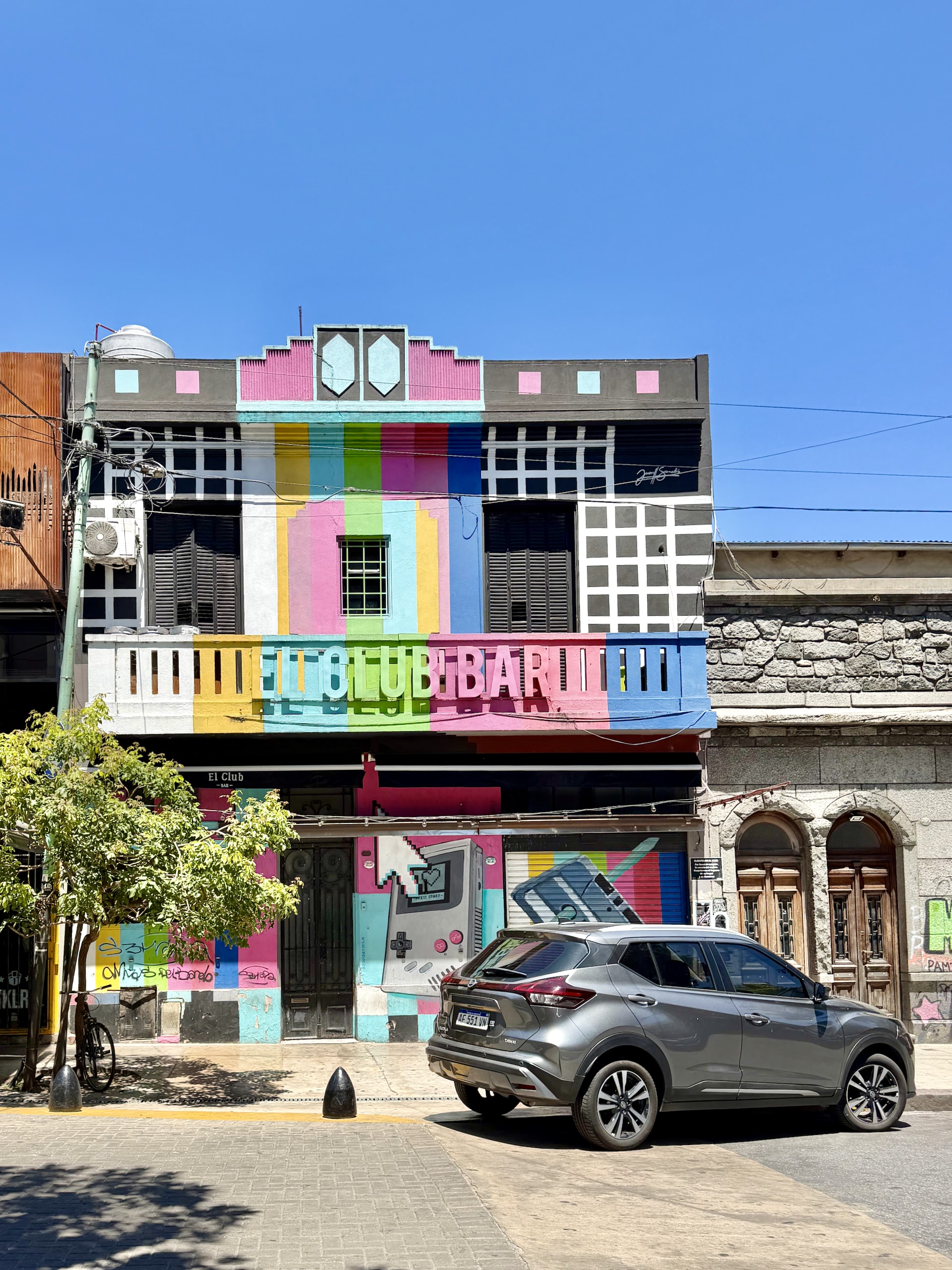
The roughly 1.5-hour walk, partly along Calle Lavalle, took us through the parts of Buenos Aires tourists don’t usually see. Palermo caters heavily to visitors – it’s the nightlife-and-brunch district – but the streets beyond it belong to everyday life. What struck us was the hyper-specialization of the shops: an entire run of textile shops side by side, a balloon shop, a hardware store, a chimney shop. Nothing about the walk felt sketchy. This part of the city was clean, calm, and perfectly pleasant. If you want to calibrate what Buenos Aires is like for the people who live there, a long walk like this does it better than any tour.
The Avenida de Mayo Free Walking Tour
We booked the historic center tour with Buenos Aires Free Walks, and our guide for the day was Victoria. The surprising thing about this tour is that it essentially covers a single street – but what a street. The Avenida de Mayo runs from the Congress to the presidential palace, and nearly everything worth knowing about Argentina’s political history lines up along it. The tour takes about two hours. Victoria was solid: factual, thorough, more of a well-prepared history lesson than a personal storytelling session. Not a bad thing – just a style.
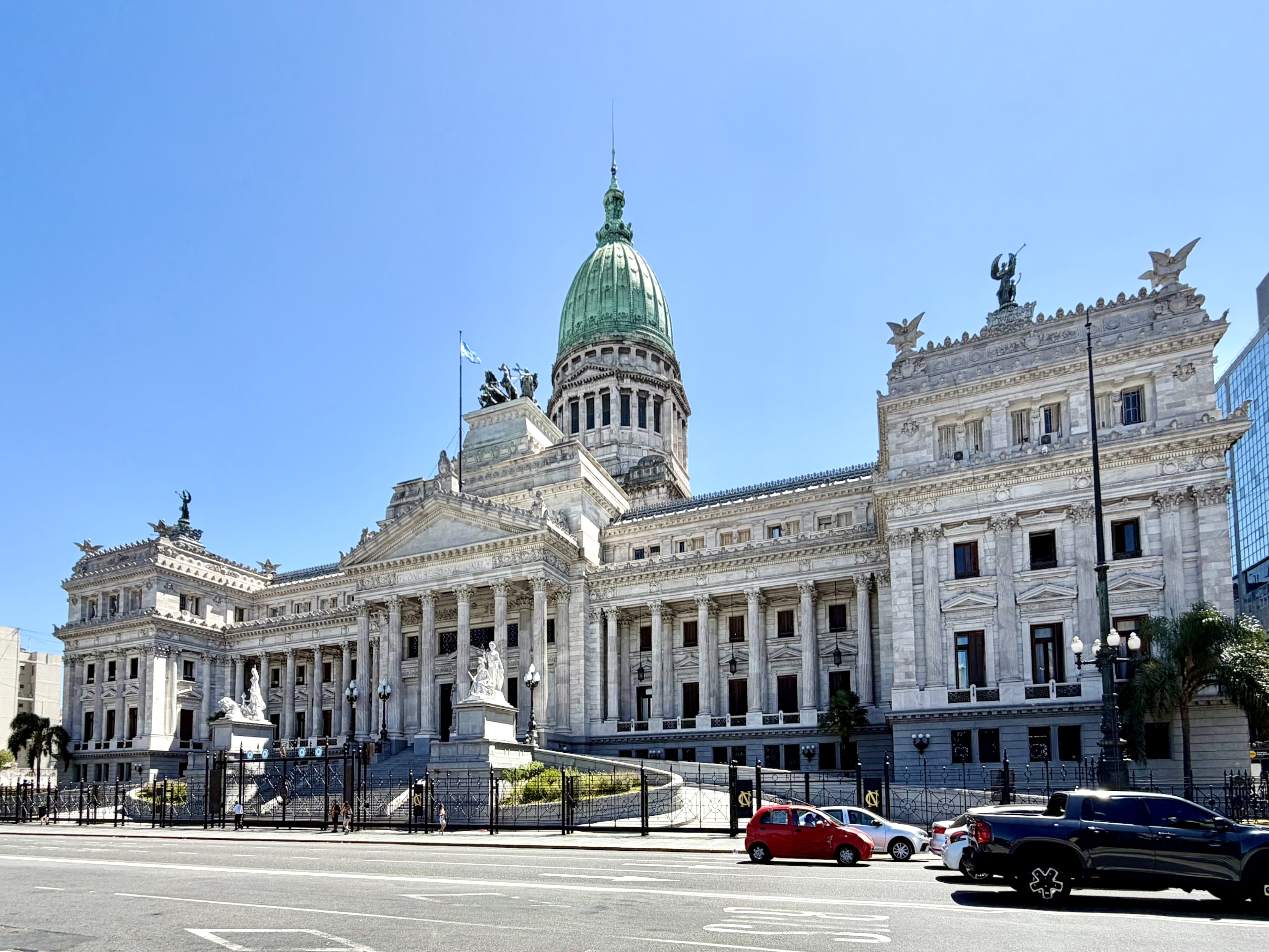
The starting point, the Palacio del Congreso, is one of those buildings you’ve seen even if you’ve never looked up Buenos Aires: a white, domed structure inaugurated in 1906 that clearly nods to the US Capitol. From there, the route heads down Avenida de Mayo, and the next stop is the strangest building in the city: the Palacio Barolo.
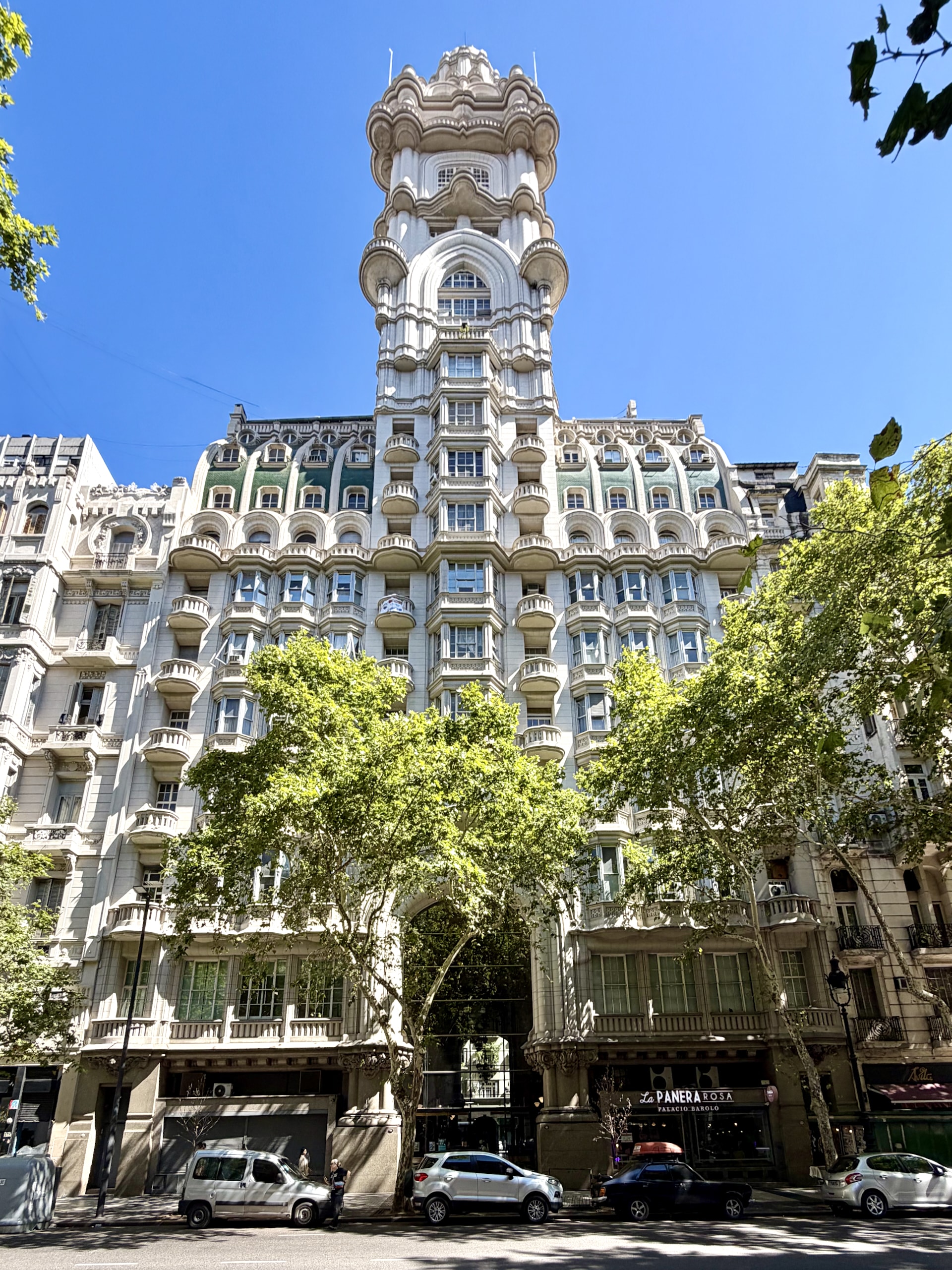
Completed in 1923 for Luis Barolo, an Italian textile magnate, and designed by architect Mario Palanti, the Barolo is a 100-meter (328 ft), 22-story office building conceived as a monument to Dante’s Divine Comedy. This is not a loose inspiration – the whole structure is the poem. The 100 meters match the poem’s 100 cantos, and the 22 floors the stanzas of its verses. The building is divided into Hell (the ground floor, decorated with dragons and serpents, entered through nine vaults for the nine circles), Purgatory (the middle office floors), and Paradise (the top floors, crowned by a working lighthouse). Barolo was convinced Europe was heading for collapse and originally wanted the building to house Dante’s ashes, safely across the Atlantic. The ashes stayed in Ravenna, but the building was the tallest in South America until the Kavanagh Building overtook it – more on that one later, because it has an even better story.
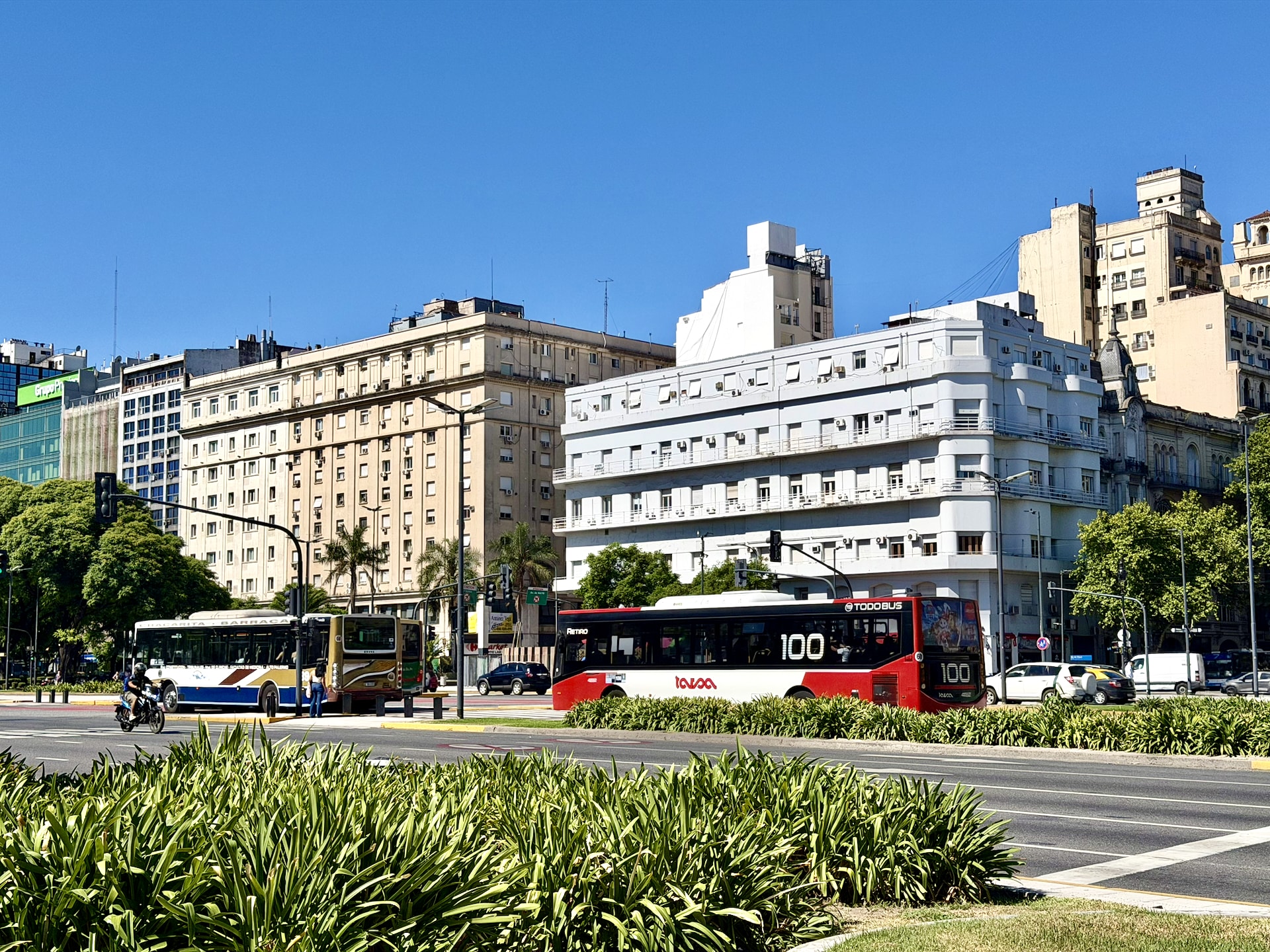
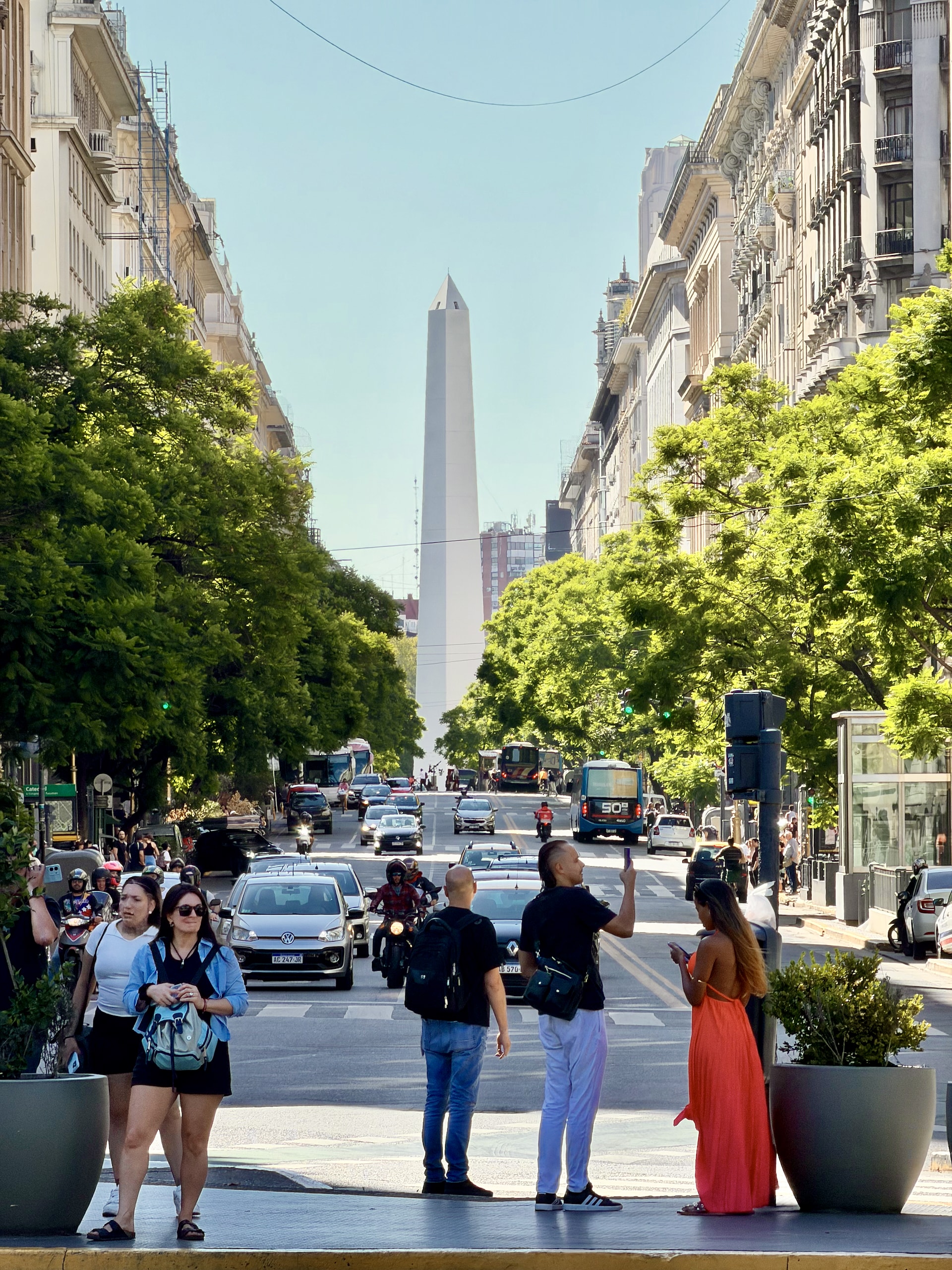
Continuing on, you reach the Avenida 9 de Julio, which some Argentine sources call the widest avenue in the world. To be fair, it’s really four or five roads merged into one, but the result is genuinely a full city block wide, greenery and tree lines included. Looking one way from the intersection, you see a giant steel portrait of Eva Perón on the facade of a modernist tower – the former Ministry of Public Works building, where Evita gave some of her famous speeches. The two 31-meter (102 ft) steel silhouettes, installed in 2011 by artist Alejandro Marmo, face opposite directions: the official portrait looks south toward the working-class districts, and the “combative” Evita, mid-speech at a microphone, looks north. Looking the other way, you see the famous Obelisco. The punchline: over our entire stay, we never once got close to the Obelisco – arguably the single most famous landmark in the city.
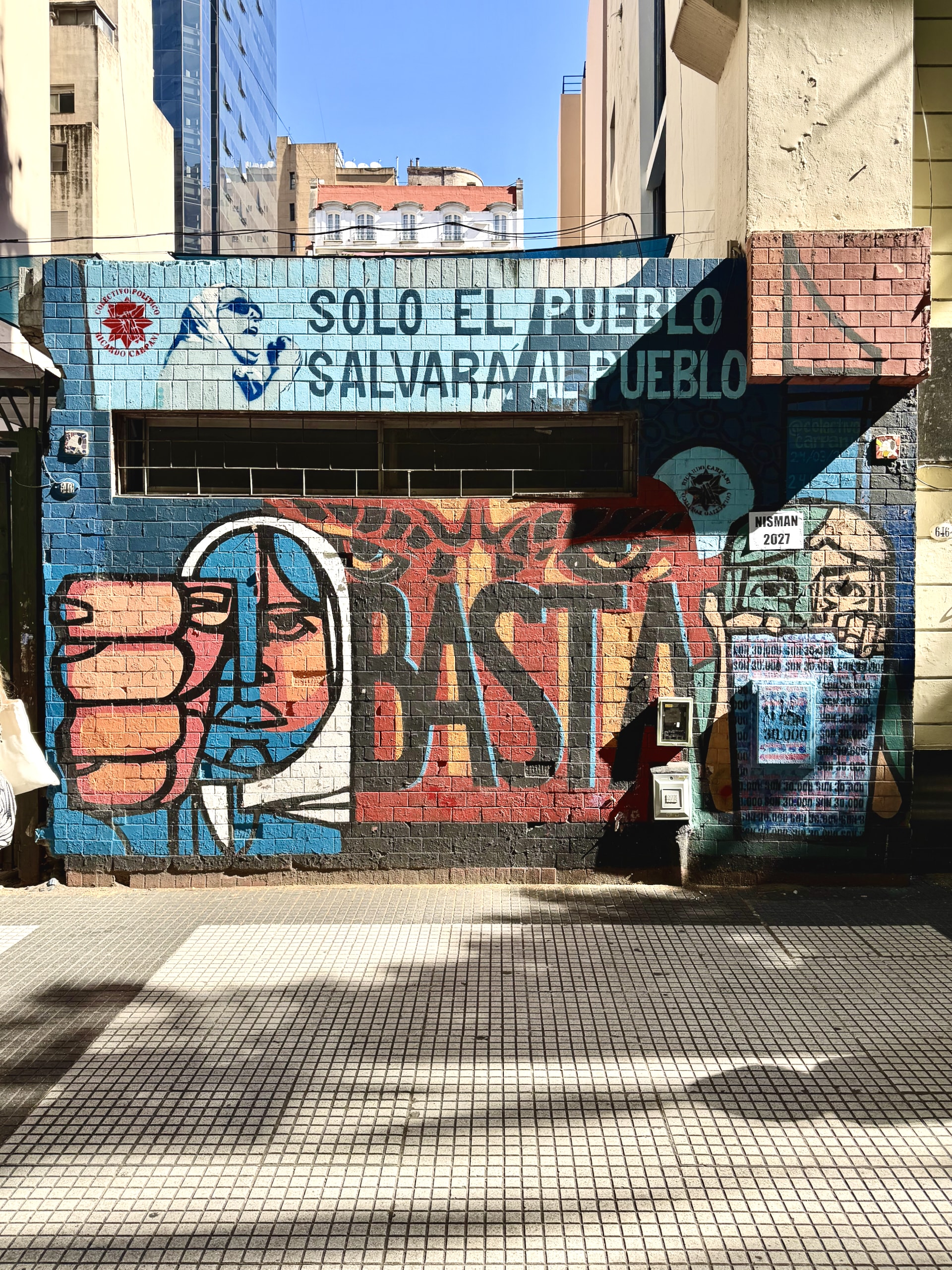
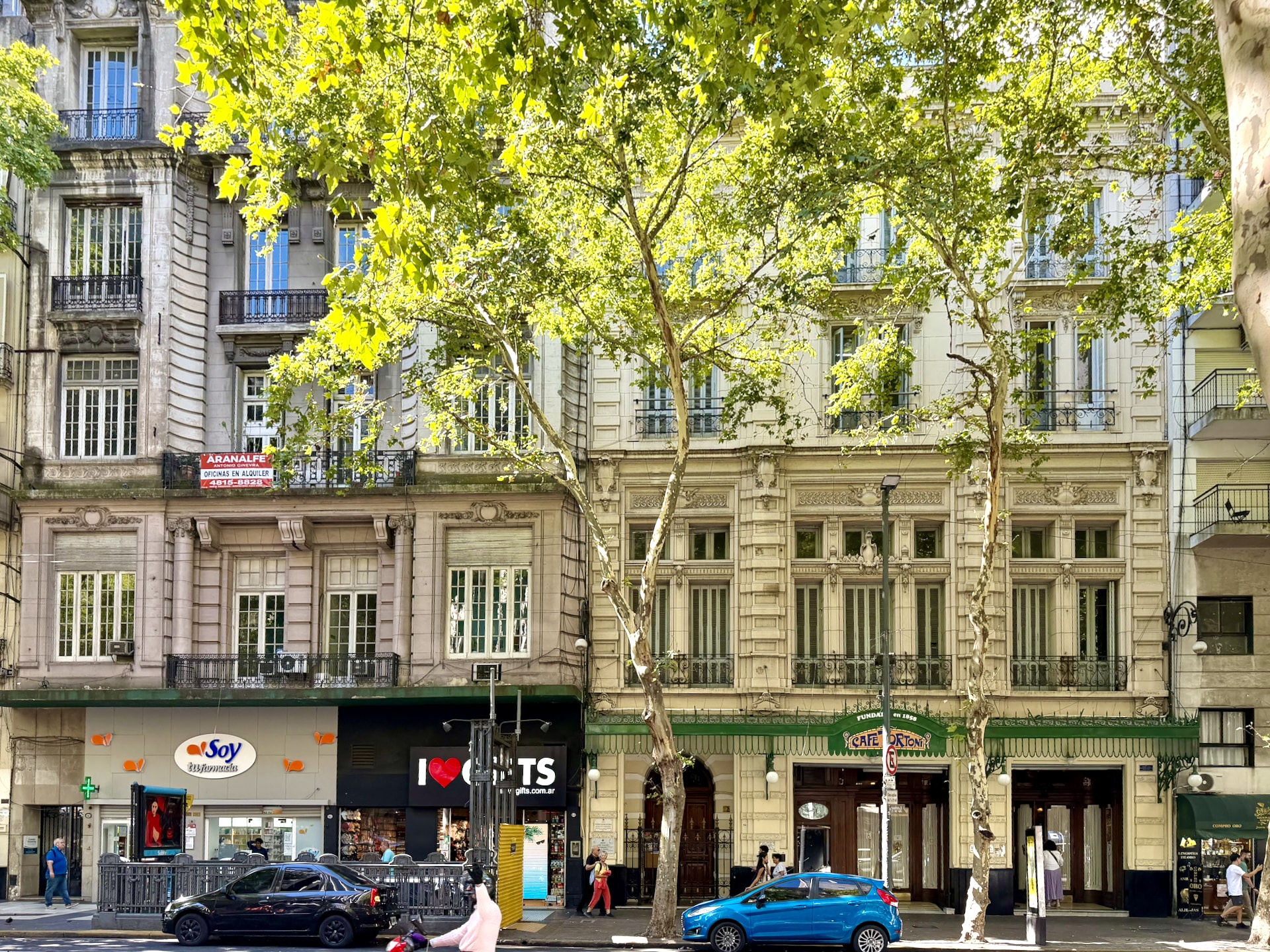
The avenue is also home to one of Buenos Aires’ celebrated cafés, the Café Tortoni, open since 1858. Like many European capitals, Buenos Aires built its social life around grand cafés in the 19th and early 20th centuries, and the surviving ones are famously spectacular inside – Tortoni above all. We never made it in, which is one more item on the list for next time. Along the way there’s plenty of street art too: Messi and Maradona, naturally, but also murals of the white-headscarved women. More on them in a moment.
Plaza de Mayo: Cabildo, Cathedral, and the Casa Rosada
The Avenida de Mayo ends at the Plaza de Mayo, which is effectively the historic main square of Buenos Aires. It’s not enormous, but the buildings around it make up for the size.
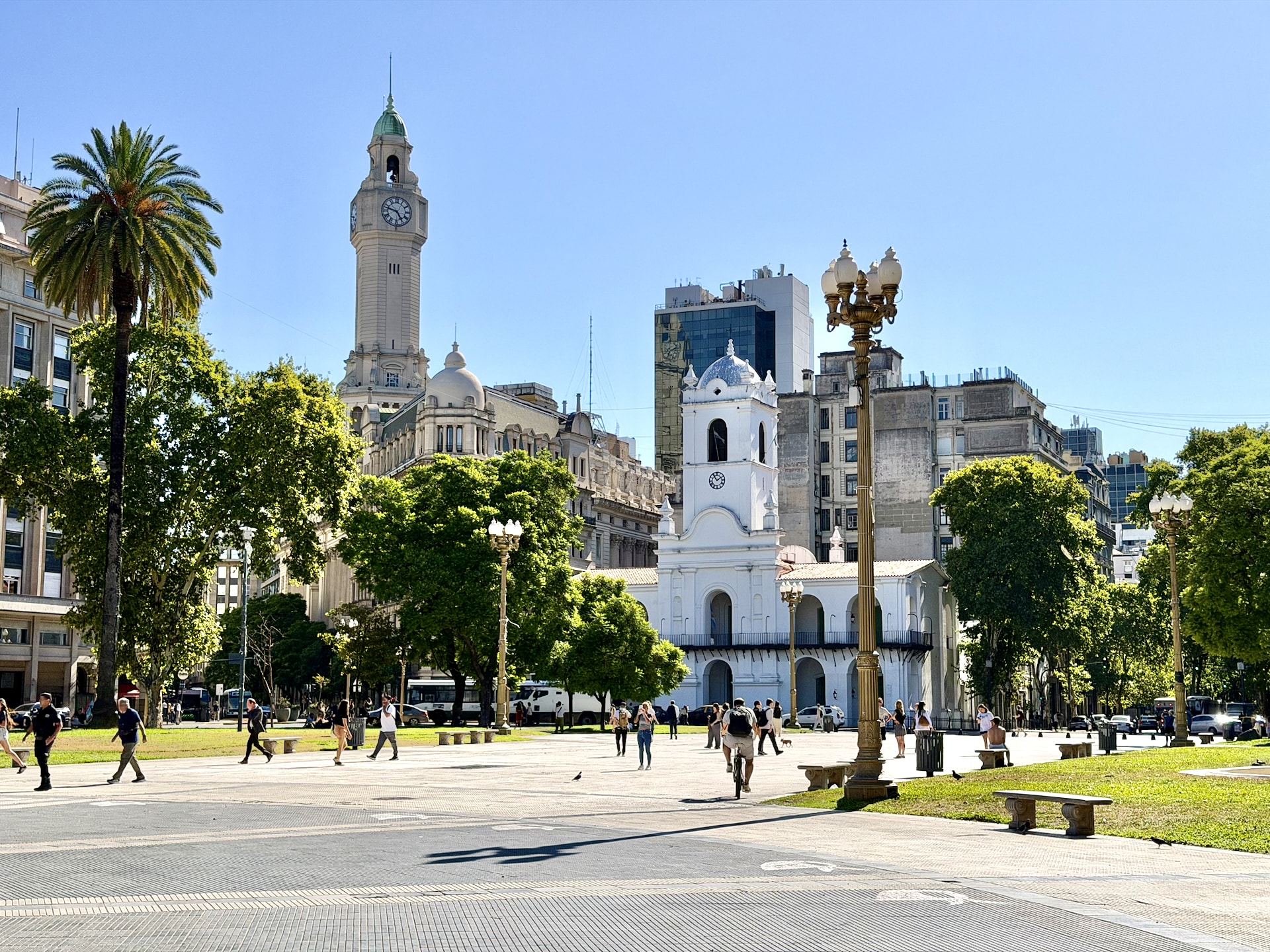
On one side stands the Cabildo, the whitewashed colonial-era town hall, today home to the national museum of the Cabildo and the May Revolution. It’s exciting precisely because Buenos Aires kept so few buildings like it. The city never had much sentimentality about its architectural past: when a new style or a new avenue came along, older buildings were demolished or trimmed without much hand-wringing. The Cabildo itself lost whole rows of its arches – first when the Avenida de Mayo was cut through in the 1880s, then again for a diagonal avenue in the 1930s – so what stands today is considerably smaller than the original.
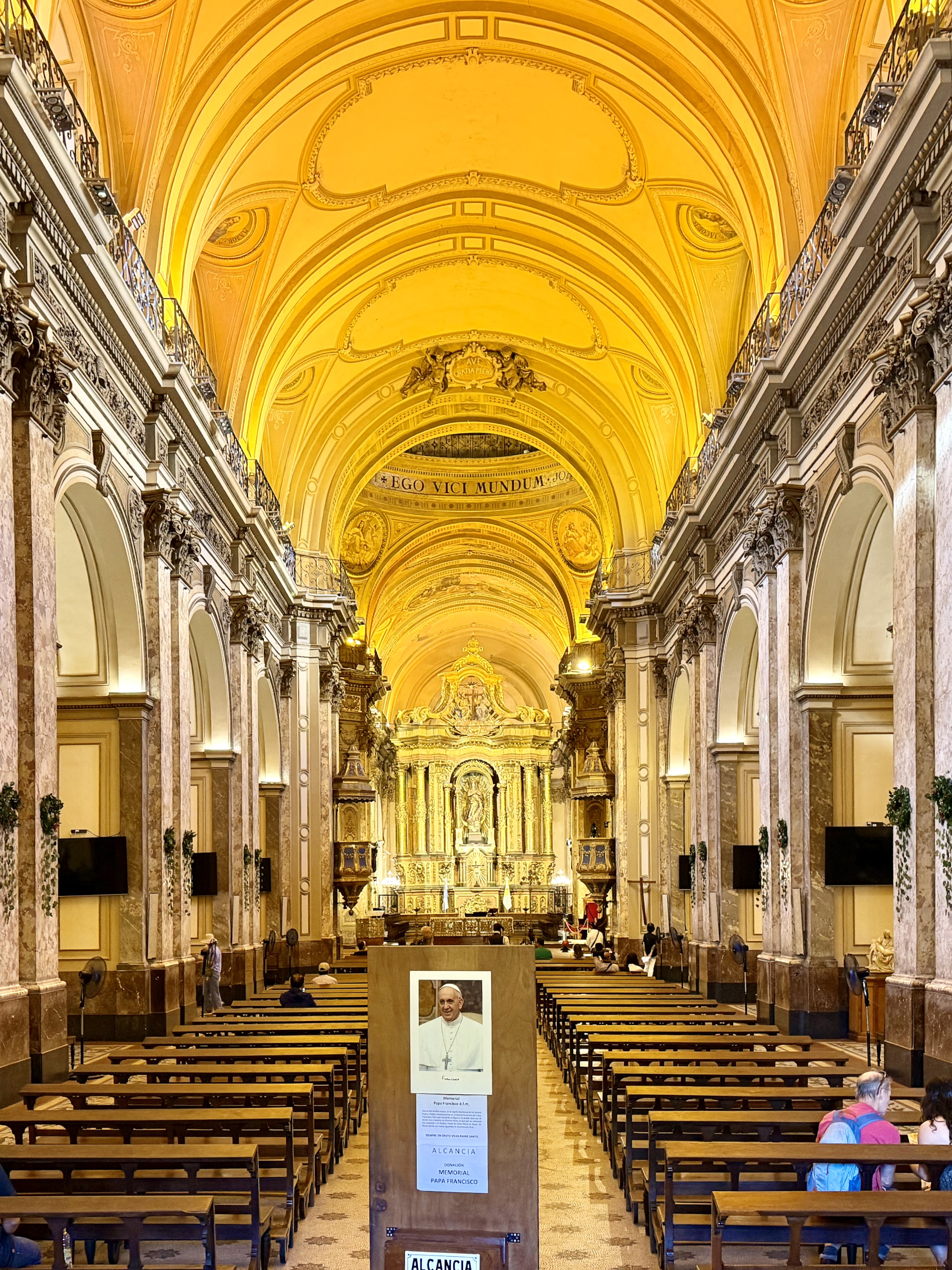
Nearby is the Catedral Metropolitana, the city’s main cathedral. Don’t picture a classic twin-towered Latin American church – from a distance we didn’t even register it as a church. Instead of towers, it has a broad neoclassical portico with twelve columns, more Greek temple than cathedral, with a dome behind it. The tour didn’t include going inside, but we peeked in on our own. The interior is worth the few minutes, and it also holds the mausoleum of General José de San Martín, Argentina’s independence hero. This is also the church where Pope Francis served as archbishop before his election.
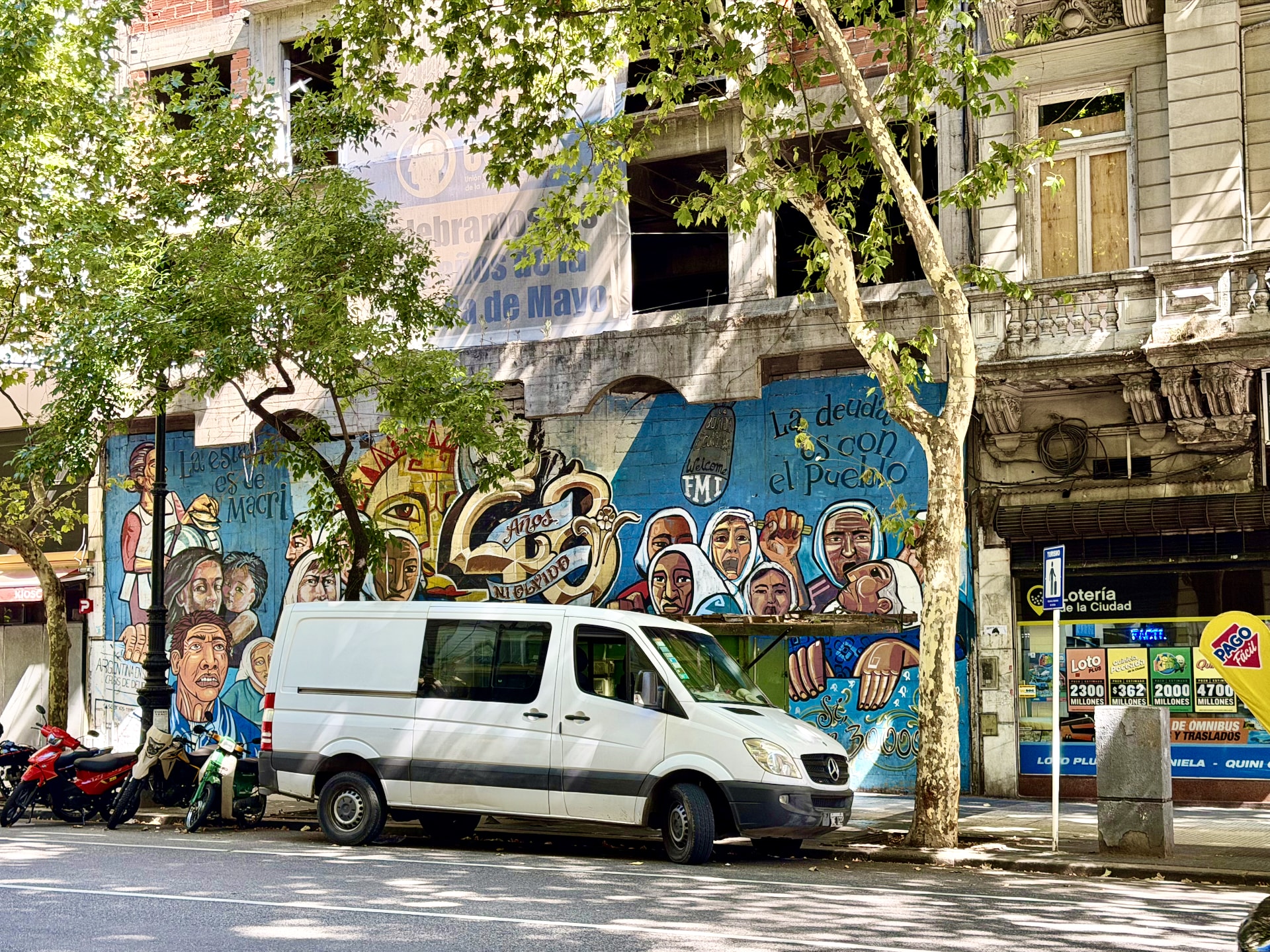
In the center of the square stands the Pirámide de Mayo, a small obelisk (very small, compared to The Obelisk) erected in 1811 for the first anniversary of the May Revolution. The circular walkway around it has a heavier story. During Argentina’s last military dictatorship (1976–1983), an estimated 30,000 people were forcibly “disappeared” by the regime. In 1977, a group of mothers whose children had vanished began gathering on this square, wearing white headscarves, demanding answers. Standing still in a group counted as a demonstration and was banned – so the women started walking in circles around the pyramid. Since they were moving, technically it wasn’t a protest. The Madres de Plaza de Mayo have marched here every Thursday at 3:30 pm ever since. The few surviving founders are very old now, some circling the square with walkers, but the march continues – one of the most quietly devastating traditions you can witness in any city.
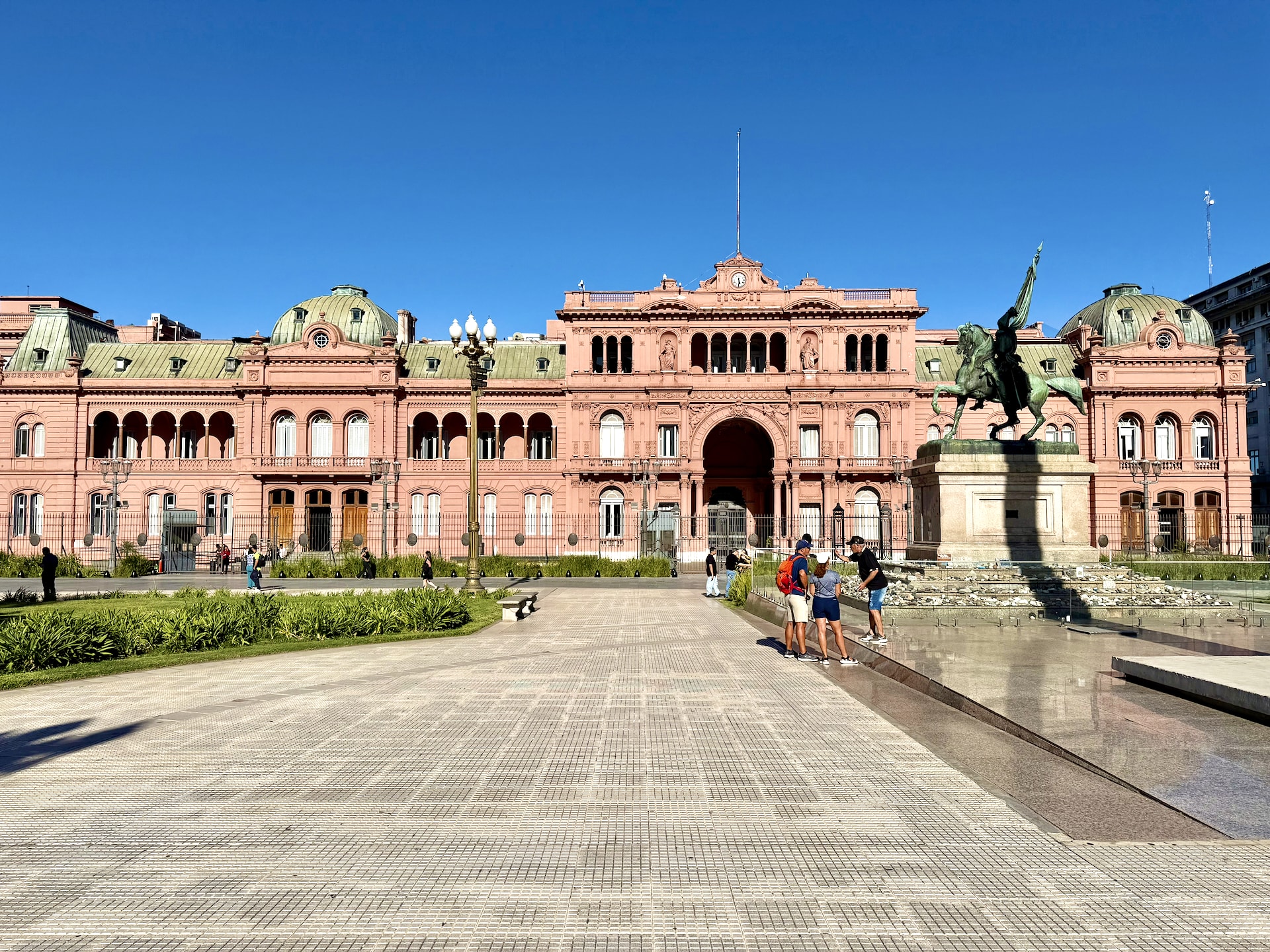
And from anywhere on the square, you see the Casa Rosada, one of the most emblematic buildings of Buenos Aires, which unsurprisingly takes its name from its color. It’s the office of the Argentine president – the workplace, not the residence. Argentina’s political life hasn’t exactly been calm in recent years, and it showed: heavy steel barriers stood stacked near the building in case of protests, though you can still walk right up to it. We even caught a small changing of the guard. Two details worth knowing: the building is asymmetrical because it’s actually two older buildings – the government house and the central post office – joined together with a grand arch in the 1890s. And the pink? The classic explanation is that in the era it was built, paint was commonly mixed with ox blood to protect the plaster, which produced this shade. Today’s color is just a reference to that tradition – no blood involved, which felt important to confirm.
Around the corner you can spot the imposing headquarters of the Argentine central bank, and from the small Parque Colón beside the Casa Rosada you can see the skyscrapers of Puerto Madero in the background – the modern district we covered in our Buenos Aires guide.
The tour ended here. We wandered around a little, then took the subte back toward Palermo – how the metro and buses work is in the other article as well. The one thing Google Maps didn’t know was that our stop was closed, so we rode one station further. The silver lining: we got an unplanned look at Palermo Hollywood, the more residential end of Palermo, and walked the last twenty minutes home. In the evening we ate steak and provoleta at an excellent parrilla and went for cocktails – both covered in the food section below – and then fell into bed.
Free walking tours run on a pay-what-you-wish basis, and guides in Buenos Aires generally can’t accept cards. Bring cash for the tip – pesos or US dollars both work – and book your spot online in advance, especially in the January–February high season.
Recoleta and Retiro: Buenos Aires’ Grand Architecture
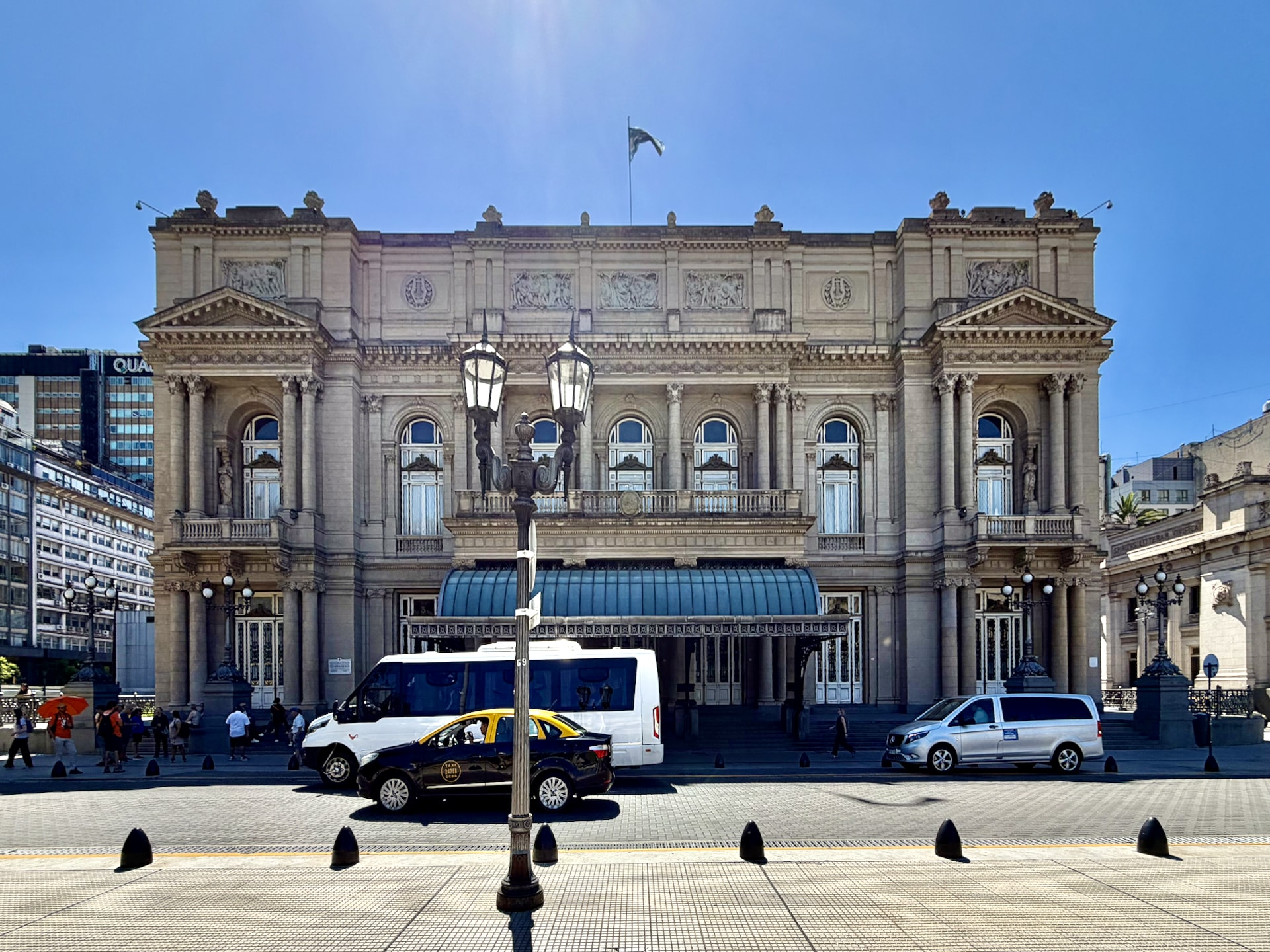
We liked Buenos Aires Free Walks enough to book their tour for the next day too. Day 2 was about the Retiro and Recoleta districts – the classic, most European-feeling quarters of the city. The meeting point was at the Teatro Colón, which we reached from our accommodation on the 39 bus (again, the mechanics of public transport are in the practical guide).
This tour covered far more ground than the previous day’s single-street route. Our guide was Martín, who was a little mad – in the good sense. Where Victoria was a history teacher, Martín was a personality, and it added a lot. Along the way he wove in the story of the country itself: what Argentina was a century ago, what happened since, and how the economy got to where it is now.
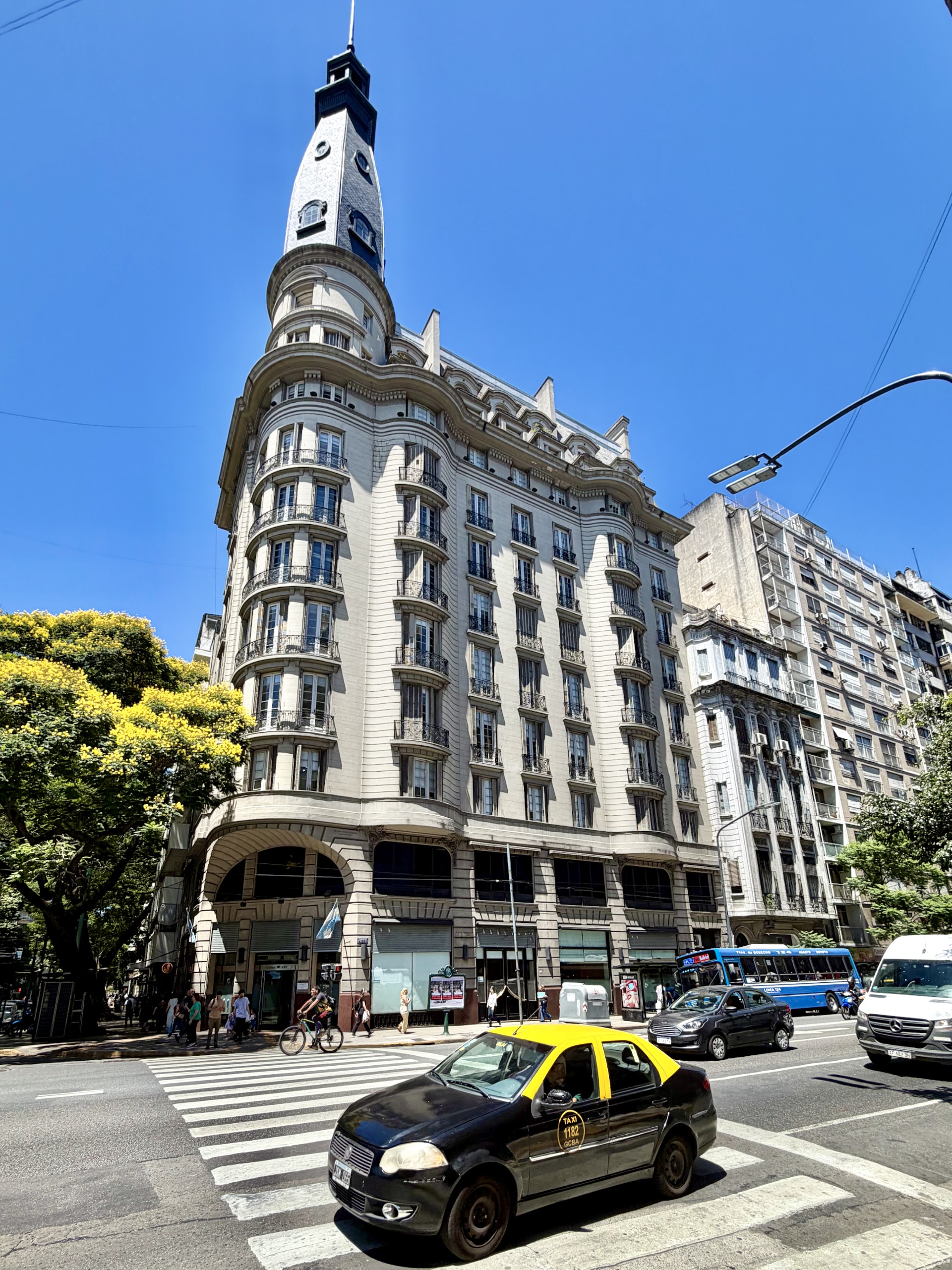
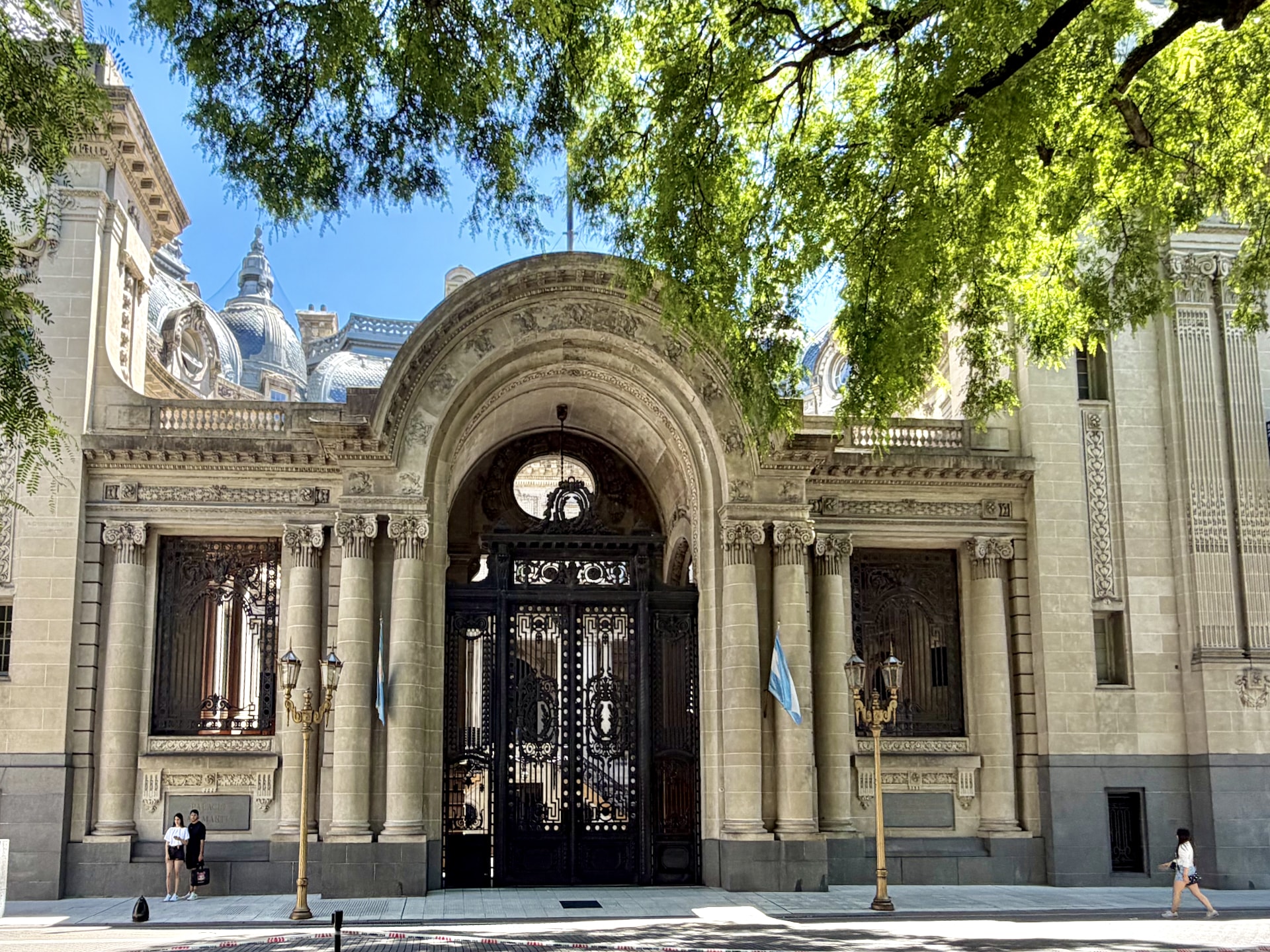
The architecture here is the point. These neighborhoods are stacked with genuine palaces built in styles reaching back centuries – French-academic Beaux-Arts mansions, art deco towers, and rows of what we privately called “typical Budapest-style buildings,” the eclectic and neoclassical apartment blocks that would look at home on Andrássy Avenue. This is where you can see just how rich this country once was: in the early 20th century, Argentina ranked among the wealthiest nations on Earth, and Retiro and Recoleta are the physical evidence. Embassies, palaces, generous green squares – both districts are walkable, comfortable, and visibly upscale.
We also stopped at the memorial to the fallen of the Falklands War – or, as it’s called here, the Islas Malvinas, a wound that is clearly still raw. In a neat historical irony, the memorial faces a clock tower that was a gift from the city’s British community back in 1916. The guides tell these stories in detail on the tour, so I won’t spoil more of them.
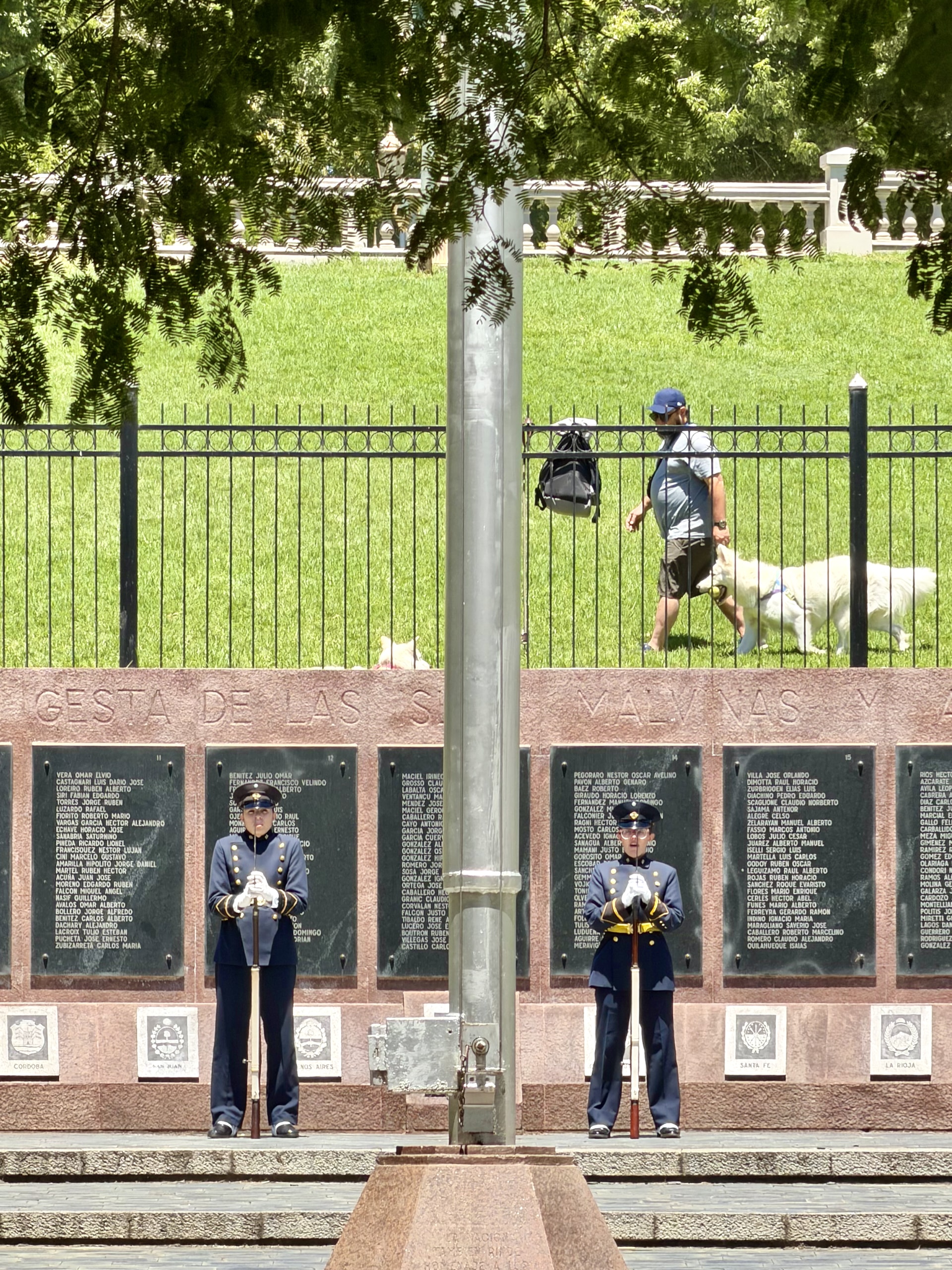
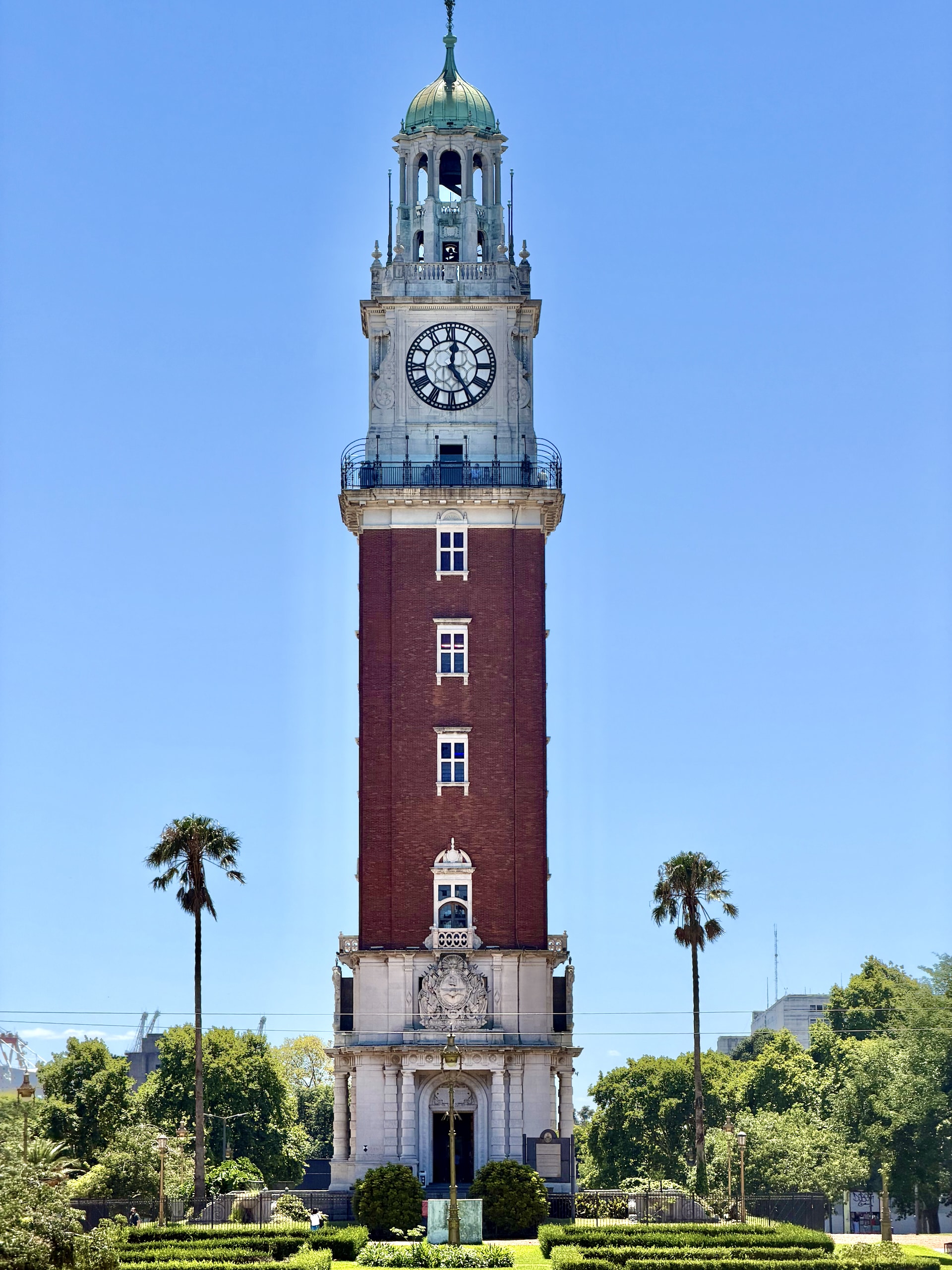
The Kavanagh Building: A Love Story Written in Concrete
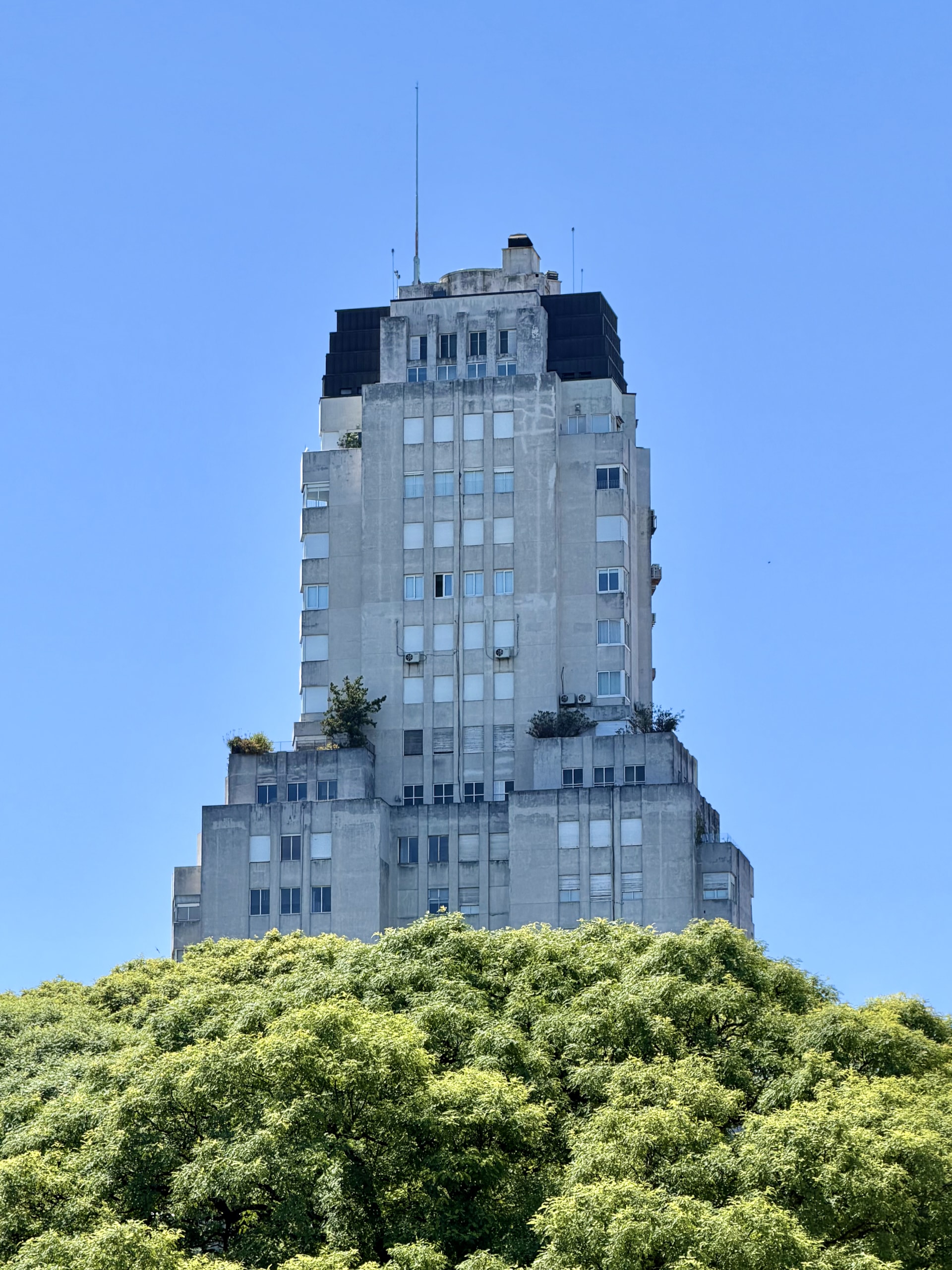
The best story of the day belongs to the Kavanagh Building, a gray art deco skyscraper looming over Plaza San Martín. Here’s the legend, which we fact-checked afterward because it sounds too good to be true.
In the 1930s, Corina Kavanagh – the wealthy daughter of Irish immigrants, and therefore hopelessly “new money” in the eyes of the local aristocracy – was in a relationship with a son of the Anchorena family, one of the most powerful old-money dynasties in Argentina. The Anchorenas lived in a palace on Plaza San Martín and had built the ornate Basílica del Santísimo Sacramento across the square, intended as the family’s own church and final resting place, admired in an unbroken view from their windows. The family deemed Corina unworthy, and the relationship was ended.
Corina’s revenge was architectural. She bought the plot of land directly between the palace and the basilica, and in 1936 raised the tallest building in Latin America on it: a 120-meter (394 ft) art deco tower of 105 luxury apartments, completed in a record 14 months. The placement was the point – the tower blocks the view of the basilica from the palace almost completely. To this day, the only spot with a clear frontal view of the church is a narrow passage beside the tower, which bears the name Corina Kavanagh. The family that rejected her must walk down her street to reach their own chapel, forever.
How true is it? The building, the plot, the blocked view, and the passage are all real. Historians point out one inconvenient detail: the Anchorena matriarch who supposedly opposed the match died in 1920, sixteen years before the tower went up, so she never saw the revenge. But Buenos Aires has collectively decided the legend is too good to let facts ruin it, and honestly, we agree.
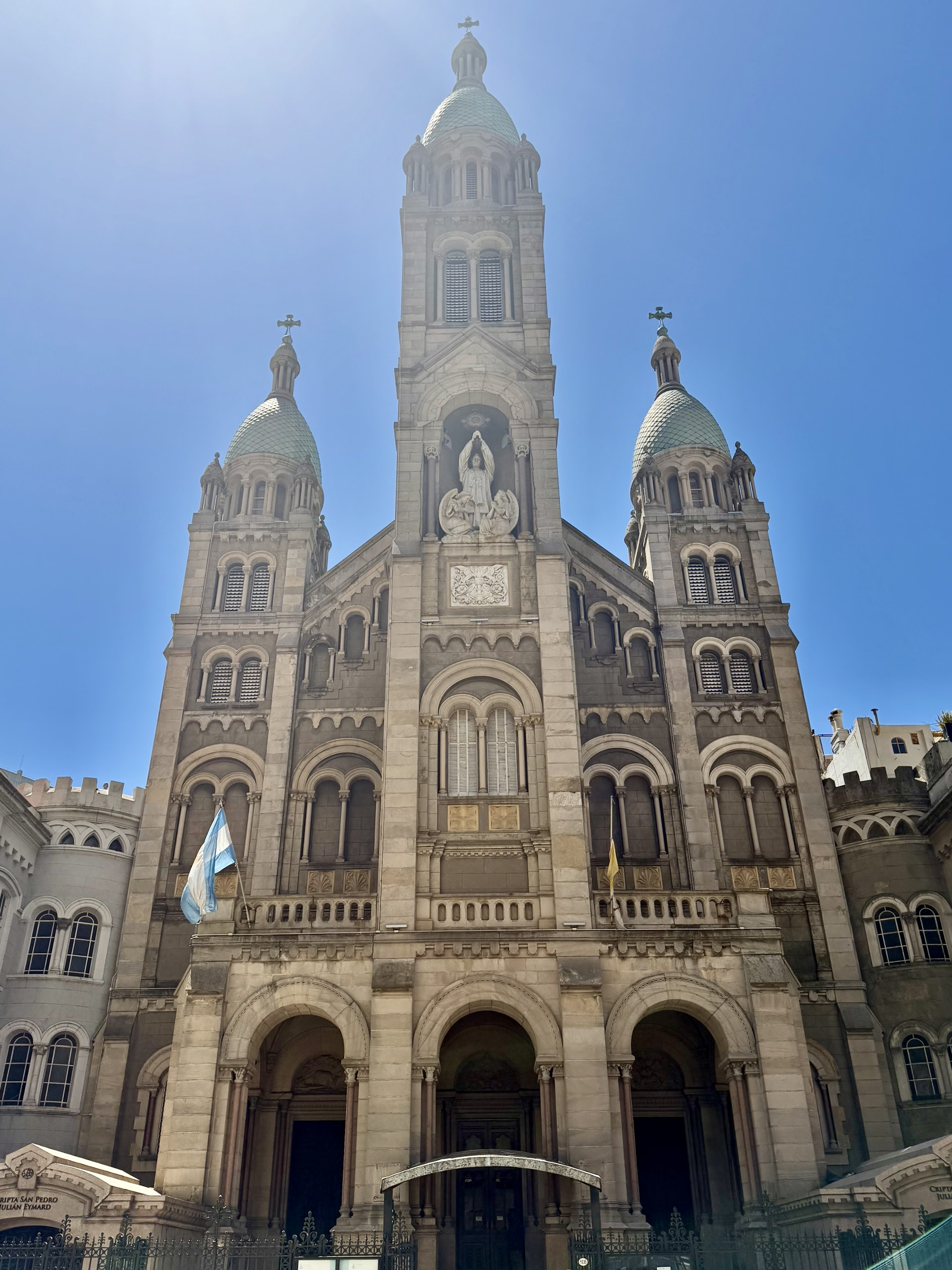
Recoleta Cemetery: Crypts, Evita, and Surprising Quiet
The day’s tour ended at the entrance of the Recoleta Cemetery, where Martín delivered a detailed account of what exactly happened to the body of Eva Perón – or Eva Duarte, depending on whether you go by her maiden or married name – after her death. I’ll spare you the details here, but let’s just say the corpse had a genuinely adventurous couple of decades before it finally came to rest in the Duarte family crypt.
Going inside the cemetery isn’t part of the free tour, but obviously you go in – this is one of the most famous sights in Buenos Aires. Don’t picture a classic cemetery with headstones: it’s thousands of crypts of every size, arranged into actual streets. Entry is fairly steep – around 24,000 ARS (~$16 USD) for foreign visitors at the time of writing – but you do get a map showing which crypt is where, useful if you’re hunting for specific names. Plenty of famous Argentines are buried here, most of whom meant nothing to us but a great deal to Argentina.
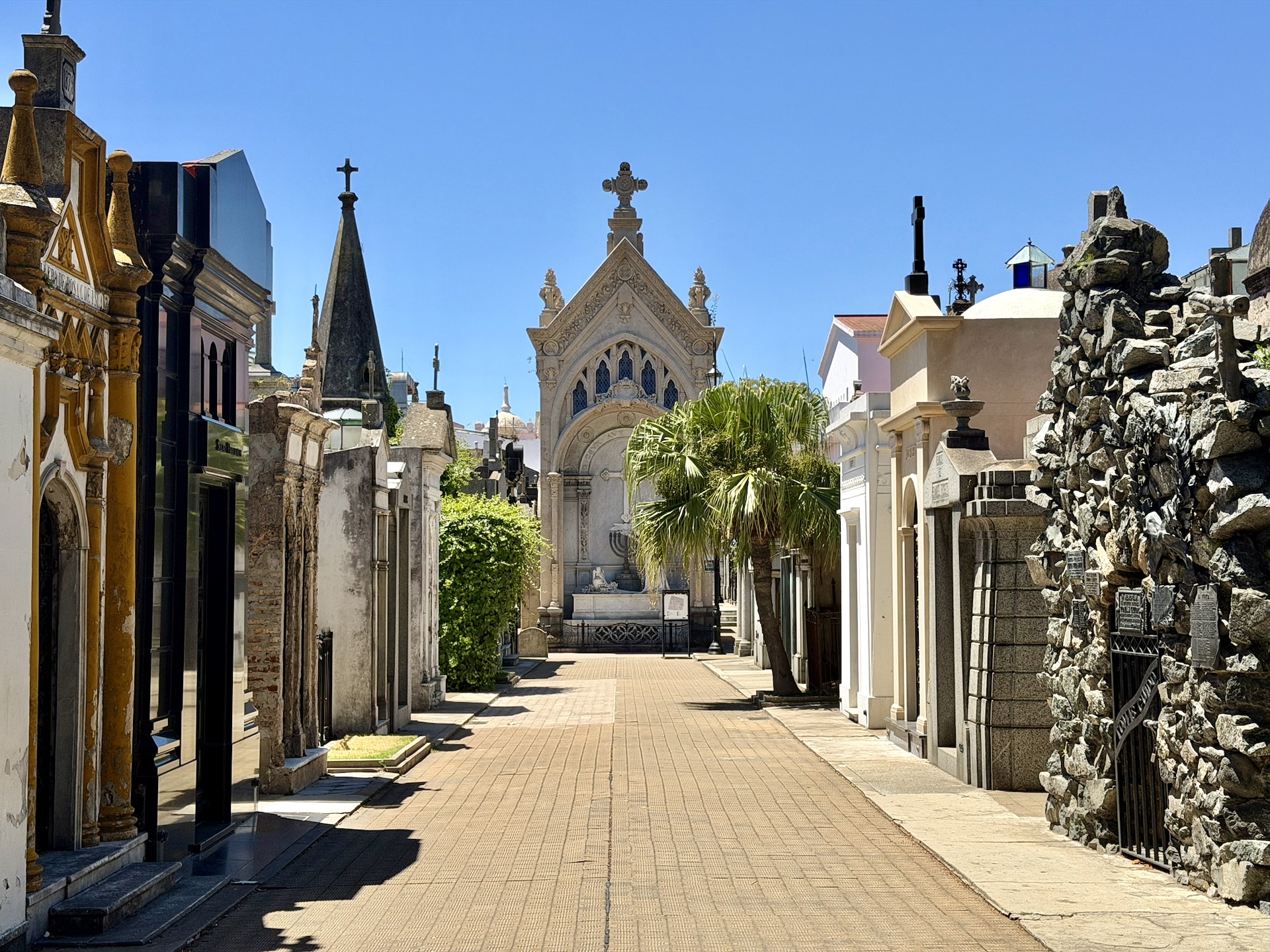
Despite its popularity, the place was surprisingly empty when we visited in the early afternoon. Maybe because it was a weekday, maybe because it was ferociously hot and the sun was hammering down. Either way, we could wander the narrow and wide “streets” between the crypts in relative peace. It’s an atmospheric, genuinely fascinating place – though I suspect blazing summer sunshine and blue sky are the wrong weather for it. On a gray, moody day it must be even better.
The one place that was crowded, predictably, was the Duarte crypt, where Evita now lies. People queued and photographed continuously. The crypt itself is not particularly spectacular – the story is the attraction, not the marble.
Tickets to Recoleta Cemetery are sold at the entrance by card only – no cash accepted. Argentine residents enter free, so the queue at the ticket window is shorter than the crowd suggests.
After the cemetery, our evening program was a tango show over in San Telmo – that one gets its own section further down.
La Boca and Caminito
On our last day, we were flying on to Ushuaia to board our Antarctic expedition cruise – but the morning still had room for a third walking tour. We booked it with the same company as the previous two. The La Boca tour is a paid one, but knowing their guides by now, we signed up without hesitation.
So we jumped into an Uber – or Cabify, I honestly don’t remember – with all our luggage, dropped the big backpacks at a Radical Storage luggage storage point in La Boca, and set off.
Before the tour we had some time to kill, wanted to buy water, and possibly find a bathroom, so we wandered completely by accident into a place called Lo del Diego – part restaurant, part bar, part souvenir shop, part full-blown shrine to Diego Maradona. As we later learned, it’s a legitimate tourist attraction in its own right. We just didn’t know it at the time. If you have a few minutes, look inside, because it’s genuinely something to see. I wouldn’t necessarily shop there – shrine status comes with shrine prices.
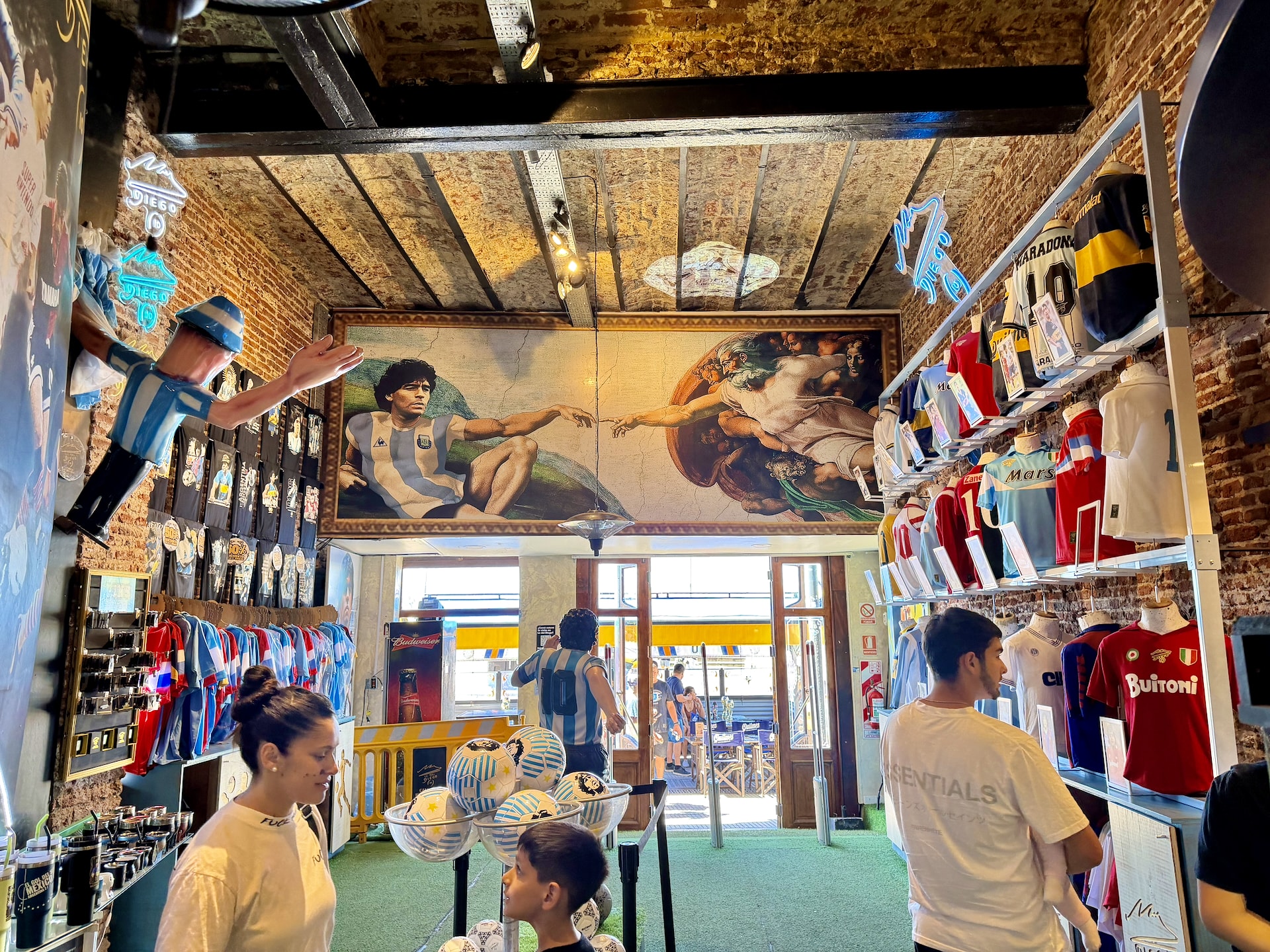
Our guide was Santiago, who was an even bigger character than Martín the day before, and he carried the tour. The route itself isn’t long – which suited us fine with a flight to catch. It starts on the small square before Caminito, walks the famous alley, and also covers La Boca’s riverfront while Santiago explains what the neighborhood is actually about: who lived here, why the houses look the way they do.
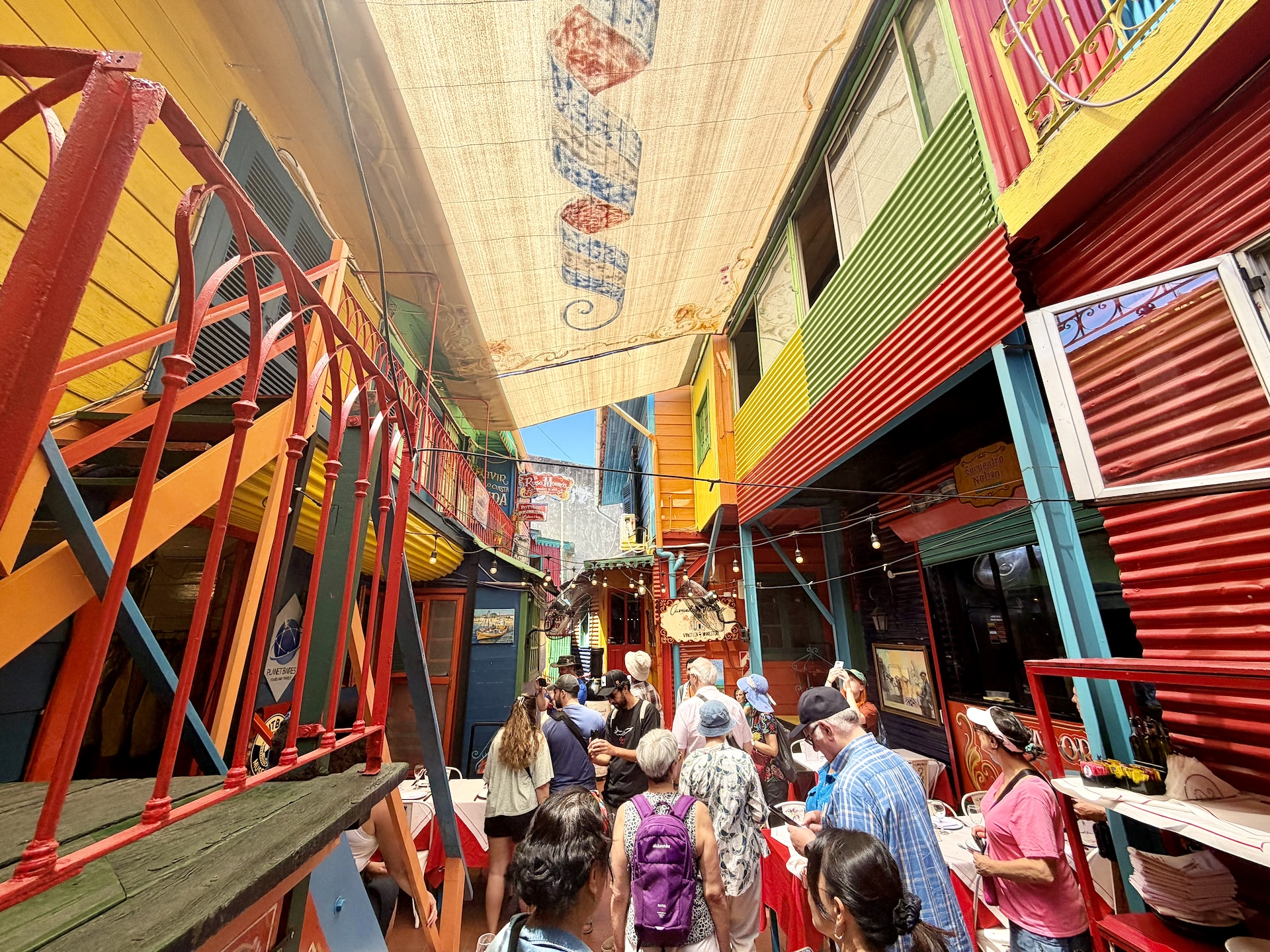
The short version: La Boca was the port district where immigrants – above all Italians – landed and settled, and it was very poor. The houses are patchworks of corrugated metal and salvaged sheet iron, painted in whatever leftover ship paint could be scrounged from the docks, which is where the famous colors come from. Caminito itself, named after a 1926 tango song, is today effectively an open-air museum: extremely colorful, extremely touristy, built for visitors. The artists’ quarter reputation is real, though – it’s largely painters and similar characters who live in the neighborhood now.
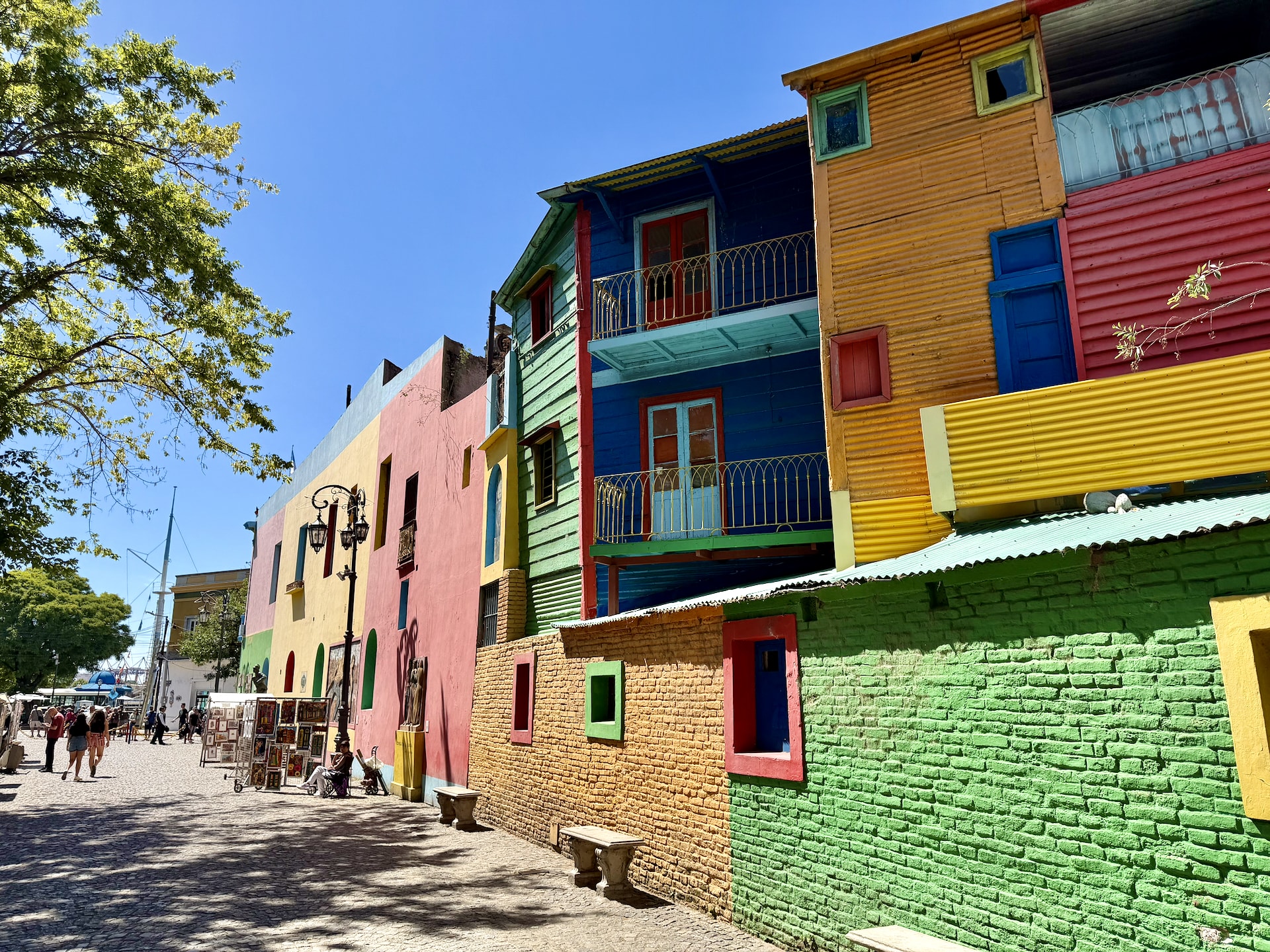
Down at the water, you can’t miss the enormous iron structure over the Riachuelo: the Puente Transbordador Nicolás Avellaneda, a transporter bridge from 1914. Instead of a fixed roadway, a suspended gondola platform ferried pedestrians, carts, cars, and even trams across the river, leaving the channel clear for ships. It’s one of only eight transporter bridges left in the world, and the only one in the Americas – it ran until 1960, was nearly demolished, and was restored and reopened in 2017 as a national historic monument.
After Caminito and the parallel Magallanes street, the tour’s last stop is the Estadio Alberto J. Armando – La Bombonera, the Boca Juniors stadium. On safety: the tourist core of La Boca is completely fine these days, but the standing advice is not to wander too many blocks off the beaten path. We strayed slightly off it, and while it was rougher than the rest of Buenos Aires we’d seen, it didn’t feel genuinely problematic.
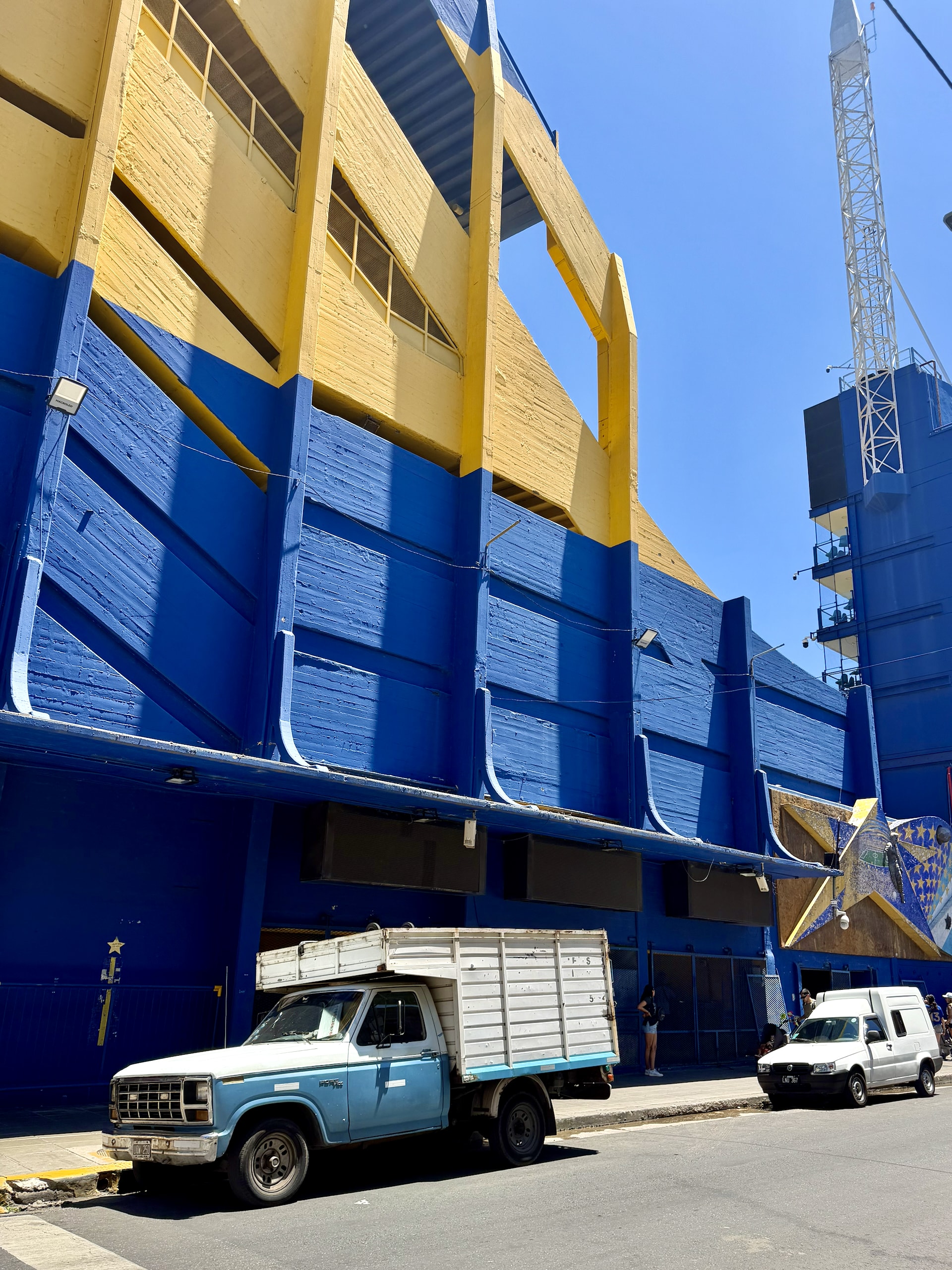
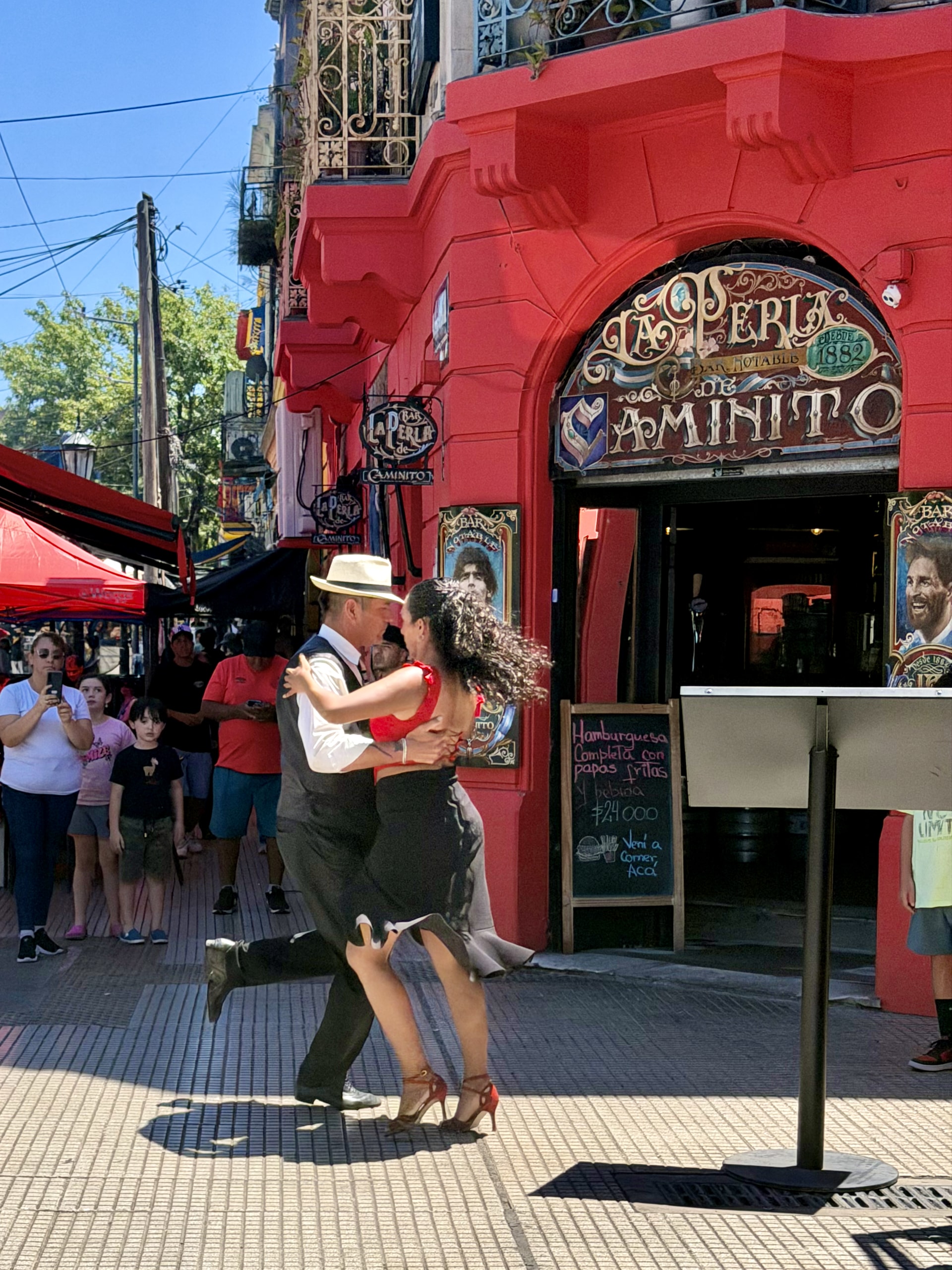
If you have more time in the neighborhood than we did: football fans can tour the Boca Juniors stadium or raid the club shop, and Santiago was adamant that the Teatro Colón Fábrica is worth a visit – a warehouse where the Teatro Colón’s stage sets and costumes are stored and built. We, unfortunately, only had time for a quick lunch – and sadly not at the roadside parrillas and street-food stands near the stadium, but at another place I’ll get to below. Then it was into a Cabify and off to AEP airport, direction Ushuaia.
Treat La Boca as a daytime destination. Come in the morning or early afternoon, stick to the Caminito–Magallanes–stadium triangle, and combine it with San Telmo if you have the extra hours.
Seeing a Tango Show in Buenos Aires
Full disclosure: I’m not a big tango fan. Originally I didn’t want to see a tango show in Buenos Aires at all. Then I figured Andrea would surely want to, and I could claim we were going for her sake – except she didn’t want to either. And once she didn’t want to, suddenly I did. You read so much about tango being the essential Buenos Aires experience, the city being the birthplace of the whole genre, that in the end I decided we couldn’t skip it. Neither of us cares much for the music or the dance, but we were here, so off we went.
The next challenge was choosing one, because there are a lot of tango shows in this city. I went properly down the rabbit hole researching them, and I’ll spare you the full list. The real decision is between something small, dark, and local – the kind of place where locals get up to dance afterward – and a produced show that gives you context. Since we knew next to nothing about tango, we went for context and picked El Querandí, whose show walks through the history of tango from its 1890s origins to the modern style, era by era, style by style. Yes, it’s touristy. For first-timers, that’s kind of the point.
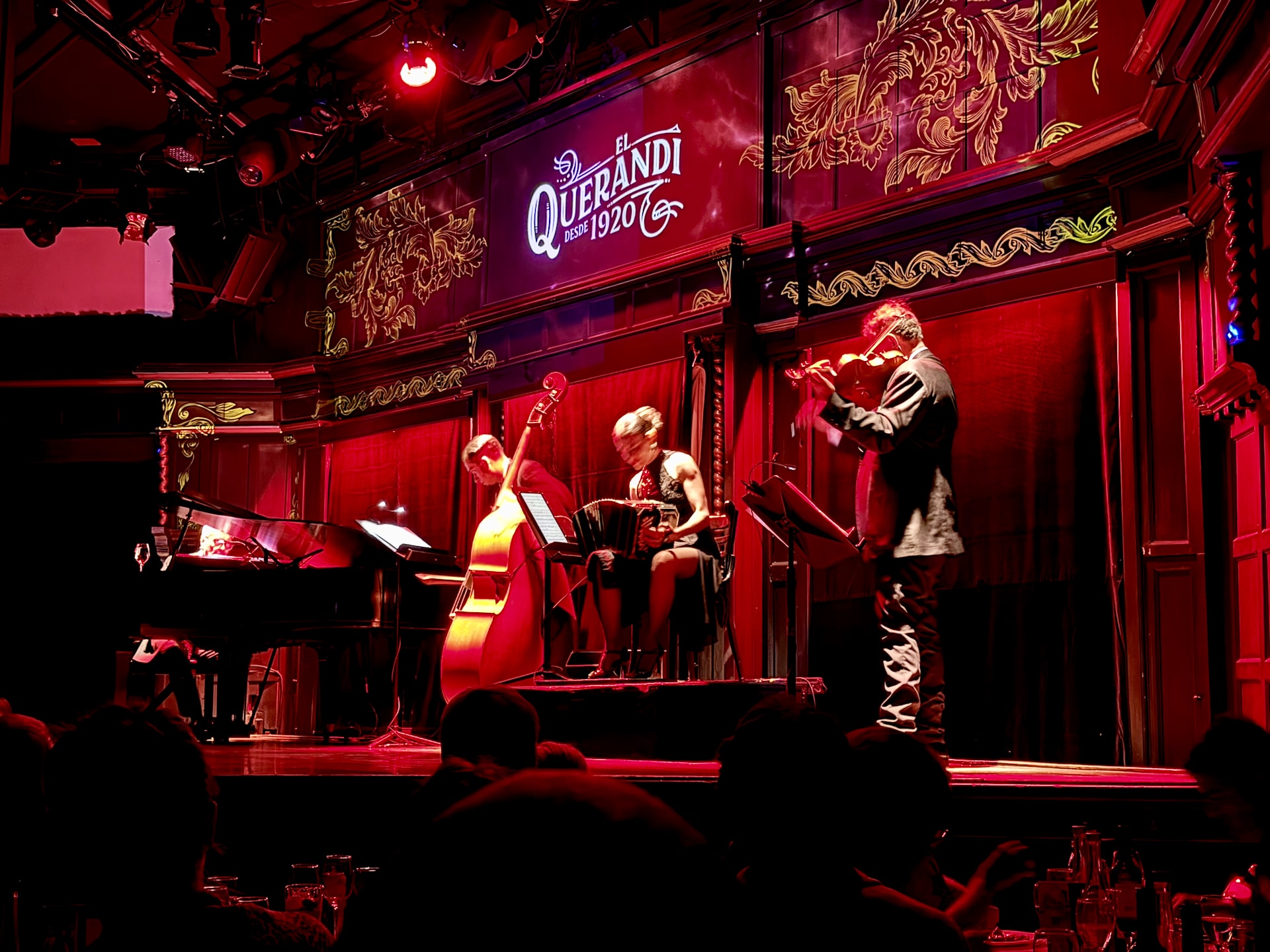
Most shows work the same way: dinner first, then the performance, with hotel-district pickup included in the price. A minibus collects guests from Palermo and the central neighborhoods and delivers everyone to the venue. El Querandí is a large L-shaped room with tables facing a stage. You can usually book with or without dinner. I’d leave that to you, but here’s my honest take – the food at El Querandí wasn’t bad, just entirely forgettable. I had an empanada starter, a bife de chorizo, and a flan. Nothing memorable. If your time in the city is short and you’d rather spend a dinner slot on one more real restaurant, the show-only option is defensible – though I noticed almost nobody actually arrived for just the show at ours.
The wine, on the other hand, was effectively unlimited. We got through about two bottles. Whenever a glass emptied, it was refilled automatically, and you had to actively ask them to stop. Budget your next morning accordingly.
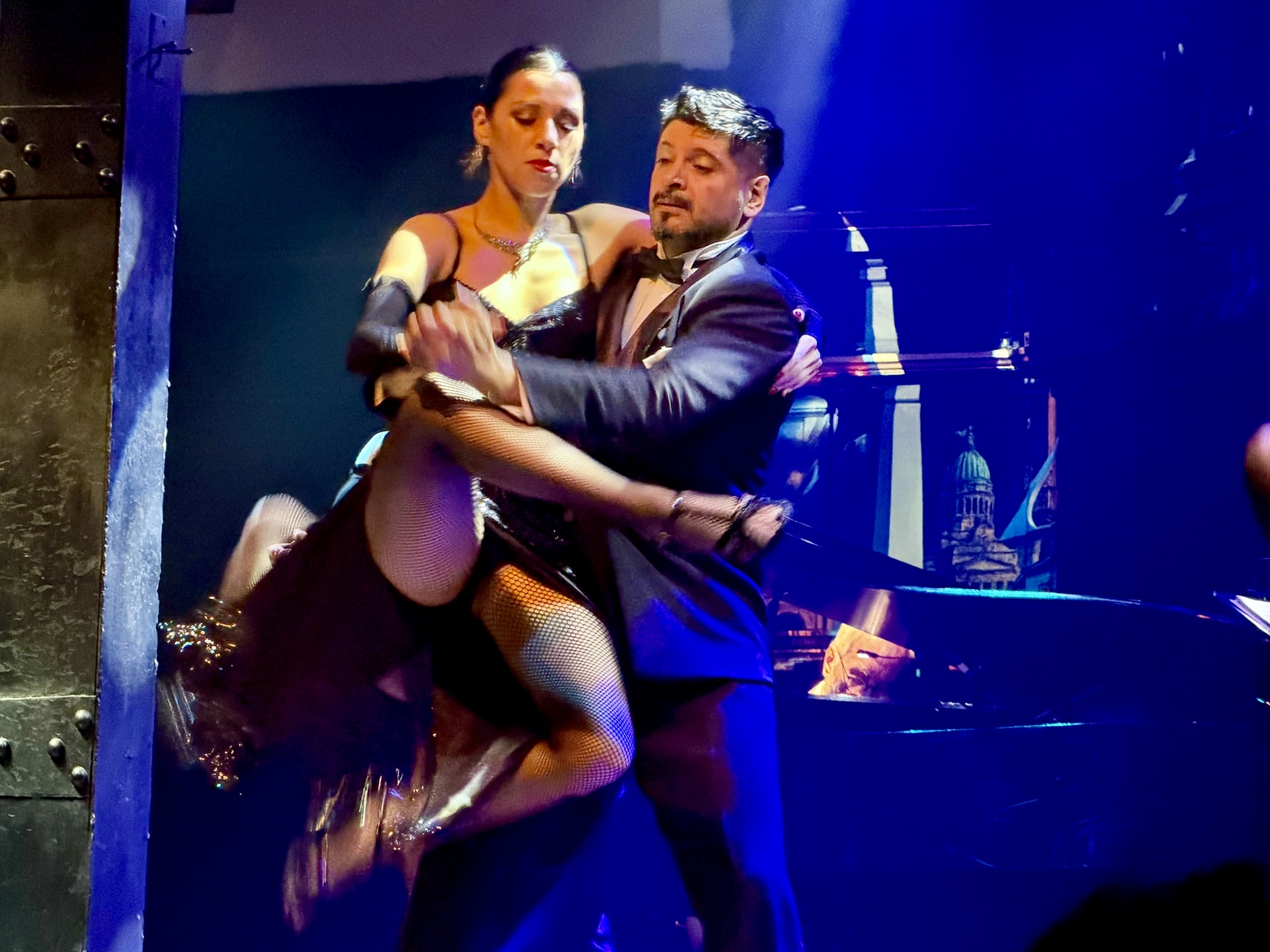
The show itself was good. I wouldn’t watch one every night, but hats off to the dancers – tango is visibly brutal work, requiring serious fitness, and these people looked like professionals to my admittedly untrained eye. The music is live too, and this is where a lifelong mystery resolved itself for me: the Hungarian word for accordion literally translates as “tango accordion,” and watching the bandoneon player, I finally understood why. That says more about me than about the show.
We chose the Traditional Dinner Show option, which cost $100 USD per person at the time. It has since gone up to $110 USD on their website. The VIP tiers mostly buy you a table closer to the stage. We weren’t far and could see everything perfectly, so I wouldn’t pay for VIP – at least not on a first date. Count on the whole evening taking about three hours plus transfers, and note that shows start late: realistically you’re home around midnight or after. The whole thing ended with the same minibus driving us back to Palermo, one fellow passenger hiccupping the entire way home, to the quiet delight of the whole bus. He had clearly made the most of the unlimited wine.
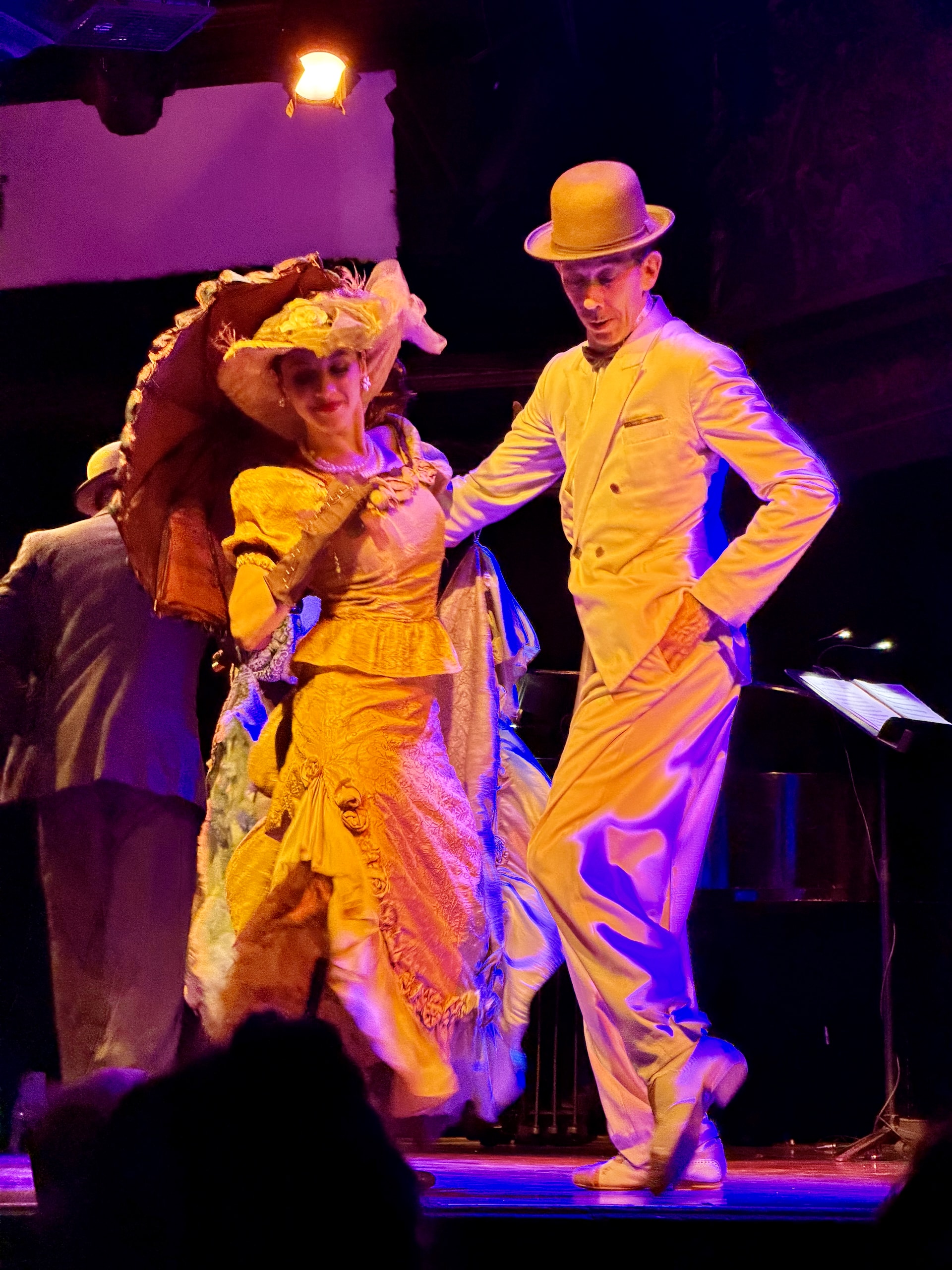
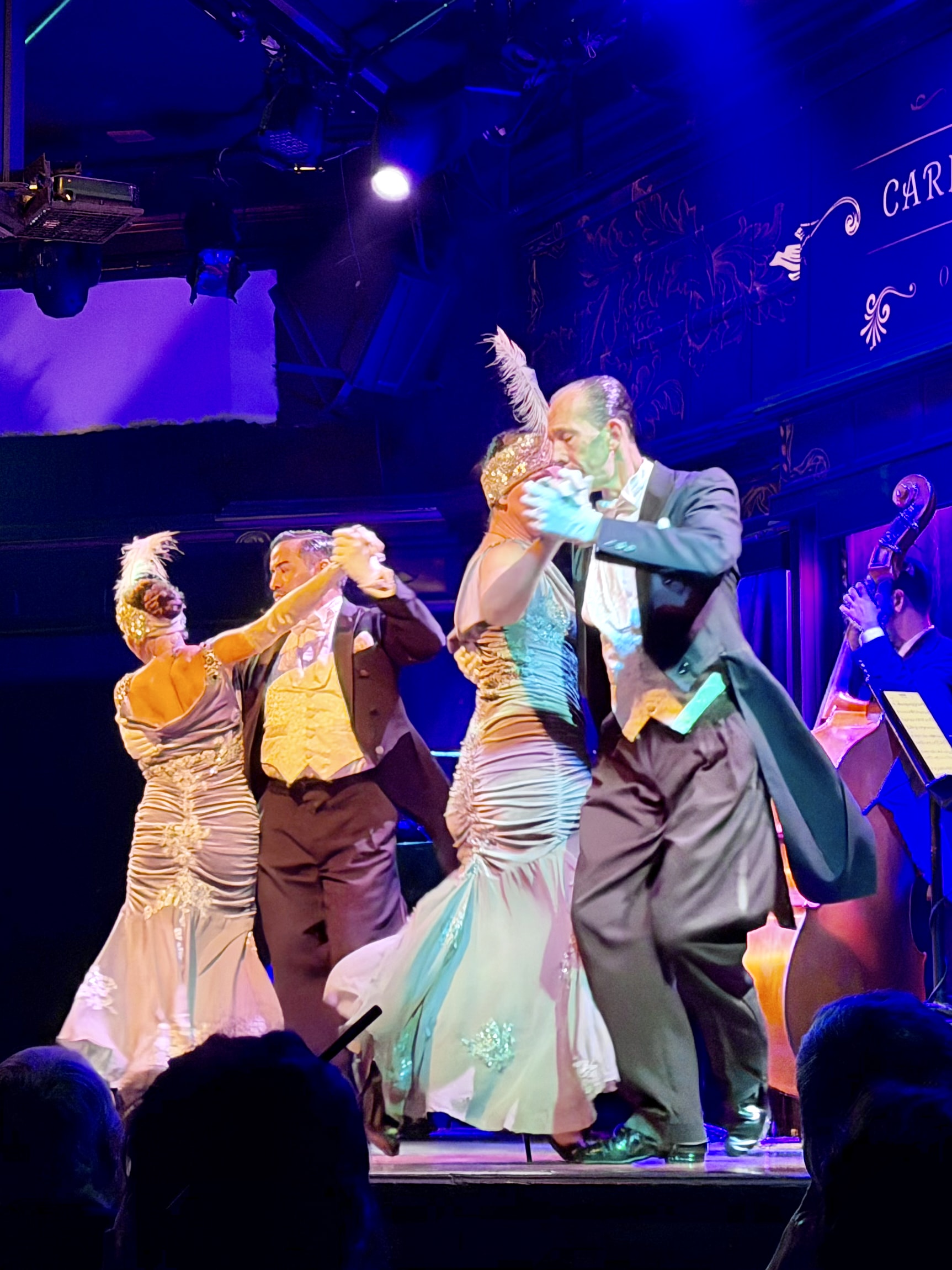
One more recommendation, secondhand: Santiago, our La Boca guide, said that if he sends anyone to a show, it’s the Homero Manzi one. And of course, you can also dance tango “in the wild” at milongas all over the city – provided you can actually dance tango. There are places to learn, but on a three-day visit, I’m not sure that’s where your hours should go.
Where to Eat and Drink in Buenos Aires
When it comes to food, Buenos Aires is also a wonderful city – and three days lets you visit far, far fewer places than you’d want. So here are the ones we actually went to, plus a few we didn’t make it to but that came recommended by our walking tour guides. We have no personal experience with those, but a local recommendation always counts for something.
Our routine: simple breakfasts near the Airbnb (Palermo is dense with good cafés), dinner as the main event, and when hunger struck during the day, an empanada or two from a corner shop – the city is full of them. Look for the places where locals are queuing and you won’t be disappointed.
Full City Coffee Roasters
We found this spot on our first morning for a quick breakfast and immediately loved it. The coffee was excellent and the sandwich delicious – and this is where we first noticed something that held true across the city: the bread in Buenos Aires is almost universally very good. A sympathetic little place with a garden. Sadly, when we tried to return, it was closed, and Google Maps currently lists it as temporarily closed – no idea what the situation is, but if you’re in the area, check. Recommended, hopefully still.
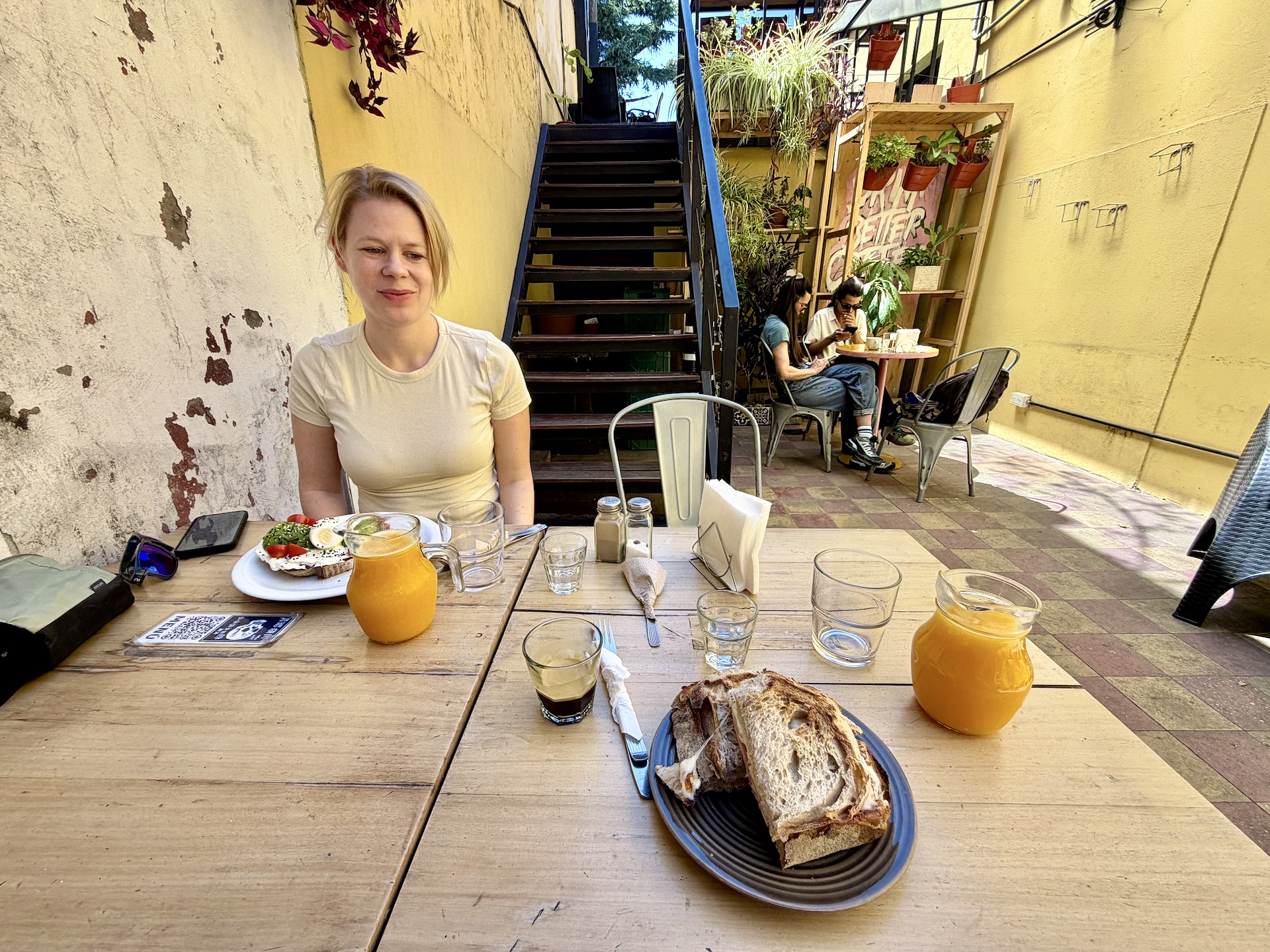
Dopo Café Palermo Soho
Our other breakfast spot. Also very good coffee, also very good food – a touch more polished in style than Full City, but we had zero complaints. Solid choice.
Celia Parrilla y Pizza
Meat lovers will be very happy in Buenos Aires, and I confess I love a good steak, so a proper local parrilla was non-negotiable. There are endless options. Ours was Celia, barely a block from our Airbnb, and we didn’t regret it for a second.
The decor is traditional Argentine – which is confirmed the moment you spot the wall dedicated to Maradona photos. We ordered a two-person steak platter with the essential Argentine cuts: bife de chorizo (sirloin strip), ojo de bife (ribeye), and entraña (skirt steak), with a provoleta to start – grilled provolone cheese, and absurdly good. Bread and various chimichurris arrived unprompted, we drank a glass of house wine each, and – to my genuine surprise – they served soda from a siphon, which I’d always assumed was a Hungarian and Eastern European thing. Delighted to report it’s alive and well in Argentina.
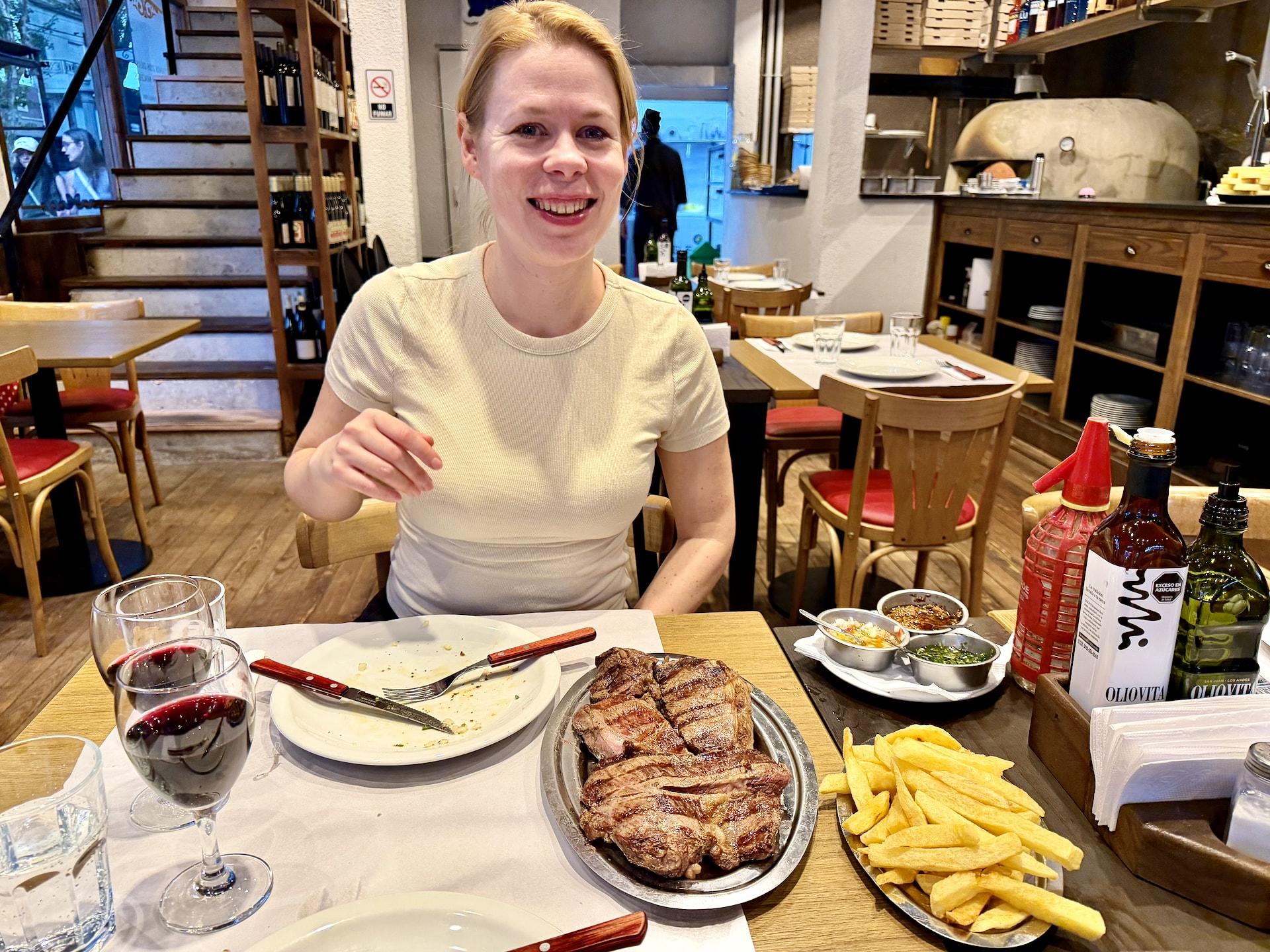
Needless to say, we had no chance of finishing the meat. It was close to a kilo (2.2 lbs) for two, plus fries, and even though we’d barely eaten all day, it was far more than I can manage on a normal weekday. All of it delicious. The bill came to 94,500 ARS (~$66 USD) total, tip included, which for that quantity and quality is a seriously good deal. If you’re staying in Palermo, go.
Argentine steak platters for two comfortably feed three. Order less than you think you need – you can always add, but nobody has ever finished a parrilla platter they sized optimistically.
La Cabrera
We didn’t eat here, but it’s an institution – you can tell just from the 23,000+ Google reviews. It’s actually two venues facing each other across the street. Reportedly always packed, reportedly excellent, definitely book ahead. We didn’t regret choosing the smaller, homier Celia for our real parrilla night, but La Cabrera belongs on the list because La Cabrera is a concept.
Vinnies Empanadas
A fast-food chain doing empanadas and pizza – including the famous Argentine muzza, which is essentially a mozzarella pizza on the local thick, doughy crust. Argentine pizza is its own genre: heavier than Italian, arguably not quite pizza at all, but the cheese-forward muzza is good.
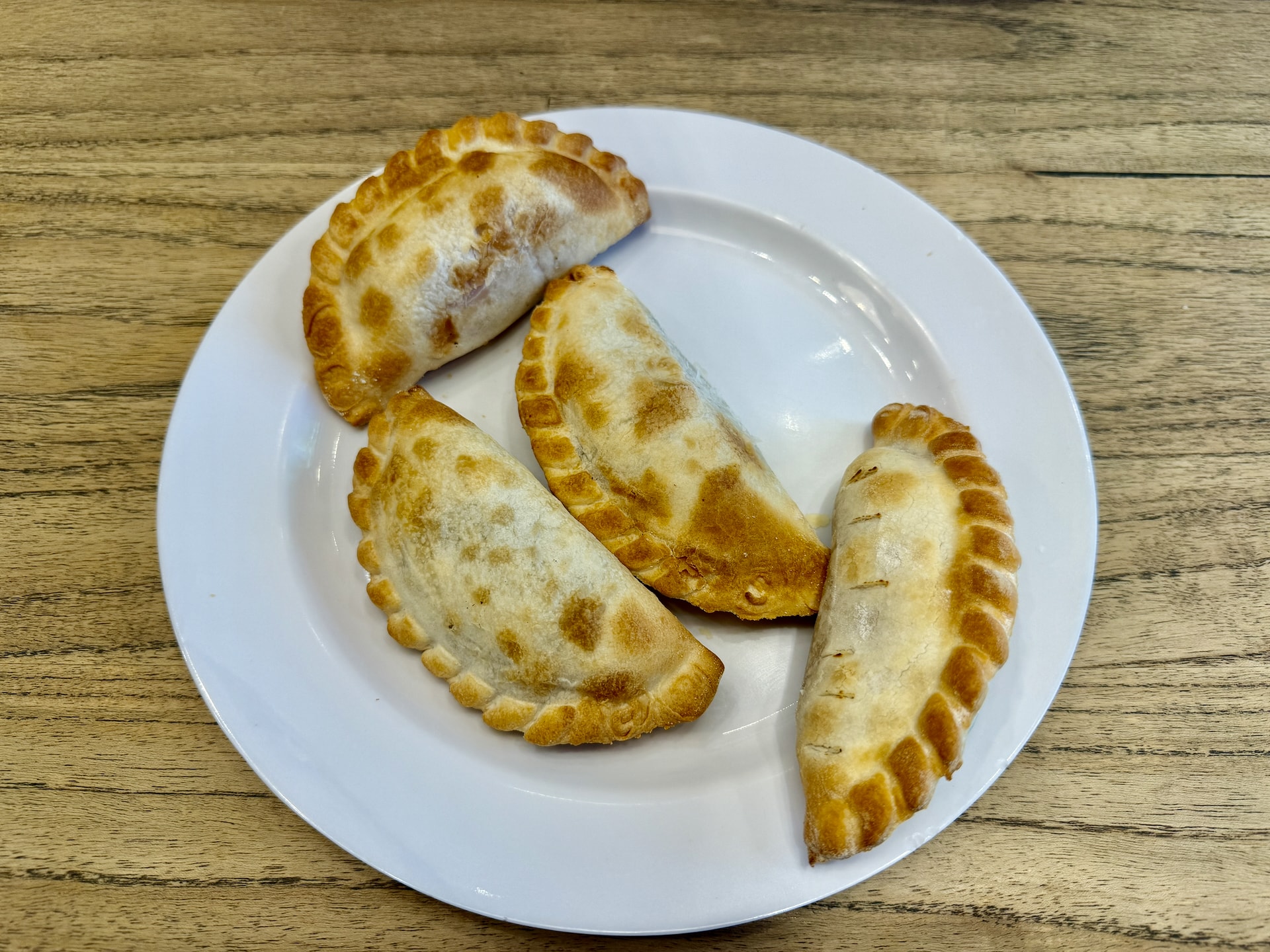
We ducked into the branch near Recoleta Cemetery when we were starving and needed fast comfort food – and anyway, we make a point of eating at everyday places when we travel, not just the curated ones. The local motorcycle police had just parked outside and walked in ahead of us, which we took as a reasonable stamp of authenticity. Verdict: good, cheap, decent empanadas, decent pizza (we tried a small one). Nothing special, but if you need something filling at a fair price and one is nearby, walk in without hesitation. Our lunch for two came to 13,970 ARS (~$9.8 USD).
Café Martínez
While we’re on chains: Argentina’s answer to Starbucks. Over 200 locations, so you’ll run into one constantly in Buenos Aires. Nothing special, and not great value for money in my view – but if you urgently need a coffee or, heaven forbid, a bathroom, it does the job. It never quite won my heart, but it’s fine.
Encuentro Nativo
In the middle of Magallanes, La Boca’s famous tourist street, sits this restaurant-slash-tourist-attraction hybrid. Very touristy, very expensive – on price-to-value, definitely not good. And the food wasn’t anything special either: we had a choripán (Argentina’s classic chorizo sandwich) here, and you could almost certainly get a much better one a few steps away. Our one clear miss of the trip.
Choripoint by El Gran Paraiso
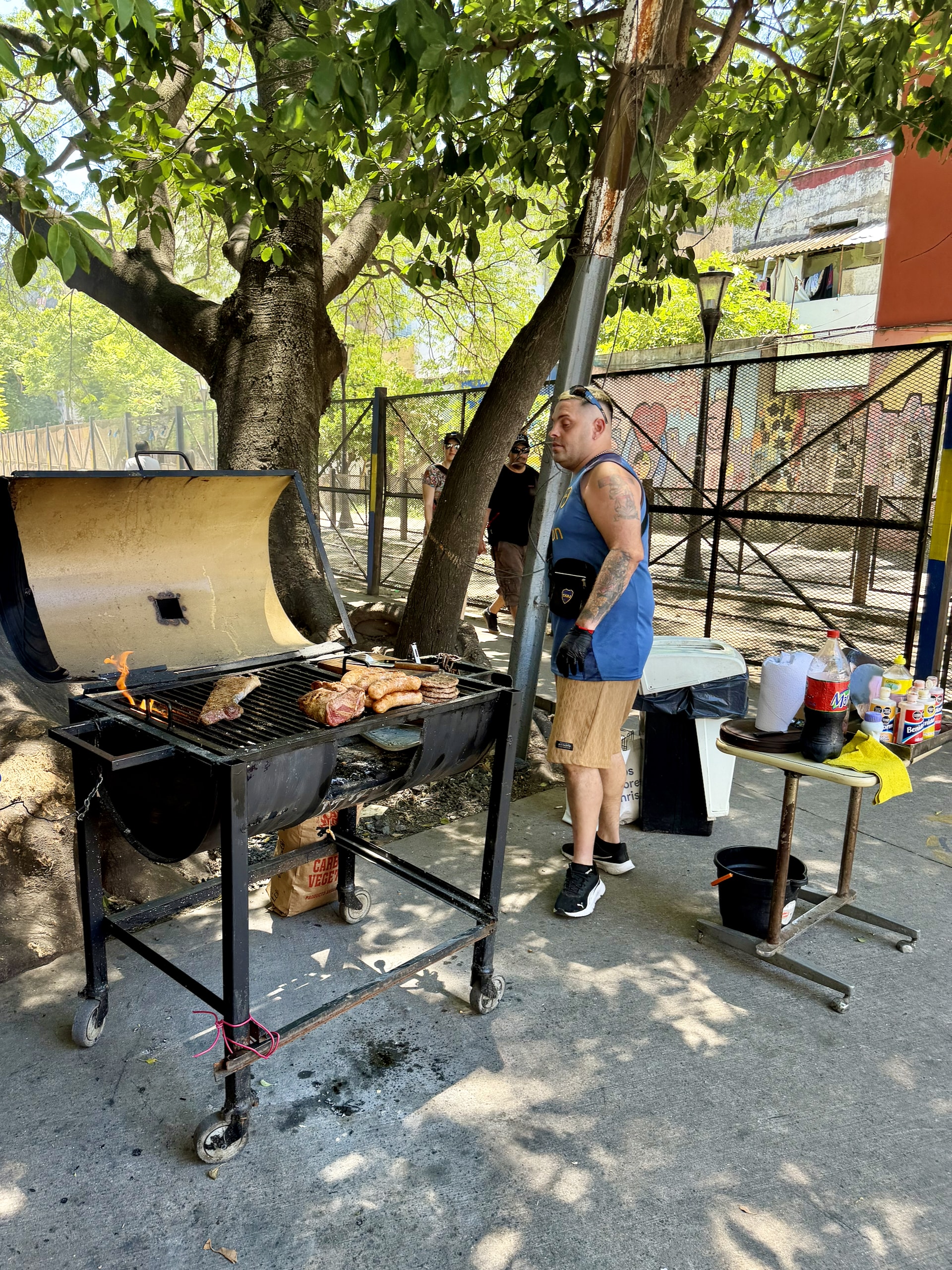
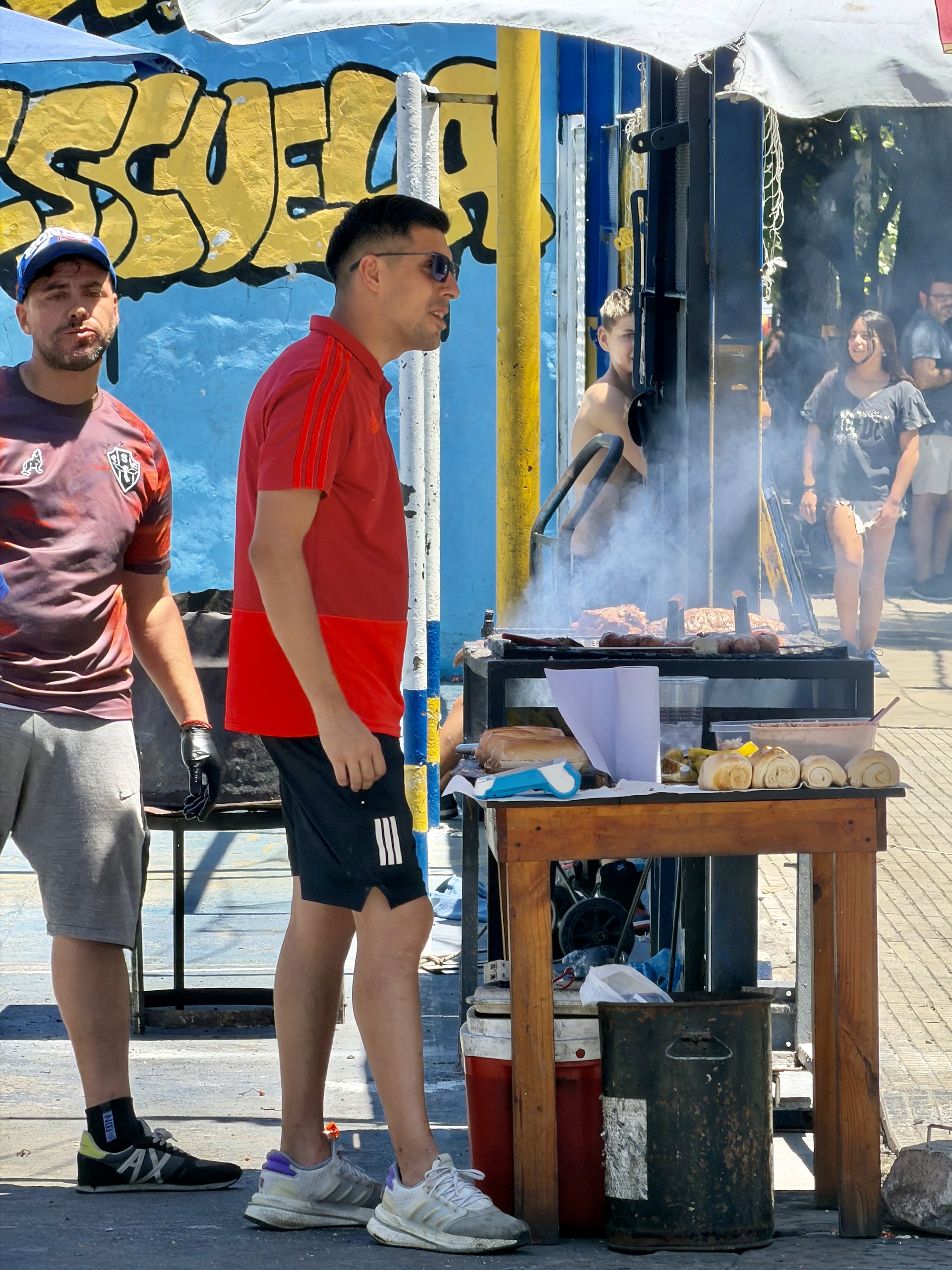
We eyed this place during the walking tour – it sits on the edge of La Boca’s tourist zone, on the way to the Boca Juniors stadium. Its Google ratings are genuinely excellent, and the smells coming out of it were seriously tempting, but in the end we didn’t have lunch here. See the previous entry for how that decision worked out.
El Gauchito
We didn’t make it here either. It’s a gloriously scruffy-looking empanada joint on Avenida Independencia in San Telmo, recommended by one of our walking tour guides as a place where he eats himself – cheap and good, he said. The ratings back him up. “Cheap” is relative: at 4,000 ARS (~$2.8 USD) per empanada you can find lower, but if you’re passing, it looks worth a stop. They do other traditional dishes beyond empanadas too.
Parrilla Mi Sueño
The only place on our list in the modern Puerto Madero district – and since we never made it to Puerto Madero, we never made it here either. This tip comes from Santiago, our La Boca guide: supposedly a food truck with great sandwiches, specifically the bondiola (slow-cooked pork shoulder, 9,000 ARS / ~$6.3 USD) or the grilled provolone – provoleta – sandwich (6,500 ARS / ~$4.5 USD).
Cadore Gelato Artigianale
It’s a bit off the route of the places covered in this article, but according to Martín, our guide on day two, this is where you get the best ice cream in the city. This is the real Argentine gelato, not the mass-produced stuff you can find on every corner. We didn’t try it ourselves, but a recommendation like that earns its place on the list.
Rey de Copas
After eating ourselves half to death at Celia, we figured a cocktail or two was in order, and Rey de Copas looked like the most sympathetic option nearby. It’s a fairly fancy spot – not cheap, but the cocktails are excellent. We ended up in a semi-separate room inside with a very particular old-school bar atmosphere. Cocktails run around 16,000 ARS (~$11 USD), so it’s not the budget end of the scale, and they serve simpler food too. If you’re staying in Palermo, worth a look.
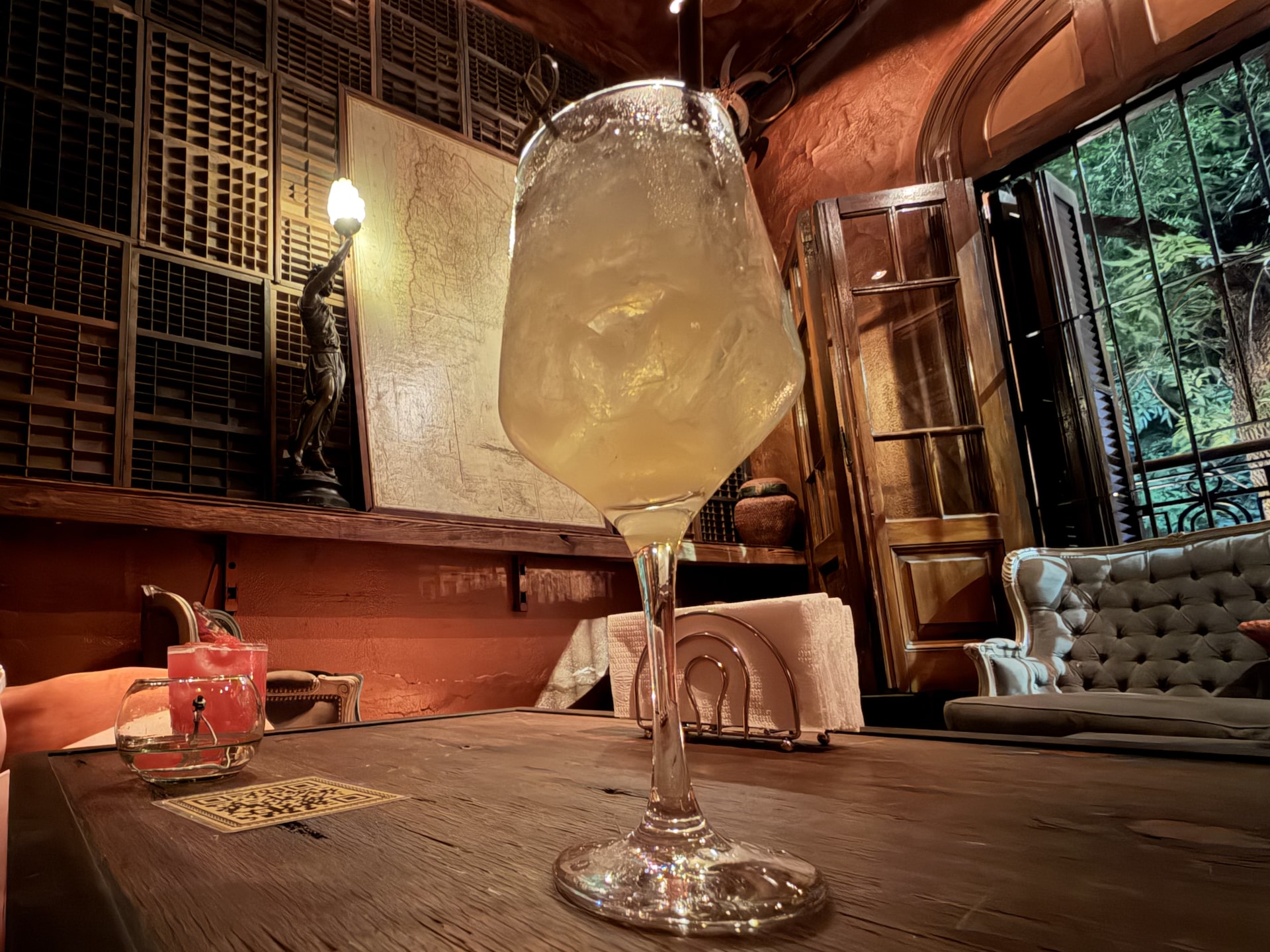
Tres Monos
We mentioned in the other article that a friend of Andrea’s – who lived near Buenos Aires for years with his Argentine wife – helped us pick our neighborhood. His other insistence: go to a proper bar, because Buenos Aires has some of the best in the world.
He’s right. Two of the World’s 50 Best Bars are currently in this city, and both are in Palermo. We had planned an early birthday celebration at one of them, but ran out of time – the tango show won instead. The bigger name is Tres Monos, currently ranked the 10th best bar in the world and the best in South America, and it’s not far from anywhere in Palermo Soho. Don’t picture a suit-and-tie temple of mixology: it’s a rawer, louder, more relaxed place with loud music – and reportedly outstanding cocktails.
CoChinChina
If you are after something more elegant for a special occasion, this is the answer. Also in Palermo Soho, currently the 26th best bar in the world, and quite different from Tres Monos in both mood and design: it blends Vietnamese and French traditions with Argentine ones, which sounds exactly as intriguing as it is.
What 3 Days in Buenos Aires Cost Us
And now for the dirty financials: what those roughly three days in Buenos Aires cost us in early 2026. This includes every expense – small shop runs, food, and all the activities, from walking tour tips through the Recoleta Cemetery ticket to the tango show. What it doesn’t include is the cost of getting to Buenos Aires, since that depends entirely on where you’re coming from. Transport within the city – Cabify, buses, the subte – is included.
| Category | Total (2 people) | Per Person | Per Day | Per Person/Day | Notes |
|---|---|---|---|---|---|
| Accommodation | $182 | $91 | $61 | $30 | 3 nights, Airbnb in Palermo |
| Activities | $311 | $156 | $104 | $52 | Tango show with dinner, 3 walking tours with tips, Recoleta Cemetery |
| Food & Drink | $236 | $118 | $79 | $39 | Restaurants, cafés, cocktails |
| Groceries & Shopping | $23 | $12 | $8 | $4 | Water, soft drinks, small shop runs |
| Transportation | $48 | $24 | $16 | $8 | Cabify, city buses, subte, airport transfers |
| Other | $24 | $12 | $8 | $4 | Luggage storage in La Boca |
| Total | $824 | $412 | $275 | $137 |
Peso amounts were converted at the official rate at the time of our trip (roughly 1,430 ARS to the dollar, January 2026), while the tango show was priced in USD to begin with. For comparison with the rest of the trip, the full month’s numbers are in our 4-week Patagonia and Antarctica itinerary.
The takeaway: the single biggest line item was the tango show, food is remarkable value for the quality (that near-kilo of steak for $66 USD still haunts me, in a good way), and the walking-tour-heavy approach kept sightseeing costs modest while covering an enormous amount of the city.
Is Buenos Aires Worth Visiting?
Absolutely – it was a very positive surprise. I expected much less from this city. Buenos Aires turned out to be an energetic, good-humored capital full of striking, European-style architecture, with food and drink that punch far above their price. Three days was enough for a real first impression, but plan for more if you can: you could easily fill a week here without getting bored – we never even made it to Puerto Madero, San Telmo’s market, or the Obelisco, and the city’s best bars are still waiting for us.
If Buenos Aires is the start of a bigger trip south, the way it was for us, our Patagonia and Antarctica itinerary covers where we went next – and if your flight there gets catastrophically delayed, well, we have an article for that too.