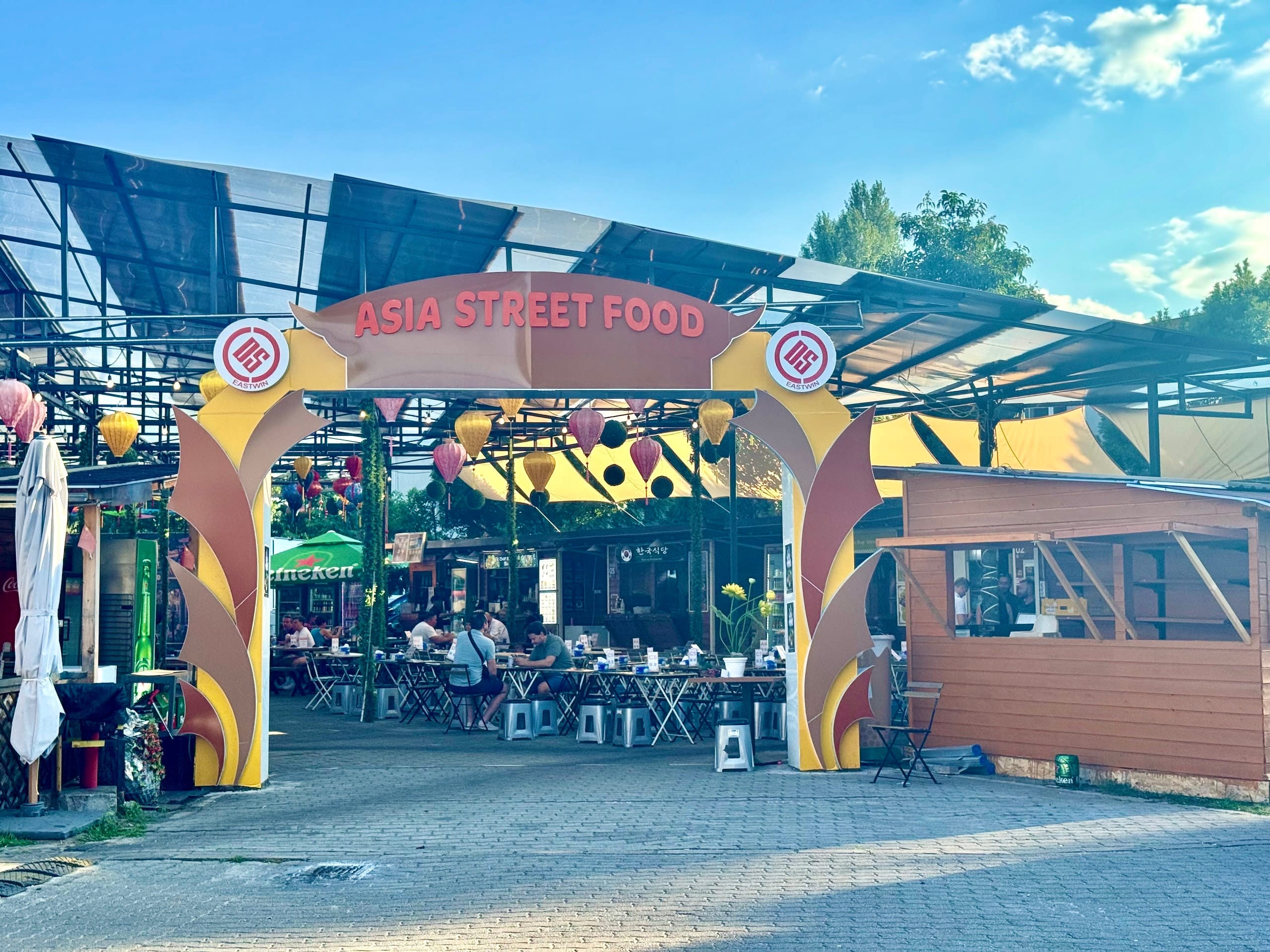
Over the years, a summer evening at Budapest’s Chinese night market became a ritual for us. Our friend Peter usually times his visits home from Southeast Asia for exactly this, so the three of us have been sweating over skewers and Tsingtao at the Chinatown Terasz every summer for years.
Then came 2026, and with it the sad discovery that our beloved night market didn’t open this year. The area is reportedly being redeveloped, so the big tent, the panda fountain, and the plastic stools are all on pause.
That left us with a mission: find a new place in Budapest to satisfy our cravings for Asian food and that particular night market atmosphere. After a bit of research, our first candidate was Bian Garden, a smaller, primarily Vietnamese night market, also in Kőbánya. So on a warm evening not long after the brutal 2026 Budapest heat dome had finally broken, we headed out to District 10 once again.
What Is Bian Garden? Budapest’s Vietnamese Street Food Courtyard
Bian Garden is proof that the original Chinese night market was a success well beyond our circle of three. It opened in 2025 as a dedicated Vietnamese street food courtyard, and in 2026 the lineup expanded with other Asian food stalls. Besides Vietnamese, we mostly saw Korean and Chinese food, plus a little sushi, which for some reason Budapest treats as the default Asian food. There wasn’t much of it here.
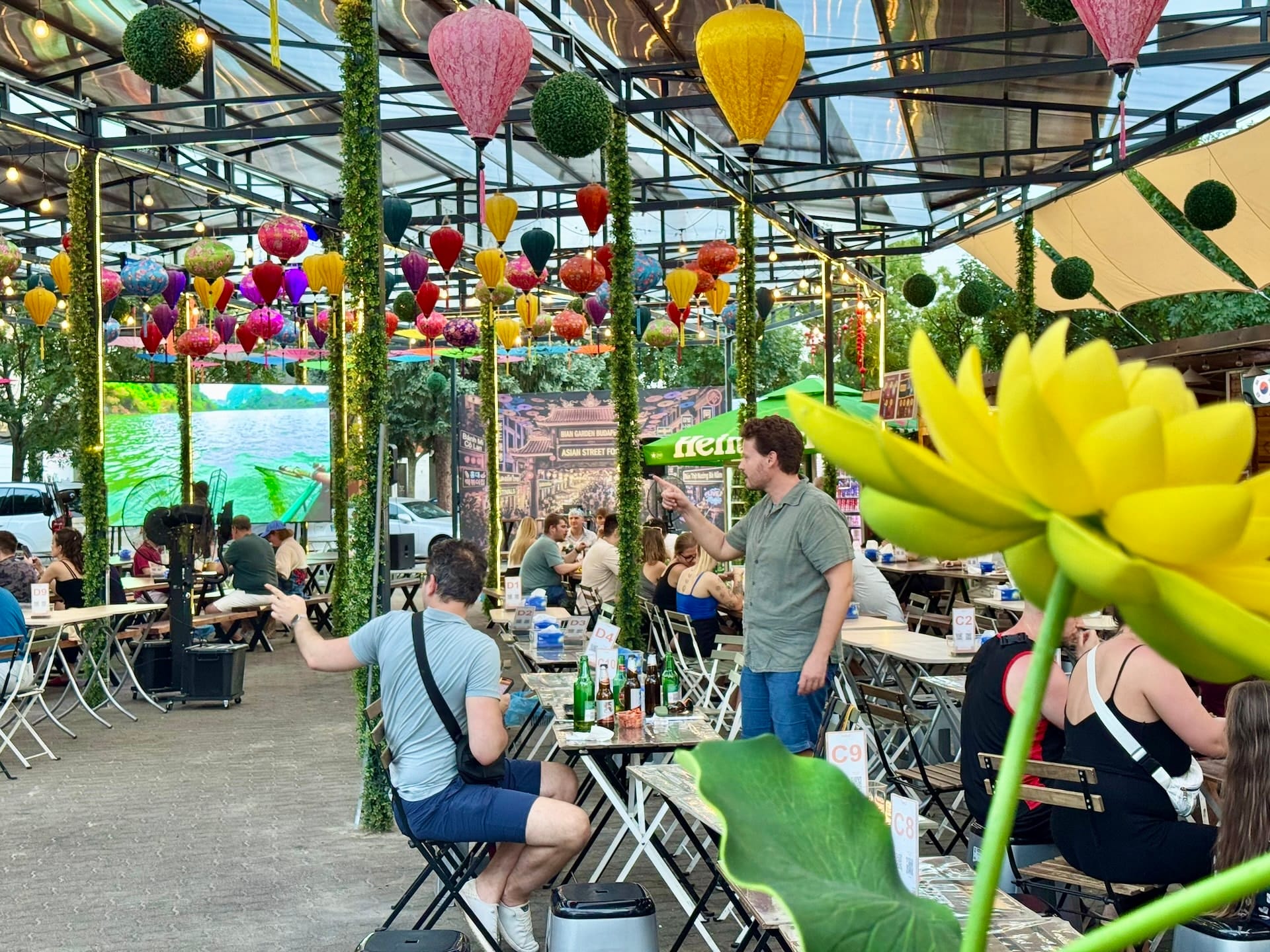
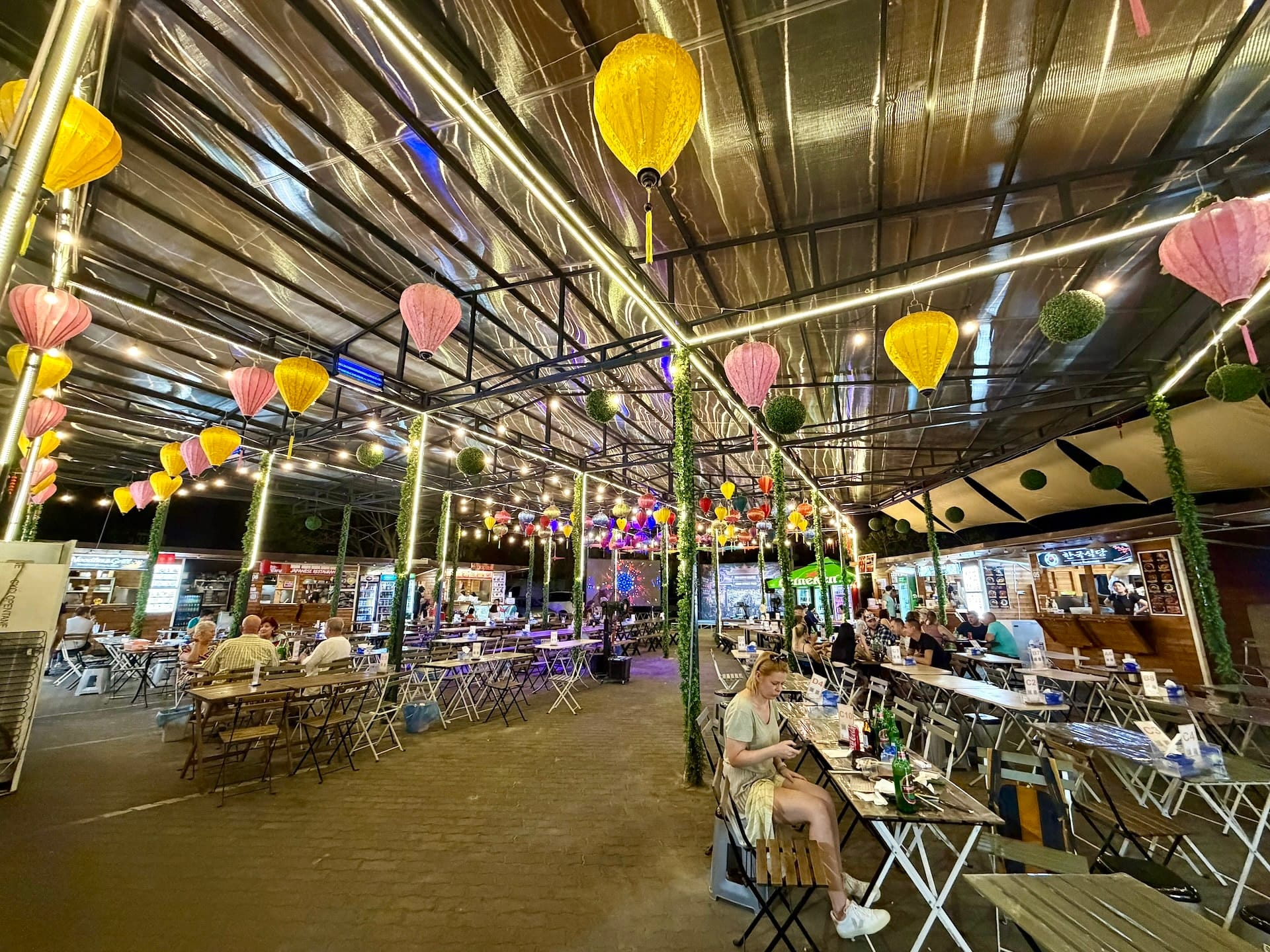
My first impression was that the venue is somewhat smaller than the old Chinatown Terasz, but more polished. A large roof structure covers the whole courtyard, with the typical Vietnamese paper and silk lanterns hanging from it, and the inevitable LED strips glowing here and there. It looks great, but the roof also means the warm air gets trapped underneath, just like under the tent at the Chinatown Terasz. We found a table near the entrance, where an occasional breeze and a couple of fans made things bearable. On a properly hot day, especially with the sun still up, I can imagine it getting uncomfortable.
The layout is simple: food stalls around the perimeter, tables in the middle. The seating is a mix. There are the wooden-slat garden chairs familiar to anyone who has ever shopped at IKEA, which I can personally confirm are good for about half an hour before you start shifting around. And there are the good old plastic stools, slightly taller than the ones we hunched over slurping pho at street stands in Vietnam.
There’s a stage, too, though nothing was happening on it during our Thursday visit. If there are concert or event nights, their Facebook page is the place to check before you go. What we did get was a huge screen playing what appeared to be a Vietnamese tourism promo video. We ended up reliving our two weeks in Vietnam, because the footage covered pretty much every place we visited. Around 9 pm the promo gave way to music videos.
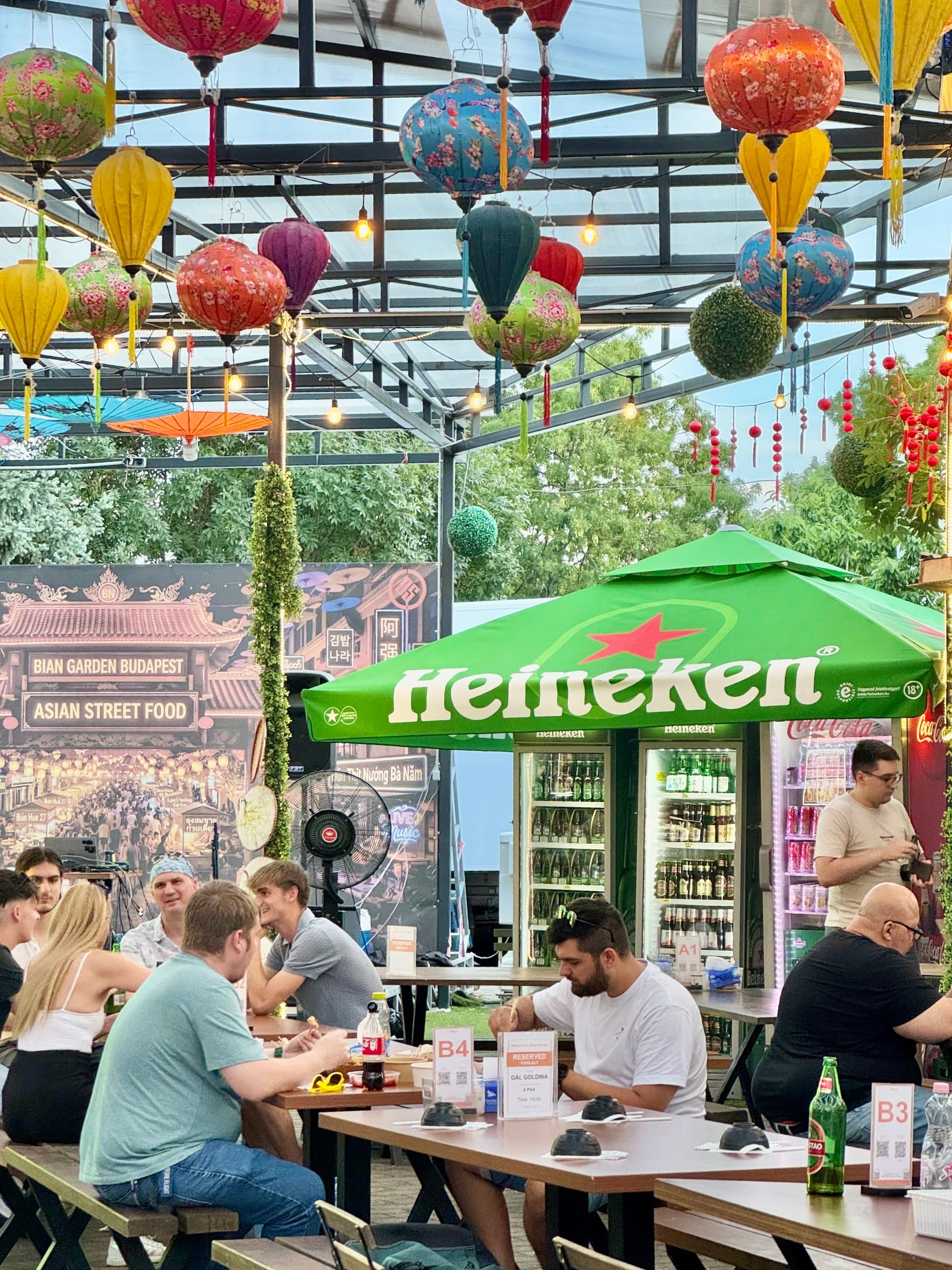
One thing I don’t remember from the Chinatown Terasz: you can reserve a table. It happens through a simple Google Form, and it clearly works, because a larger group was celebrating a birthday at a visibly reserved, signposted table. Not that you need it on a weeknight. There were plenty of empty tables the whole evening.
As for the crowd, I’d put it at roughly fifty-fifty: half Asian guests, half everyone else. As far as my very limited language skills allow me to judge, I definitely heard Vietnamese, caught some Korean words, and probably Mandarin too. The overall mood felt calmer than the old Chinese night market, though we were there on a Thursday. Weekends are probably livelier. July might go the other way, since that’s when Budapest empties out for summer vacations, and the start and end of the season could feel different again.
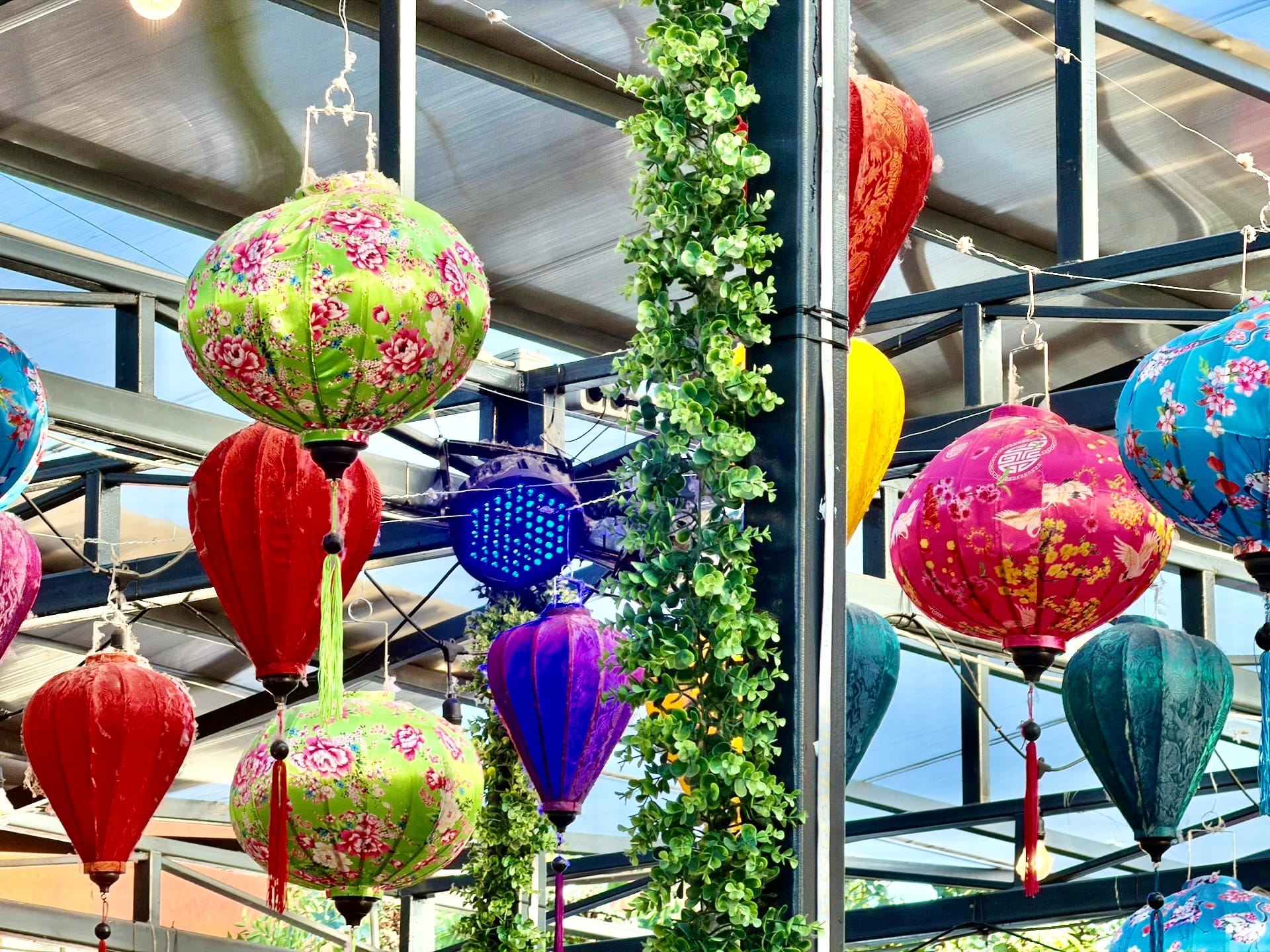
Bian Garden is open daily from 1 pm to 11 pm, with the outdoor season running from May 1 to the end of September. And it’s not purely a seasonal operation: right next to the courtyard there’s a regular Vietnamese restaurant under the Bian name that stays open year-round.
Arrive an hour or so before sunset. You can browse the stalls in daylight, and then the lanterns and LED strips do their thing once it gets dark, which is when the courtyard looks its best.
The Food Stalls: Vietnamese, Korean, and Chinese
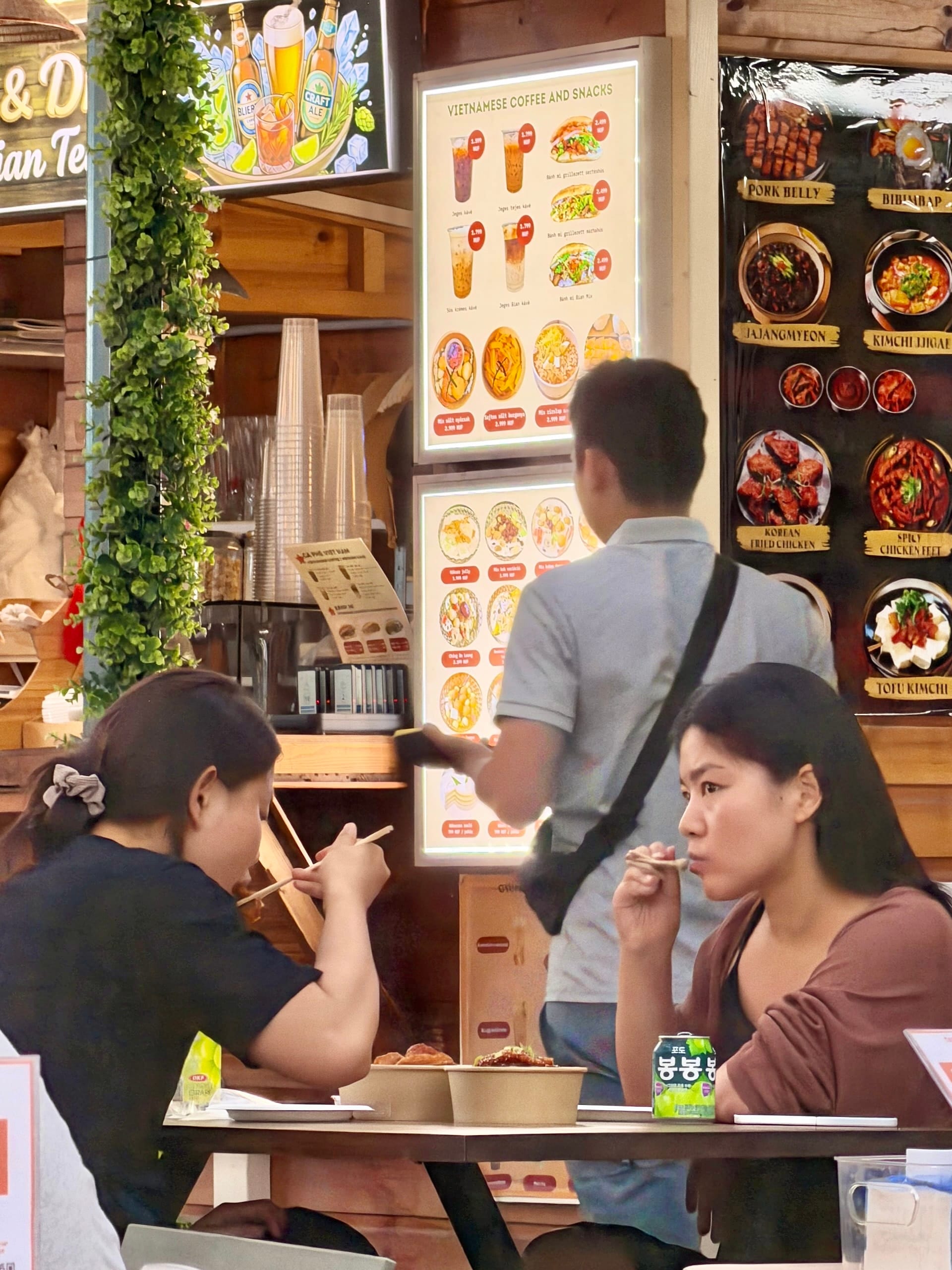
Now for the important part. There are about 10 to 12 stalls in total, mostly Vietnamese, with Korean and Chinese representation.
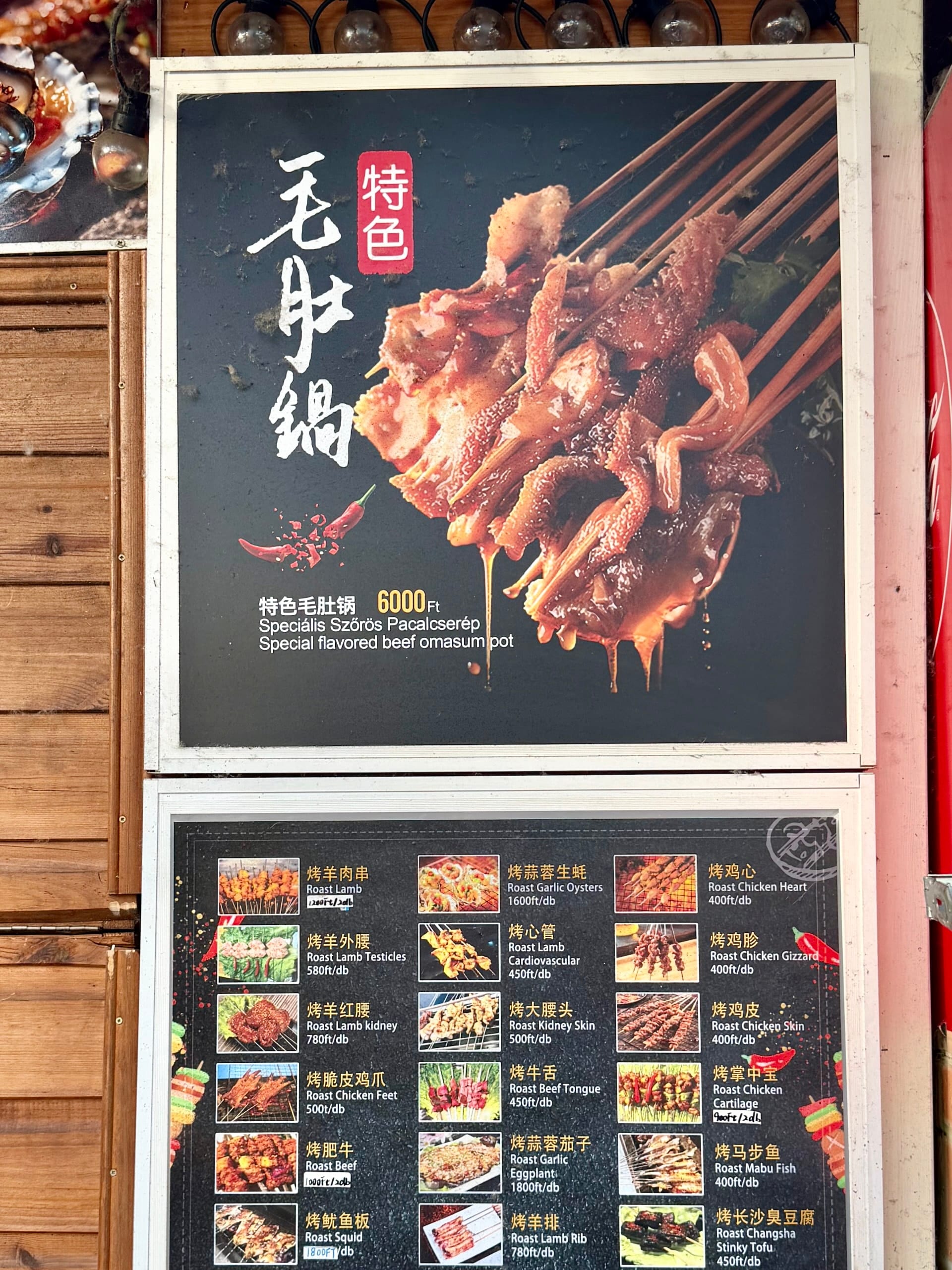
The most interesting concept was a skewer stall where you pick your own skewers, and they grill them for you on the spot. The selection covers everything from seafood and shrimp to meats and vegetables, with prices marked per skewer, ranging from 500 to 1,500 HUF (~$1.6 to $4.7 USD). We didn’t try it this time, but it’s high on the list for the next visit.
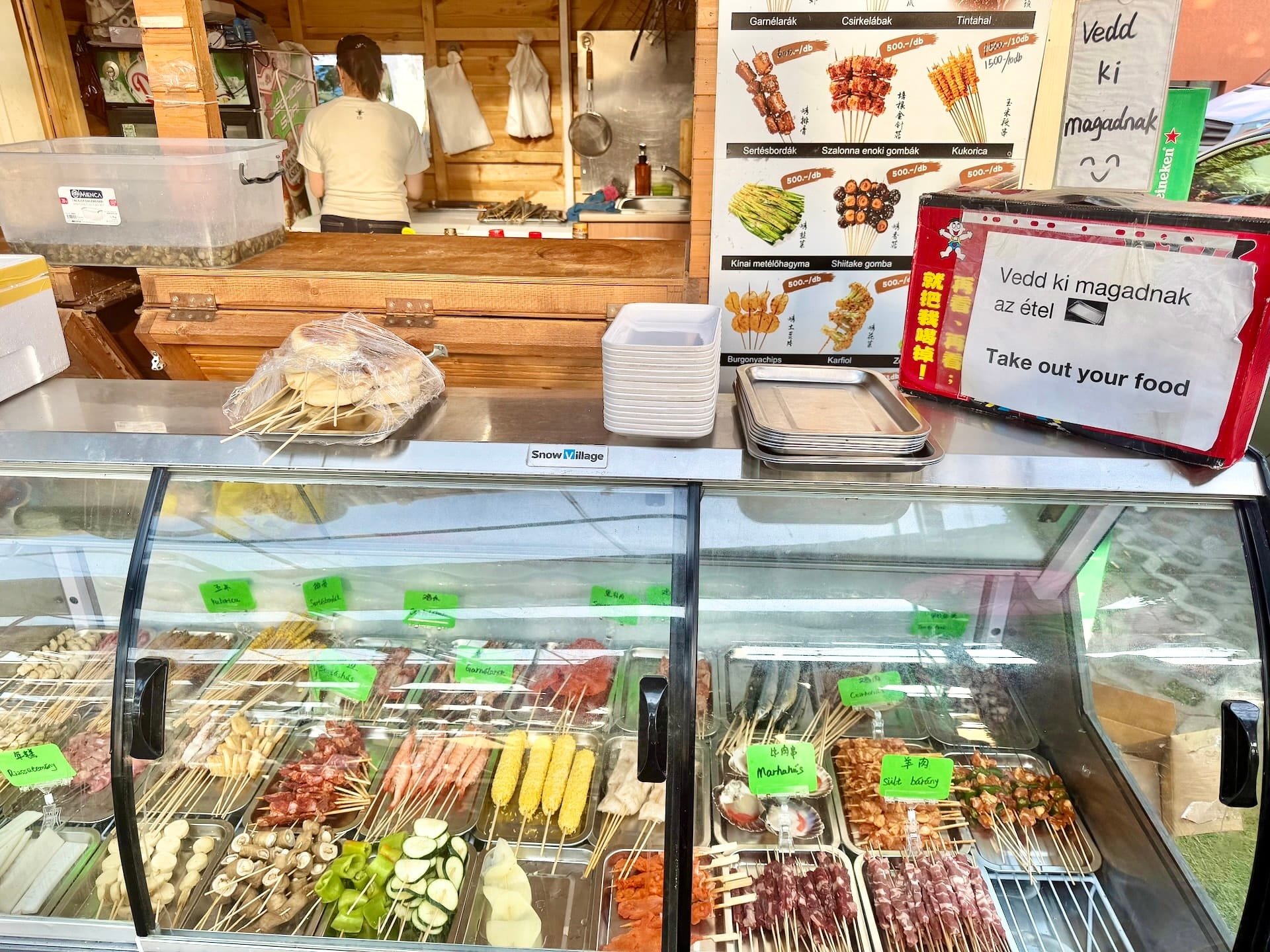
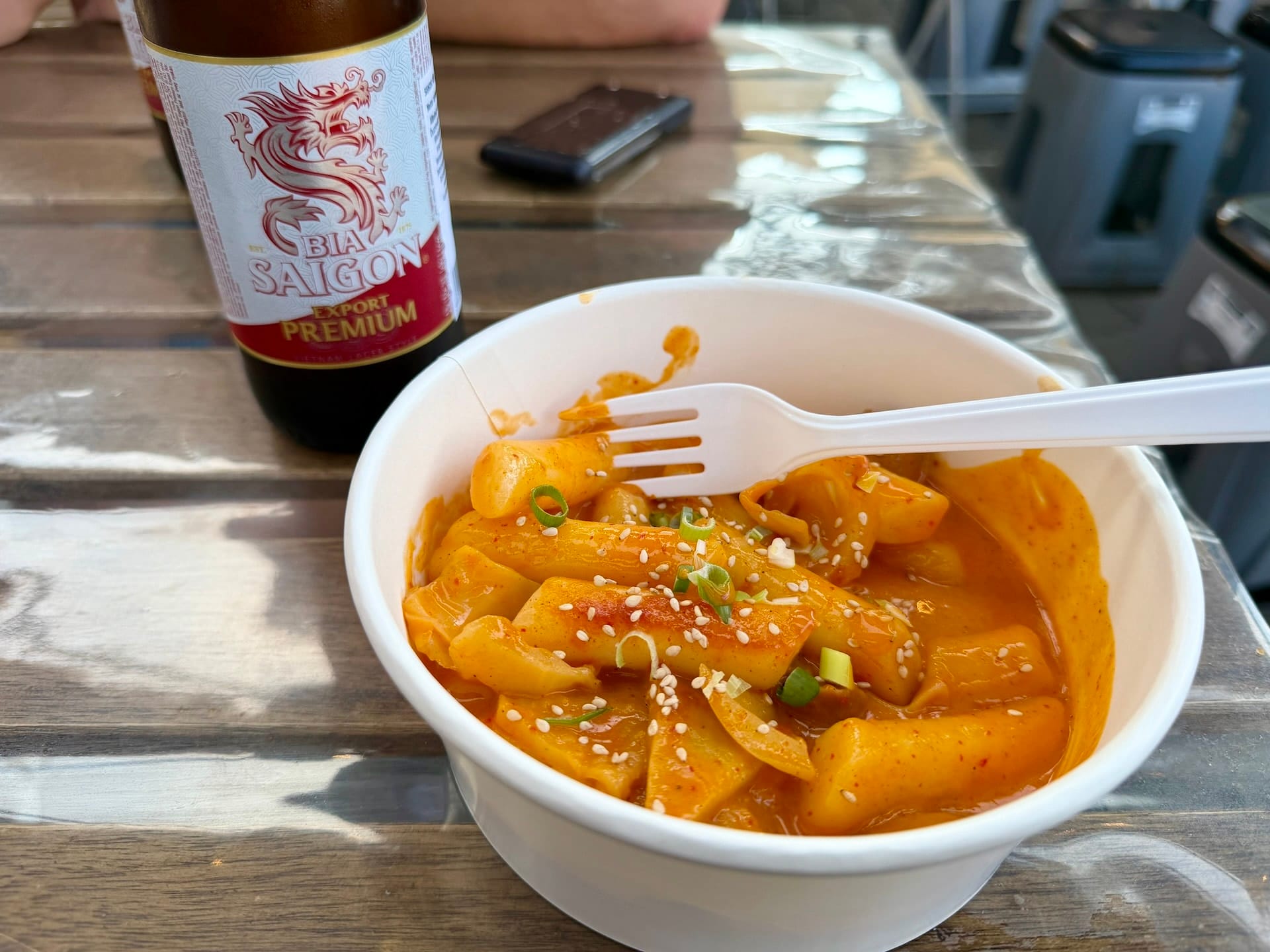
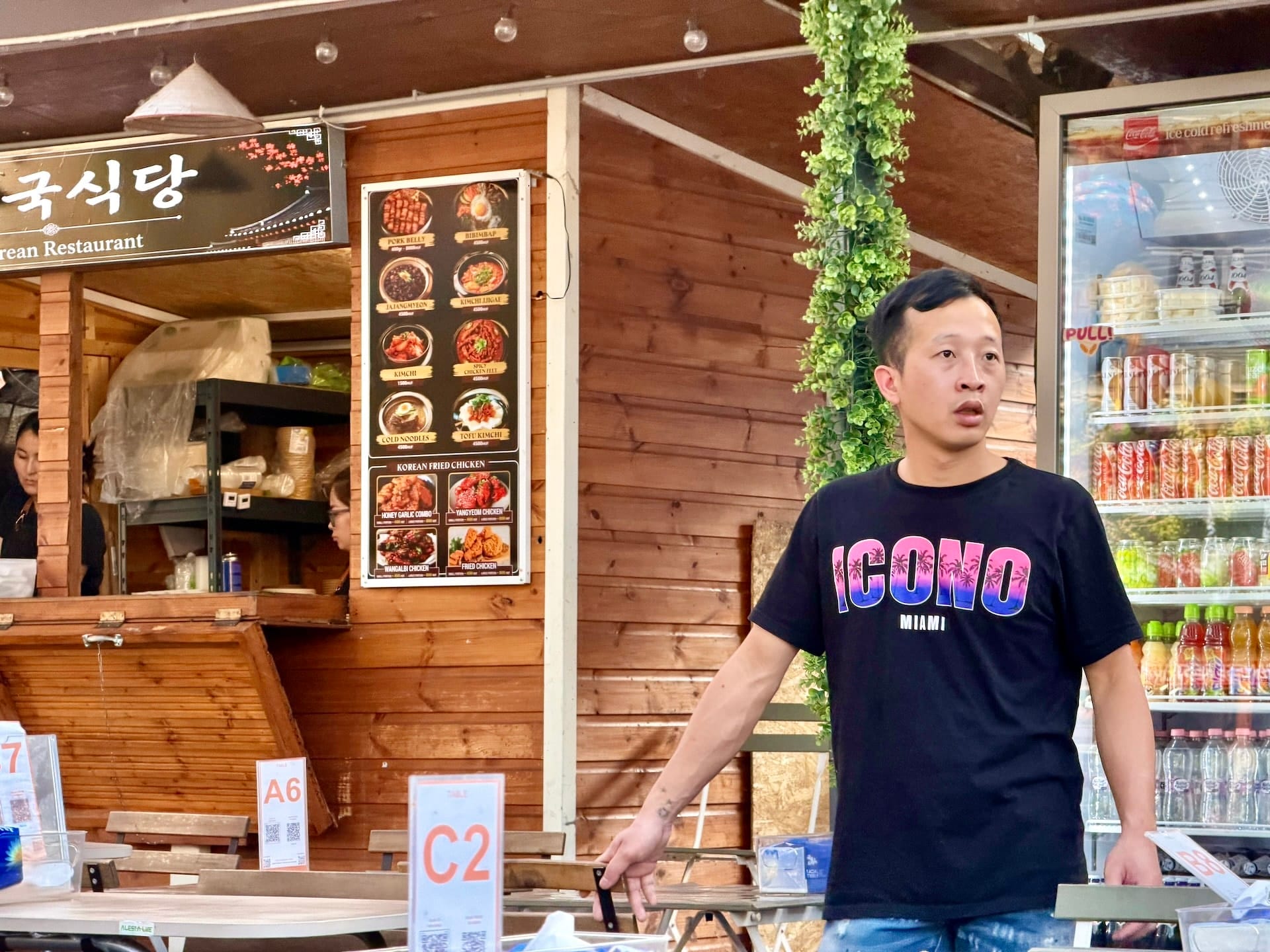
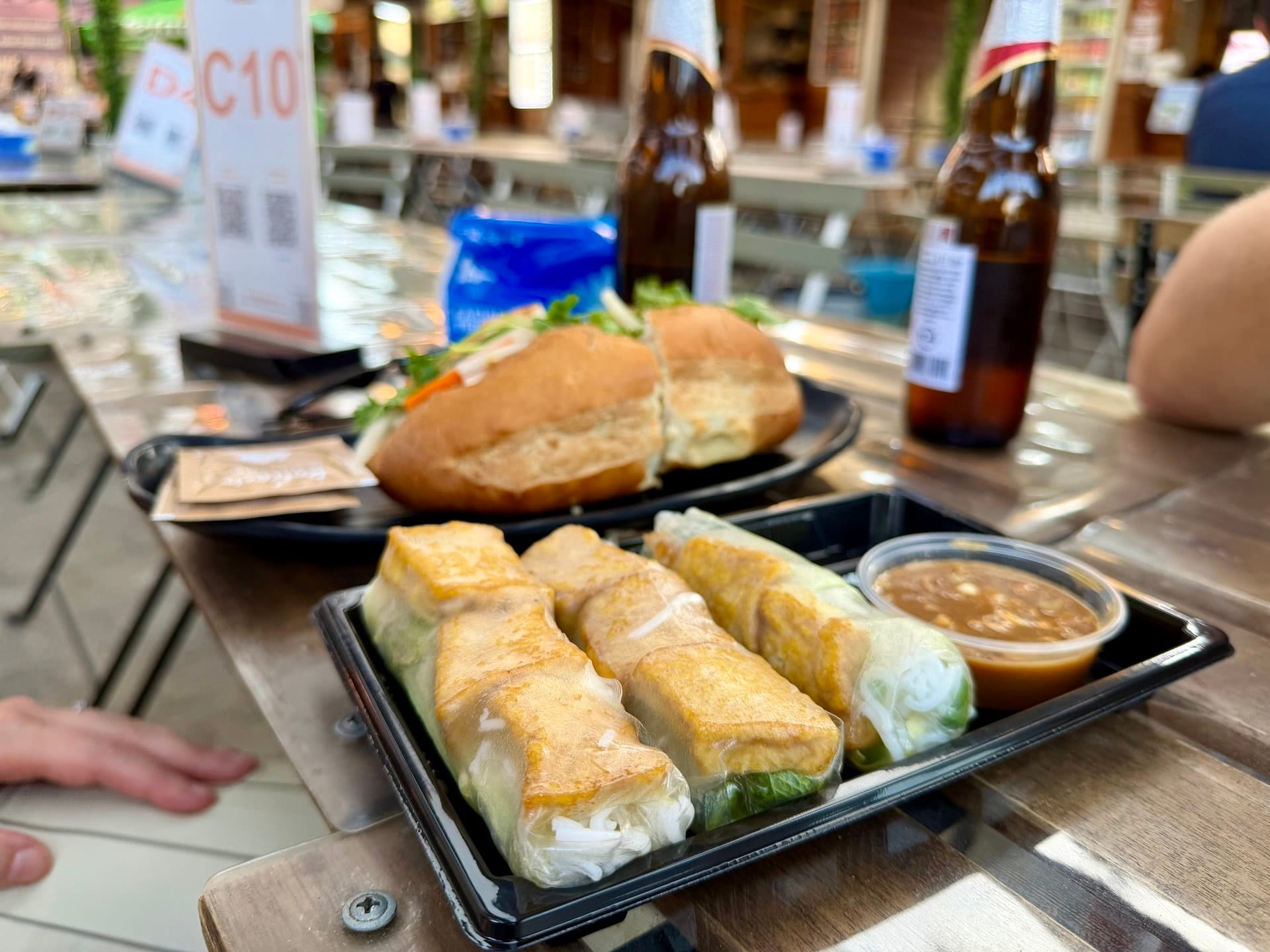
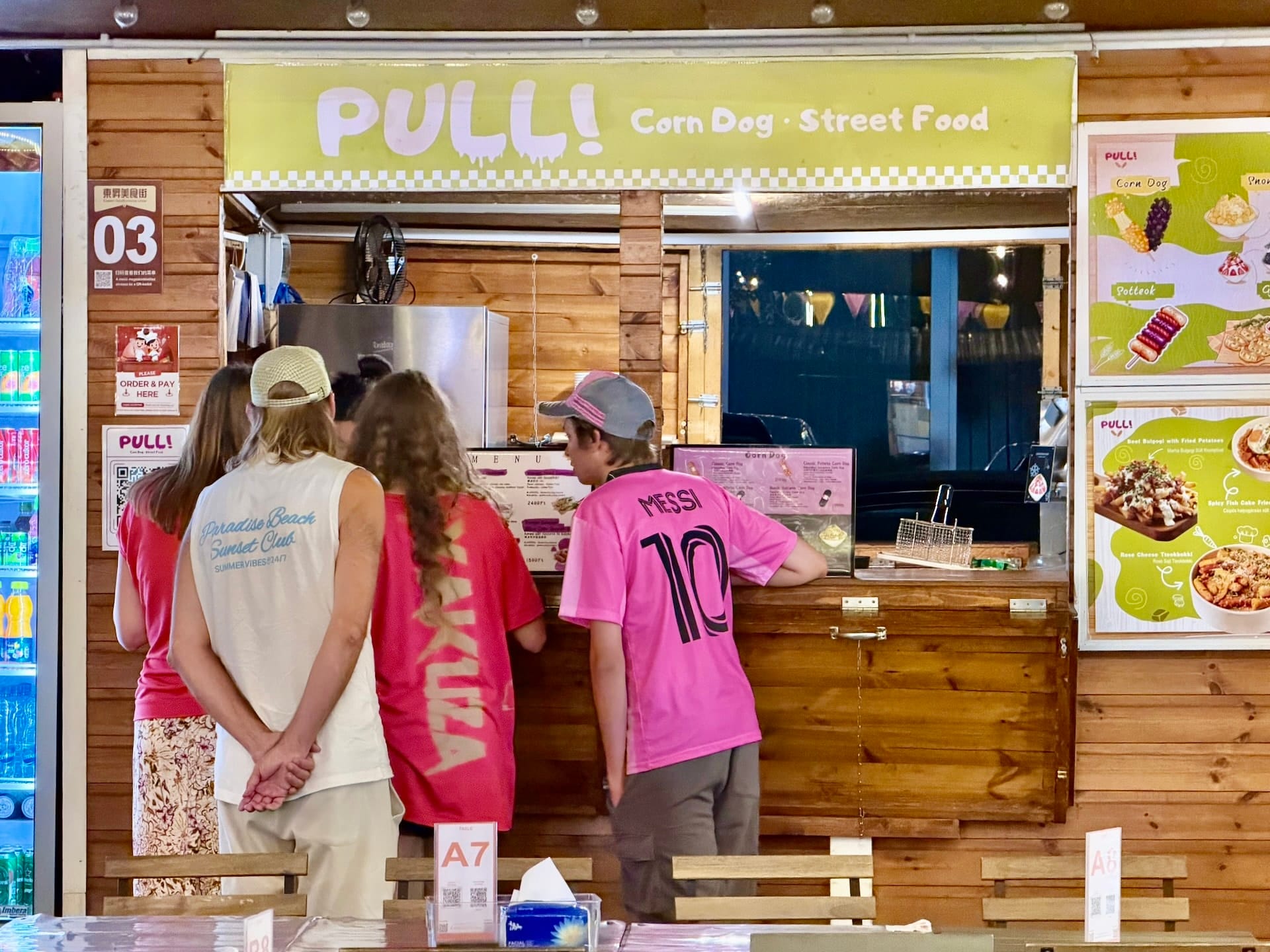
Since Korean food is still relatively rare in Budapest, that’s where we started. We ordered tteokbokki and a beef bulgogi, and both were good, though the portions weren’t huge and I would have welcomed a bit more heat in both. From the Vietnamese side, a bánh mì and fresh spring rolls landed on the table next. The spring rolls didn’t win me over, mostly because of the heavy dose of mint, though to be fair, that happens in Vietnam too.
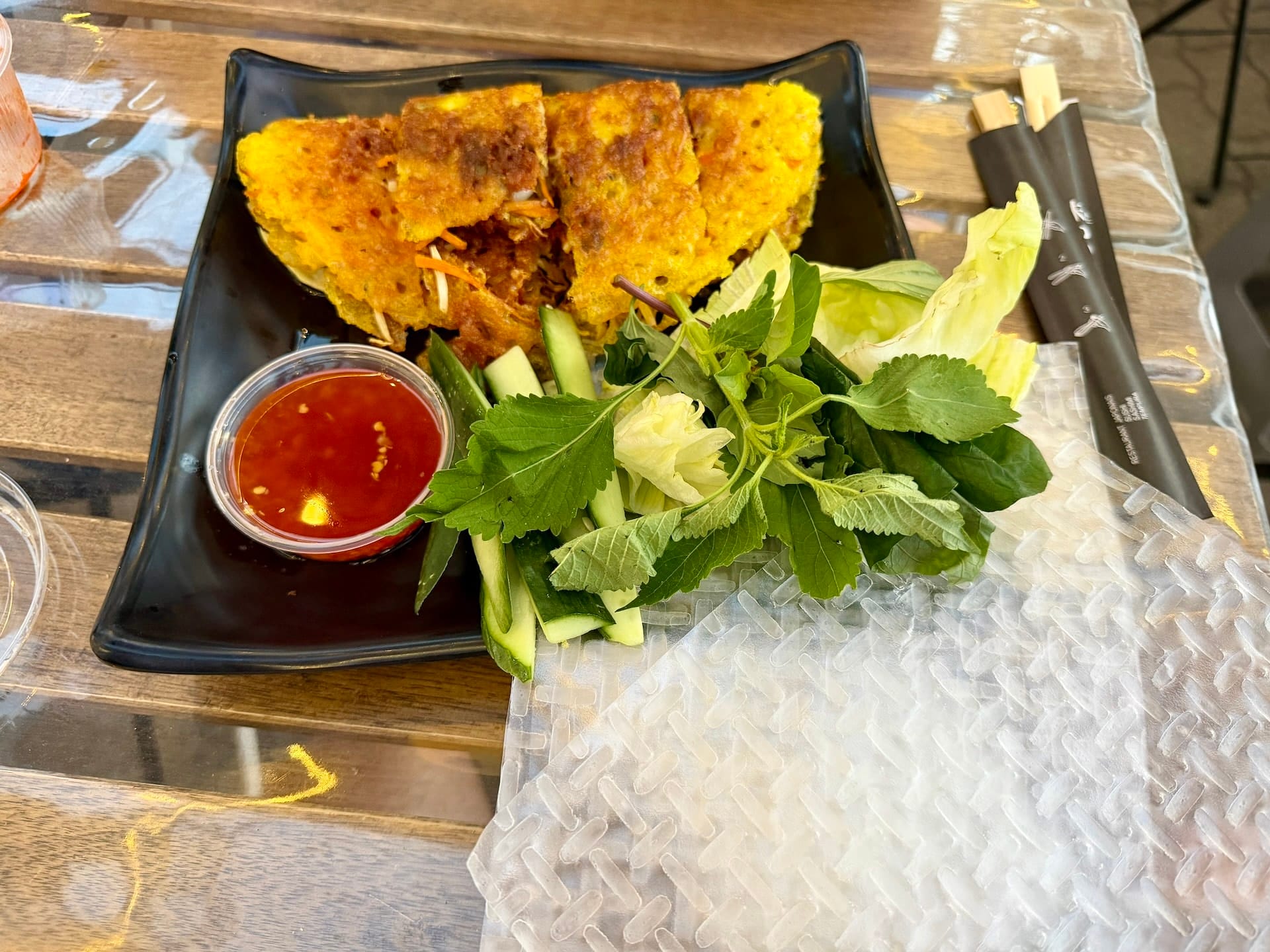
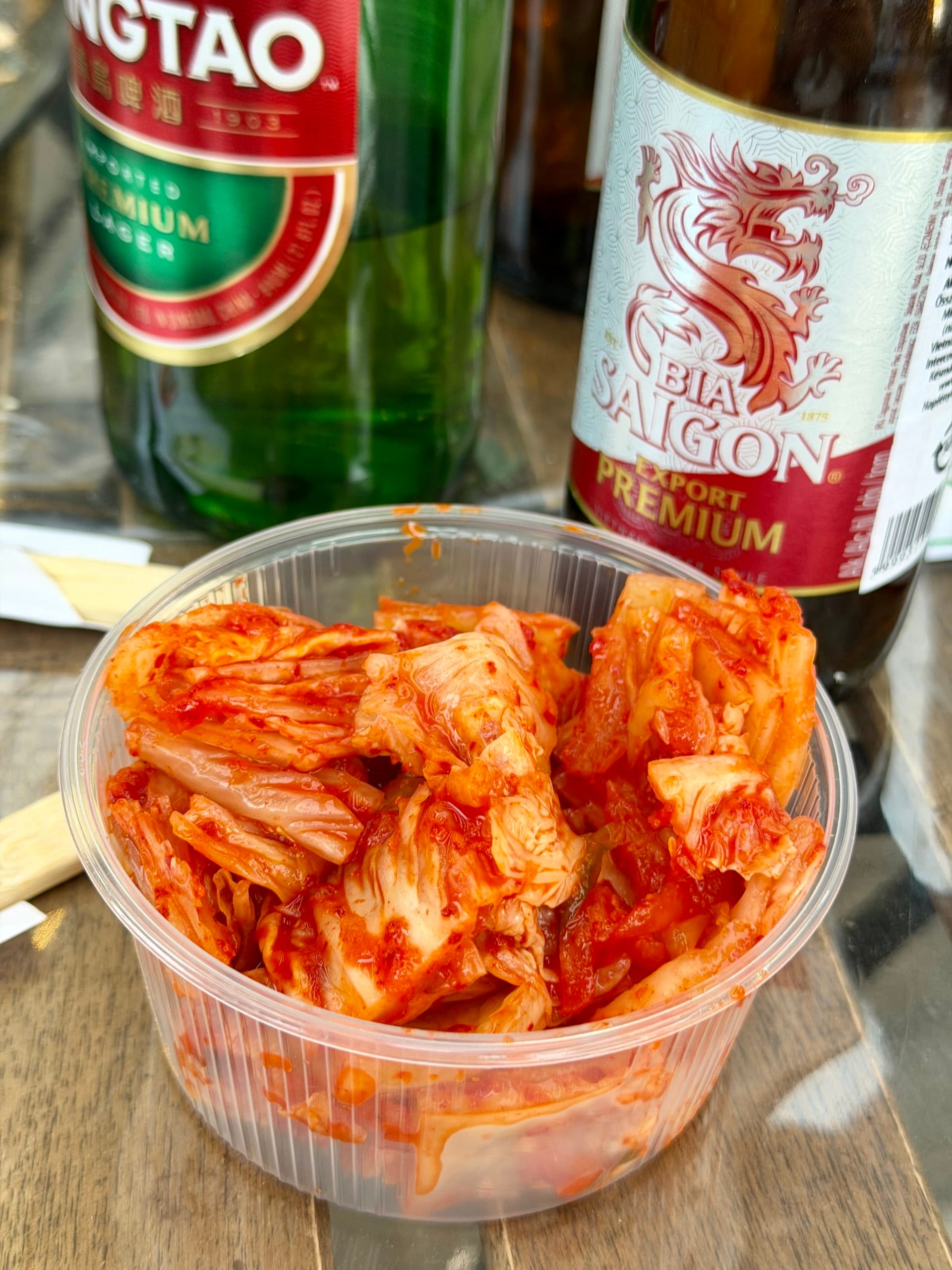
Later we tried a bánh xèo, the crispy southern-style Vietnamese pancake, served the proper way with a pile of greens and translucent rice paper sheets to wrap it in. It was good, but it’s a heavy, oily, generous portion, and ordering it at the end of the meal was a tactical error. Peter and I also shared a small portion of kimchi along the way.
Then, in a rare break from our habits, we ordered dessert, because the Vietnamese coffee jelly caught my attention and wouldn’t let go. It was more or less what I expected: it arrived in a plastic cup, built in layers of condensed milk and coffee jelly, with some watery liquid around it that I never quite identified. The jelly itself was firm, with a texture I found oddly compelling, and sweet in that condensed-milk way most Vietnamese coffee things are. I liked it.
Prices are worth a mention, because Bian Garden is not cheap, and that goes for every stall. A bánh mì is 2,500 HUF (~$7.9 USD), and main dishes generally run 2,500 to 4,000 HUF (~$7.9 to $12.6 USD). The drink selection is wide but similarly priced: milk teas and bobas hover around 2,000 HUF (~$6.3 USD), and there’s a dedicated tea stall where every drink costs 2,400 HUF (~$7.6 USD), with nearly 30 kinds to choose from. The big international soft drink brands are present, alongside some more unusual sodas.
Beer drinkers can choose between small and large Tsingtao or Bia Saigon, the Vietnamese lager. A small beer is 1,300 to 1,400 HUF (~$4.1 to $4.4 USD), a large one 2,000 HUF (~$6.3 USD), so the beer prices sting a little. Seeing Bia Saigon on the menu brought back a memory from Hoi An: I once ordered one at a beach bar there, and the waiter explained to me, with a straight face, that it isn’t really Bia Saigon, it’s Bia Ho Chi Minh. To this day I don’t know if he was joking or delivering a small act of political correction.
And of course, the extreme section. This time we didn’t manage to drink enough beer to attempt the roasted worms available at one of the Chinese stalls, and the same goes for the dishes labeled “roast lamb testicles”, “roast kidney skin”, and my favorite mystery, “roast lamb cardiovascular”. The clear winner of the evening, though, was a dish whose Hungarian label translated to something like “special hairy tripe pot”. Only the English line below it, “Special flavored beef omasum pot”, revealed what it actually was. The Hungarian version is doing its own thing entirely.
Overall, the food was solid, and as far as we can judge based on what we ate in Vietnam, it seemed authentic, allowing for the fact that not every ingredient is available in Hungary.
Ordering at Bian Garden: Pagers, QR Codes, and the Bill
The routine is similar to the old Chinese night market. Grab a table first, then everyone wanders off to whichever stall appeals to them. Where we ordered at the counter, we got a pager, went back to the table, and picked up the food when it buzzed. And as always, the right way to do a night market is as a group: order a spread, share everything, taste as much as possible.
But Bian Garden has a trick I haven’t seen at any Budapest night market before. Every table has a number and a QR code, and the QR code lets you order directly to your table. You scan it, a menu comes up on a Vietnamese-domain website, and you pick what you want. Within seconds of ordering, someone appears at your table with a card terminal, you pay, and the food arrives as soon as it’s ready. Our dessert showed up almost instantly, the bánh xèo and the beers took a bit longer.
It’s very convenient, since you don’t have to get up at all. There’s one catch: not every stall is on the QR menu. As far as I could tell, only the Vietnamese ones are listed, and the Korean stall definitely wasn’t. So it’s worth doing a lap of the stalls first anyway. Card payment, on the other hand, works everywhere.
Treat the QR menu as a convenience, not the full catalog. Walk the perimeter once before you sit down, note which stalls you want to order from in person, and save the QR ordering for drinks, desserts, and second rounds.
Budget-wise, count on roughly 10,000 HUF (~$31.5 USD) per person, and closer to 15,000 HUF (~$47.3 USD) if you go heavy on the extras and the drinks. That covers about two dishes each plus a few drinks. It’s not cheap, but the alcohol and tea prices are what really move the bill.
We arrived at 6:30 pm and left a little before 10, and those two to three hours felt right. The ordering process itself is fast and the food comes quickly, so you could be in and out much faster. But that would miss the point. We talked, we ate, we people-watched, and it was a good evening.
How to Get to Bian Garden by Public Transport
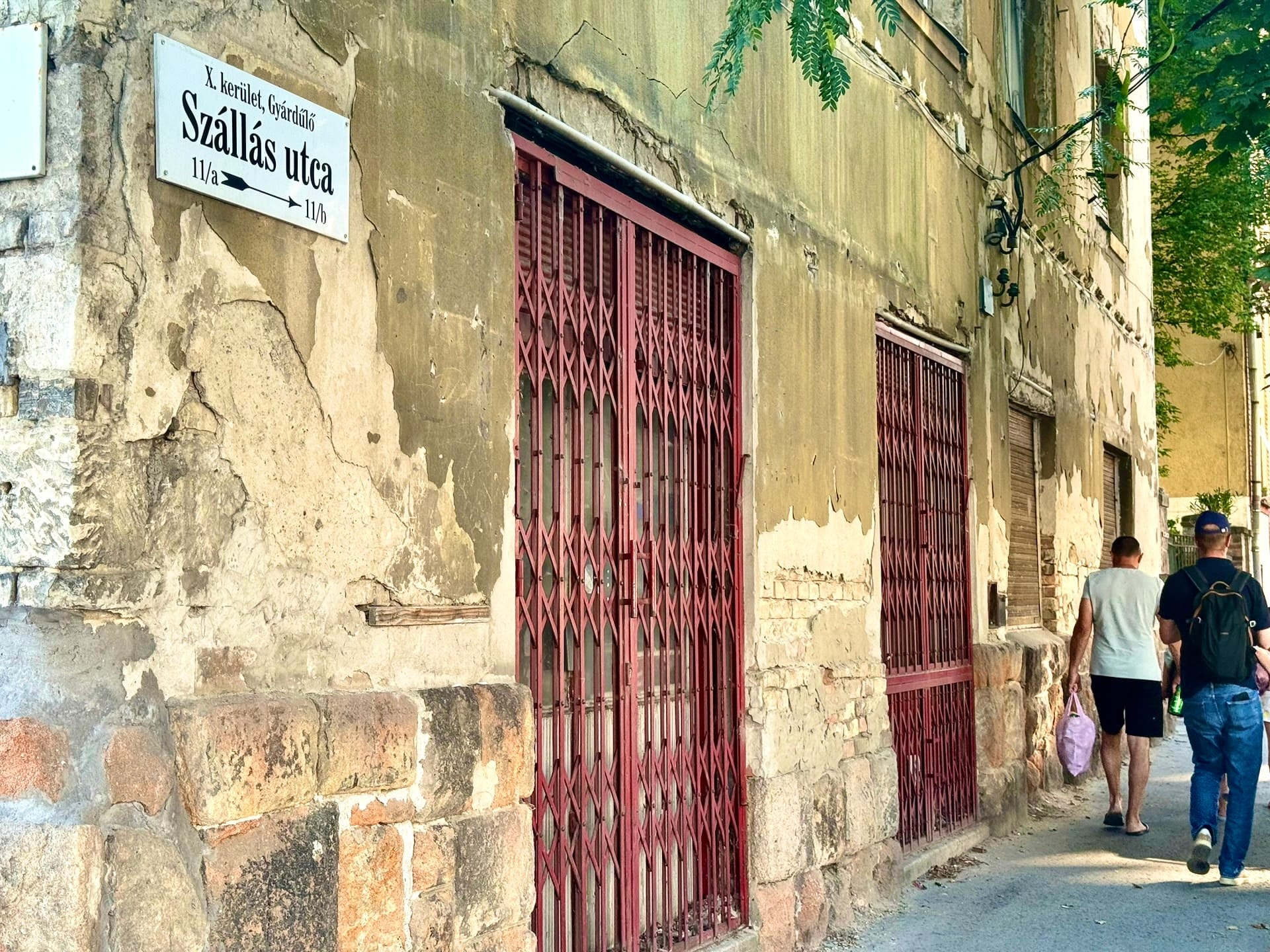
Like its predecessor, Bian Garden is not exactly downtown, so it falls well outside the usual visitor routes. The exact address is Szállás utca 21, in District 10 (Kőbánya).
We went by public transport, and it’s a painless trip: about 30 minutes from the city center. The simplest option from the Deák tér area is bus 9, which runs direct to Kőbánya with no transfers, or you can take metro line 2 or 3 and connect to a bus or tram. As always in Budapest, plan the route with the BudapestGO app, and Google Maps handles it fine too. For tickets, passes, and general navigation, our Budapest public transport guide covers everything.
One thing to watch: if you leave around 10 pm, services in this part of town run much less frequently, so budget extra time for the trip back.
Buy your tickets in the BudapestGO app before heading out, and check the return schedule while you still have wifi at the venue. Late-evening waits at outer-district stops are a lot more pleasant when you know exactly when your bus is coming.
And to address it directly: Kőbánya is not Budapest’s fanciest district, and this is an outer, semi-industrial part of the city. We had zero problems, nothing felt off, but expect warehouse-and-side-street scenery rather than Habsburg facades.
Is Bian Garden a Worthy Replacement for the Chinese Night Market?
So, the verdict: is Bian Garden the true successor to the Chinatown Terasz? For me, not quite.
It’s hard to put into words. The food was very good, the Korean stalls are a real plus, the QR ordering is the most convenient system I’ve seen at any Budapest night market, and the crowd included plenty of Asian guests, which is usually a good sign. But the atmosphere just wasn’t the same. The old market had a chaotic, slightly overwhelming energy that I found myself missing under Bian Garden’s tidy lantern-hung roof.
That’s not a reason to skip it. If you’re in Budapest between May and September and want Vietnamese and Korean street food in an authentic setting, Bian Garden delivers, and it’s an easy trip from the center. But our search for the Chinatown Terasz’s real heir continues. The next stop in that search was the Fully Night Market, a few streets away. Between the two I still give Bian Garden a slight edge on atmosphere, but Fully is the one with room to grow.