I didn’t expect much from Gdańsk. It was my mother’s pick for her 70th birthday, and I showed up assuming it would be pleasant and little more. It became one of my favorite cities in Europe – the way Oslo once won me over, another northern city I’d arrived at expecting nothing. If you’re weighing up the things to do in Gdańsk, the short version is that the headline sights fit into two or three unhurried days – and that this is one of the few cities where you can stand inside two of the 20th century’s defining turning points in a single day’s walk.
This is where the Second World War began, at Westerplatte in 1939, and where the Soviet bloc started to come apart, at the shipyard gates in 1980. The rest of the time, Gdańsk is a compact, walkable Hanseatic port of brick churches and ornate merchant houses – most of them rebuilt from rubble after 1945, and rebuilt so well you’d never guess. Here’s how we spent three days.
Gdańsk at a Glance: Quick Facts
- Currency: Polish złoty (PLN). Cards accepted essentially everywhere; we barely touched cash.
- Language: Polish. English is widely spoken in the center.
- Time zone: Central European Time (UTC+1), daylight saving in summer
- Plugs: Type C and Type E, 230 V / 50 Hz
- Tap water: Safe to drink
- Tipping: Around 10% in restaurants
- When to visit: We went over the Pentecost long weekend in late May and had excellent weather – warm enough for the riverside terraces, without the full summer crowds. Summer (June–August) is the peak: long evenings, but the Main Town fills with cruise groups by mid-morning. May and September are the sweet spot. Baltic winters are gray, wet, and windy.
- Getting around: Compact and flat – the center is walkable end to end. Over-70s ride free.
Getting there and where to stay
That word – Hanseatic – explains a lot of what you’re about to look at. The Hanseatic League was a medieval trading network of merchant towns along the Baltic and North Sea, powerful from roughly the 13th to the 17th century. Gdańsk (then Danzig) was one of its wealthiest members, a grain port that converted its money into tall brick churches, ornate merchant houses, and grand waterfront granaries. If the Main Town’s facades remind you of Lübeck, Riga, or the old wharf in Bergen, that’s not a coincidence – they were all working from the same commercial playbook.
We flew in from Budapest with Wizz Air and came into town by Uber, partly out of laziness and partly because the public-transport options weren’t obvious to us on landing. The airport itself is large, modern, and almost eerily calm, and the ride in took about 30 minutes through green, forested outskirts – the first thing I noticed was simply how many trees there are here compared to home. For the record, the cheaper routes are real: bus 210 runs directly to Gdańsk Główny, the main station, in about 40 minutes, every 30 minutes on weekdays, for 4.80 PLN (≈1.1 EUR / 1.2 USD) a ticket. A taxi, Uber, or Bolt usually runs 35 to 60 PLN (≈8–14 EUR / 9–15 USD). There’s also an SKM train from the airport’s own station, but you generally have to change at Wrzeszcz to reach the center, which makes it the least convenient of the three.
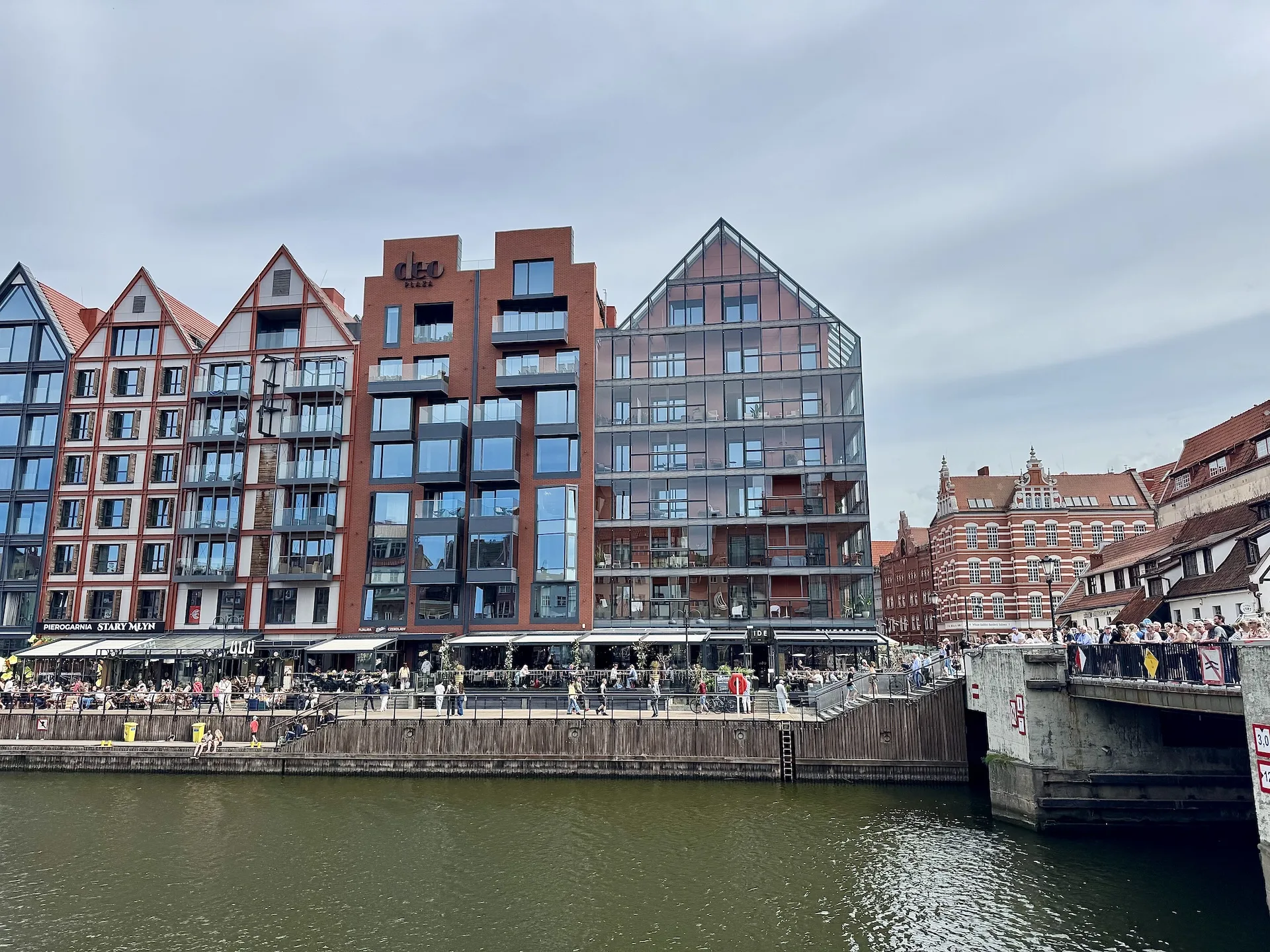
We based ourselves on the old shipyard side rather than in the postcard core, and it turned out to be the best decision of the trip. Our apartment was a modern one-bedroom with a small terrace and a full kitchen on Wałowa, in the redeveloped strip between the European Solidarity Centre and the Museum of the Second World War, right next to the Montownia Food Hall. It ran about 92 EUR / 100 USD a night, with coffee thrown in but no breakfast, and the Old Town was a 15 to 20 minute walk away. This is the DOKI district – a redevelopment built on former shipyard land, where new apartment blocks sit among restored brick industrial halls; the name comes from the Polish for docks. Staying here meant walking daily through a working slice of the city’s old-and-new history that most visitors never see, instead of the same three tourist streets. Comfortable, quiet at night, genuinely local, and a short walk from everything that mattered.
Adults over 70 ride Gdańsk’s trams and buses for free. For everyone else, download the Jakdojade app – it plans routes across the tram, bus, and SKM network and lets you buy tickets on your phone, which saves hunting for a ticket machine.
Day 1 – The Old Town and Main Town on foot
If you’ve only got one day in Gdańsk, this is the day to do: a slow walk from the old churches and mills down through the Main Town to the river. It’s almost entirely on foot and almost entirely flat.
The Old Town: amber, churches, and two medieval mills
Walking in from the shipyard side, you reach the Old Town (Stare Miasto) before you hit the postcard core – and it’s worth slowing down here rather than rushing through.
This pocket of the city is stacked with churches, one brick-red giant giving way to the next. The first you reach is St. Bridget’s Basilica (Bazylika św. Brygidy), and it’s the one to step inside. We paid the entrance fee on our last morning, mostly for one thing: the amber altar. It’s the largest sacred object made of amber in the world, and it’s still unfinished – a work in progress, a wall of Baltic resin lit from within, more overwhelming than beautiful. It’s also wired through with recent Polish history: the parish priest here was the Solidarity chaplain, Lech Wałęsa worshipped here as an unknown shipyard electrician, and the altar carries a Solidarność map and amber crowns funded by the Wałęsas. Downstairs there’s a crypt of skulls, opened to visitors after hundreds of 17th-century bones were found during renovation – we didn’t go down, but it’s there if you want it.
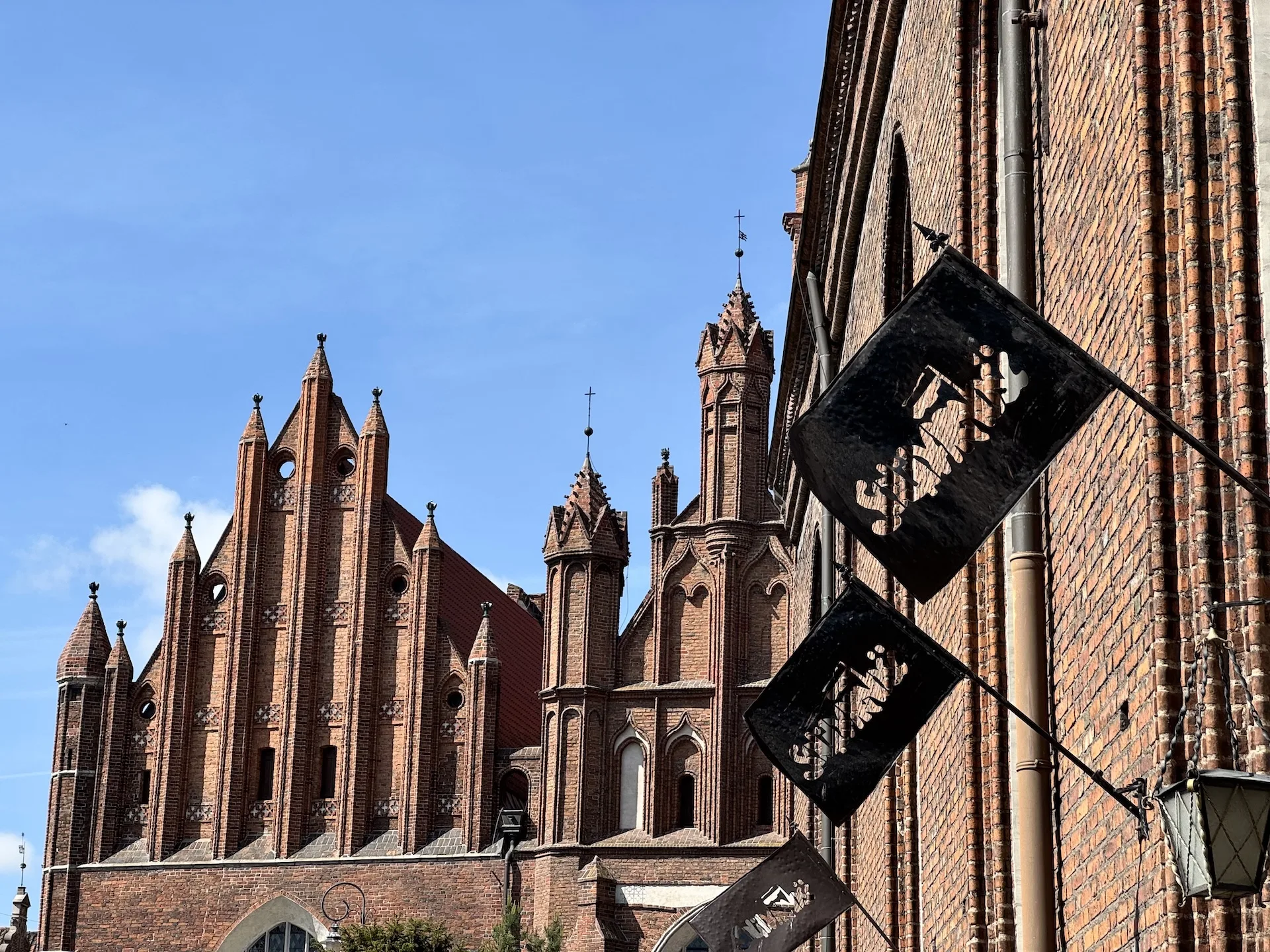
Next door is St. Catherine’s (Kościół św. Katarzyny), the oldest church in Gdańsk. A fire in 2006 did serious damage and the restoration is still going, but it’s open to visitors. The astronomer Johannes Hevelius is buried here, and his statue stands in a small park nearby, over by the mills.
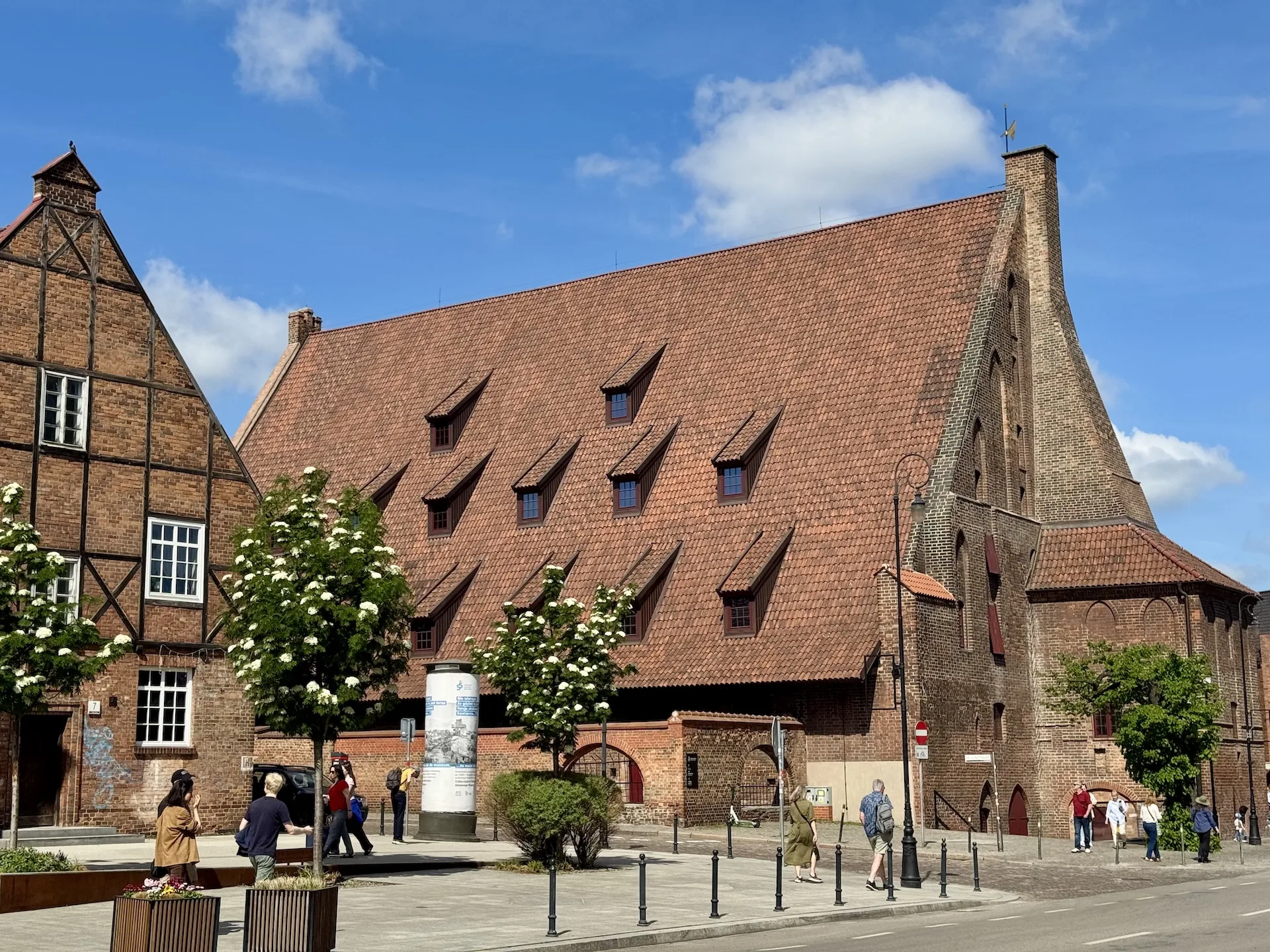
A short walk away are the city’s two Gothic mills on the Radunia Canal. The Great Mill (Wielki Młyn), a 14th-century watermill, now houses the Amber Museum – we admired it from outside but didn’t go in. The Small Mill (Mały Młyn) nearby was, despite the name, never a mill at all but a granary, and now holds offices. Between them runs the little Lovers’ Bridge (Most Miłości) over the canal – a quick, pretty detour.
Heading south from the mills, you pass the Baszta Jacek, a stout medieval guard tower, and the Hala Targowa, the old market hall: a handsome brick building, though it happened to be closed when we passed.
The Main Town: Długa Street to the waterfront
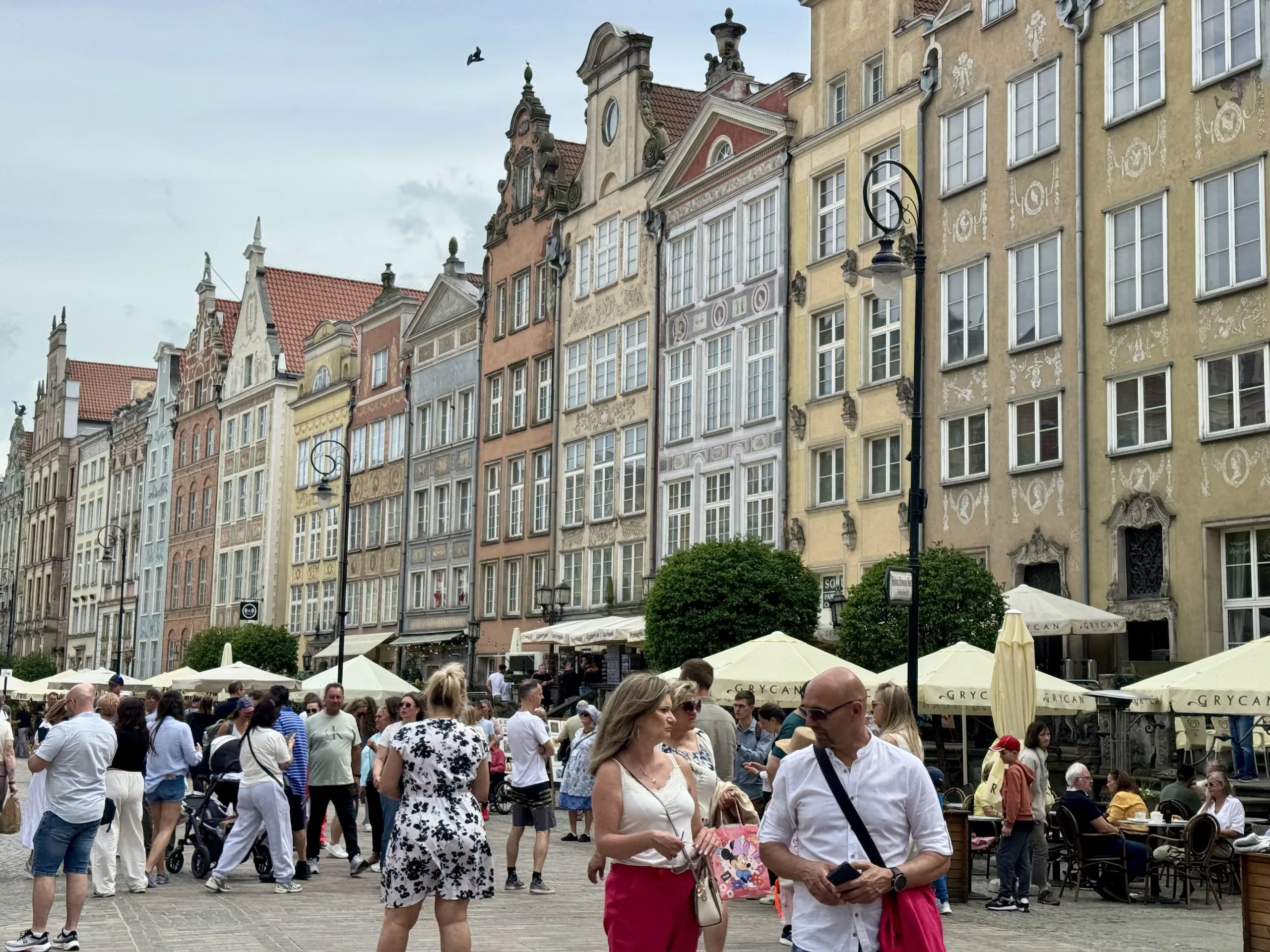
From here you cross into the Main Town (Główne Miasto), and the colorful merchant houses start almost immediately, getting better as you go. A routing tip, since it makes a difference: rather than diving straight in, walk out to the far end first, to the Golden Gate (Złota Brama) and the Upland Gate beyond it, then turn around and walk the length of Długa back toward the river. On the square beside the Golden Gate stands the Great Armoury (Wielka Zbrojownia), a flamboyant Dutch-Renaissance arsenal that looks more like a merchant’s palace than a weapons store – worth a couple of minutes before you set off. Długa is effectively the main street – the old Royal Route – and taking it in this direction means the city keeps opening up in front of you rather than petering out behind you. When we were there, an architecture festival was on, and we could go inside the Golden Gate itself and look out over the street from its windows, which is not something you usually get to do.
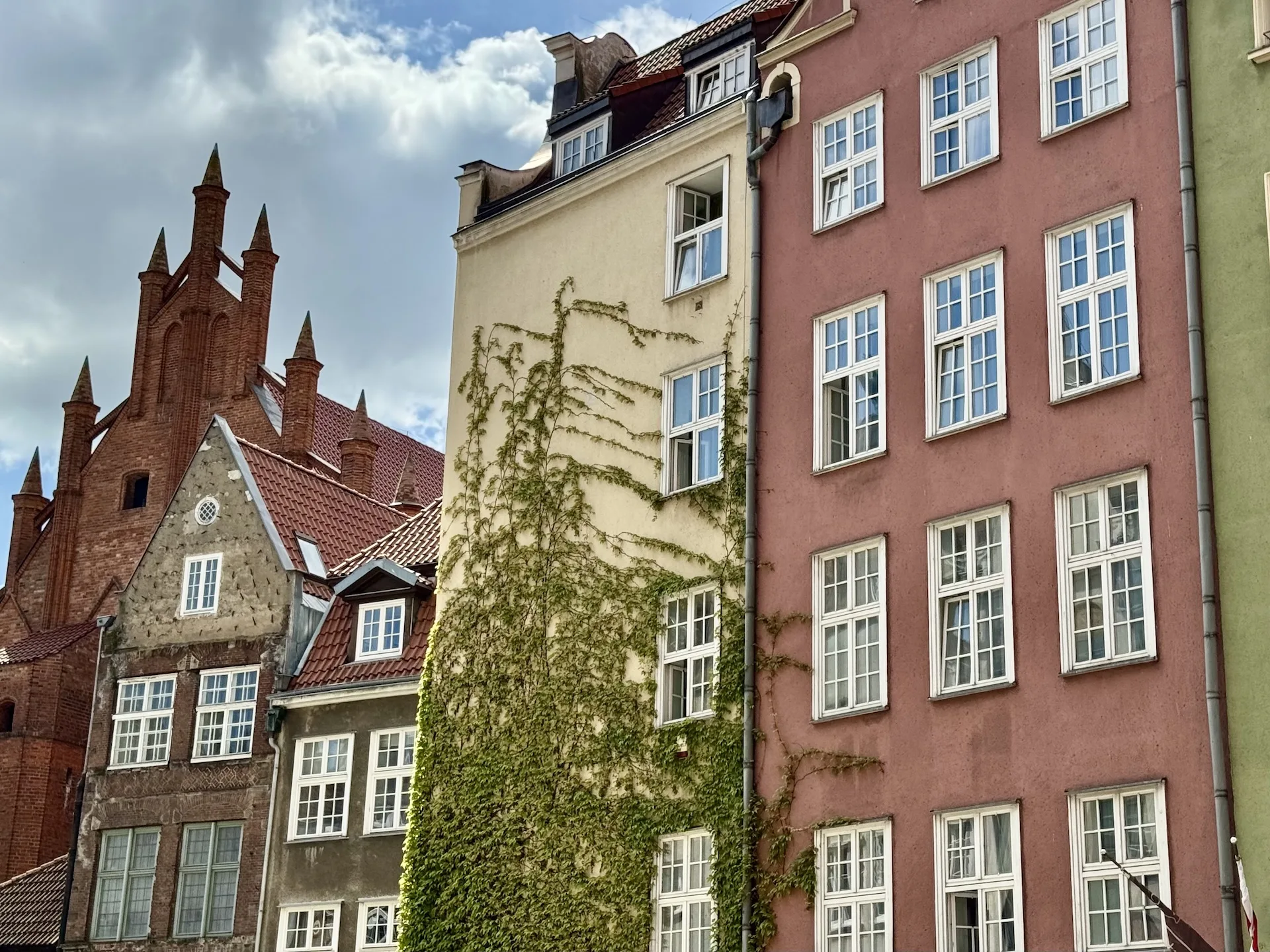
From the Golden Gate it’s a straight, slow walk past one ornate facade after another to the Neptune Fountain, the bronze sea-god who’s been the symbol of the city’s maritime wealth for centuries, and on into Długi Targ (the Long Market), the widest and grandest stretch, lined with the Main Town Hall and the merchant houses. Look out for the Schumann House (Dom Schumannów) at Długa 45, where the street meets the Long Market: a red-fronted Renaissance townhouse with statues of Diana, Apollo, and Zeus perched on the gable. The street ends at the Green Gate and spills you straight out onto the river.
Here’s the part that took me a while to absorb. Almost none of this is technically old. St. Mary’s and most of the center were severely damaged in 1945, during the Red Army’s storming of the city – in places the heat was so intense that the bricks melted. What you’re walking through is a postwar reconstruction, rebuilt in the original style with such care that it reads as genuinely medieval rather than as a theme-park copy. And the more remarkable thing: they’re still doing it. Some of the houses here are going up now, with modern materials and modern interiors, but built to slot into the original concept so precisely that you have to look twice.
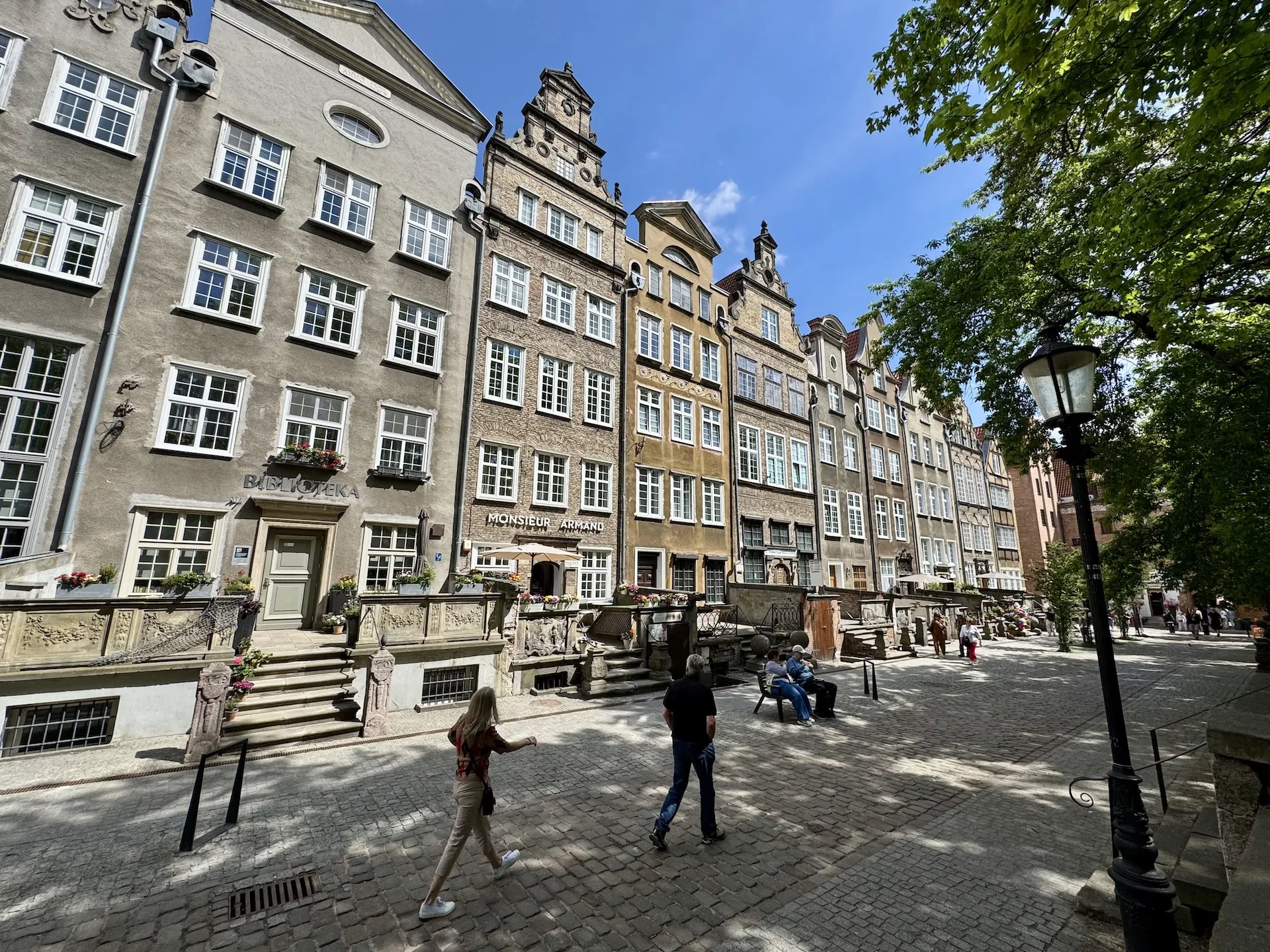
The other street worth walking is Ulica Piwna (Beer Street), which runs parallel to Długa one block north, from the Great Armoury down to St. Mary’s Basilica – so you can go out on one and come back on the other. St. Mary’s is the centerpiece – commonly cited as the largest brick church in the world, and known locally as the Crown of Gdańsk. It’s big enough to hold 25,000 people, which mattered during martial law in the early 1980s, when Solidarity members sheltered here. Inside there’s a 15th-century astronomical clock, and the tower is a 405-step climb to a viewing platform. We skipped the climb ourselves – it seemed unkind to leave my 70-year-old travel companion at the bottom – but we’re told the view from up there is the best in the city.
Right beside it sits the small baroque Royal Chapel (Kaplica Królewska), easy to miss next to its enormous neighbor. In front of it stands the Four Quarters Fountain (Fontanna Czterech Kwartałów): four bronze lions marking the junction where Gdańsk’s four medieval quarters once met. And then my favorite street in the city: Mariacka, which runs from St. Mary’s down to the river. It’s lined with amber galleries and cafés, with the terraced stone stoops and gargoyle waterspouts of the rebuilt townhouses on either side, and the whole thing simply has the best atmosphere in the Old Town. We didn’t buy any amber, though this is where my mother picked up the truly essential souvenir: a fridge magnet.
When Mariacka fills up, slip onto Świętego Ducha (Holy Spirit Street), which runs parallel one block over. It’s a near-twin – same rebuilt townhouses, same cobbles – but with a fraction of the tourists and a small green spot to sit and reset. It comes out at the same place.
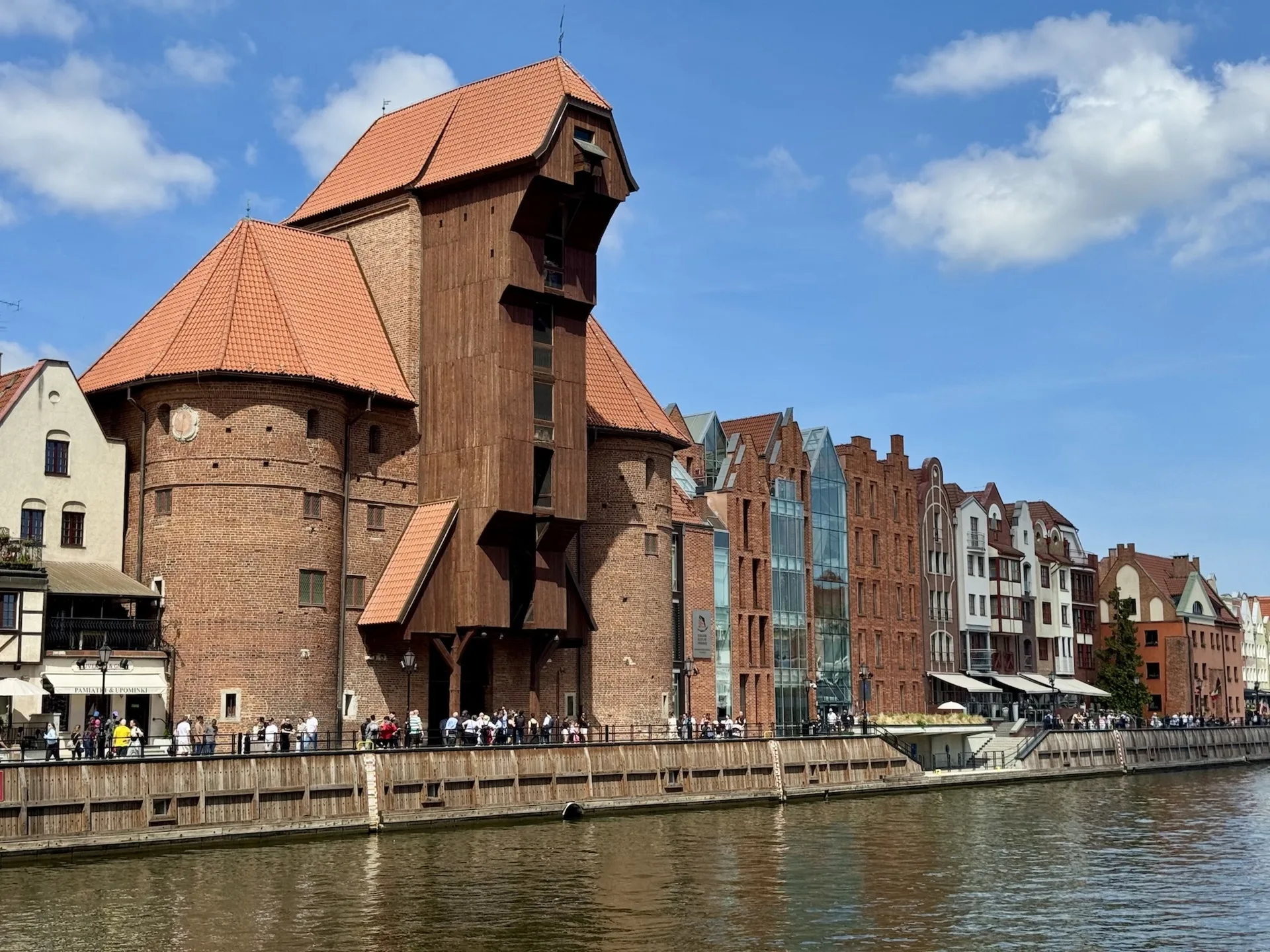
Either street drops you out at the waterfront and the Crane (Żuraw), the great medieval port crane that’s become the city’s emblem. We’ll come back to the river properly on Day 3.
Day 2 – Walking through history
Day 2 is the heavy one, but you can do it as a traveler rather than a historian: two of the 20th century’s hinge moments, two genuinely excellent museums, and a long lunch in between. Here’s the order we’d recommend.
Westerplatte: where the war began
Start at Westerplatte, the spit of land at the harbor mouth where the Second World War began. On 1 September 1939, the German battleship Schleswig-Holstein opened fire on the small Polish garrison stationed here – the first shots of the war in Europe.
It’s a big, open, green peninsula, and even in season it doesn’t feel crowded, so you can walk the ruins of the barracks and guardhouses at your own pace. That space is what makes it land. Standing among the shattered concrete, you get a physical sense of what a couple of hundred men were looking at when the German navy opened up on them – and how obviously impossible it was. They held out for seven days.
The other thing to see here is the new cemetery. For eighty years the defenders’ burial place was simply lost; archaeologists working here in 2019 finally located a mass grave and recovered the remains of nine Polish soldiers, seven of whom have since been identified by name. They were reburied in 2022 in a new cemetery built on the spot – a low circular path with the headstones set at equal intervals, all facing inward, on the principle that rank stops mattering at that point. White roses are planted where the remains were found. It’s a very restrained piece of design, and it works.
The Museum of the Second World War
Back toward the shipyard, the Museum of the Second World War is worth the time – we went in, and it’s outstanding: visually ambitious and genuinely informative rather than just solemn. The main exhibition sits well below ground and walks you through the whole grim arc of the period.
What stuck with me was the breadth of the propaganda material: not just the usual Nazi and Polish posters, but Japanese fascist ones, Italian ones, and material demeaning Black people – the wider ugliness of the period, not only the version of it you’ve already seen a hundred times. Beyond that, whole Polish streets have been reconstructed inside, and the lighting is used deliberately enough that you know what kind of room you’ve walked into before you read a word: you can tell instantly which one is the atomic-bomb room. The building itself is worth a look too, a dramatic leaning tower clad in reddish panels. It opened in 2017 and was politically contentious from the start, because it tells the war as a global, civilian story rather than a narrowly national one.
Admission to the permanent exhibition is free on Tuesdays – which is exactly why the queue on a Tuesday can run to a couple of hours. If your time matters more than the ticket price, come on another day; if it doesn’t, get there for opening.
Lunch at Montownia
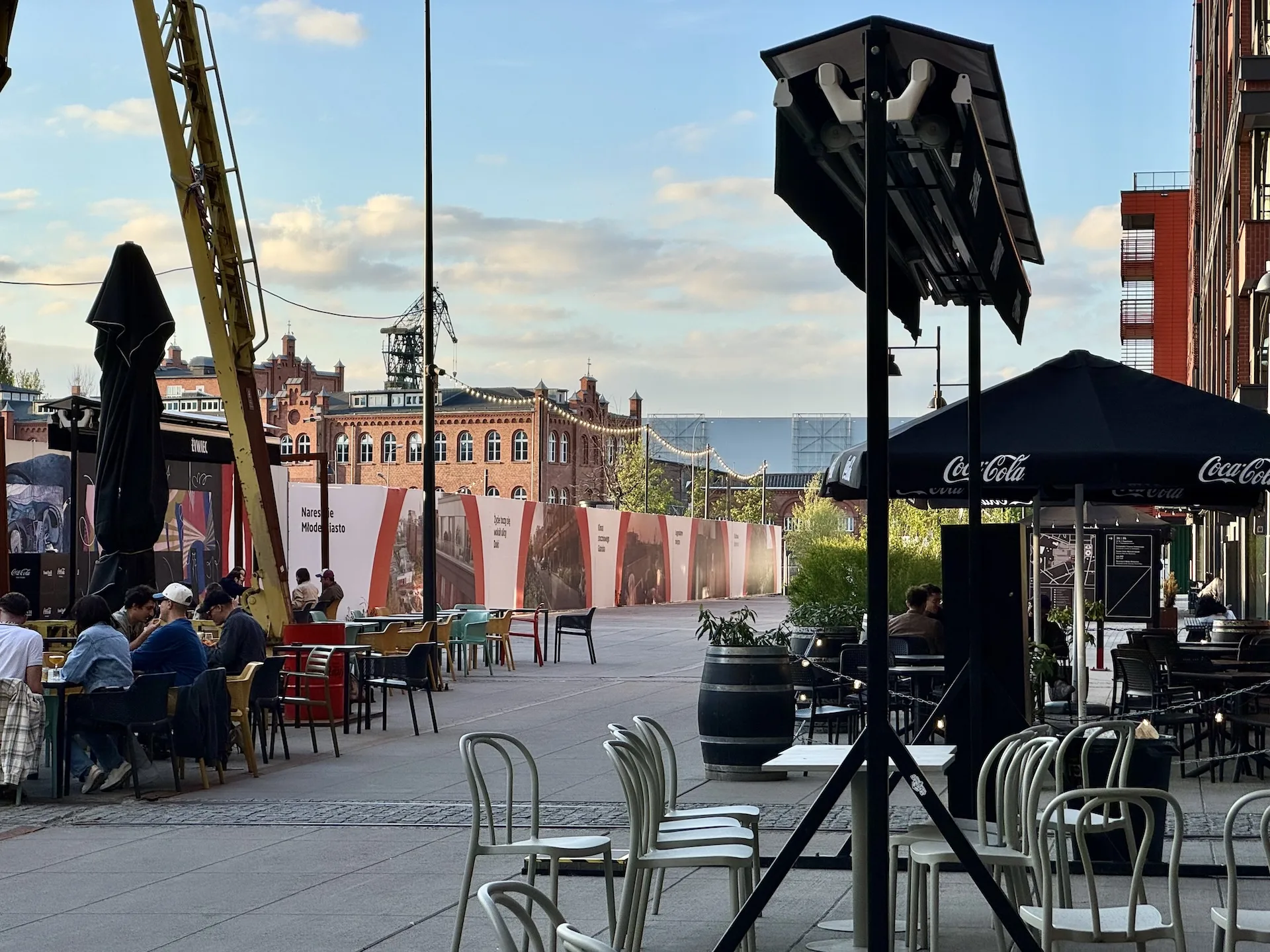
By now you’re hungry, and the Montownia Food Hall is right here. The building has a past: it was a German U-boat assembly hall during the war, where submarine sections were built and tested, and the redevelopment kept the industrial bones on purpose – cobblestone floors, concrete columns, a steel roof. Inside is the largest food hall in the city, a sprawl of stalls running from Korean fried chicken and Thai to Spanish tapas, Mexican, ramen, and Polish dumplings, so you can eat local or not, and there’s good beer to go with it. Presiding over the room is the Bloop – a giant octopus art installation by artists from the Gdańsk Academy of Fine Arts, named after a mysterious deep-sea sound recorded in the Pacific in 1997 whose source was never identified, though the measurements suggested something at least 75 meters (246 ft) long.
We came here for one of two reasons: a drink, or international comfort food after a long day. Polish food we mostly ate elsewhere, with one exception – the kumpir, the loaded baked potato, which I had here. There’s an outdoor section too, so on a good day you can sit out in the spring sun rather than under the octopus.
The shipyard and the birth of Solidarity
The afternoon belongs to the other turning point. In August 1980, a strike at the Lenin Shipyard, led by an electrician named Lech Wałęsa, produced the August Agreements and the first independent trade union in the Soviet bloc – the crack that eventually brought down communism across Eastern Europe. The agreements were signed nearby in the Sala BHP, the shipyard’s old health-and-safety hall.
We gave the European Solidarity Centre about two hours, which was enough, and it’s a very good museum – hands-on in a way that catches you off guard. I sat in a crane cab. I stood behind a camera as a broadcaster in the reconstruction of the round-table negotiations. The number that stayed with me is the membership: Solidarity counted its members in the millions, a genuinely society-wide movement rather than a narrow one. The building makes a similar point in steel – its rusted cladding is meant to read as a ship’s hull under construction.
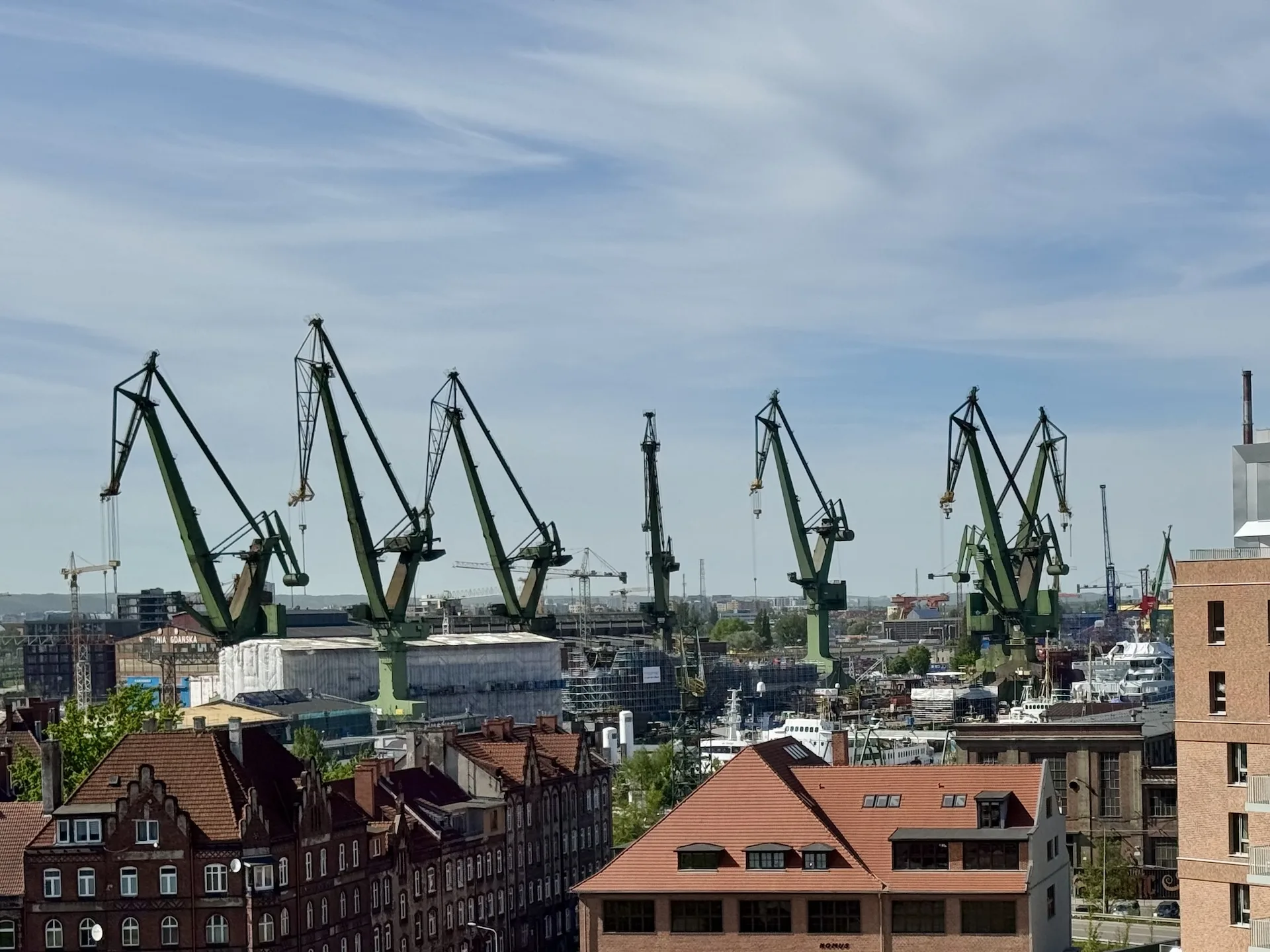
Afterward, go up to the rooftop terrace, which is where we got our best view of the shipyard: the cranes, the brick warehouses, the half-abandoned, half-rebuilt sprawl of Stocznia Gdańska laid out below. The old halls and gantries are largely intact, which gives the whole area its slightly unreal quality – history left standing in the open.
You can also go down into it, and if you have the legs for it you should. The Imperial Shipyard (Stocznia Cesarska) was closed to the public for decades and is now open, with a signposted, numbered self-guided trail through the site; some of the buildings can be entered, at least in part, and the riverside M3 crane is open for the view in summer. There’s an art space, WL4, in one of the old halls. We were too tired by this point and settled for looking at it from above – learn from our failure.
Day 3 – The river and the islands
Two days of brick and history earn you a slower third. I’d arrived assuming the sea would be the headline act, but the sea is some way off, and it’s the Motława – the river running through the middle of the city – that turns out to be the real draw.
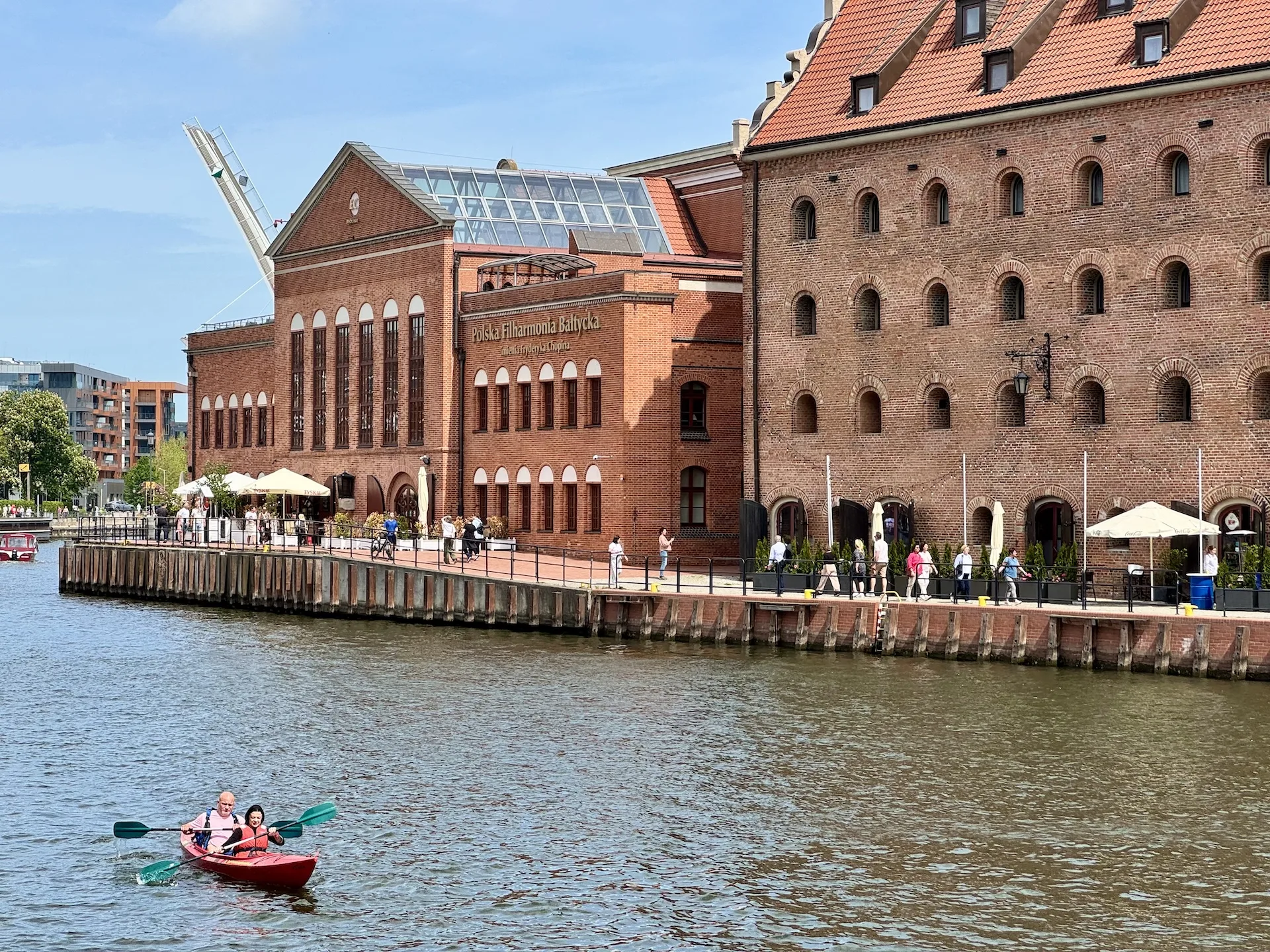
The waterfront along the Długie Pobrzeże embankment, anchored by the Crane, stays busy from morning on. Tourist galleons and replica “pirate” ships share the water with tiny ten-person party boats you can rent by the hour, plus kayaks and pedal boats. The banks are one long row of terraces – people with a coffee and a cigarette, one good spot to eat or drink after another – and the best thing to do here is genuinely very little: pick a bench or a café and watch the river work.
We did cross the footbridge from the Mariacka side to Granary Island (Wyspa Spichrzów), and it’s well worth it. This was once wall-to-wall granaries, flattened in 1945, and it’s now been rebuilt into a strip of modern hotels, apartments, and restaurants, with the surviving 16th-century Blue Lamb granary left standing as a reminder of what was here before.
The other island, Ołowianka, sits directly opposite the Crane, and we only looked at it from the banks rather than crossing over. If you’ve got the appetite, it holds the National Maritime Museum in reconstructed granaries, with the SS Sołdek moored in front – the first ocean-going ship built at the Gdańsk Shipyard after the war, which ties the lazy river day neatly back to Day 2. The Polish Baltic Frédéric Chopin Philharmonic is on the same island, and the AmberSky Ferris wheel rises over it, 50 meters (164 ft) of enclosed gondolas, if you want the whole city in one slow turn.
If you have a fourth day
The obvious add-on, and the one friends kept recommending, is Sopot – the seaside resort town just up the coast, easily reached on the SKM commuter train, best known for its long wooden pier out into the Baltic. We didn’t make it there ourselves, so treat this as a pointer rather than a review.
Final thoughts: why I’ll be going back
I came to Gdańsk with low expectations and left with a project. The Hanseatic thread runs through everything here – the brick, the gables, the granaries, the whole logic of a city built on shipping other people’s grain – and by the third day I’d decided I want to work through the rest of them. Lübeck, Hamburg, Bergen.
The other thing is more specific, and rarer. There are plenty of cities I’d go back to because I ran out of time – a museum I skipped, a district I never reached. Gdańsk isn’t that. We did the things. What I want is to go back and simply be there: sit on the Motława with a coffee while the pedal boats go past, walk Mariacka early before it fills up, have a beer in a former U-boat hall at the end of a long day. It’s a short list of cities I want to return to for no particular reason, and this one is on it.