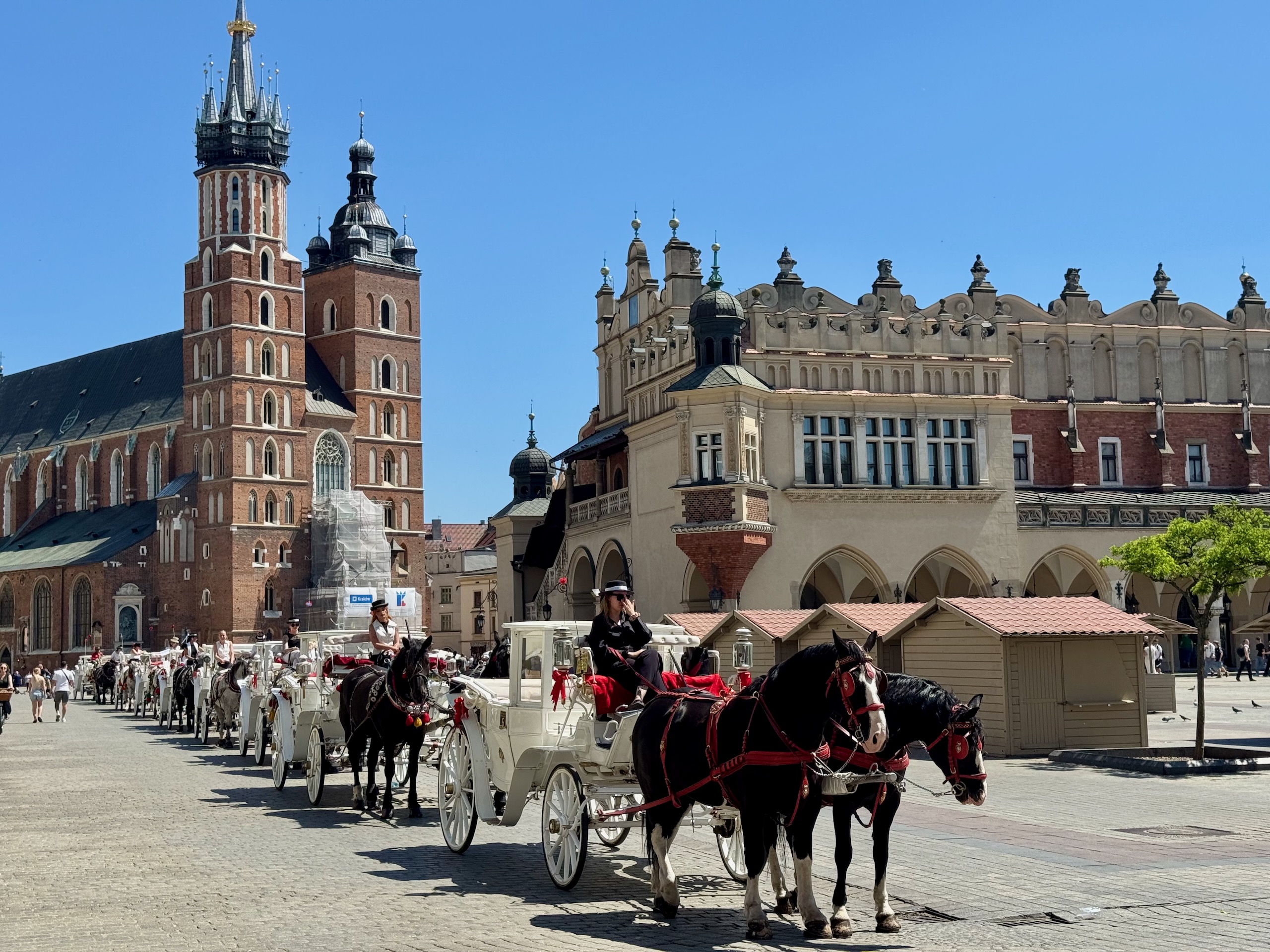
I had wanted to go to Krakow for years, the way you want to see a city everyone else has already been to and come back enthusiastic about. We got there at the end of May, over Whitsun, as the second half of a trip that started in Gdansk, and we had one full day in the city on top of the evening we arrived. My mother and I came home with the same verdict.
It is a beautiful city. I did not fall in love with it.
That is not a warning to stay away. It is the honest version, and it is the one I would have wanted to read before booking. What follows is a full day in Krakow, morning in the Old Town and afternoon in Kazimierz, in the order I would use a second time rather than the order we actually walked it. One thing to know going in: it was more expensive than I expected, consistently, in a way that adds up over a day.
Getting in from the airport
Take the train. The SKA1 runs from Kraków Lotnisko to Kraków Główny, the main station at the edge of the Old Town, in 17 minutes, and a ticket is 20 PLN (about $5.40 USD, August 2026). There are two an hour between 06:00 and 22:00, one an hour outside that.
The thing that catches people out is that the station is not inside the terminal. It sits behind the multistory car park, connected by a covered footbridge and signed as “Train” or “Kolej Małopolska”. You can buy from the machines on Level 0 of the terminal or from the machines on the platform, both of which take cards, or from the conductor once you are aboard. And if you are staying in Kazimierz rather than the Old Town, get off a stop earlier at Kraków Grzegórzki, which is closer.
That is what we did. We had two nights at BC 29 Residence, between Krakowska and Bocheńska. About 45 m² (roughly 480 sq ft), comfortable and genuinely spacious, with an inner terrace, at a reasonable price and a few minutes from everything below. I would recommend it, and Kazimierz is the right base if it is the part of the city you actually care about.
Once you are in the city
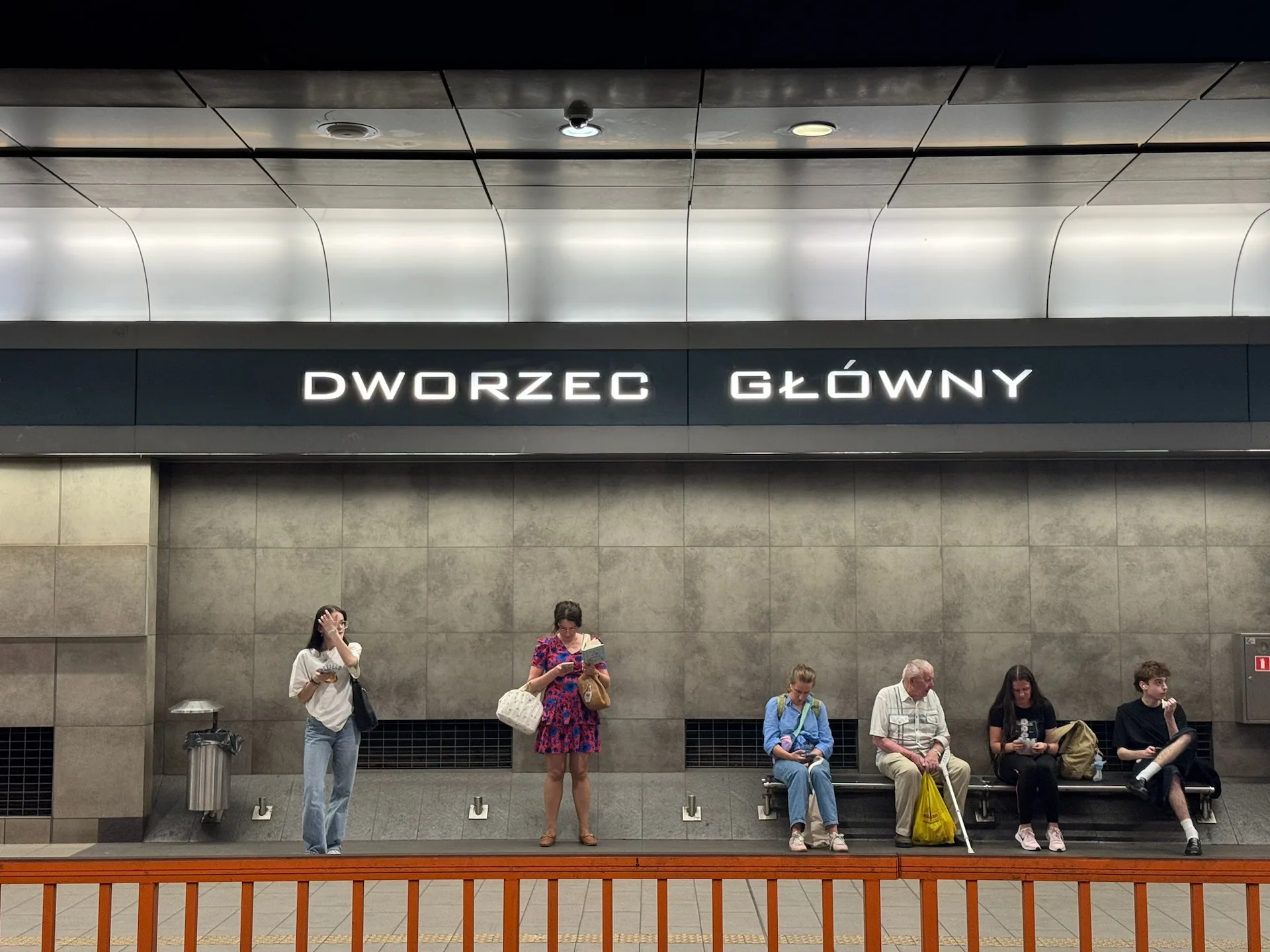
There is no metro in Krakow. It is trams and buses, run by MPK, and the trams are the fast way across the center. Buy tickets in the Jakdojade app, which works in English, plans your route and then sells you the exact ticket for it, and is more reliable for Polish public transport than Google Maps. It also works in Gdansk, which is worth knowing if you are doing both cities.
As of August 2026 a 20-minute ticket is 4.60 PLN (~$1.25 USD), a 50-minute ticket 6.00 PLN (~$1.60 USD), and 24 hours 17 PLN (~$4.55 USD). A single covers unlimited changes inside its window, and in Krakow the ticket activates the moment you buy it, so there is no separate validation step to forget. Traveling without one costs 266 PLN (~$71 USD), and traveling with an unvalidated one costs 133 PLN (~$36 USD).
If you are only in Krakow for a day, you may not need a transport ticket at all. The Old Town is compact, Kazimierz is a 20-minute walk from the main square, and the walk between them is one of the better parts of the day. Buy the 20-minute single if your feet give out, not a day pass out of habit.
Morning: what to see in the Old Town
Start at the Barbican and St Florian’s Gate
Krakow used to be walled, and in the early 19th century most of those walls came down. What replaced them is the Planty, a ring of park that follows the exact line of the old fortifications the whole way around the Old Town, which means the green belt you keep crossing is not landscaping. It is the outline of the medieval city, kept as negative space.
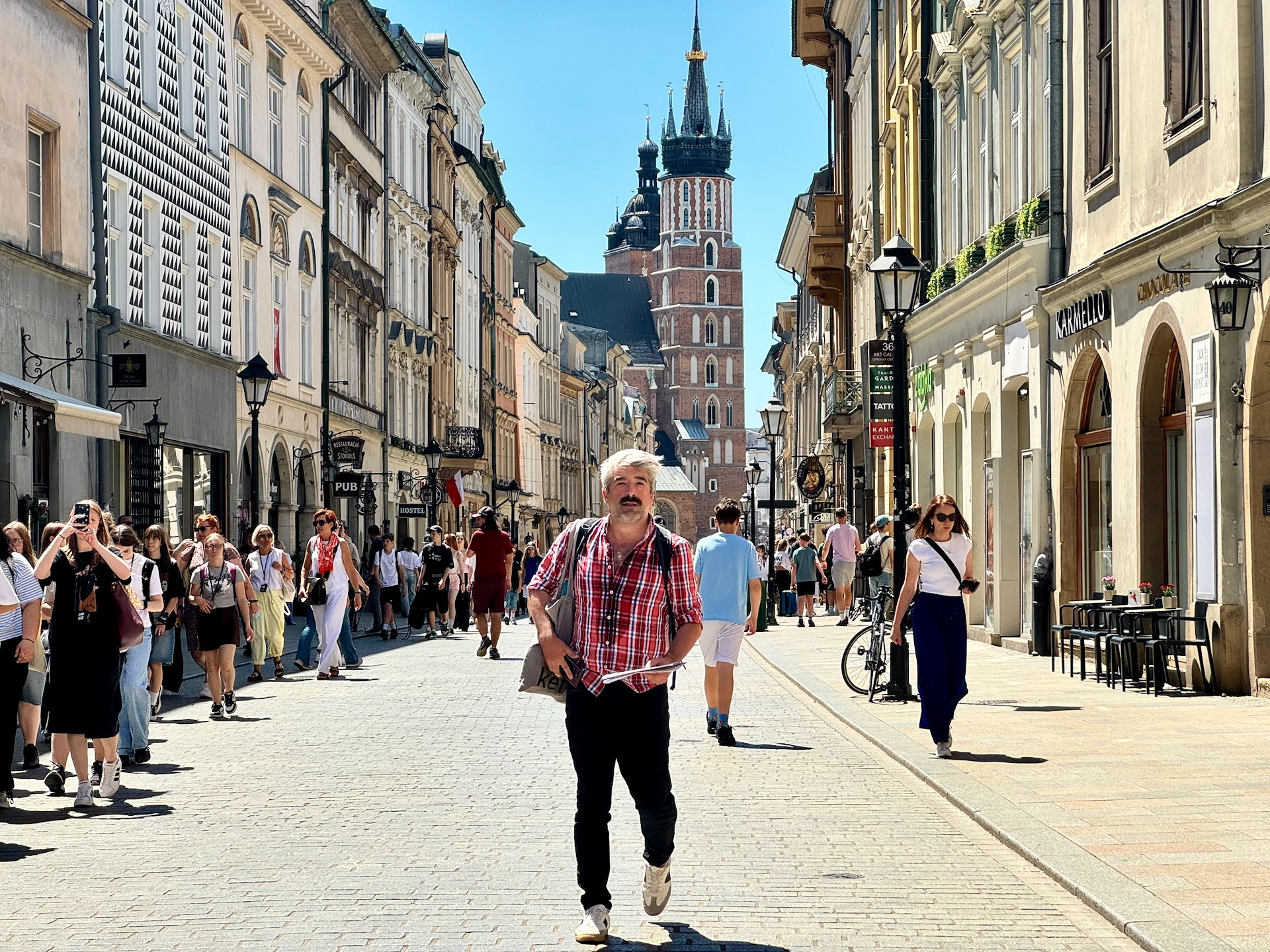
What survived the demolition sits at the north end: the Barbican, a round brick artillery fort, and St Florian’s Gate behind it. Start there, because the gate opens onto the Royal Route running south through the middle of the Old Town and the geography then does the work for you. Walk in and keep going, and take the side streets on either side while you are at it, because they are the best-looking part of the Old Town.
We did it the other way round, starting at Wawel and working north, which meant hitting the Old Town at its fullest and reaching Kazimierz late in the day. Going south from the Barbican is better, and it is what I would do a second time.
The main square, which did not do it for me
Rynek Główny is one of the largest medieval town squares in Europe and I found it unexciting. That is a low-information verdict, so let me be fair about why. It is enormous, it is surrounded by handsome buildings, and it is completely full. Not with locals, but with tour groups, and above all with school groups, from small children up through teenagers. They cross the square in clusters taking the tour the way any group does, or they sit down in circles on the ground in the middle of it while someone talks at them. We saw the same thing later inside Wawel, a whole room of them sitting through a lecture or simply resting. School trips appear to be timed around Whitsun, so if you go when we went, this is what you get.
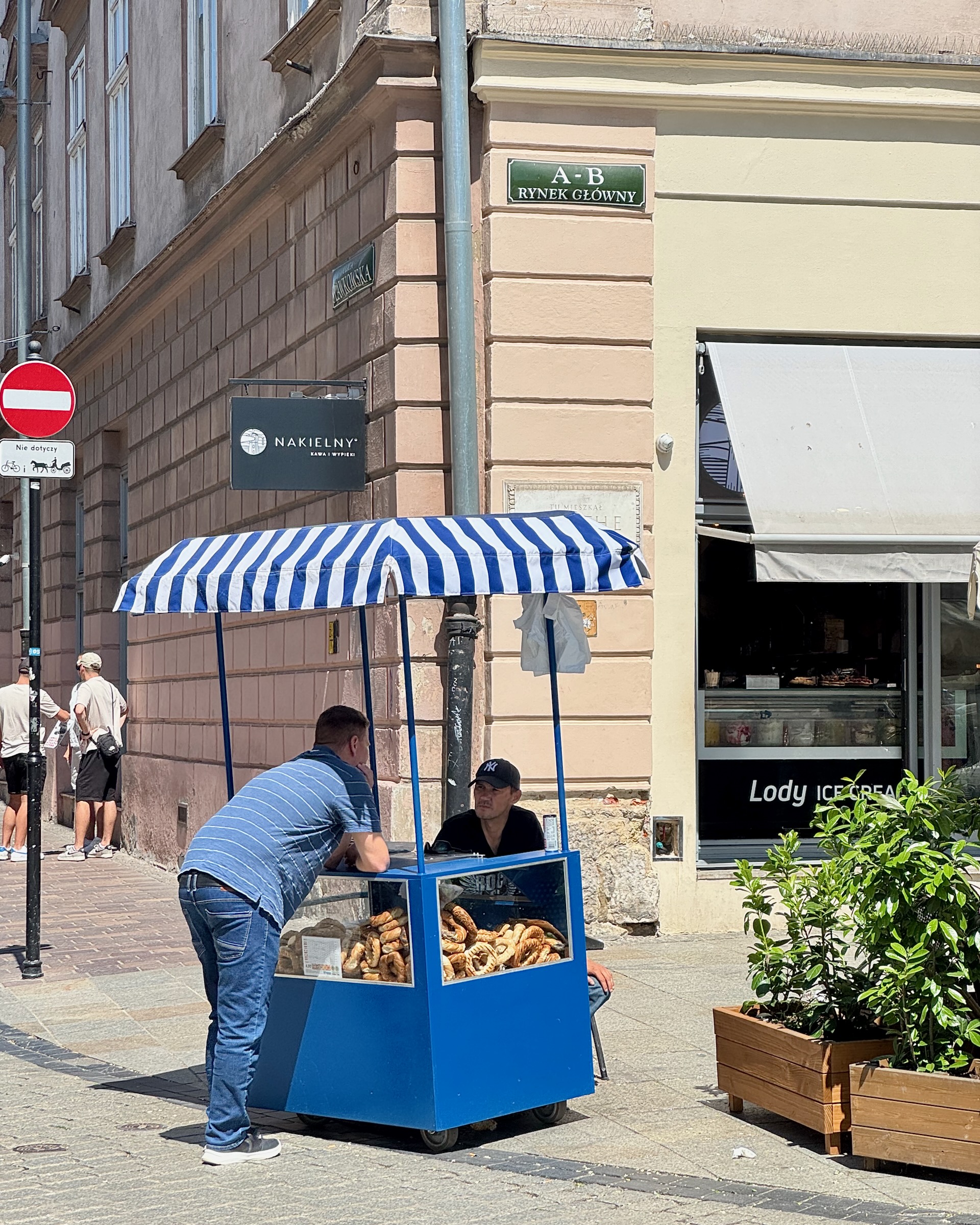
The Cloth Hall in the middle is a covered market selling amber and souvenirs, a genuinely old building doing a genuinely old job, and I still would not spend long in it. Around the edges you will see small blue carts selling obwarzanki, the ring-shaped braided bread crusted with poppy seed or salt, closer to a bagel than to a pretzel and costing a few zloty. It is the thing to eat here, though I never got round to one.
The horse-drawn carriages lined up along one side, done up in white with a lot of brass, must lend a city a certain charm. I would rather watch a horse gallop about loose somewhere than carry people up and down a street.
St Mary’s Basilica, and the one thing that should shape your morning
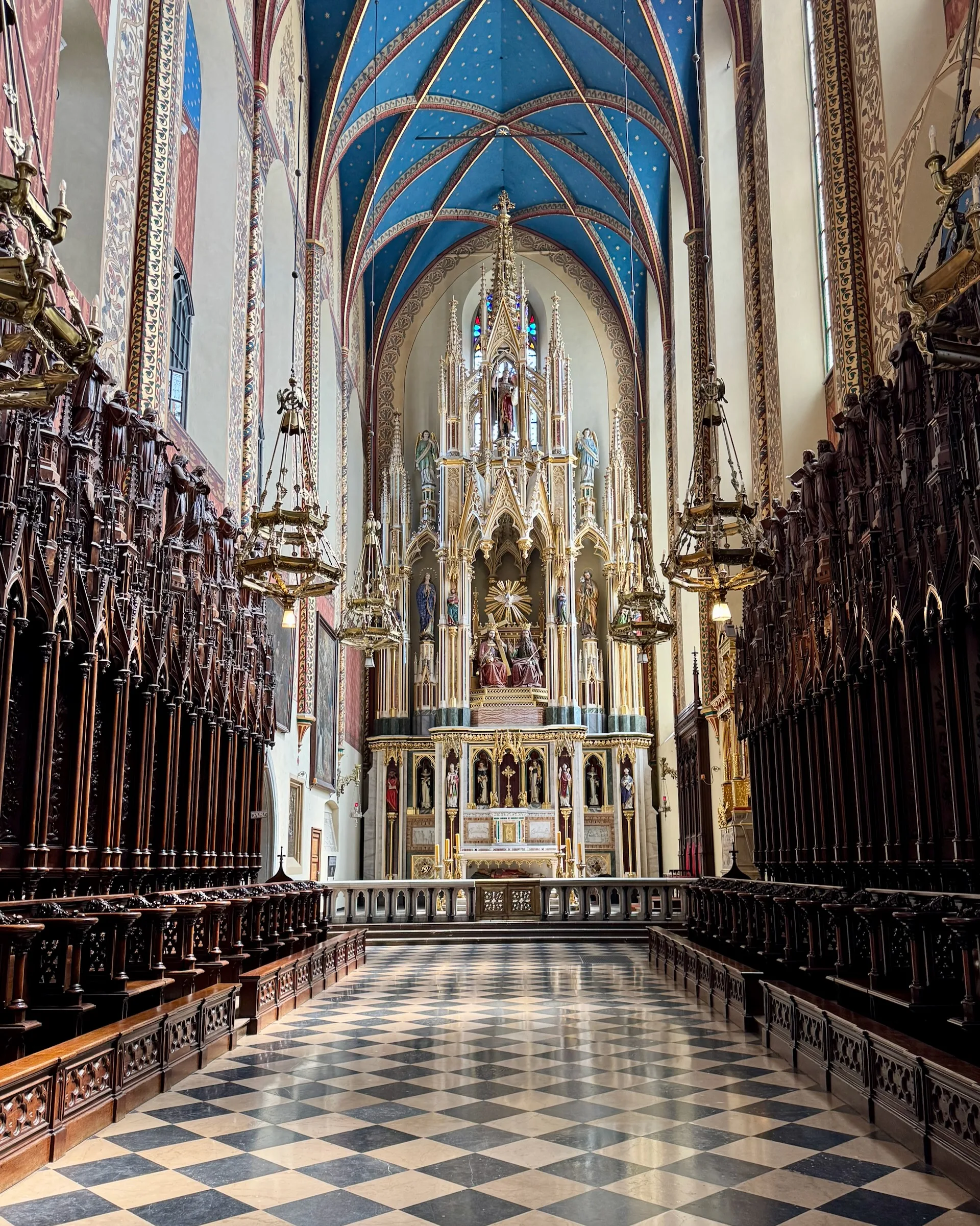
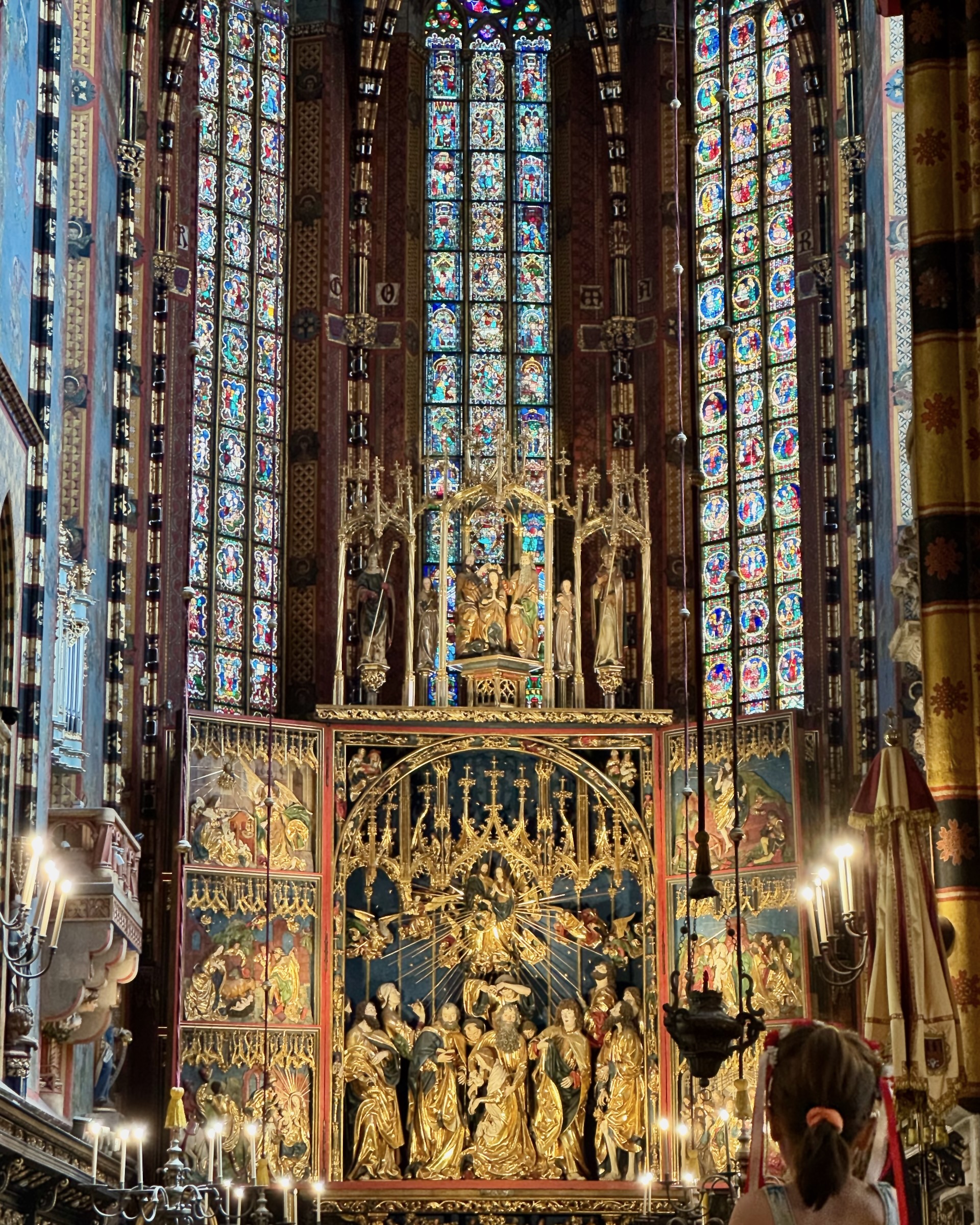
The church with the two mismatched towers on the corner of the square is the best thing in the Old Town. Inside is the Veit Stoss altarpiece, carved between 1477 and 1489, the largest Gothic altarpiece in the world at over 12 meters (about 40 ft) high, and its wings are closed most of the time and opened ceremonially, by hand, every day.
On weekdays the altar is opened at 11:50 and stays open until 18:00. On Sundays and holidays it runs from 14:10 to 18:00, and on some religious holidays there is no ceremony at all and it stays open through the liturgy. This is the one fixed point in an otherwise flexible day, so build the morning backwards from it and be inside by 11:30, because the crowd forms early and the basilica is not large. We were there for the opening by pure accident, which is not a method I can recommend, but it did leave me certain it is worth planning around.
While you are in there, listen for the hejnał, the trumpet call played from the taller tower every hour in four directions. It stops mid-phrase. The story is that it commemorates a trumpeter shot through the throat mid-warning during a Mongol raid, almost certainly a much later invention, but the trumpeter cuts off every hour regardless.
St Mary’s has separate tickets for the main body of the church and for the tower climb, and the tower is limited to small groups at set times. If you want both, book the tower first and fit the altar opening around it, not the other way round.
Wawel
South along Grodzka you pass two more churches worth a look from the street. Saints Peter and Paul is the Baroque one with the twelve apostles lined up along the railing outside, and St Andrew’s next door is Romanesque, fortified and nearly a thousand years old. They really like their churches here. There are more than 120 in the city, and by the end of a day of walking you will believe it.
Then the hill, and Wawel.
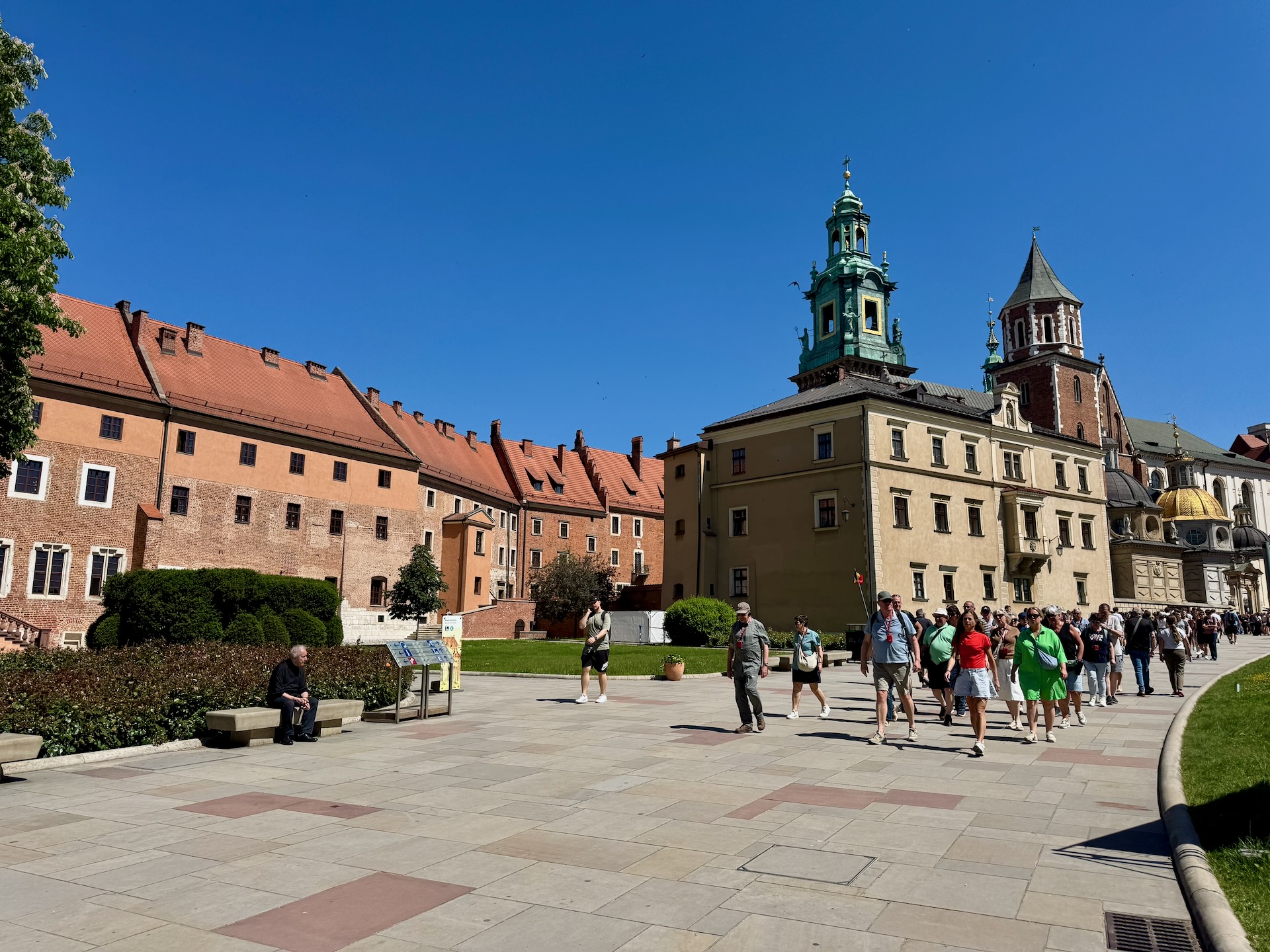
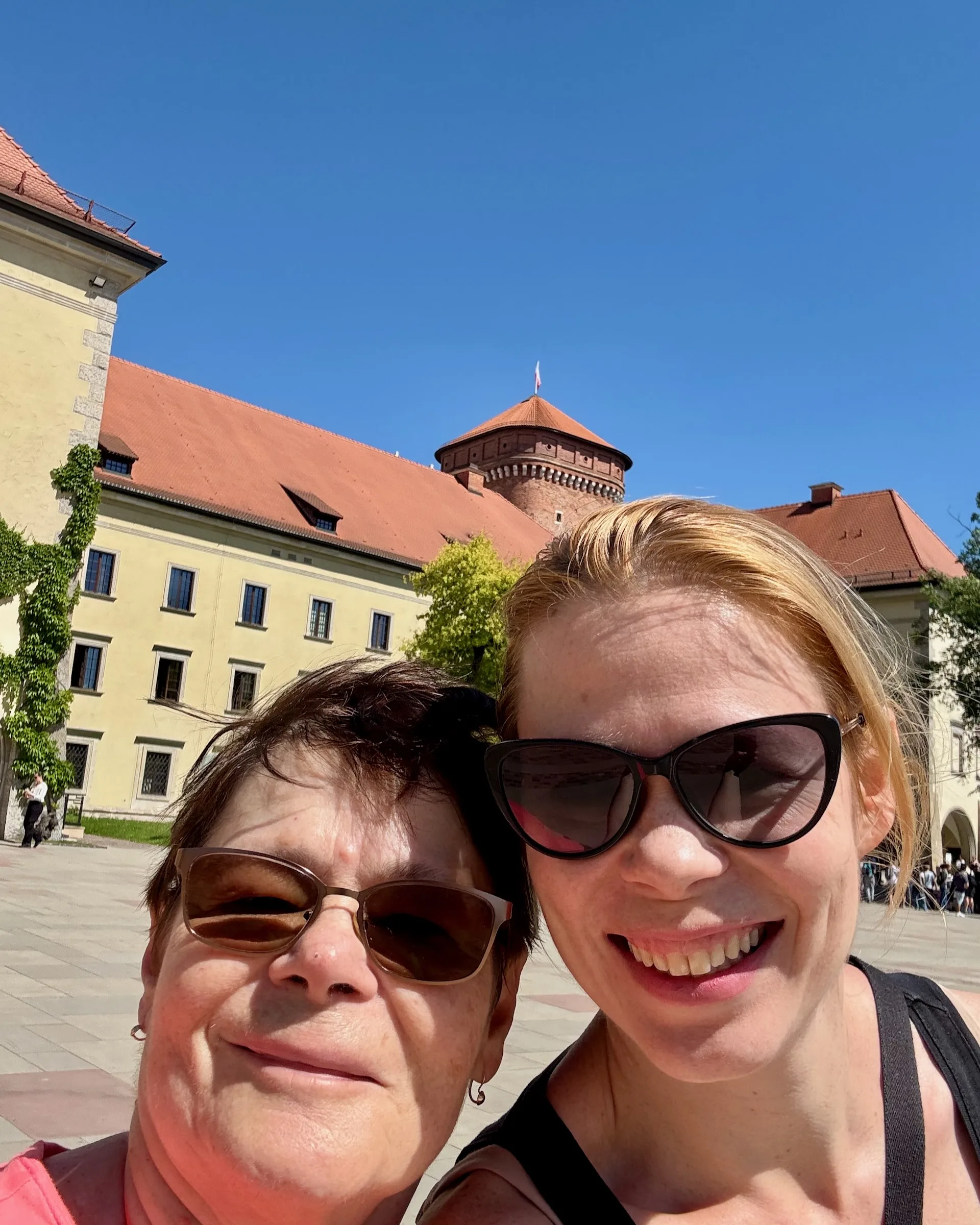
Wawel has been the center of Polish power for about as long as there has been a Poland. The Piast kings made Kraków their capital and the hill their seat, replacing the first wooden buildings with stone in the 11th century and rebuilding the whole thing in Gothic in the 14th under Władysław Łokietek and Casimir III the Great. What you see now is largely the Renaissance version: Sigismund I the Old brought in Italian architects in the early 16th century, and they gave it the arcaded courtyard and the gold-domed Sigismund Chapel. Then the court moved to Warsaw at the end of that century, the Austrians later turned the place into barracks, and it took a long restoration across the late 19th and 20th centuries to get it back. A thousand years of Polish statehood, in other words, and it looks it.
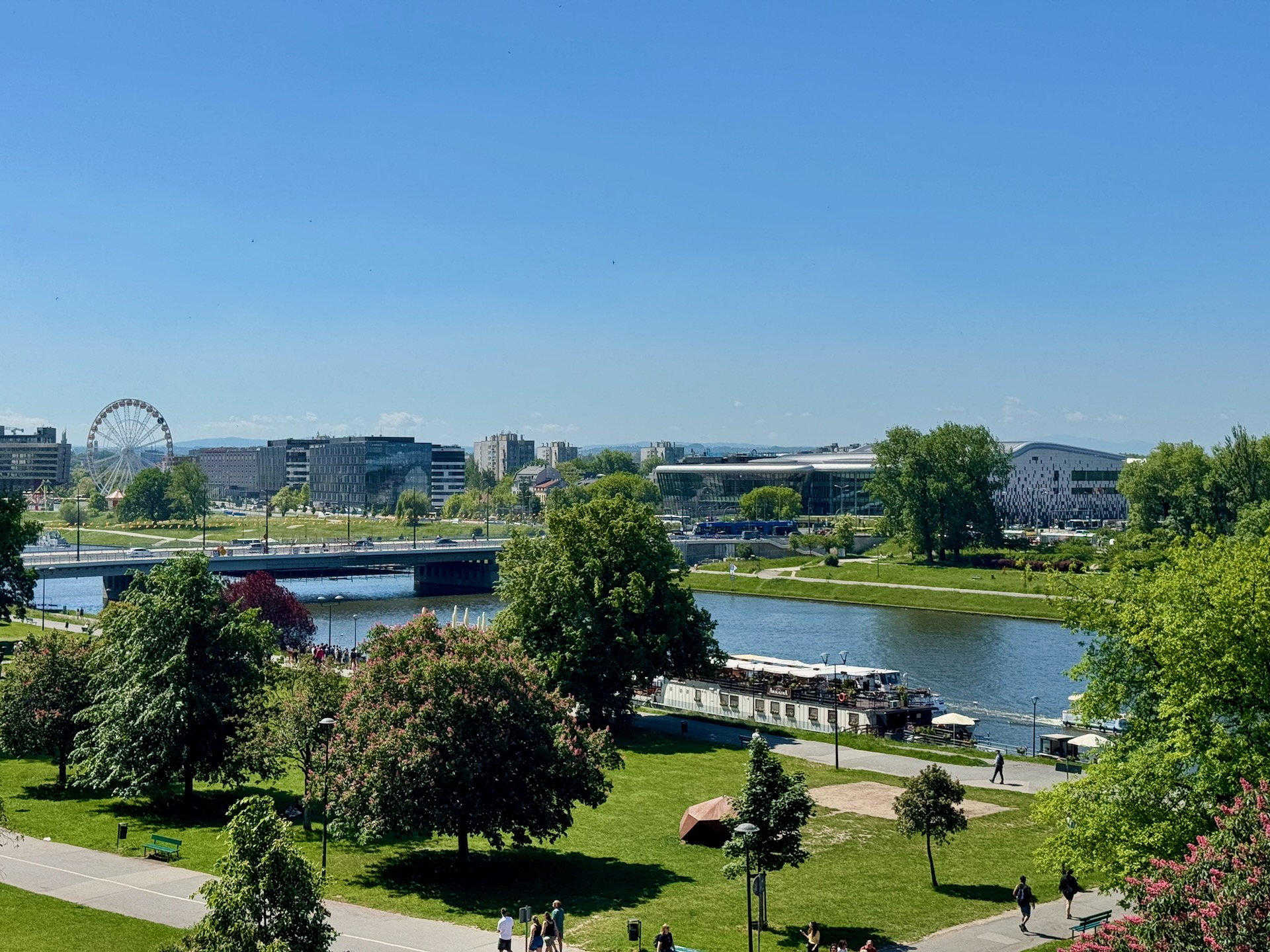
The grounds are the good part. Open space, walls, views down over the Vistula, and no ticket needed to walk around them.
The interiors are where it stops being fun, because Wawel is not one museum but a long menu of separately ticketed exhibitions, each with its own timed entry and its own daily limit. We bought the plain Castle ticket, which covers the first and second floors, the private royal apartments and the state rooms with the tapestries. At 95 PLN (about $25.50 USD) full price and 71 PLN reduced, it was the single biggest admission of the trip.
Everything else is extra. The Crown Treasury is 47 PLN, the Armoury another 47, the Castle Underground another 47 again. The Dragon’s Den is 15 PLN, the viewing platform 19, the Royal Gardens 11, an audioguide 14. If you want most of it in one purchase, the “Wawel for Enthusiasts” ticket runs 199 PLN (about $54 USD). The cathedral is sold separately from all of it, at its own ticket office opposite the entrance.
One quirk worth knowing, because it is the sort of thing you work out too late: the two castle floors are also sold individually at 57 PLN each, so buying them one at a time costs 114 PLN against 95 PLN for the combined ticket. You end up doing arithmetic in a queue instead of looking at a castle. Book online in advance if you want a particular slot, because the castle interiors do sell out. And I will say plainly that I did not think they justified the effort or the money.
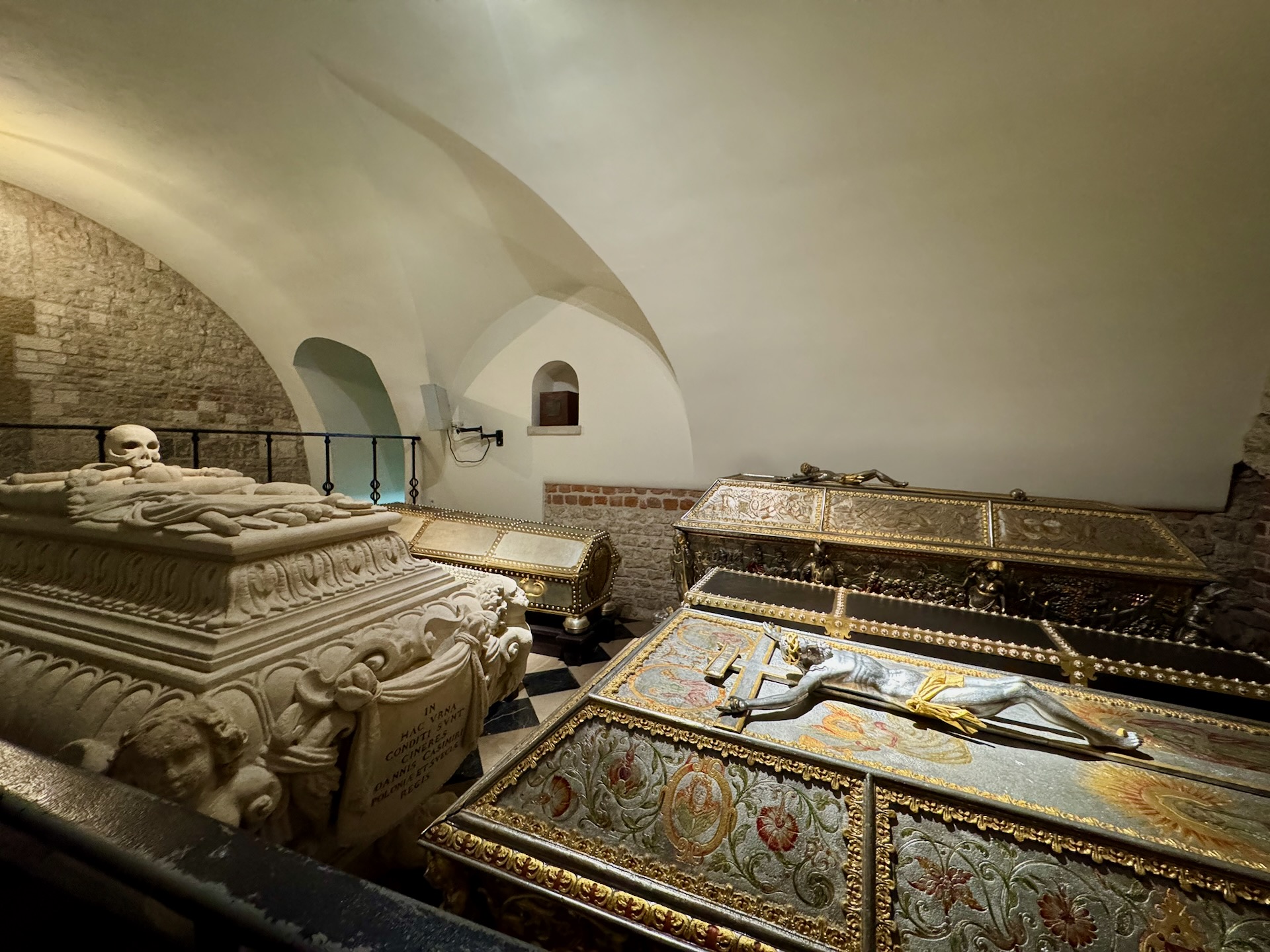
The cathedral is worth knowing about even if you skip everything else. Polish kings were crowned and buried here for centuries, and one of them was Hungarian. Stephen Báthory, Prince of Transylvania, was elected king of Poland in 1576 and laid in the crypt here in 1588. He is in mixed company down there. Piłsudski is a few chambers away, and so are Lech and Maria Kaczyński, interred in 2010 after the Smolensk air crash, a burial contested at the time, publicly and loudly, on the grounds that a modern president did not belong among the kings. We went down. It is a strange arrangement to stand in, a thousand years of monarchy and a plane crash from within living memory filed a few meters apart.
The walk to Kazimierz
From Wawel it is about 1.5 km (roughly a mile) south to Kazimierz, 15 to 20 minutes on foot or under 10 on tram 6, 8, 10 or 13. Walk it. The route down Krakowska is unremarkable in a way that turns out to be useful, because it is the first stretch of the day without a tour group in it.
Afternoon: Kazimierz
What it actually is
Kazimierz was founded in 1335 by Casimir III the Great as a separate town rather than a district, and it stayed legally independent of Krakow for centuries. The name is his. From 1495, after Jews were expelled from Krakow proper, the Jewish community settled its northern part, and over the next four hundred years that quarter became one of the most significant centers of Jewish life in Europe: synagogues, schools, printing houses, businesses, a whole functioning world packed into a few streets. The Nazis destroyed it. The community was moved across the river to the Podgórze ghetto in 1941, and from there to the camps.
What is left is the buildings, a handful of working synagogues, a great many museums and, since the 1990s, the bars.
The Budapest problem
Kazimierz looks like Erzsébetváros. That is Budapest’s ruin bar quarter, and the resemblance is not a general one, it is specific: run-down buildings with genuinely good places inside them, craft everything sold at a price, hippie but not on a hippie’s budget.
I spent my entire youth in Erzsébetváros, from the first nights out I was not really old enough for through to the years when the foreigners took it over and the rest of us moved a few streets out to drink. So walking into Kazimierz was not a discovery. It was recognition.
None of which is a fault in Krakow, only a limitation of where I happen to be from. Somebody arriving from a city without a ruin bar quarter will have a completely different afternoon. But I had been told Krakow would surprise me, and this part of it could not.
Plac Nowy and the round building
Plac Nowy, in the middle of Kazimierz, has a round brick building at its center called the Okrąglak, and in the afternoon the square around it is not much: scruffy, a thin flea market, a few people eating. It is worth knowing what you are looking at anyway. The Okrąglak went up in 1900 as a trading pavilion, became a Jewish ritual poultry slaughterhouse in 1927, was closed by the Germans at the start of the war and served afterwards as a market hall. The interior trading floor is shut now, and what operates today are the hatches around the outside, which sell zapiekanki to a crowd that mostly arrives late and mostly after drinking.
Which explains why the square feels flat at three in the afternoon. You are looking at a night venue in daylight. So look around, note where it is, and come back after dark, when Plac Nowy fills up, the queues form at the hatches and the bars along Szeroka and Józefa do what they are known for. We never managed it. We were too tired and we went to bed, so I cannot tell you which of them deserves your evening, only that the evening is plainly the point.
The synagogues
The Tempel Synagogue is the one we went into, open 10:00 to 18:00 in summer and 10:00 to 16:00 in winter, closed Saturdays and Jewish holidays. It is small and it is pretty, and I will admit I came out without much to say about it.
There are others if you want them. The Old Synagogue is the oldest surviving synagogue building in Poland and now a museum, and the Remuh on Szeroka is the main working synagogue in the quarter, with its cemetery attached. We also went into the Corpus Christi Basilica on Bożego Ciała, the large Gothic church with the Baroque interior, which is impressive from the outside and did not particularly move me once I was in it.
Skałka
At the quiet end of Kazimierz, near the river on Skałeczna, is the Basilica of St Michael the Archangel and St Stanislaus, known as Skałka, the little rock. It sits back from the bar streets and it is properly quiet, which after an afternoon of them is rather the point. Below it is the Crypt of the Distinguished, where Poland buries its cultural figures rather than its royalty: the chronicler Jan Długosz, the composer Karol Szymanowski, the poet Czesław Miłosz. Worth the twenty minutes if you are already down this end, though I would not build a day around it.
Schindler’s List Passage
At Józefa 12 a covered passage runs through to Beera Meiselsa 17, a walkway through a courtyard, and it is pretty enough that people photograph it constantly. Spielberg filmed part of the ghetto liquidation here, the sequence where families are driven out of their building and their possessions come over the balconies, and the staircase where Danka Dresner is hidden is at street level in the same building, altered a little since 1993.
The thing to understand, and it is widely misunderstood, is that this is not where it happened. The real Krakow ghetto was across the river in Podgórze, and it had been destroyed, so the film used Kazimierz as a stand-in for a place a few hundred meters away. What you are standing in is a location, not a site. People come, photograph an attractive courtyard, and leave believing they have visited the ghetto.
If you want the actual place, cross the river. Ghetto Heroes Square with its empty chairs, the surviving fragment of ghetto wall and Schindler’s Factory itself are all in Podgórze. We did not get across, and of everything we missed, that is the one I regret.
One more thing will come up on your map while you are here. There is a Banksy museum on Berka Joselewicza, in a converted 1886 factory, and it caught my eye exactly the way it will catch yours, which is why I looked into it. Worth knowing before you plan around it: the roughly 150 works inside are reproductions, and Banksy has no involvement in exhibitions of this kind and has publicly disavowed them. We did not go in.
Eating
You will eat well here whatever you are after. Polish tradition, good Italian, proper Jewish cooking, most of it within a few streets of each other in Kazimierz.
For everyday prices, the Judah Food Market on Święty Wawrzyńca is an outdoor food court with a range of stalls, named after the Judah mural on the wall beside it, where plates run about 20 to 40 PLN (~$5.40 to $11 USD). We had an enormous pulled pork there with an alcohol-free beer carried over from the place next door, which is roughly what the square is for.
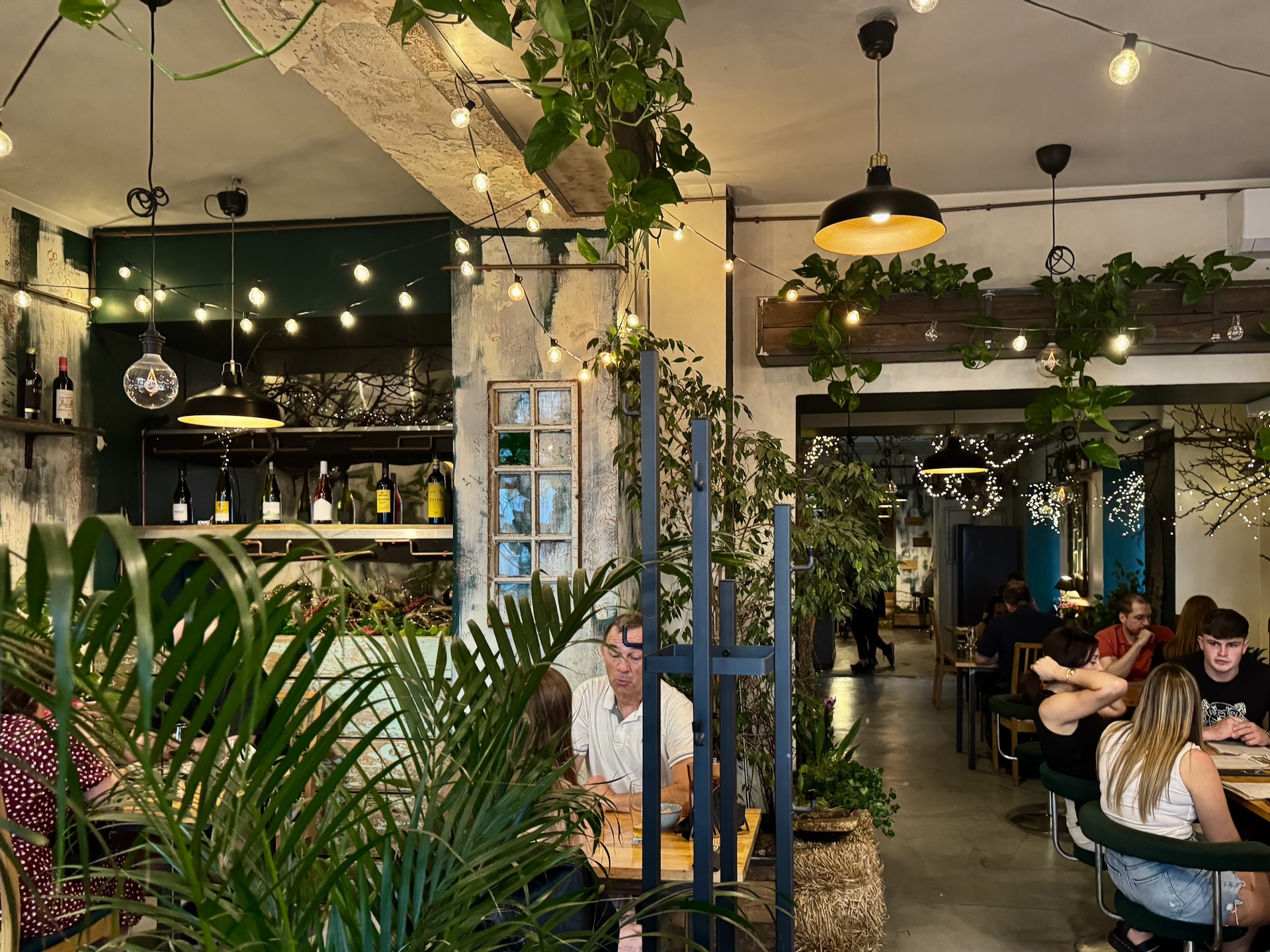
Then there was the last evening, when we marked the end of a girls’ trip and said goodbye to Poland properly. That was Pierwszy Stopień on Krakowska: Polish cooking, local ingredients, biodynamic wine, a dining room full of plants, mains from 40 to 120 PLN (~$11 to $32 USD). I had the best steak tartare of my life there. What made it was the balance, the small sharp pickles alongside it, the fresh egg, the texture holding everything together, nothing on the plate competing with anything else. It is possible I had simply never eaten a really good one before. We ate it in something close to reverence.
How many days do you need in Krakow?
One, I think, if the Old Town and Kazimierz are what you came for. A single day is exactly right at the pace described here, and you will not feel rushed doing it.
Two or three if you want more than that, and I would spend the extra time going out of the city rather than back up the hill. The three obvious trips, in order of how much of a day they cost you:
Wieliczka salt mine is the half day. It sits just outside Kraków, half an hour out on a local train or bus, and the underground tour itself runs about two and a half hours. You are back in the city for dinner.
Auschwitz-Birkenau is a full day. Oświęcim is roughly 65 km west, an hour and a half to two hours by bus from the main bus station, or 60 to 90 minutes by train with a two-kilometer gap between the station and the museum at the far end. Organized trips tend to run about seven hours door to door. Reserve your entry in advance through the museum’s own site rather than turning up and hoping.
Zakopane is the other full day, two hours south by bus or train, and the reason to go is the Tatras rather than the town.
Any of those is a better use of a second or third day than going back up the hill for Wawel’s interiors.
Krakow is a good-looking, well-preserved, historically dense city with excellent food and a lot of churches, and everything in it is competently done. I had been told for years that it was extraordinary, and I found it pleasant. It did not leave a deep mark on me, but I will go back for everything around it that we did not have time for.
If a city in a day is your format, Laszlo wrote up one day in Vilnius, which holds one of the largest surviving medieval old towns in northern Europe.