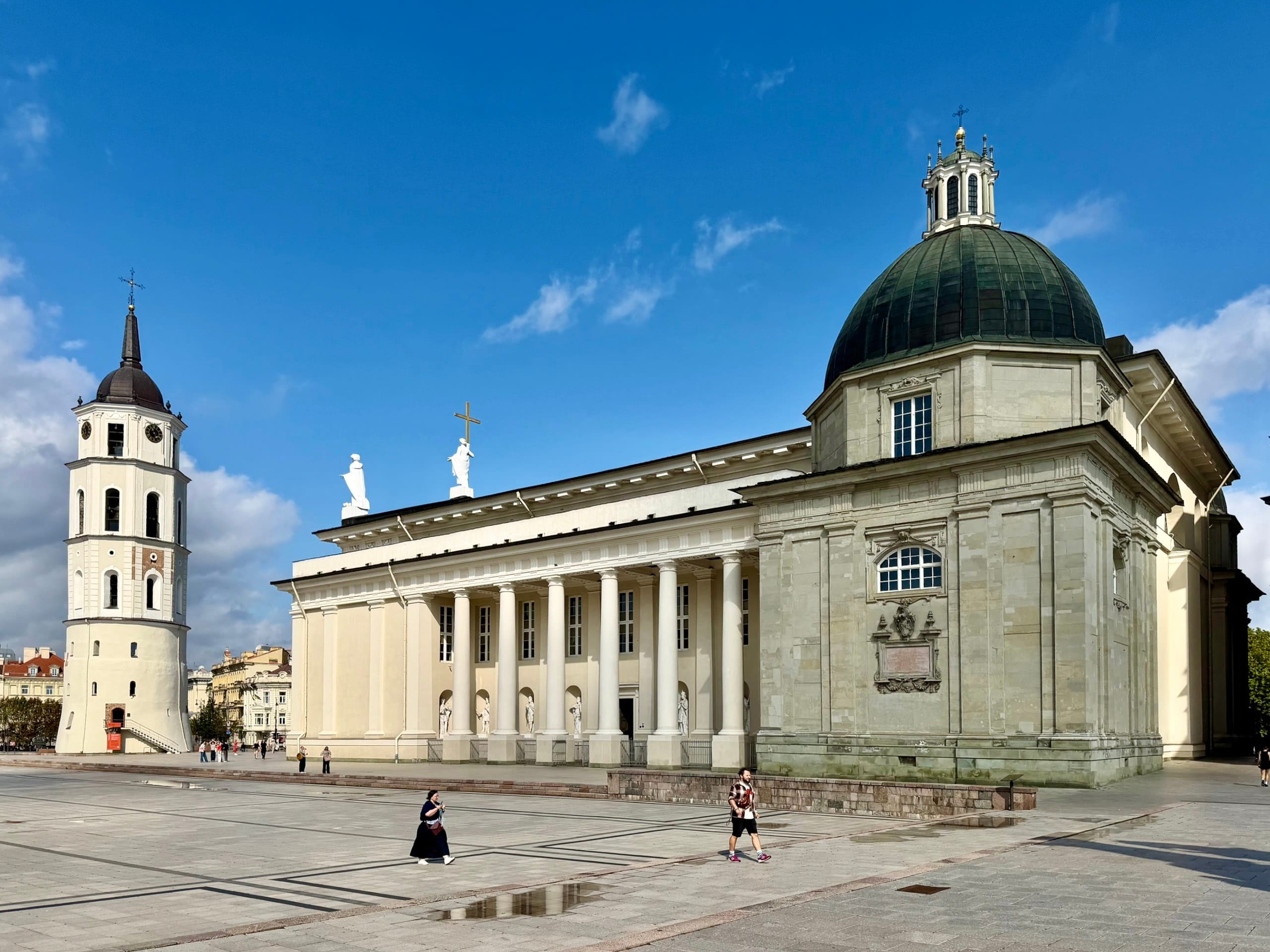
We landed in Vilnius on a Friday at 14:10 and flew home on the Sunday at 9:55, which on paper is one usable day plus two halves. What we actually got was a Friday afternoon and evening, and then a Saturday that began at 11:00 because the Lithuanian state sent an emergency alert to my phone telling us not to go outside.
So this is not a clean one-day itinerary reconstructed to look tidy. It is what fit into roughly one day with the morning taken out of it, what we would move if we had the full day back, and what everything cost.
How many days do you need in Vilnius?
One full day is enough for the Old Town, and it is a good day. Two nights is the comfortable minimum, because it gives you an evening, and the evening turned out to be the best part. Three if you want anything beyond the center.
The center is compact, everything worth seeing is walkable, and we used public transport so rarely that a 24-hour ticket would not have paid for itself. What two nights did not give us was the city outside the tourist frame: the Soviet housing estates in Žirmūnai, the wooden houses, the early morning when the Old Town is empty. Those are the reason to stay a third night, and they are the reason I would go back.
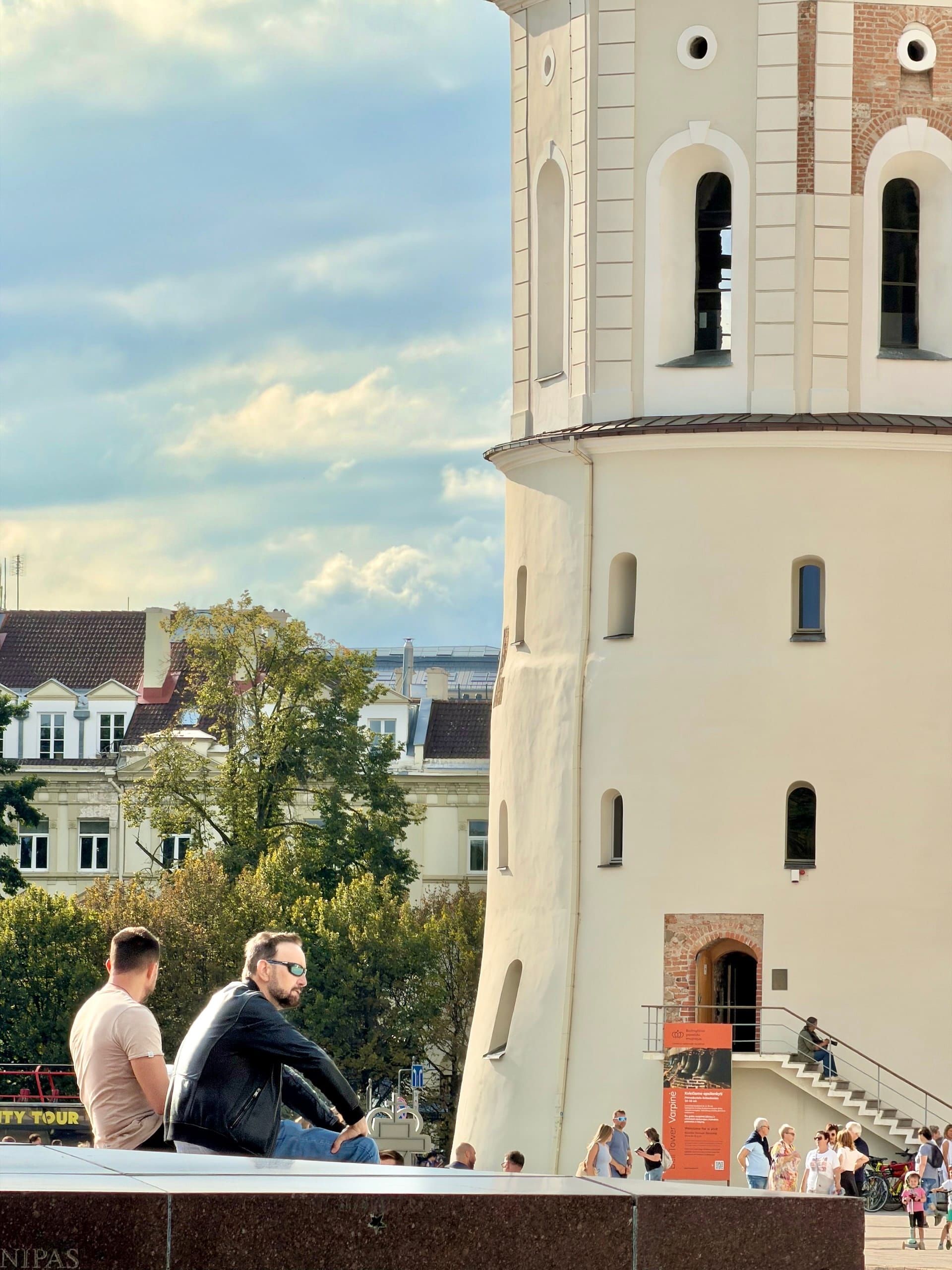
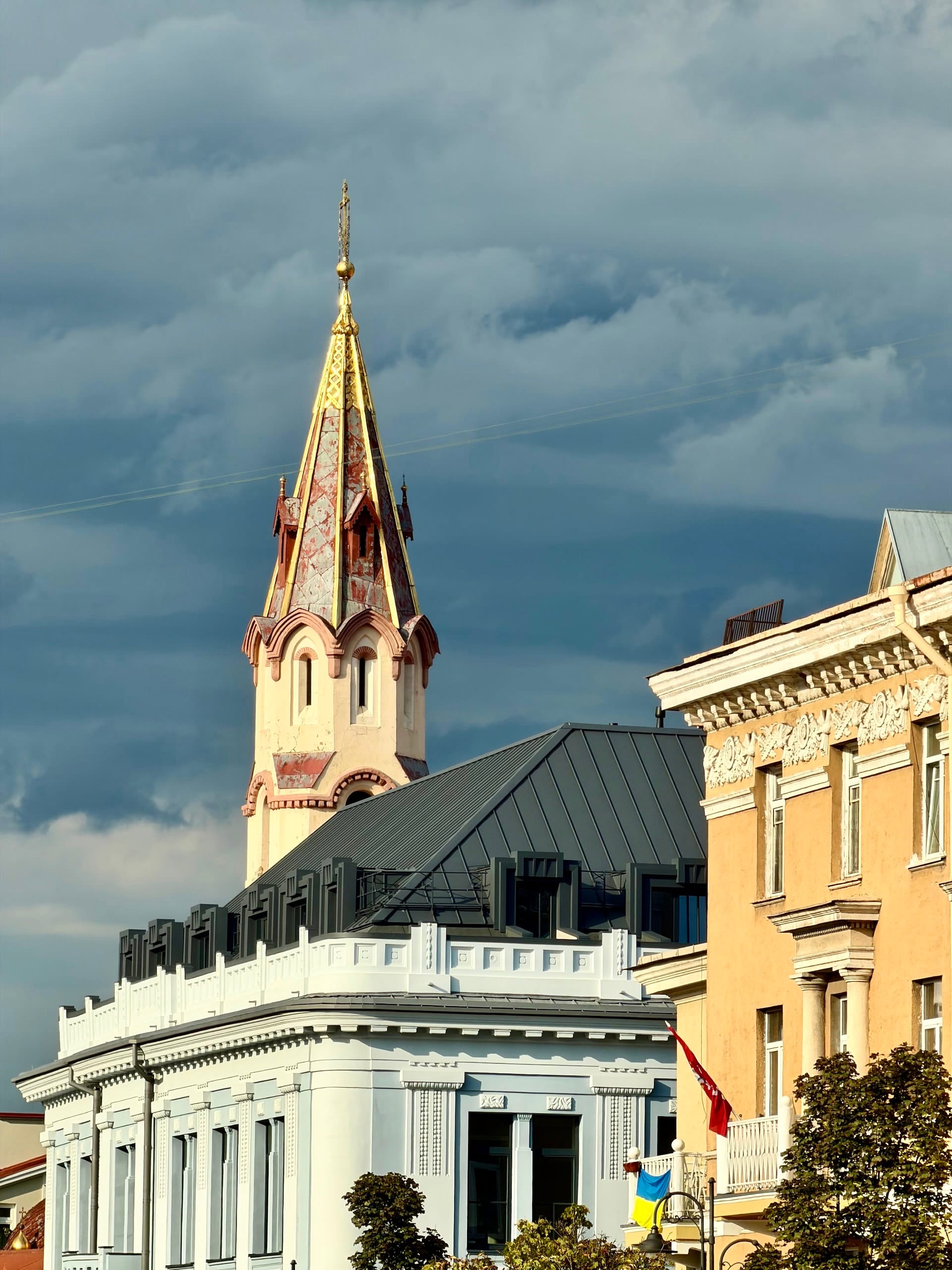
A short history of Vilnius, in the places you stand in
Vilnius first appears in writing in 1323, in the letters Grand Duke Gediminas sent across Europe inviting merchants and craftsmen to settle here. That makes the city 703 years old in 2026 by the only date anyone can prove, and plainly older than that in practice.
Lithuania stayed pagan longer than anywhere else in Europe and was Christianized at the end of the 14th century, which our guide clearly enjoyed telling a group of mostly Western Europeans. From 1569 it shared a state with Poland, and the Baroque that covers the Old Town arrived on that road, by way of Italy. This is where Vilnius differs from the other two Baltic capitals: Riga is the Art Nouveau city, Tallinn is the medieval one, and Vilnius is the Baroque one.
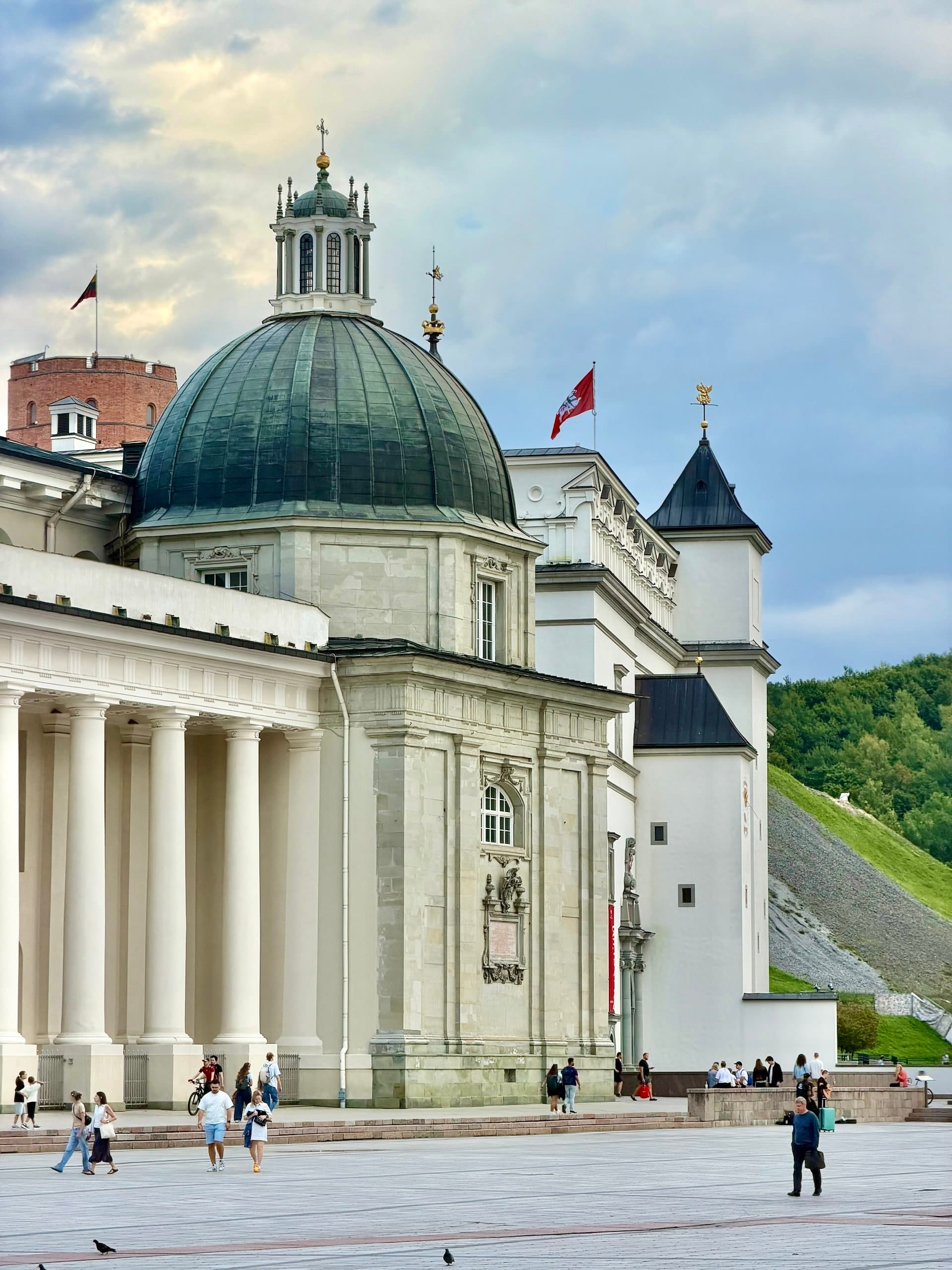
In Cathedral Square, look down. A line of red brick set into the paving marks where the walls of the old fortress ran, so you can walk the outline of the original city while standing in the middle of the modern one.
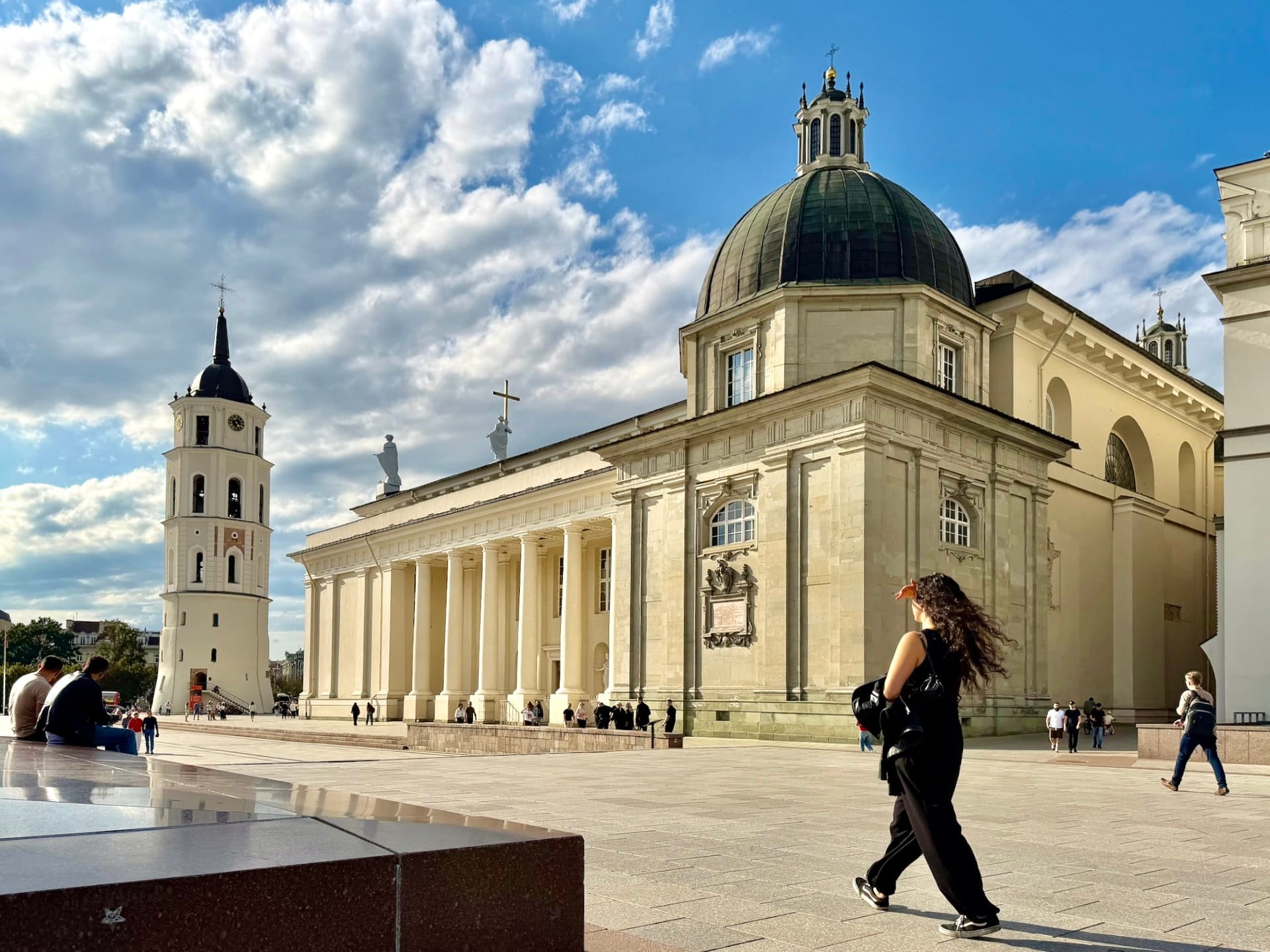
Two dates matter more than the rest. Lithuania was the first Soviet republic to declare independence, in March 1990. And on August 23, 1989, around two million people joined hands in a chain 675 km (419 mi) long running from Vilnius through Riga to Tallinn, on the 50th anniversary of the Molotov-Ribbentrop Pact that had handed all three countries to Stalin. That was the Baltic Way, and its anniversary fell on the Sunday we flew home, which is why half the city was closed to traffic at eight in the morning and our Bolt took 25 minutes to arrive.
One correction. Our guide called Vilnius the largest old town of the three Baltic capitals, and you will see that claim repeated everywhere. All three hold UNESCO listings and I could not stand it up. What is sourced is 352 hectares (870 acres), listed in 1994, one of the largest preserved historic centers in Europe. That is enough without the league table.
The derelict Soviet palace we photographed without knowing what it was
Our hotel was on the north bank of the Neris, in Šnipiškės, about fifteen minutes’ walk from Cathedral Square. With a couple of hours to kill before the walking tour we did what we always do, which is walk in roughly the right direction and look at things.
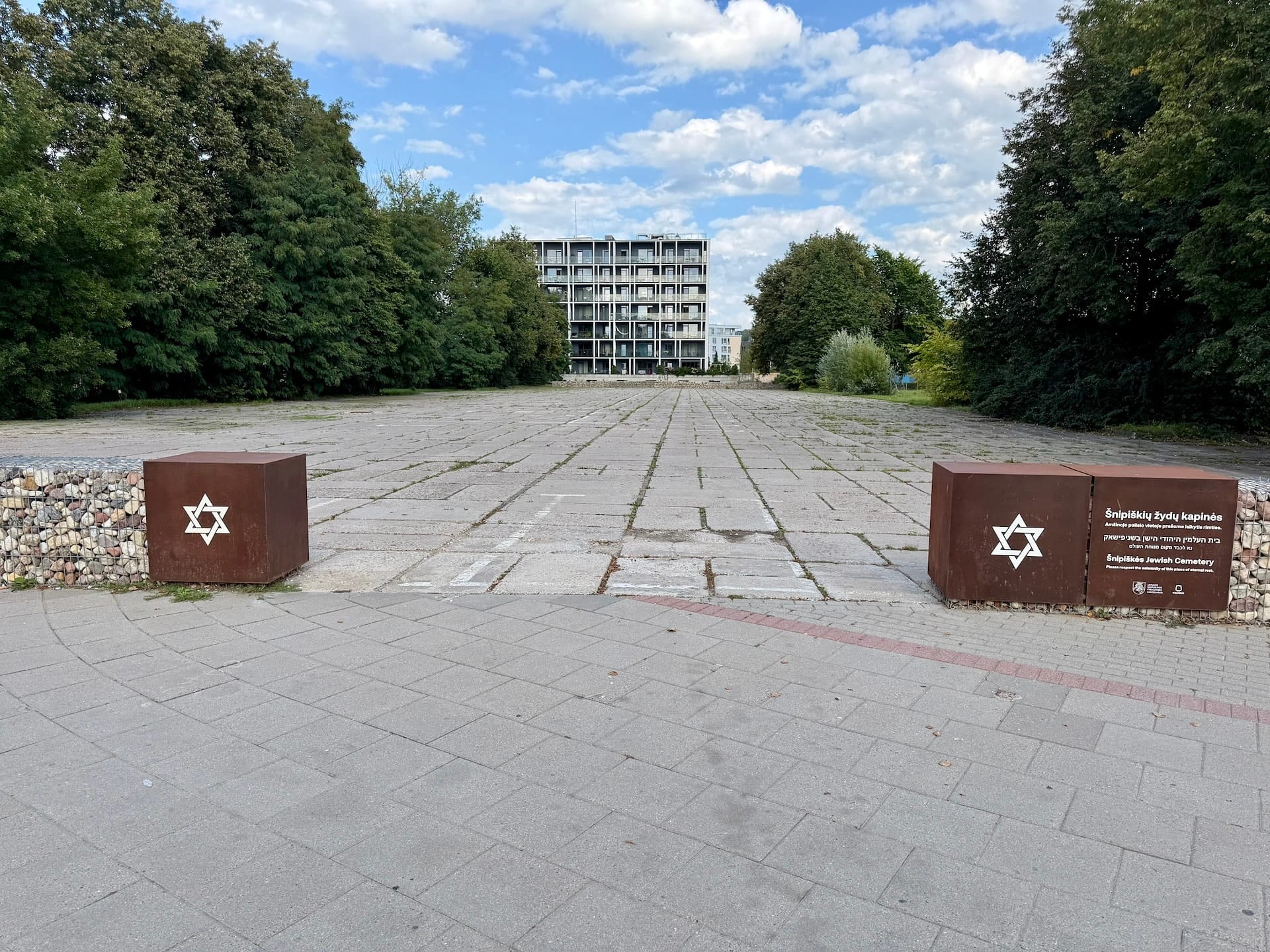
First we passed a Jewish cemetery memorial, which is essentially nothing. Two plaques on a patch of ground. We read them, shrugged, and moved on.
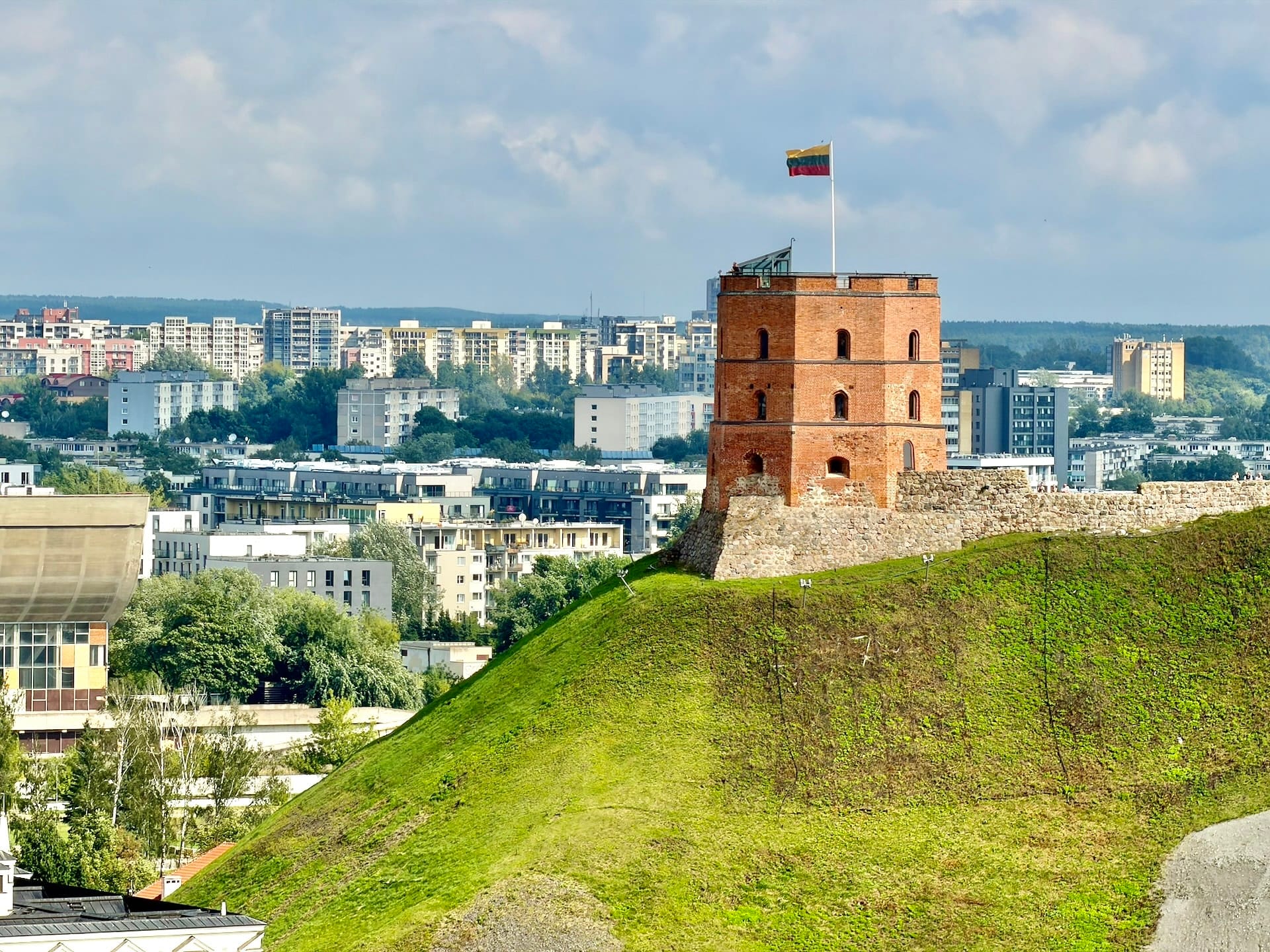
A minute later we found the building. A huge Soviet concert hall with a swooping cantilevered roof, boarded up, weeds through the paving, empty water features, temporary fencing across the forecourt. It looks terrific, in the way that only abandoned modernism does, and I photographed it from every angle I could get to. While I did, a security car circled the site, slowly, twice, with both men in it watching us. We assumed it was an urbex problem, took the pictures, walked down to the river, and sat in the deck chairs on the bank looking up at the fortress tower on its hill.
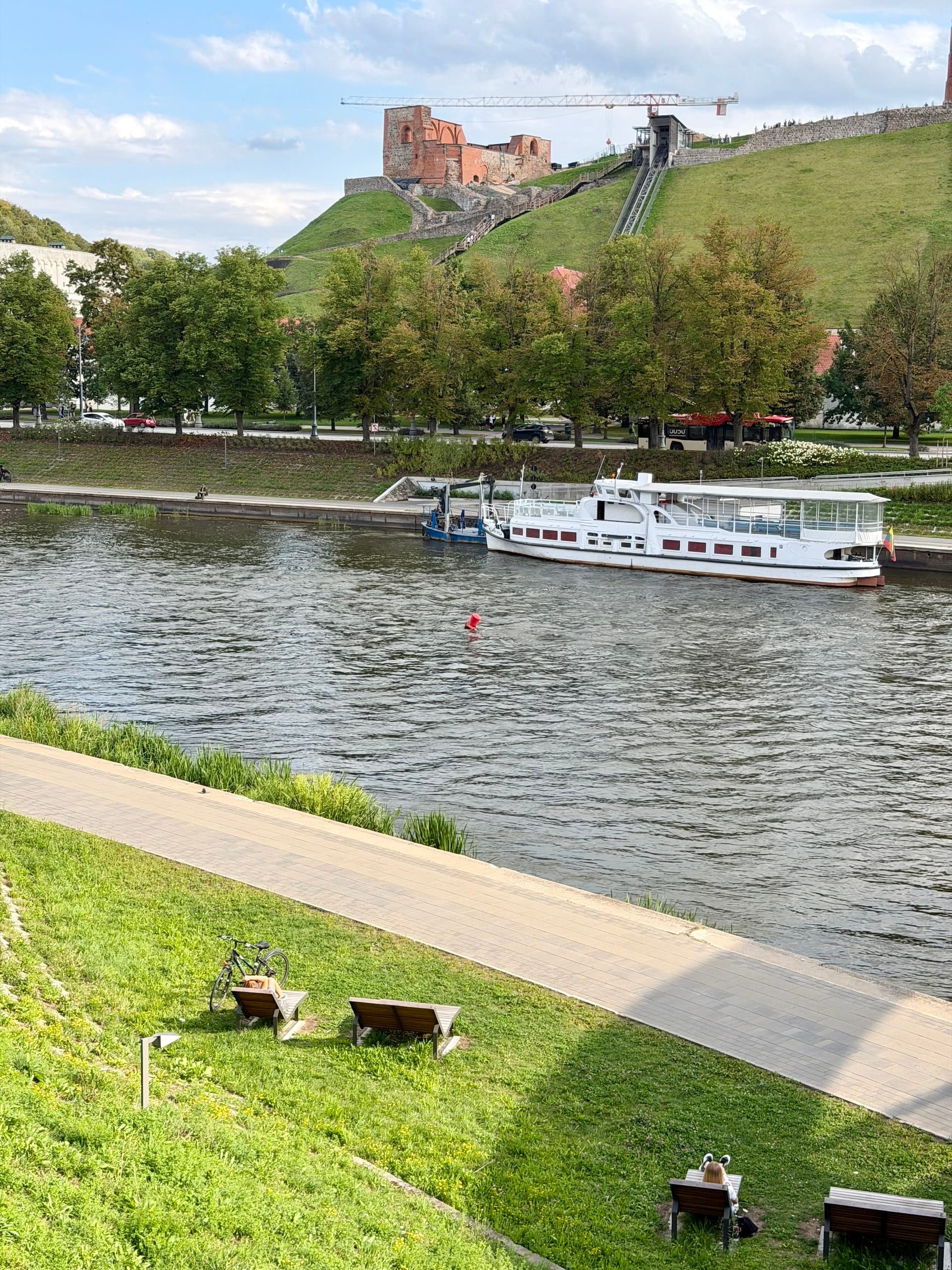
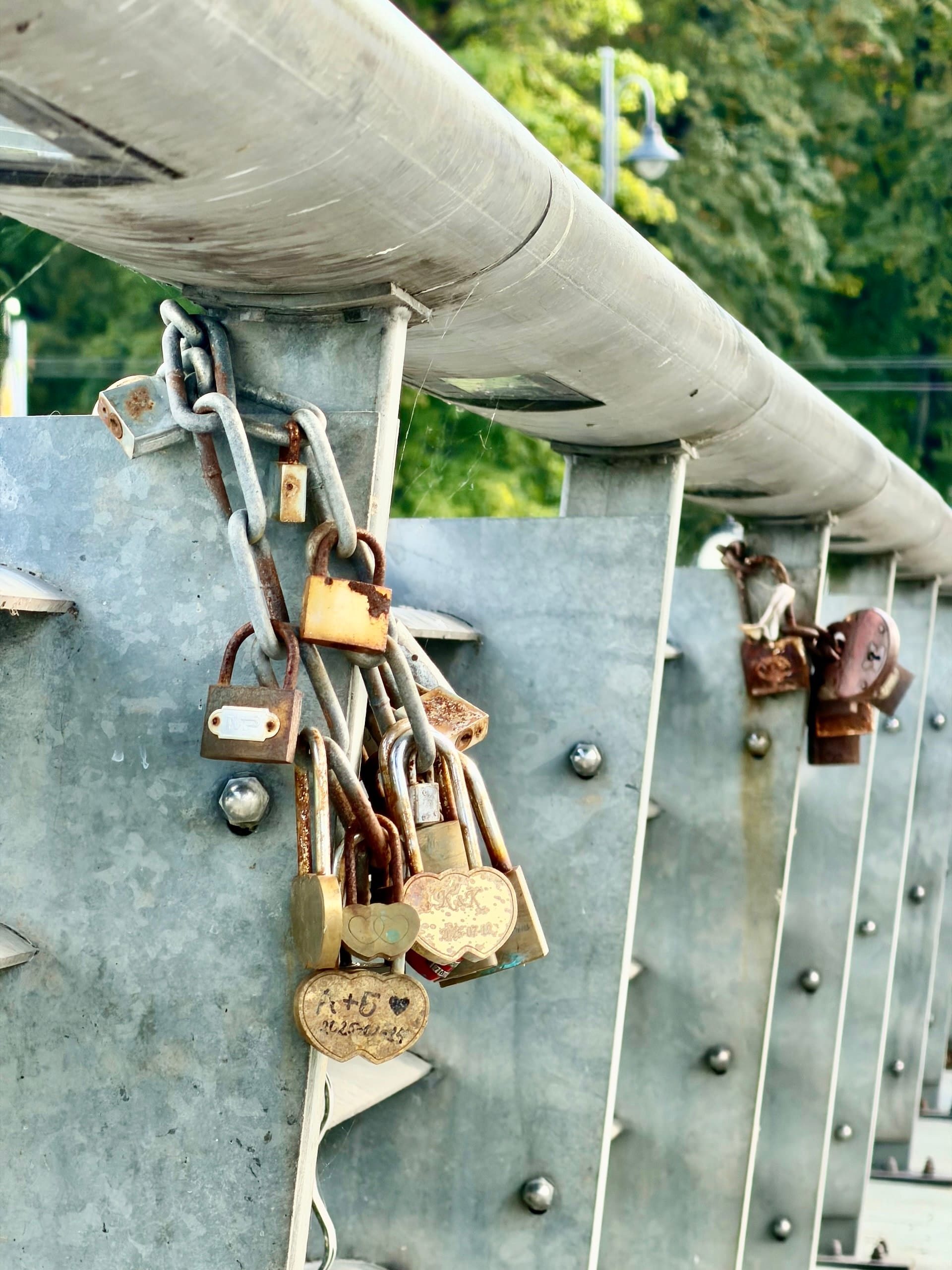
Three unconnected things on an aimless afternoon. Except they are one thing, and I only worked it out days later, at home, going through the photographs.
The building is the Palace of Concerts and Sports, the Sporto rūmai. It opened in 1971, held 4,400 people, was closed as unsafe in 2004 and has been derelict ever since. That is the security car explained.
It stands on the Šnipiškės Jewish cemetery, also called Piramónt, the oldest in Vilnius, established in the late 15th century. The Russian authorities closed it in 1831. What remained of it was destroyed by the Soviets in 1949 and 1950 to lay the foundations for the building I was photographing. The two plaques we had shrugged at ten minutes earlier are the memorial to that cemetery.
Then it gets denser. In October 1988 the hall hosted the founding congress of Sąjūdis, the reform movement that led Lithuania out of the Soviet Union. Several of the people killed on January 13, 1991, when Soviet forces moved against the independence movement in Vilnius, lay in state there.
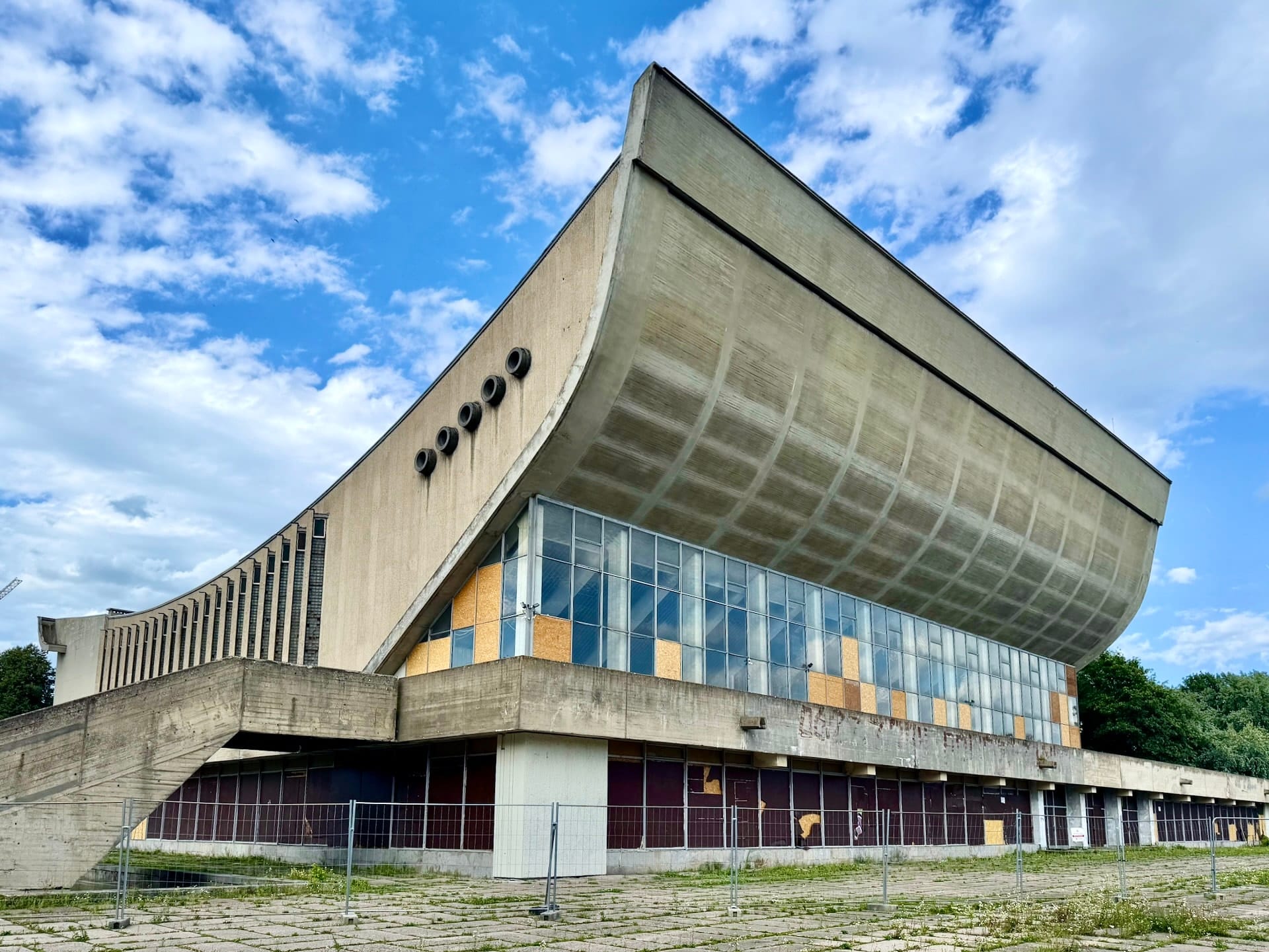
And it is still being argued about. On Monday, August 24, 2026, two days after we flew home, around a hundred people rallied at the site to demand it be rebuilt as a conference center. The rally was organized by the nationalist National Forum and opened with a commemoration of the Baltic Way. Some Jewish organizations oppose the plan because of what is under the foundations. Parliament’s Culture Committee has pushed its decision to the autumn, and the Culture Ministry is expected to seek national heritage status for a building that currently only has regional protection.
For completeness: it is also a filming location for the series Star City, which is how most people who search for it have heard of it. That is the least interesting true thing about this building by a wide margin.
I am not going to pretend I understood any of this while I was standing there. I photographed a derelict Soviet building because it looked good, got followed around by a security car, and found out days later what I had been standing on. If you go, it is about fifteen minutes on foot from Cathedral Square, over the river. Read the two plaques properly first, then look at the palace. It is a better quarter of an hour than most museums. There is more of this kind of layered history in our self-guided walking tour of Budapest’s Jewish heritage neighborhood, and the two cities rhyme more than I expected.
Getting in from Vilnius airport
Vilnius airport (VNO) is small and legible, and bus 3G runs into the city every 10 to 15 minutes. There is a validator by each door: tap a contactless bank card (or phone) against it and you have bought a 60-minute ticket for €1.25 (~$1.5 USD). No app, no machine, no ticket window. With roadworks it took us a bit over half an hour.
The honest part, which nobody prints: it was brutally hot on that bus. It was a Volvo articulated bus of exactly the kind Budapest retired years ago, with no air conditioning and windows that only open a crack. On paper it was not even a hot day. I thought I was going to die. Lithuania is clearly not built for this and I do not blame them.
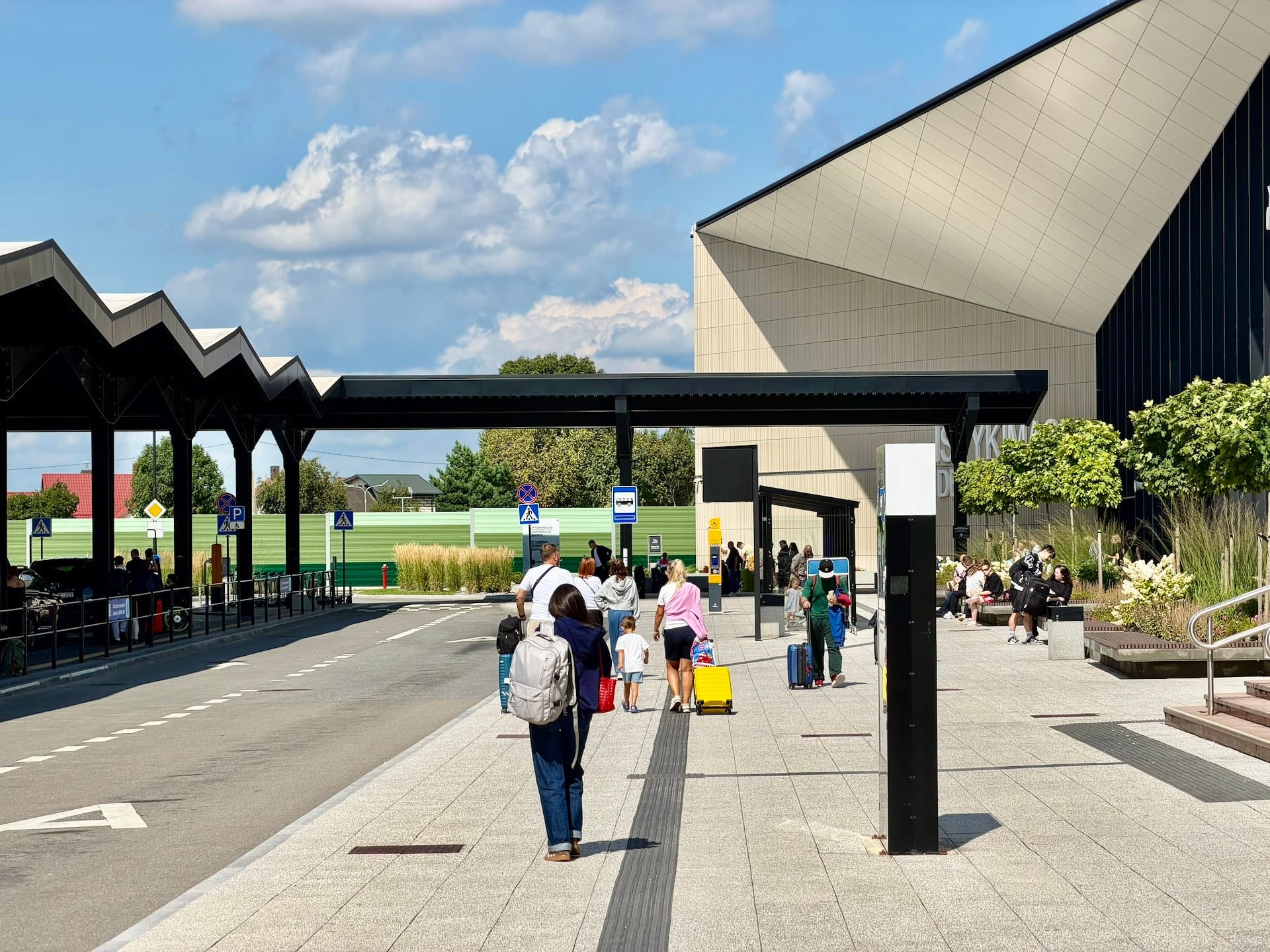
From the stop nearest our hotel it was a ten-minute walk. We stayed at the Courtyard by Marriott Vilnius City Center on Rinktinės g. 3, on the Šnipiškės side of the river, €218 (~$253.8 USD) for two nights.
Getting around Vilnius
Tap a contactless card on the validator when you board and you get the same €1.25 (~$1.5 USD) hour ticket you get on the airport bus. Apple Pay works on board. Google Maps routes the buses correctly, which is what we used to get from the market hall to the museum without thinking about it.
For anything longer than an hour at a time, install JUDU, the city’s unified transport app, which launched in July 2026 and sells day and multi-day tickets alongside parking and route planning. Older guides will tell you to download m.Ticket or Trafi. Vilnius is retiring m.Ticket and m.Parking by the end of October 2026, so do not build your trip around either.
Do the math before you buy a day pass. We took six single rides between the two of us across the whole trip, €7.50 (~$8.7 USD) for two people, or €3.75 (~$4.4 USD) each. Even a 24-hour ticket would not have paid for itself, because the Old Town is walkable end to end and the walking is the good part. Tap a card, buy singles, and only reach for JUDU if you are heading out to the housing estates. For the opposite case, where a pass genuinely pays, see our Budapest public transport guide.
One more data point, offered as exactly one data point. Leaving dinner on the Saturday night I checked both apps for the same ride at the same moment: Uber quoted €3.70 (~$4.3 USD), Bolt roughly double. My guess is that Uber here still works the way it originally worked everywhere, in the gray zone rather than as a licensed taxi. One ride, one night, not a rule.
The free walking tour, and the QR code that paid for the trip
We booked the 18:00 Vilnius Free Walking Tour, which meets at the Town Hall on Didžioji g. 31. Book it properly in advance, because the operator only runs it if at least two people have booked, and otherwise nobody turns up to guide you.
Our guide was Arminas, a journalist on the side, who told us at the start that he had to move fast because he had a last train to catch out to his mother’s. So we got an hour and a half rather than the advertised two to two and a half. We tipped €10 (~$11.6 USD) each and from what I could see that was what almost everyone else had settled on.
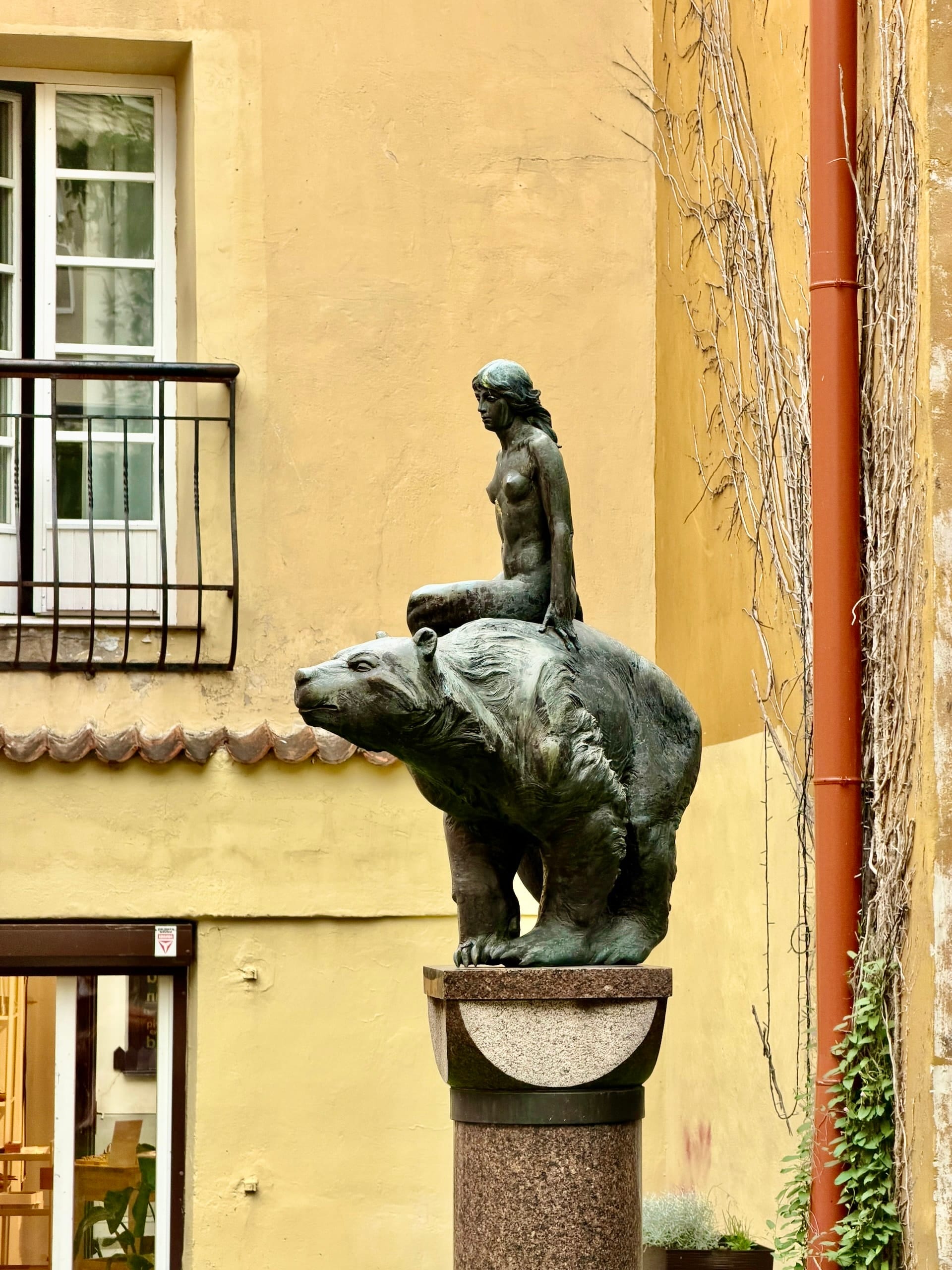
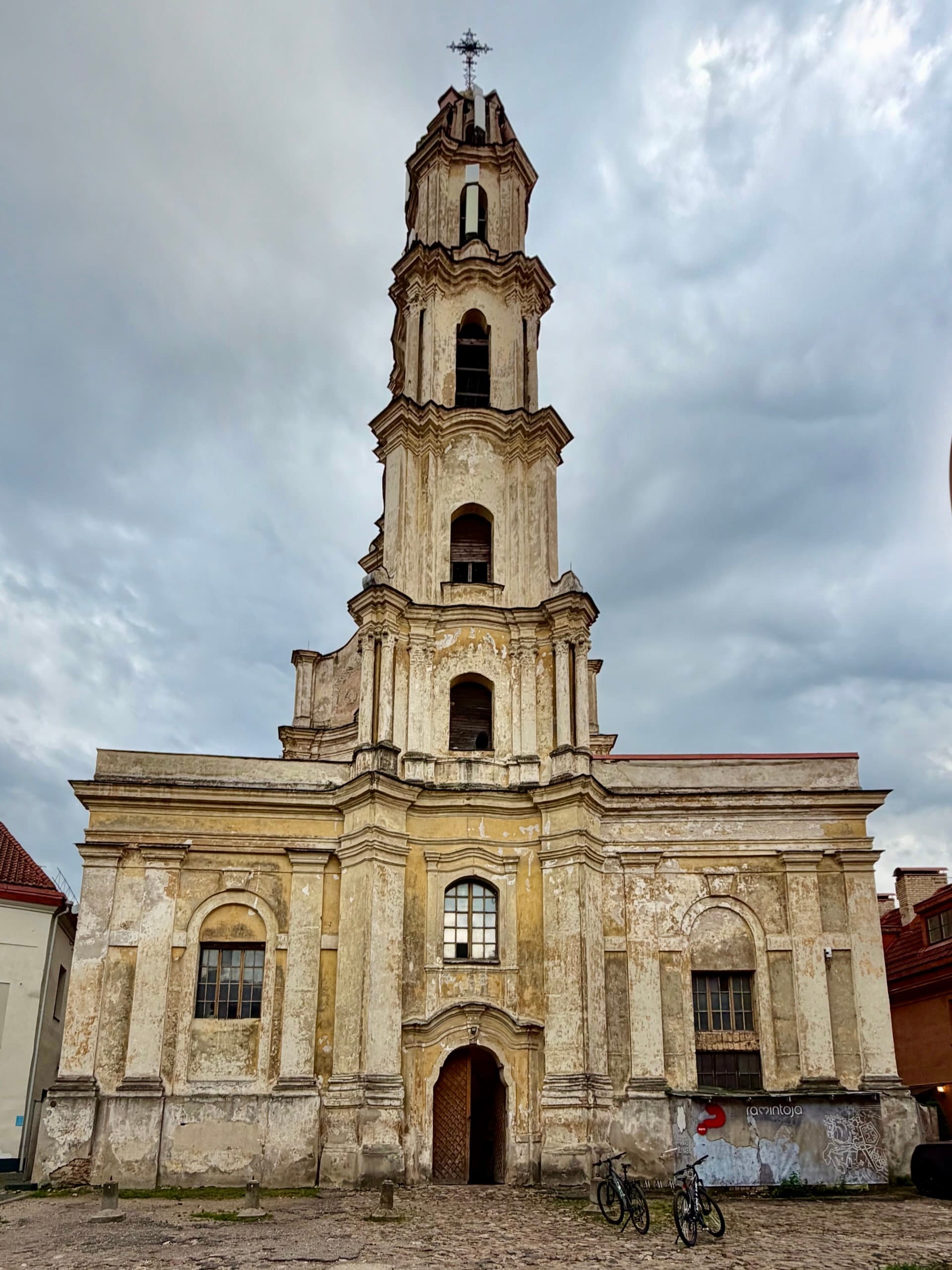
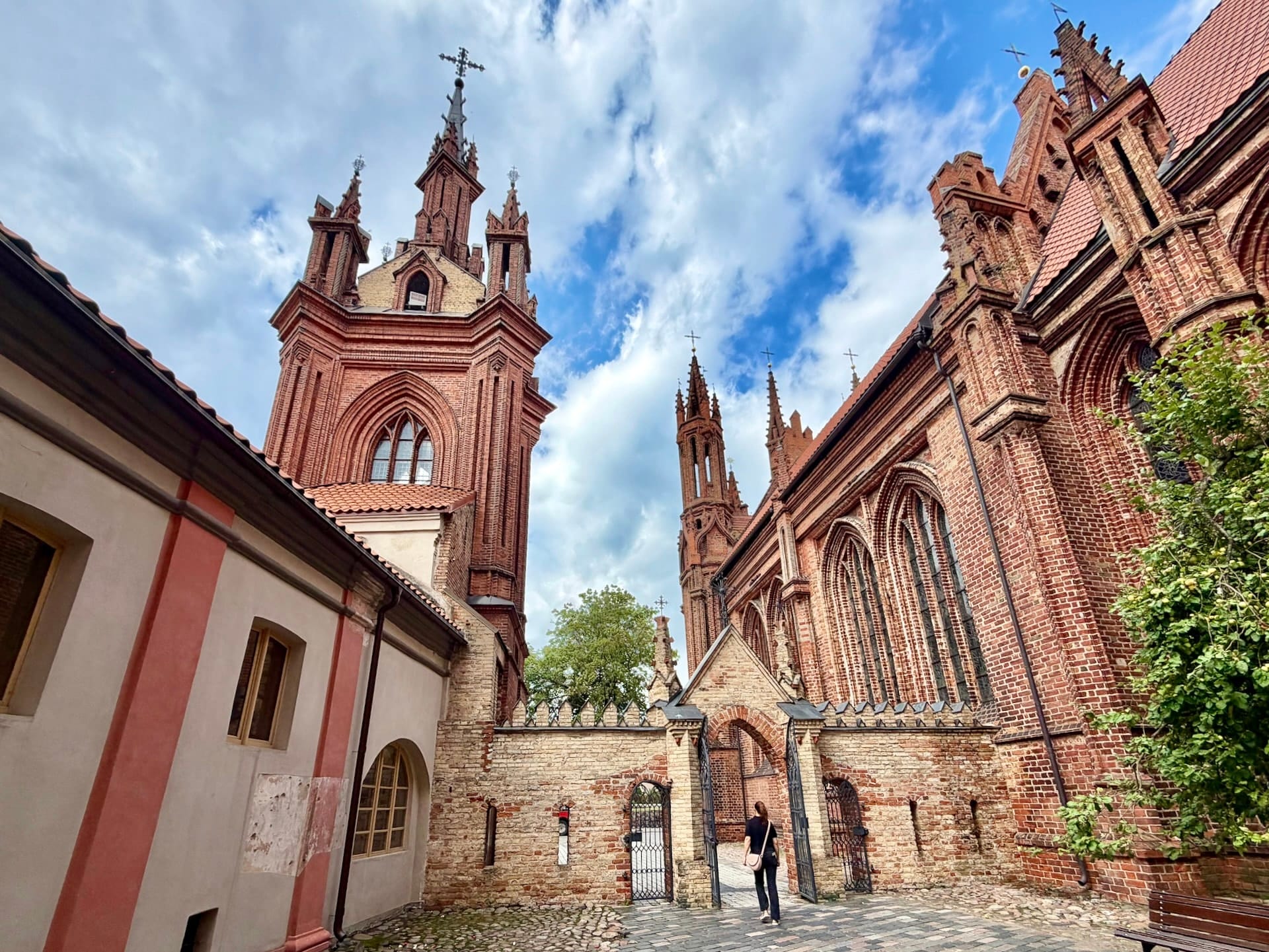
He was good. The rivalry between the three Baltic states came up roughly every ten minutes and was funny every time. We went into the former ghetto, which we already knew because we had gone in there an hour earlier looking for a public toilet, into a courtyard with a statue of a naked woman riding a bear, past the Gothic brick church of St Anne’s with the Bernardine church behind it, one for the laity and one for the monks, and past the Ramintoja church, closed by the Russians in 1854 and turned into a vegetable warehouse by the Soviets in 1962, which now houses a community restaurant employing people with disabilities and serving salads and pancakes. Repurposing is how a lot of these buildings survived at all.
The route also took us to the entrance of Užupis, the self-declared artists’ republic across the Vilnelė, far enough to see the gate and not far enough to form a view. We went back on our own the next day and did form one, and it is not the view the rest of the internet holds. Square meter prices there run at roughly double the city’s cheapest districts, which is not usually how artists’ quarters go. That is its own article: what Užupis is actually like.
At the Presidential Palace he told us that the president, Gitanas Nausėda, is an economist by background, was elected as an independent outsider rather than a party candidate, and holds a largely ceremonial job with a wartime commander-in-chief function. And that he had recently been running the country from Madeira.
That sounded like a guide’s joke, so I checked it. It is true, with one correction: he does not live there. LRT reported on August 5, 2026, two weeks before we arrived, that Nausėda spent that week working remotely from the island, and that it was legally contested. The prime minister said he saw no problem. Johanas Baltrimas, an associate professor at Vilnius University’s Faculty of Law, told LRT that “according to the constitution, the capital is Vilnius, and the very concept of a capital implies that this is where the country’s authorities work,” while adding that the question is “governed more by custom than by law.”
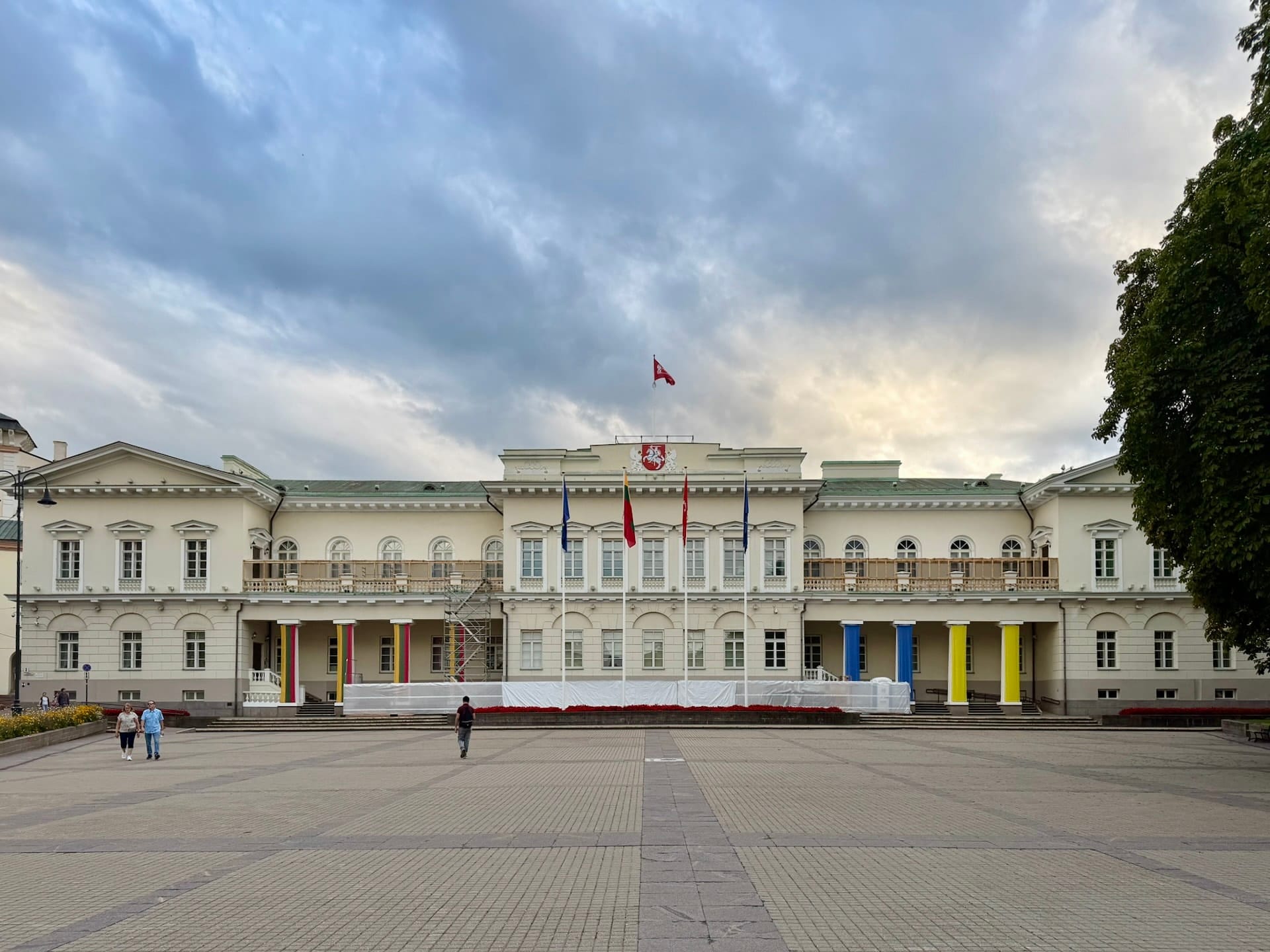
Arminas’s verdict is the one I would keep. Nobody in Lithuania, he said, was surprised by the “remote” part. They were surprised by the “working” part.
At the end of any free walking tour, ask the guide where they eat. Arminas left us a QR code with his own recommendations, and the pub it sent us to was the best evening of the trip by a distance. The tour is worth €10 for the walk. The list at the end is worth more.
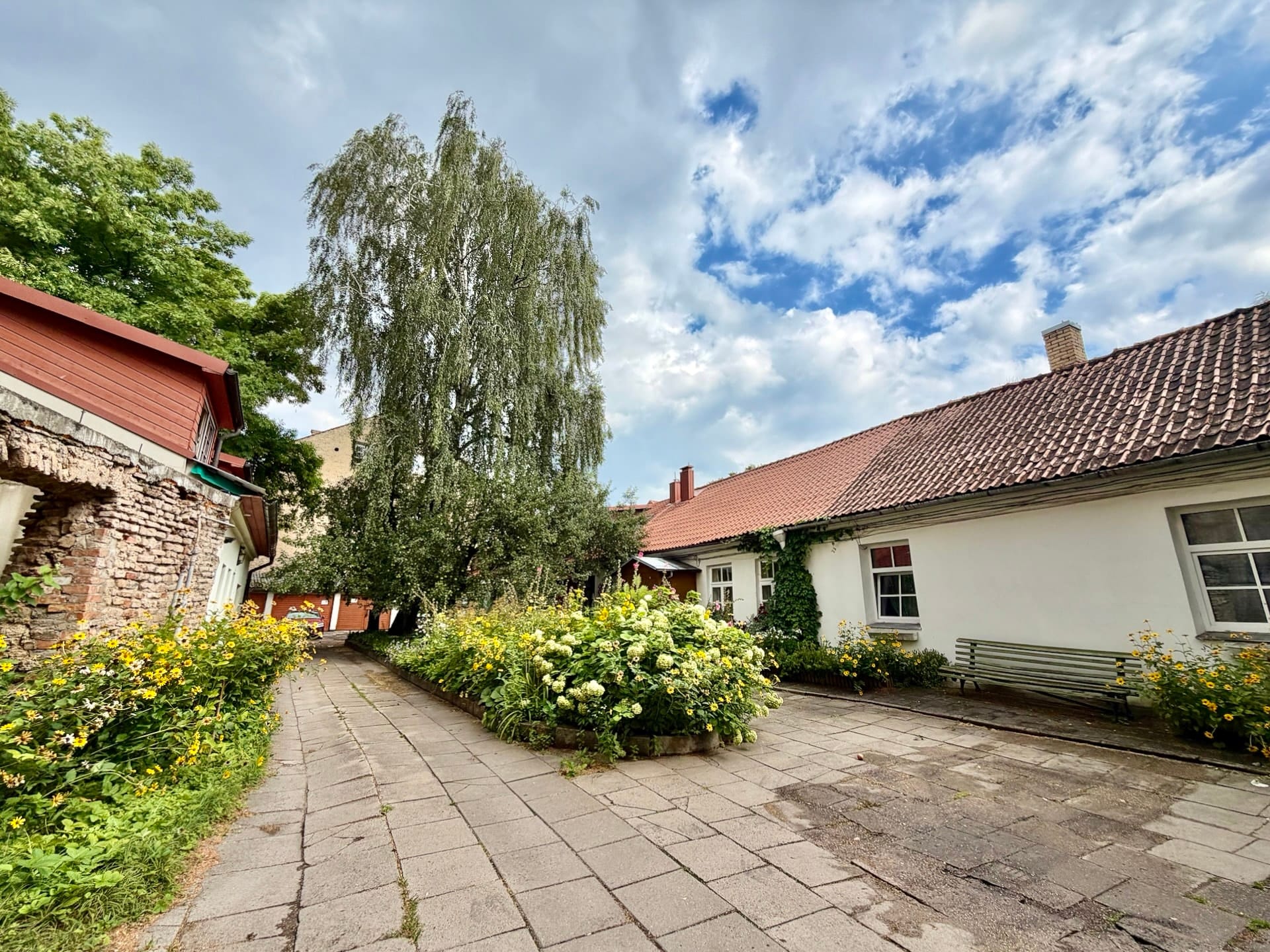
Go through the open doors: the courtyards of the Old Town
This is the single most useful thing anyone told us in Vilnius, and it is in none of the other guides I have read.
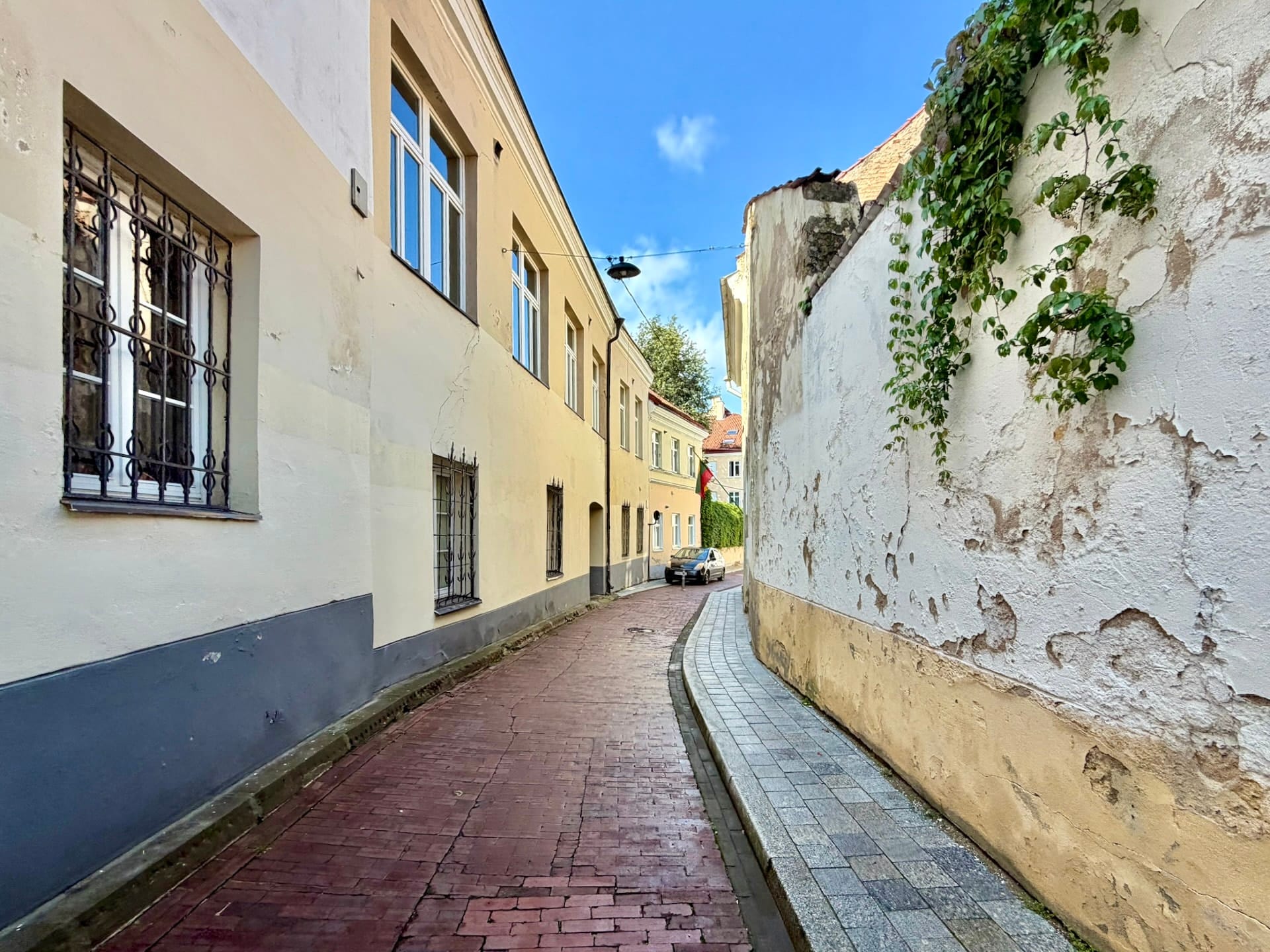
If you see an open door in the Old Town with a courtyard behind it, walk in. Arminas said it, and it is right. There are buildings here from the 1600s still in use as ordinary housing, and behind the street facades are inner courtyards, some tidy and planted, some falling apart, most of them completely empty of other people. We had already found two on our own before the tour, half by accident, which is the proof that the tip works rather than a special guide’s-only secret.
Nobody minds. Look, take a photo, come out again. It costs nothing and it is the thing I remember most clearly about the Old Town.
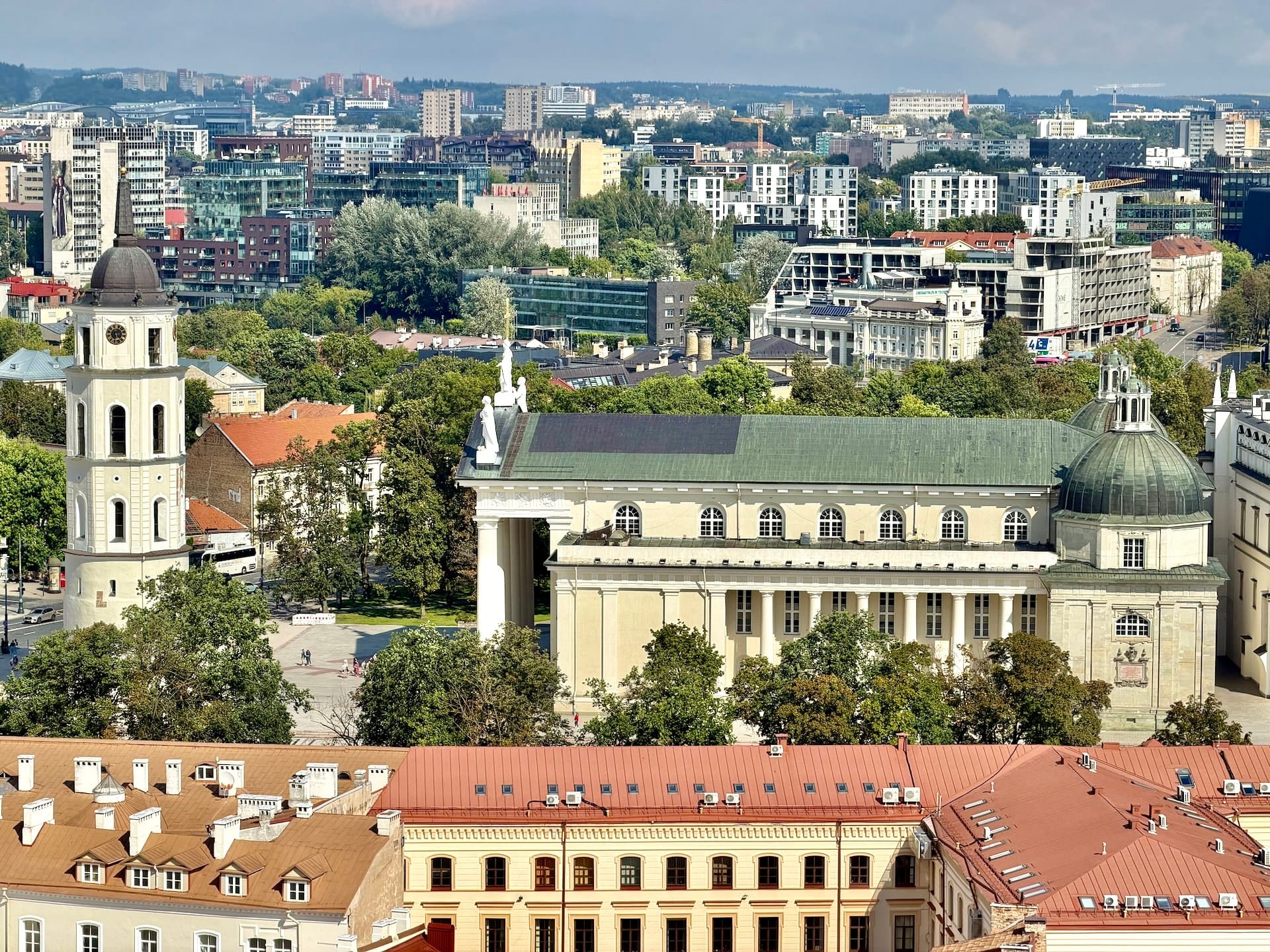
The best view in Vilnius: St John’s Church tower
The plan had been Gediminas Tower and the Hill of Three Crosses. The storm took the morning, so on Arminas’s recommendation we went up the bell tower of St John’s Church instead, inside the Vilnius University complex. It was the better call, and I would now recommend it over both.
Entry is €7 (~$8.1 USD) per person. At the base there is a small museum with a Foucault pendulum, a metal ball of 20 or 30 kg on a very long wire, swinging while the earth turns underneath it. A lift takes you most of the way up, and after that a narrow and genuinely unnerving staircase gets you to the top, where you come out into the open air and walk a full 360 degrees around the outside of the tower.
The whole city is below you and you are standing in the middle of it, which is the thing Gediminas Tower cannot do. The cathedral’s free-standing bell tower, the palace beside it, the hill with the castle tower on top, the town hall, church roofs in every direction. The sun came out for us, which after that morning felt like being owed something.
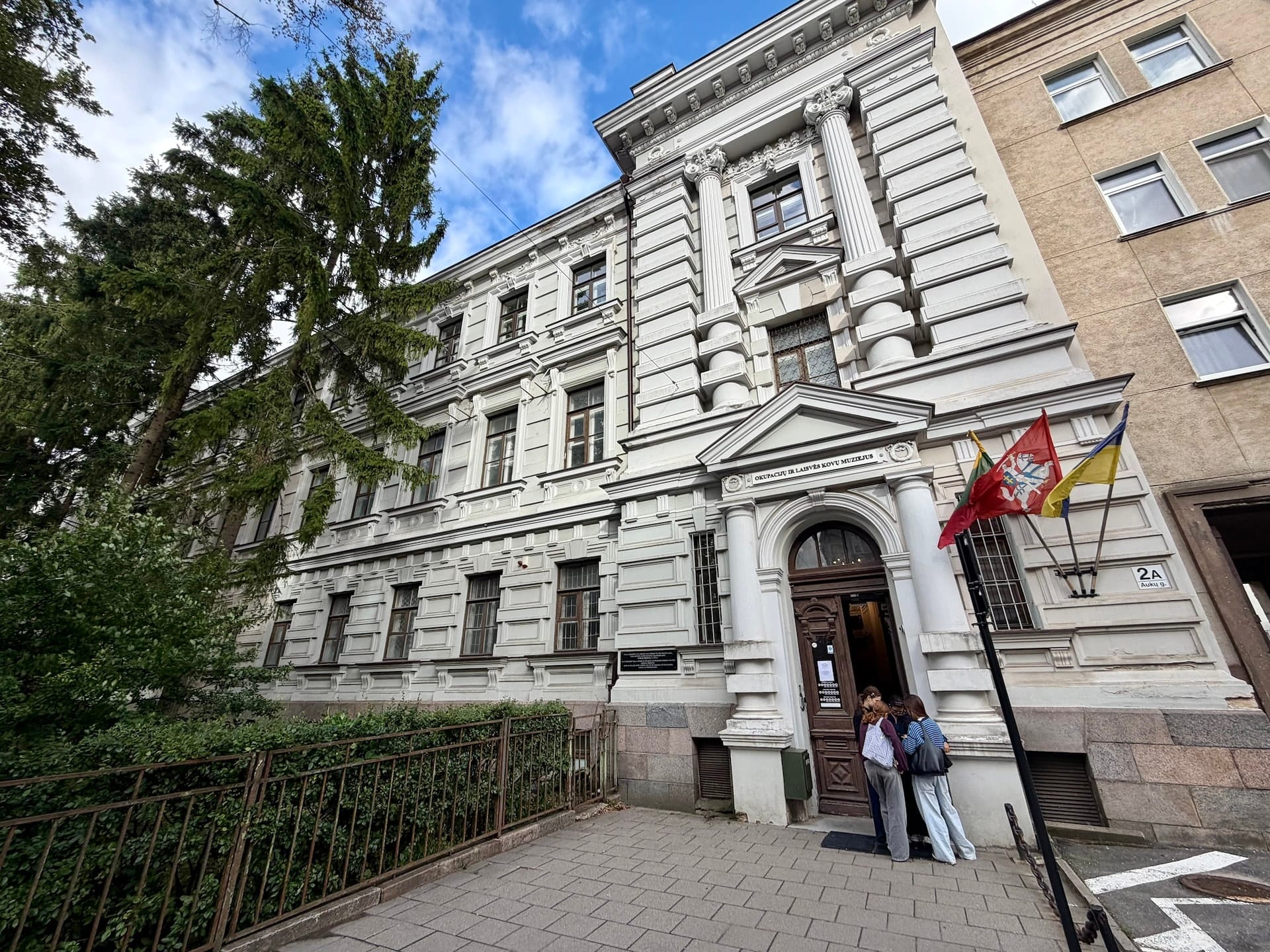
The Museum of Occupations and Freedom Fights, and what to do when it rains
Locally it is still the KGB museum. It costs €6 (~$7 USD) a head, and it is the correct answer to bad weather in Vilnius.
We got there at 16:30 and it closes at 18:00, so we had an hour and a half and could easily have used more. It is close kin to Budapest’s House of Terror, and not vaguely: the building looks similar, the cells look similar, and the narrow standing cell they put new arrivals into first is the same idea executed the same way. The communists’ methods did not vary much by country.
The basement is the prison and the hardest part of it. The execution room, the exercise yard, isolation cells, a padded cell, and a water cell that is essentially a pool with a small round platform in the middle. You stood on the platform. If you could not keep standing, you went into the cold water. The two floors above cover the first Soviet occupation, the Nazi occupation, the partisan resistance and the second Soviet occupation. It is not a cheerful afternoon. It is a good one.
Go straight after lunch, not at 16:30 like we did. Last admission is before the 18:00 closing time and the basement alone deserves an hour. If the forecast is bad for one day of your trip, make this the day’s anchor and move everything else around it.
Where we ate in Vilnius
Two and a half proper meals in three completely different price brackets, and the gap between them is the most useful thing I can tell you about eating in Vilnius. Then two small things that ended up saying more about the Baltics than any of the meals did.
Būsi Trečias, the one that made the trip
Totorių g. 18, and we would never have found it without Arminas’s QR code. Andrea picked it off his list because it looked friendly.
It is a family-run brewpub and garden with its own brewery in the cellar directly underneath, and the beer comes up from the tanks to the bar in liter mugs. Lager, dark, and a rack of flavored things I did not investigate. By its own account it is the oldest mini-brewery in Vilnius, which I cannot verify and am reporting as their claim.
We ate the standard Lithuanian beer food and all of it was excellent. Kepta duona su sūrio ir majonezo padažu, bread deep fried in fat with a cheese and mayonnaise sauce, which is to say mayonnaise with grated cheese in it. Raganos ašaros, “witch’s tears”, a minced beef dish. And bulviniai blynai, potato pancakes with sour cream and cubes of cured fat that any Hungarian would recognize instantly as kenyérszalonna. Rich, heavy, very good, and I thought I would not survive finishing it. The evening for two came to €55 (~$64 USD).
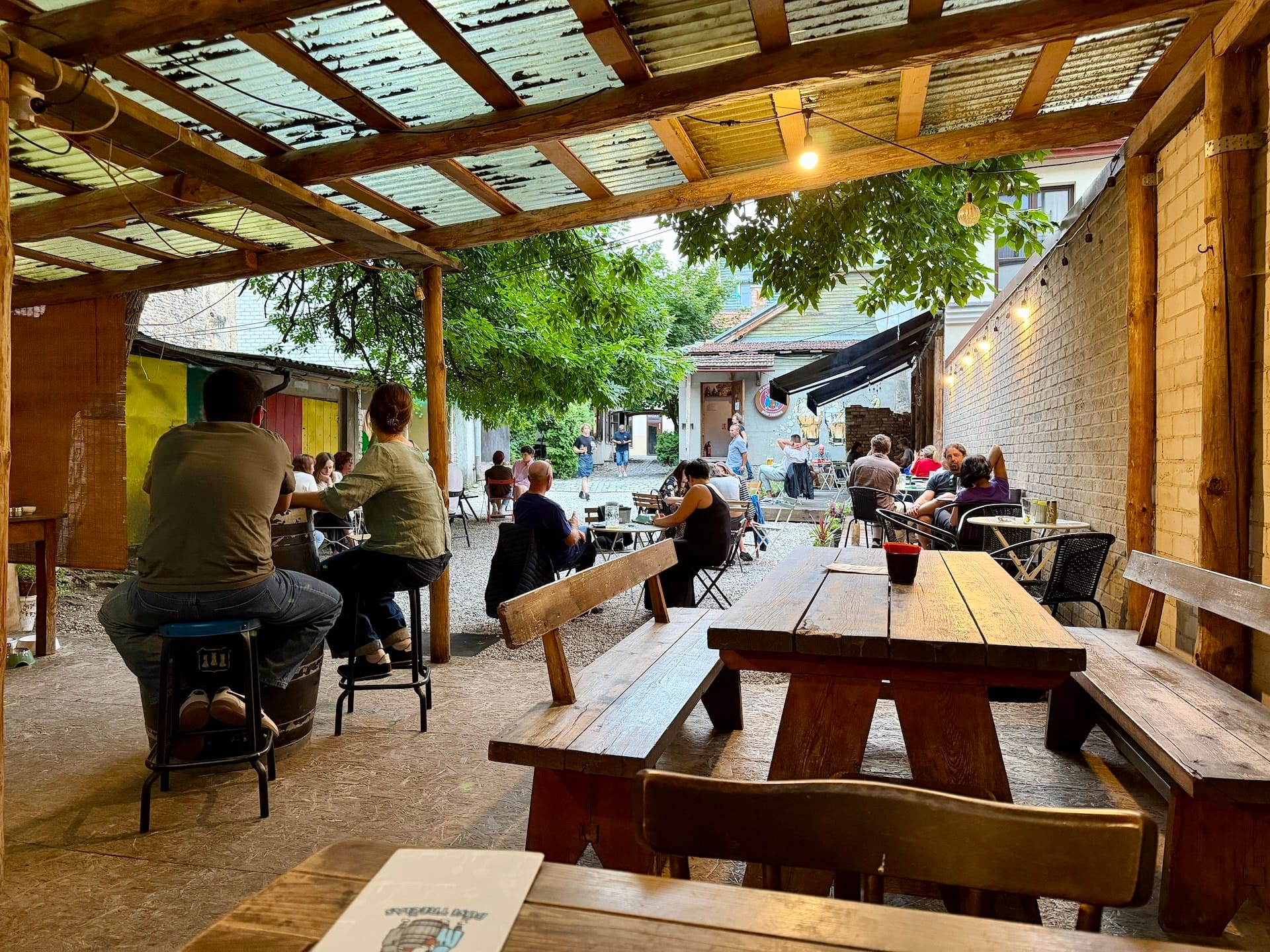
The waitress moved us to a bigger table the moment one freed up, unprompted, having decided the small one would be awkward to eat at. An older couple were working the space between the tables, and it turned out to be their family business. There is exactly one toilet, unisex, for what must be like 70 seats, and somehow there was never a big queue, which remains unexplained.
I will come back to this place at the end, because it is why Vilnius won.
Halės Turgus and the Venezuelan place
The market hall was not extra, and I would rather say so than pad it out. Pickles, vegetables, and more smart sandwich cafés than local food. We went in specifically looking for cepelinai or anything else stuffed and traditional, and could not find it.
What we found instead was El Barrio, a Venezuelan place inside the market, and it was very good. It was open when much of the hall had already closed, and I got to speak Spanish with the owner, which I was not expecting to do in Lithuania. Two empanadas and two coffees came to €11 (~$12.8 USD) for the two of us. A market hall where the best food is Venezuelan is a better story than one where the food is exactly what the guidebook promised.
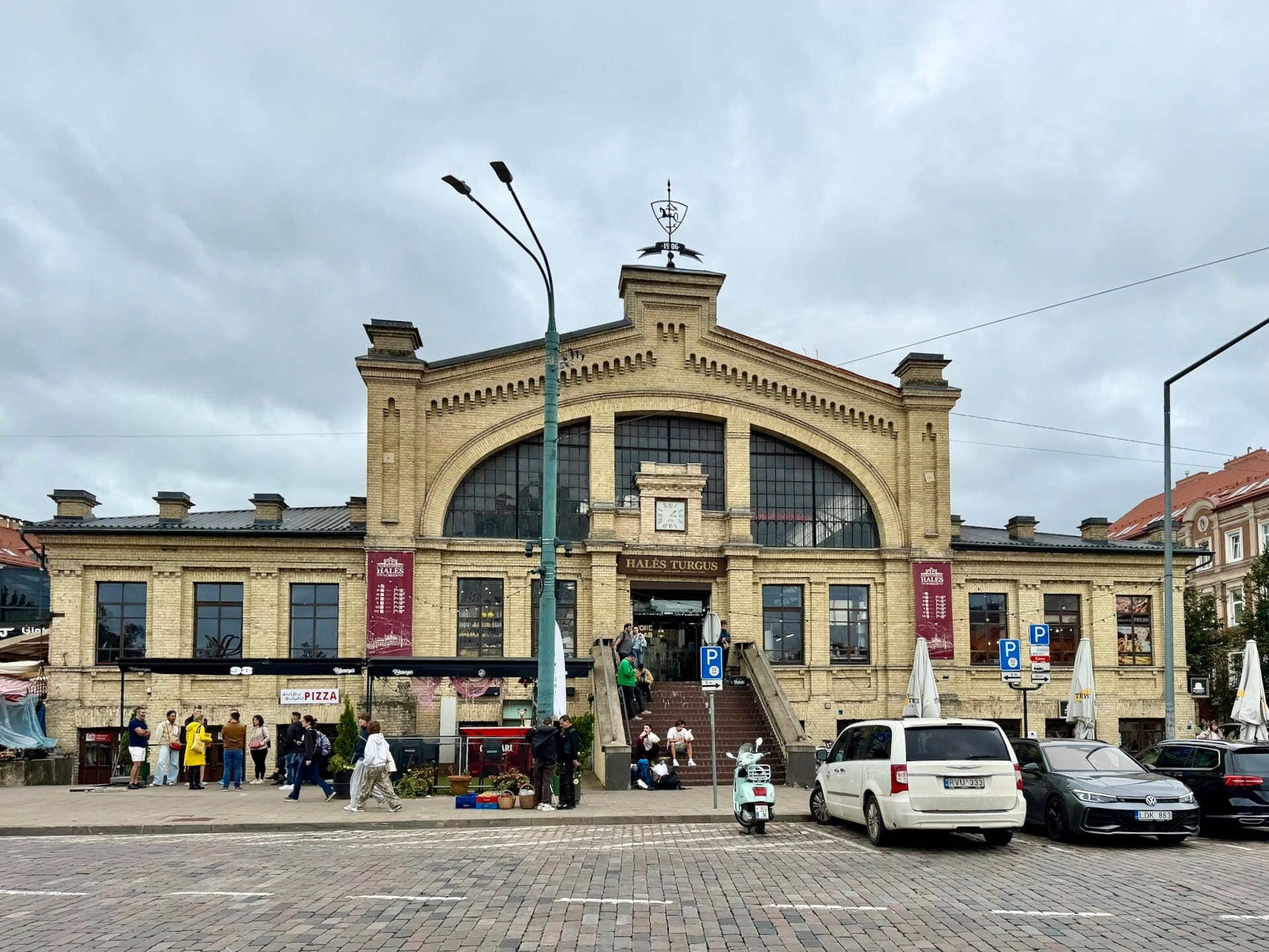
On the way there we crossed Town Hall Square and walked into a crafts fair: people in period dress, a bread oven going, a blacksmith working at a live fire, potters painting their pots. No signage anywhere, but I suspect it was tied to the Baltic Way anniversary the next day.
Ertlio Namas, the anniversary dinner
We were in Vilnius for an anniversary and we do this properly, the way we did in Sofia on our Bulgaria road trip. Ertlio Namas, booked a couple of days ahead, 20:00, out a little after 23:00.
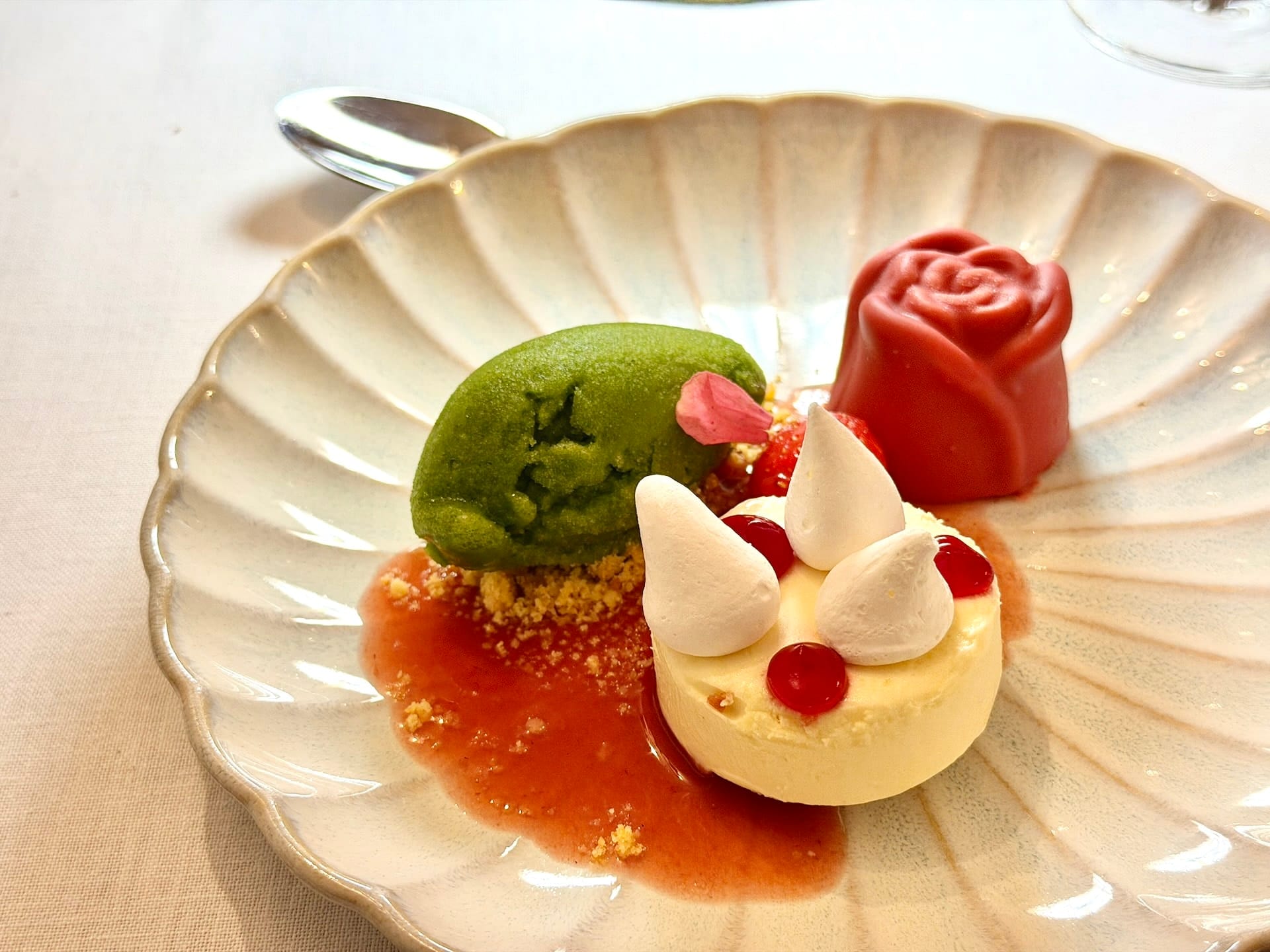
The pitch is Lithuanian historic cuisine and it is meant literally: every course on the card is dated by century. Black bread with hemp seeds and kastinys (XVI). Partridge with a biscuit (XIX). Beaver pâté with onions, saffron crispbread and rhubarb jam (XVIII). Crayfish soup with pike, millet porridge and dill (XVII). Beef zrazai with sweetbread, chanterelles, groat porridge and broth sauce (XVIII). Wild strawberry legumina with elderflower cream and basil sorbet (XIX). Mint candy with cucumbers (XIX). Before each course, the server explains in detail what you need to know about the dish and the gastronomy of that particular historical era.
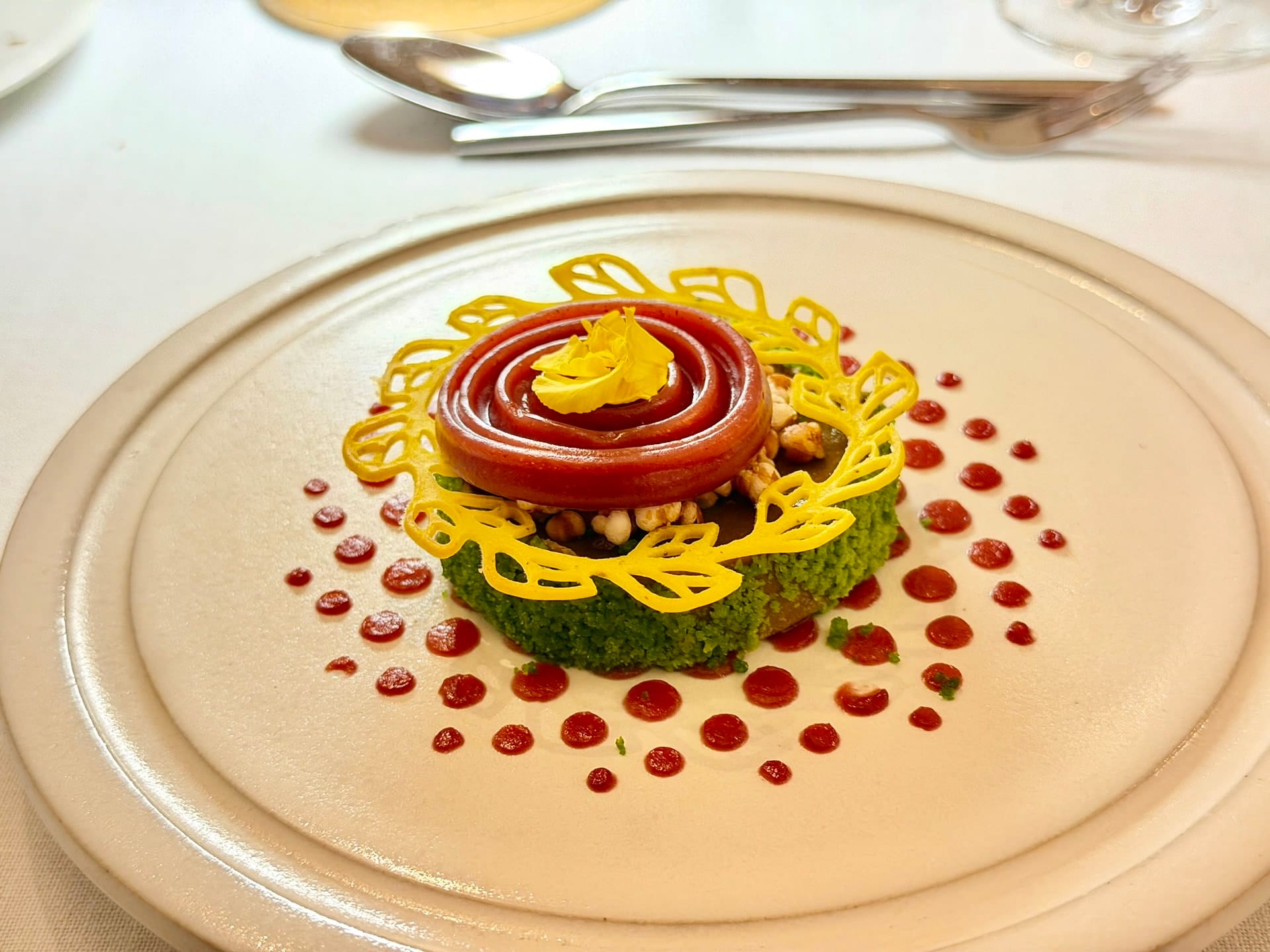
I had never eaten beaver. The partridge came with a story: they are effectively gone in the wild, so the restaurant orders them a year in advance from someone who breeds them for the table. My favorite was the crayfish soup, which surprised me, because I am not especially keen on anything out of the water. The dessert was the wild strawberry legumina, and we were told to spoon the elements together rather than eat them separately because they only make sense combined. Annoyingly, that was true.
The seven-course menu is €60 (~$69.8 USD) per person and runs about two hours, the nine-course is €70 (~$81.5 USD) and about three. Wine pairings are €30 (~$34.9 USD) and €40 (~$46.6 USD). We took two seven-course menus with two pairings, so €180 (~$209.5 USD) for two.
The one thing I would not buy again is the pairing. The card specifies what the €30 gets you: three glasses of wine and one glass of mead. That is €7.50 (~$8.7 USD) a glass, and not one of them was Lithuanian. An Austrian rosé, an Italian red, a French off-dry white, and the local mead, which is not really wine and is very sweet and very strange. Of course, Lithuania is not a traditional wine-producing place, but there are smaller vineyards in the country. Draw your own conclusion from the number.
The curd bar with the bird on it
In a Rimi supermarket on the first afternoon I found the Baltic version of Túró Rudi, the Hungarian chocolate-coated curd bar I grew up on, and was unreasonably happy about it. The brand was Kārums, the bird on the wrapper is a crow, and the whole thing is Latvian, bought in a Lithuanian supermarket about ten minutes after a Lithuanian guide finished explaining how seriously these three countries take their rivalry.
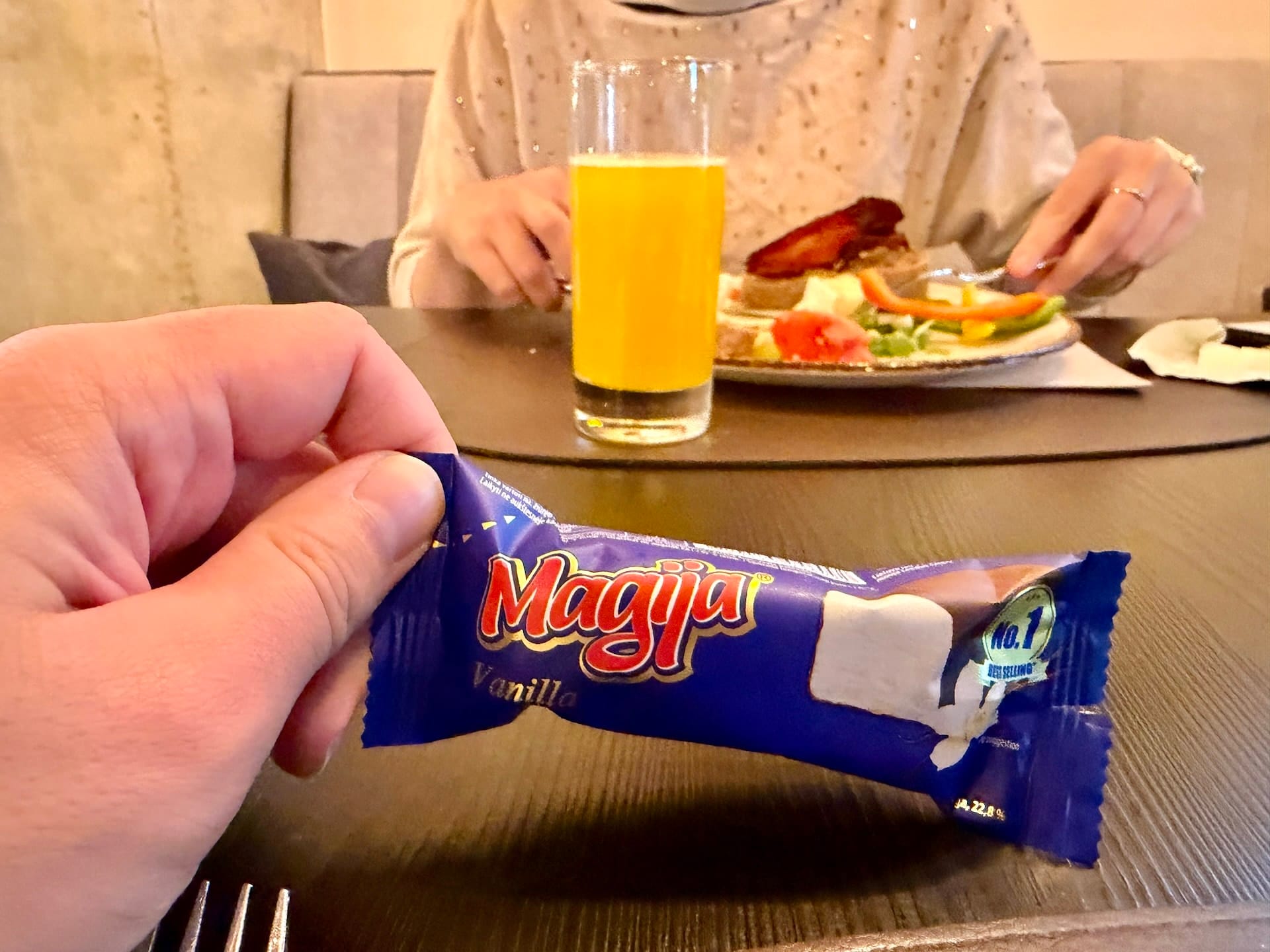
The generic product is varškės sūrelis in Lithuania, biezpiena sieriņš in Latvia and kohuke in Estonia. It is a squat brick rather than a rod, the chocolate layer is thinner and the curd is creamier. Familiar flavors, different proportions. They are cousins rather than one descending from the other, and anyone who tells you otherwise is guessing. It was also on the breakfast buffet at the hotel, a proper local brand, Magija.
The tea in Užupis
The one line in the costs table below that needs explaining. In Užupis we stopped at Yugen Tea, a very smart Japanese tea house stocking elite grades of the stuff, and two pots came to €12.40 (~$14.4 USD).
That is more than our entire lunch cost in the market hall, in a district that is supposed to be full of artists. Which is roughly where our honest look at Užupis starts.
What two nights in Vilnius cost us
Here is what the trip actually cost, for two people, over two nights and roughly two and a half days on the ground. It covers everything we spent in the city: both museums, the tower, the walking tour tips, every bus ticket, all the food and drink including the anniversary tasting menu, and three supermarket runs. It does not include getting to Vilnius, since that depends entirely on where you are flying from.
| Category | Total (2 people) | Per person | Per day | Per person/day | Notes |
|---|---|---|---|---|---|
| Accommodation | €218 | €109 | €87 | €44 | 2 nights, Courtyard by Marriott in Šnipiškės |
| Activities | €46 | €23 | €18 | €9 | Walking tour tips, St John’s tower, Museum of Occupations and Freedom Fights |
| Food & drink | €288 | €144 | €115 | €58 | Būsi Trečias, El Barrio, the Ertlio Namas tasting menu, tea in Užupis |
| Groceries & shopping | €23 | €12 | €9 | €5 | Three Rimi runs, water and snacks |
| Transportation | €22 | €11 | €9 | €4 | Airport and city buses, one Uber, one Bolt to the airport |
| Total | €597 | €299 | €239 | €119 |
At the August 2026 rate of about $1.16 to the euro, that is roughly $693 USD for two, or $347 USD each.
The takeaway is the tasting menu. Ertlio Namas was €210 of the €288 we spent on food and drink, and more than a third of the whole trip. The menu price for two was €180, the rest is water and a tip. Strip the dinner out and everything else on the ground, hotel aside, came to €84.59 (~$98.5 USD) each over two days, and that still covers both museums, the tower, the tour tips, every bus ticket, a full evening at Būsi Trečias, lunch at El Barrio and the supermarket runs.
What we did not get to, and why
At 09:00 on the Saturday, after heavy rain and strong winds in the morning, the Lithuanian state sent an alert to my phone, in Lithuanian and English, warning of heavy rain and severe wind, trees coming down and possible power cuts. I have never had one of those before. We did not leave the hotel until 11:00.
That was not bad luck on a city break, it was a serious weather event that happened to land on our only full day. Around 268,000 customers across Lithuania lost power on the Saturday evening and more than 93,000 were still without it the following Tuesday. Two municipalities declared local states of emergency, and Utena, Kaunas, Vilnius and Panevėžys were the worst hit.
What it cost us, in descending order of regret: the 06:30 empty Old Town, which is when the best photography of any city trip happens; Pašilaičiai and the Soviet housing estates out on the northwestern edge of the city, where Star City was filmed (at 54°43’33.5″N 25°13’46.3″E if that is what you are going for); the wooden houses, cut for the same reason; and Gediminas Tower and the Hill of Three Crosses, which St John’s tower replaced and I am not sorry about. That trade came out in our favor.
If you have a full day and it behaves, the order I would use is the Old Town early and empty, the walking tour or your own version of it late morning, St John’s tower at midday for the light, the palace and the river in the afternoon, and Būsi Trečias in the evening. Slot the Occupations Museum in if the weather turns.
Vilnius FAQ
How many days do you need in Vilnius? One full day for the Old Town, two nights to do it comfortably, three if you want the housing estates, the wooden houses and the parts of the city that are not on the UNESCO map.
Is Vilnius worth visiting? Yes, and of the three Baltic capitals it is the one I would go back to first. See the last section for why, since the reason is not a sight.
Do people speak English in Vilnius? Yes, without a single exception in three days. Including a taxi driver in his sixties who phoned us in English when he realized he was not going to reach us in time.
How to stay connected in Vilnius? The simplest option is an eSIM. Before you buy one, though: roaming is free across the EU, so if you already have a European SIM card it will work here without you doing anything. If you do not, we recommend Saily, where Lithuania packages start at €3.49 (~$4.1 USD) and you get a few extras alongside the data. And if value for money is the whole point, Manet is hard to beat, with packages from €1.30 (~$1.5 USD).
Is Vilnius walkable? Completely. The Old Town is compact, the river is a fifteen-minute walk from Cathedral Square, and we used a bus three times in two and a half days.
What is there to do in Vilnius when it rains? The Museum of Occupations and Freedom Fights is the obvious answer, and it is heavy going.
The lighter one, and the one Arminas pushed hardest, is Lukiškės Prison 2.0 on Lukiškių skg. 6. It is a tsarist-era prison that held inmates until 2019 and is now a creative hub with several hundred artists and studios in it, bars, concerts and events, plus the cell blocks Netflix used as the Russian prison in Stranger Things. Guided tours in English run about an hour and a half to two hours and cost €25 (~$29.1 USD) per person, groups are capped at 16, and you have to book online in advance, so it is not a walk-in. Photography is not allowed on the tour, which is worth knowing before you carry a camera across town. We picked the Occupations Museum instead and never got there.
Beyond those two: the small museum at the base of St John’s tower, the churches, and the courtyards, which are more sheltered than the streets. And a long lunch. If the rain is the kind that comes with a state alert, stay in until it passes and start your day later like we did. You will still see most of it.
Why Vilnius, of the three Baltic capitals
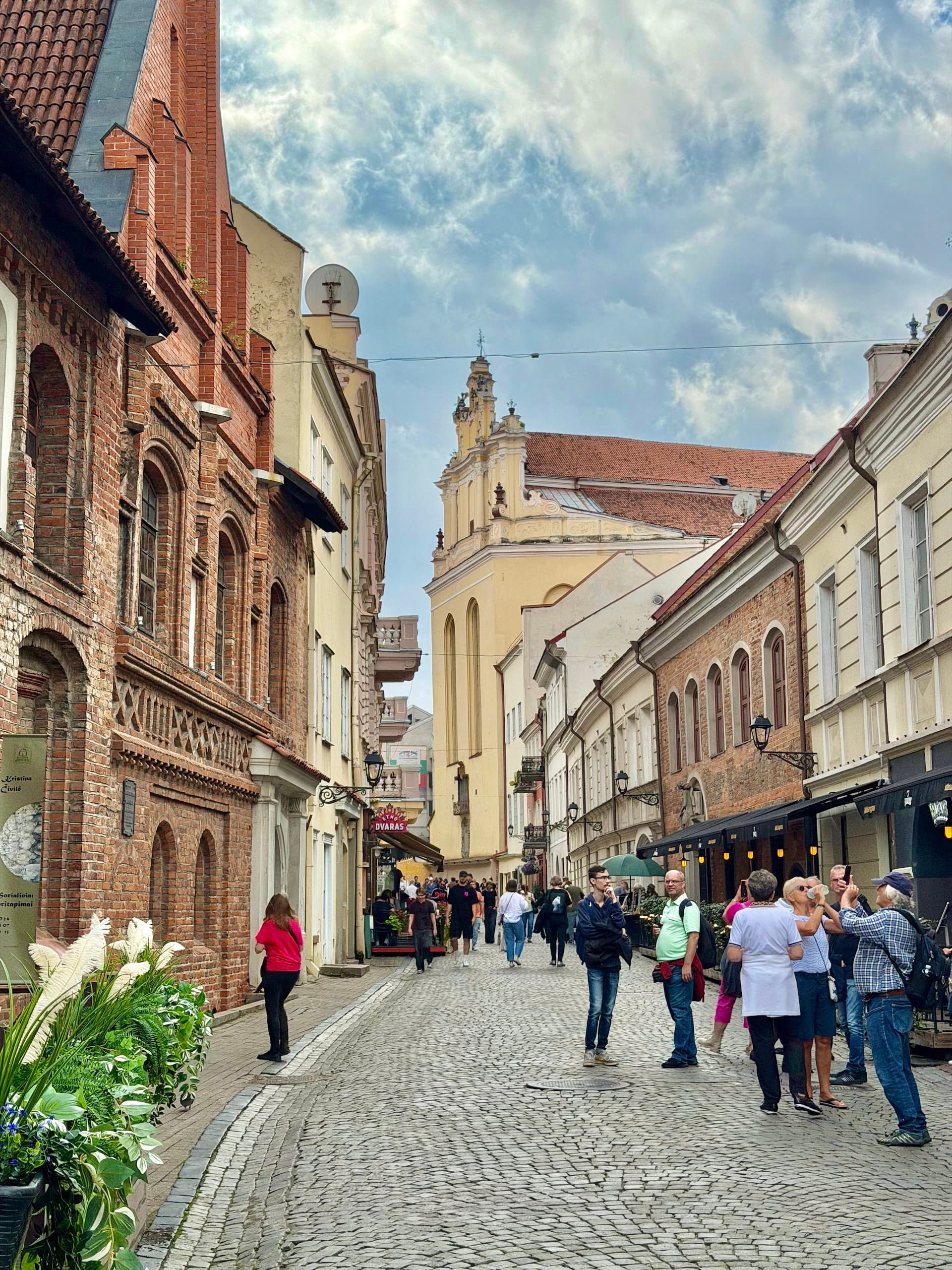
We have now been to all three together, and Vilnius is the one. It is compact, well kept, nothing in the center is rotting, the public transport works and you barely need it, and the courtyards are worth the trip on their own. Everyone we dealt with was kind, and everyone spoke English.
But that is not really why. The reason is that first evening in the pub, which felt exactly like being somewhere in Hungary fifteen or twenty years ago. The mood, the noise, the old couple working the tables, the pace at which the woman at the next table was getting through the second liter of lager while I struggled with my first. I felt at home in a way I did not expect and cannot fully account for. In fairness, two liters of beer were involved in reaching that verdict, and I am aware of what that does to a man’s sense of belonging.
Then I looked up what the name of the pub means. Būsi trečias is “you’ll be the third.” It comes from the Soviet years, when a bottle of vodka cost three rubles: a man who wanted a drink but not a whole bottle would find a second, and then the two of them would stand there holding up three fingers until a stranger agreed to be the third. A ruble each, split three ways.
The best evening of our trip was in a bar named after strangers deciding to share.