By the time Budapest gets past 35 °C (95 °F), everyone in the city is working from the same short list. There is the air conditioning at home, there is a museum, and there is the shade of a tree in a park until the worst of the afternoon has gone by. The best of those options is water, either one of the natural swimming spots in and around the city or one of the big open-air pools, which is also why several thousand other people are already on their way to one of them.
Or you can drop twenty-four degrees in about ninety seconds.
Budapest sells itself on thermal water, and fairly enough, but what the tourist board leaves out is that the same water is the reason the Buda hills are hollow. The springs and the caves are two ends of the same system. The difference, from where you are standing, is that you sit in one of them in a swimsuit and walk into the other one wearing a sweater, in August.
We went underground on a Sunday in September, not because the heat finally forced the issue but because we were both home with nothing scheduled, no errand and no family visit, and the caves are half an hour away and need no preparation at all. What put the idea in our heads was that Laszlo could not remember ever having been inside a Budapest cave, while I had been inside at least two of them as a child and remember almost none of it. Between us, that was reason enough.
Why a spa city has caves underneath it
Most caves in the world are made from above. Rain picks up carbon dioxide, turns mildly acidic, sinks through cracks in limestone and dissolves its way down.
Budapest’s caves were made the other way around.
This is the Buda Thermal Karst, and the water that hollowed it out came up from below: warm, mineral-loaded, rising through the limestone and eating it out from the inside where it met cooler karst water. Five of the caves it produced are on Hungary’s UNESCO World Heritage tentative list as a single system, and the system is still running. Molnár János cave, under Rózsadomb, is full of 20 to 23 °C (68 to 73 °F) water to this day, and that water surfaces at the Lukács Bath. The bathers upstairs and the divers downstairs are in the same plumbing.
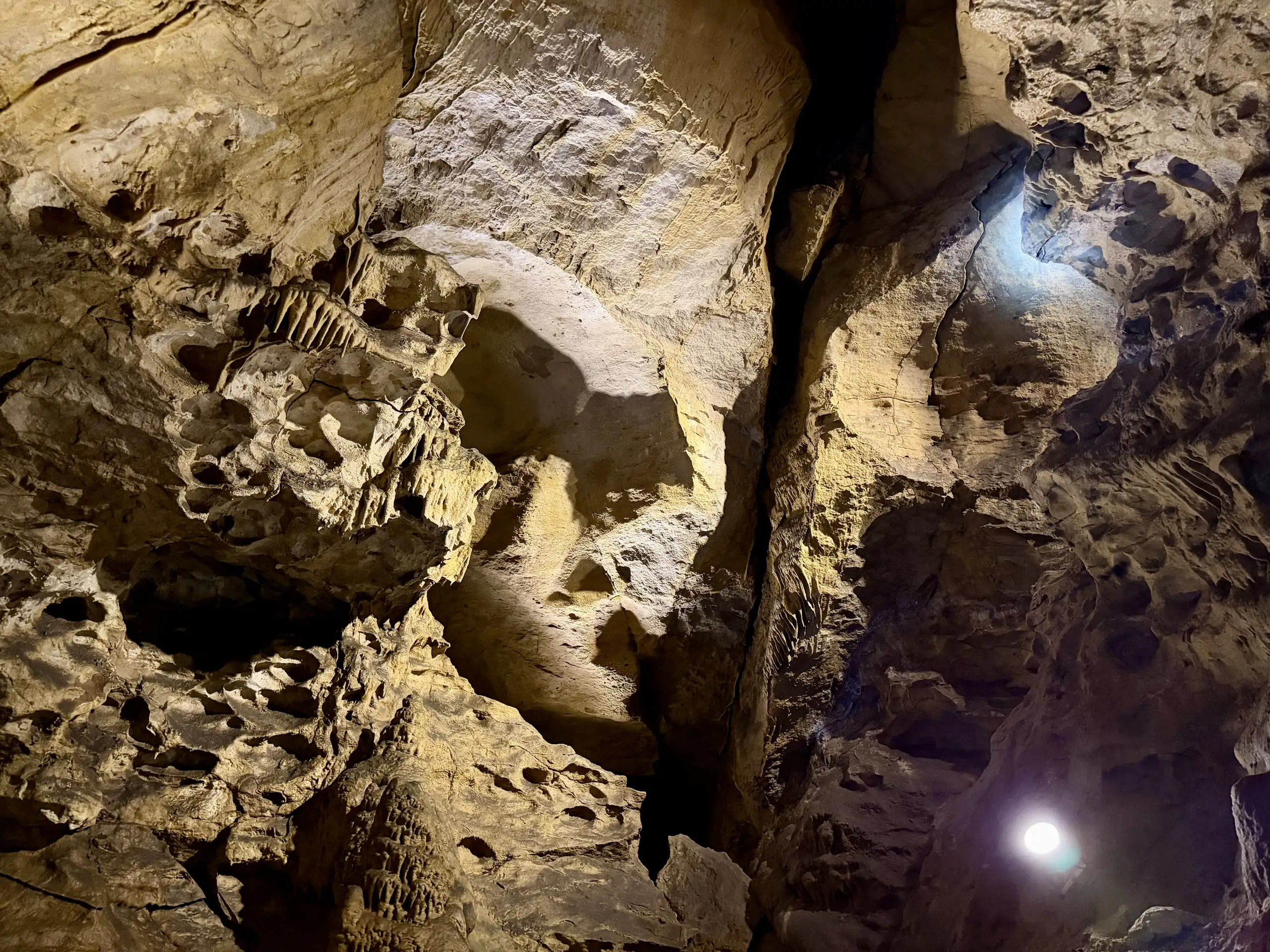
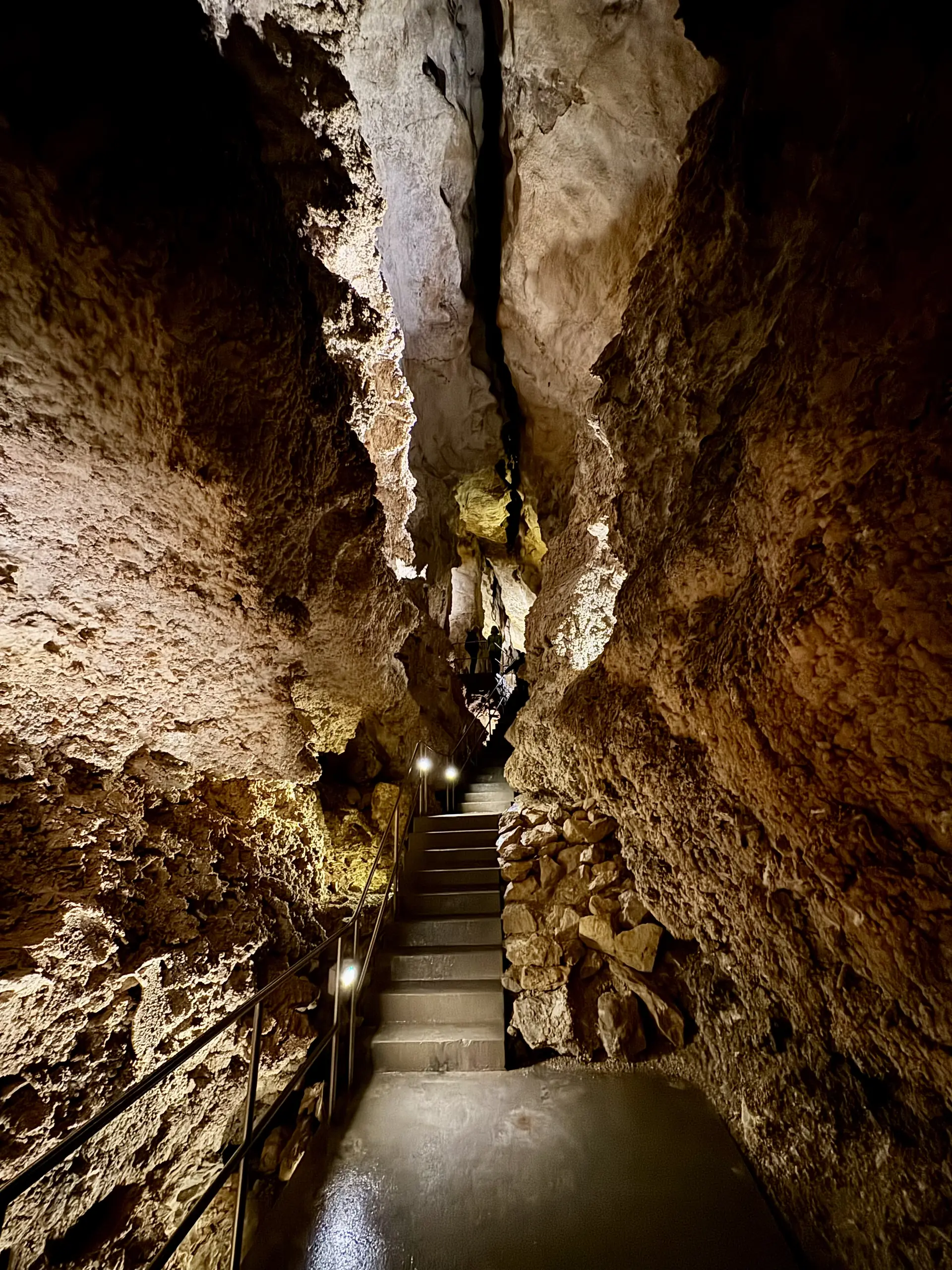
That is the thing worth knowing before you go down, because it changes what you are looking at. The pea-shaped knobs on the wall of the Szemlő-hegyi cave are not stalactites and did not drip from anywhere. They precipitated out of warm water that filled the passage. You are standing inside a cooled-down spa.
Pál-völgyi is the same story with a second chapter, which is worth spelling out because it is the one signposted as a dripstone cave. Its passages were dissolved from below as well, starting around two and a half million years ago, and then the hills kept rising, the water table dropped and the cave dried out. Only after that did water percolating from above start building the stalactites it is now named for, and in the wetter corners it still is. So Pál-völgyi has both, in that order, which is the short answer to why the two caves look nothing like each other.
The cave map: what is actually under Budapest
Budapest has over 200 known caves and roughly six ways in, depending on how you count and how much crawling you are willing to do. Here is the short version.
| Cave | What it is | Time | Effort | With kids | Temperature |
|---|---|---|---|---|---|
| Pál-völgyi | The show cave, and the spectacle. Part of Hungary’s longest cave system at 32 km, of which 500 m is built out | ~1 hour | 400+ steps, one 7 m ladder, several genuinely tight passages | From age 5 and 115 cm. No strollers | 11 °C (52 °F) |
| Szemlő-hegyi | The other show cave, and the explanation. Aragonite crystal formations, wide flat passages | ~40 min | Flat, step-free, ramps and a lift | Any age. Strollers and wheelchairs fine | 12 °C (54 °F) |
| Mátyás-hegyi | Real caving in an overall and helmet, in the unlit part of the same system as Pál-völgyi | 2.5 to 3 hours | Crawling on hands and knees and on your stomach, climbing | From school age, minimum 120 cm | ~10 °C (50 °F) |
| Buda Castle Cave | A 3.3 km system under Castle Hill where natural limestone caverns run into medieval cellars, a wartime shelter and a prison | 45 min or 1.5 hours | Easy, lit and paved | From age 5 on the short tour, 12 on the long one | 12 °C (54 °F) |
| Molnár János | Hungary’s largest underwater cave, still full of thermal water, still being explored | n/a | Cave diving certification required | No | Water 20 to 23 °C |
The Castle Cave, and where to go if you want an English guide
Before we get to the two we actually did, the Castle Cave is worth a paragraph, because it solves a problem those two create. Pál-völgyi, Szemlő-hegyi and the Castle Cave are all run by the same national park, and all three can be visited with an English-speaking guide, but only here is that a listed product with a per-person price: 7,500 Ft (~$23.8 USD) for the long tour against 5,400 Ft (~$17.2 USD) in Hungarian, or 6,200 Ft (~$19.7 USD) for the short one. At Pál-völgyi and Szemlő-hegyi it is a private group booking instead, which is covered further down. The catch here is that tickets are sold online only, with nothing available at the door, and groups are capped at 25.
So if you are in Budapest for a few days, traveling alone or as a pair, and you want one underground hour with a guide you can actually understand, this is the one, and it comes with medieval cellars and a prison attached.
Photography here needs the guide’s written permission, which is neither of the rules that apply anywhere else on this list.
And then there is the thing that regularly gets called a cave and is not quite one.
The Hospital in the Rock on Castle Hill is a WWII emergency hospital and Cold War nuclear bunker built into a natural cavity, and while it is a good museum it is not a cave visit. The practical thing to know before you buy a ticket is that photography, video and audio recording are all banned inside, with no photo permit available at any price. It is open daily from 10:00 to 19:00, the last tour leaves at 18:00, every visit is guided and takes about an hour, and groups are capped at 25, so book online.
So that is three sites and three different photography rules: encouraged with flash in the two show caves, written permission at the Castle Cave, banned outright at the Hospital in the Rock. Worth checking before you build a day around what you want to photograph.
Our choice: Pál-völgyi, then Szemlő-hegyi
We did both in one morning, in that order, and the order matters. Pál-völgyi runs tours at quarter past every hour, 10:15 to 16:15, and is the physically demanding one, so it is the fixed point you build the day around. Szemlő-hegyi runs on the hour, 10:00 to 16:00, and is shorter, flatter and more forgiving, which makes it the right thing to do second.
The timing that works: 10:15 at Pál-völgyi, out by about 11:15, walk, 12:00 at Szemlő-hegyi, done by 12:40. There is room in the middle for a pogácsa and a coffee without rushing.
The two show caves have different closing days. Pál-völgyi is closed on Mondays, Szemlő-hegyi on Tuesdays. If you are planning to do both in one day, that rules out two days of the week and it is the single easiest way to wreck the plan.
The combined ticket is 5,900 Ft (~$18.8 USD) full price and 4,700 Ft (~$14.9 USD) reduced, against 3,900 Ft (~$12.4 USD) per cave bought separately. So the two-cave day saves about 1,900 Ft (~$6 USD) a head, and more to the point, the national park sells it as a package. You are not inventing an itinerary here. They have already decided this is a thing people do.
It is also more flexible than it looks. The combined ticket is valid for a year, and it is valid in full on the day you buy it, so there is no penalty either for doing both caves in one morning or for splitting them across two visits. We bought ours at the Pál-völgyi desk and showed it again at the Szemlő-hegyi desk, which is all there is to it.
One thing worth knowing before you pay for anything: the Budapest Card covers Pál-völgyi and gets you in free, but it does not cover Szemlő-hegyi, which has been dropped from the card’s lineup. So if you hold a card, the sensible version of this morning is the free entry at Pál-völgyi plus a single 3,900 Ft ticket at Szemlő-hegyi rather than the combined ticket at all. More on the card in our Budapest public transport guide.
What language is the tour in?
This is the fact an English-speaking visitor most needs and it is buried on the national park’s own site: the live guiding is in Hungarian.
What you get instead is a free audioguide app called Guide Now, in English, German, French, Spanish, Russian, Ukrainian, Italian and Polish, and it is the official solution rather than a workaround. Download it before you go, from Google Play or the App Store. Officially the app is the only version there is, but there were foreigners on both of our tours and the Slovak family doing the same two caves on the same day was using a handset from the desk rather than a phone. The devices exist whatever the website says, so ask.
The guide will also give the safety instructions in English, and if their English is good they will usually take questions. A real English-speaking guide rather than a recording is a private booking arranged at least three days ahead, and Szemlő-hegyi prices it at 16,000 Ft (~$50.9 USD) per group, which is reasonable split between five people and absurd on your own. That is the gap the Castle Cave fills.
Download the audioguide app before you go up the hill. There is no mobile signal underground and you do not want to be the person standing at the entrance waiting for an install while a tour of 35 people walks in without you.
Getting there
Both caves are on the Buda side above Óbuda, and the whole thing hangs off Kolosy tér.
The simplest way there from the center is bus 9, which starts at Deák Ferenc tér and runs across to Óbuda, and you get off at Kolosy tér. From there it is bus 65 or 65A up Szépvölgyi út to the Pál-völgyi-cseppkőbarlang stop, with the visitor center across the road, or bus 29 if you are going straight to Szemlő-hegyi, which drops you about 100 m from the entrance. Whichever pair you end up taking, Kolosy tér is where you change. About 35 minutes door to door.
More on the network, and on the Budapest Card, in our public transport guide.
Pál-völgyi: stairs, then more stairs
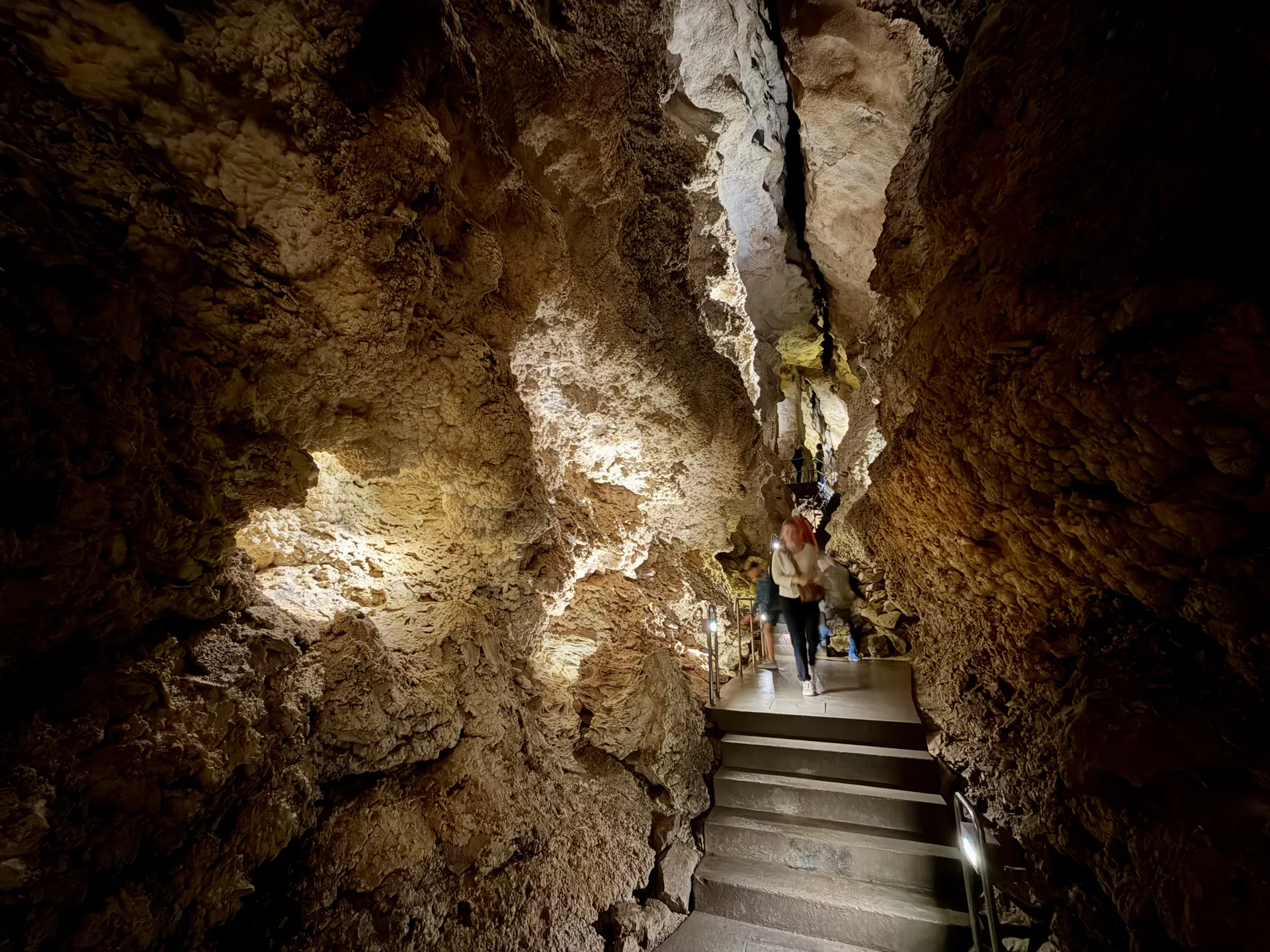
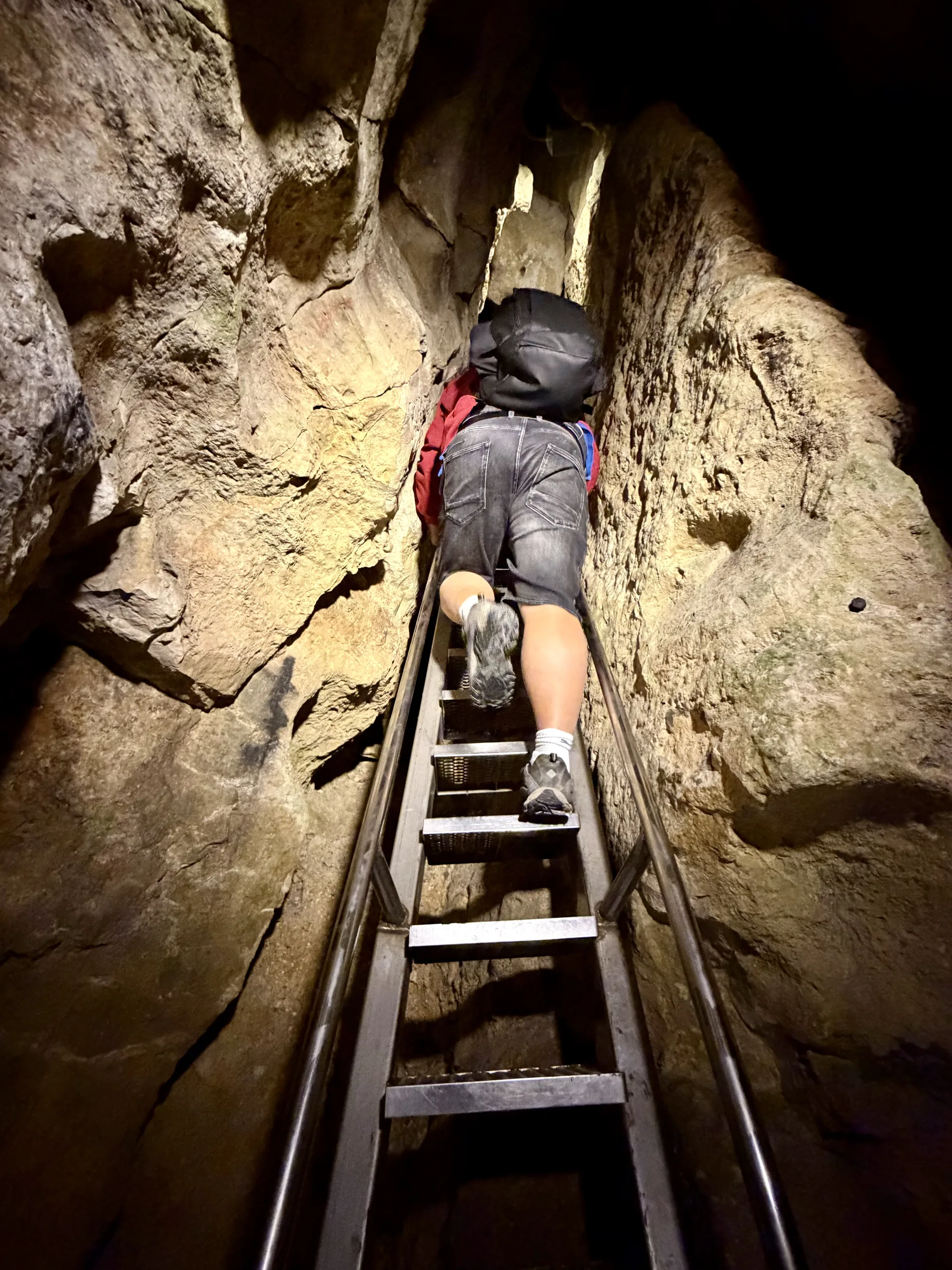
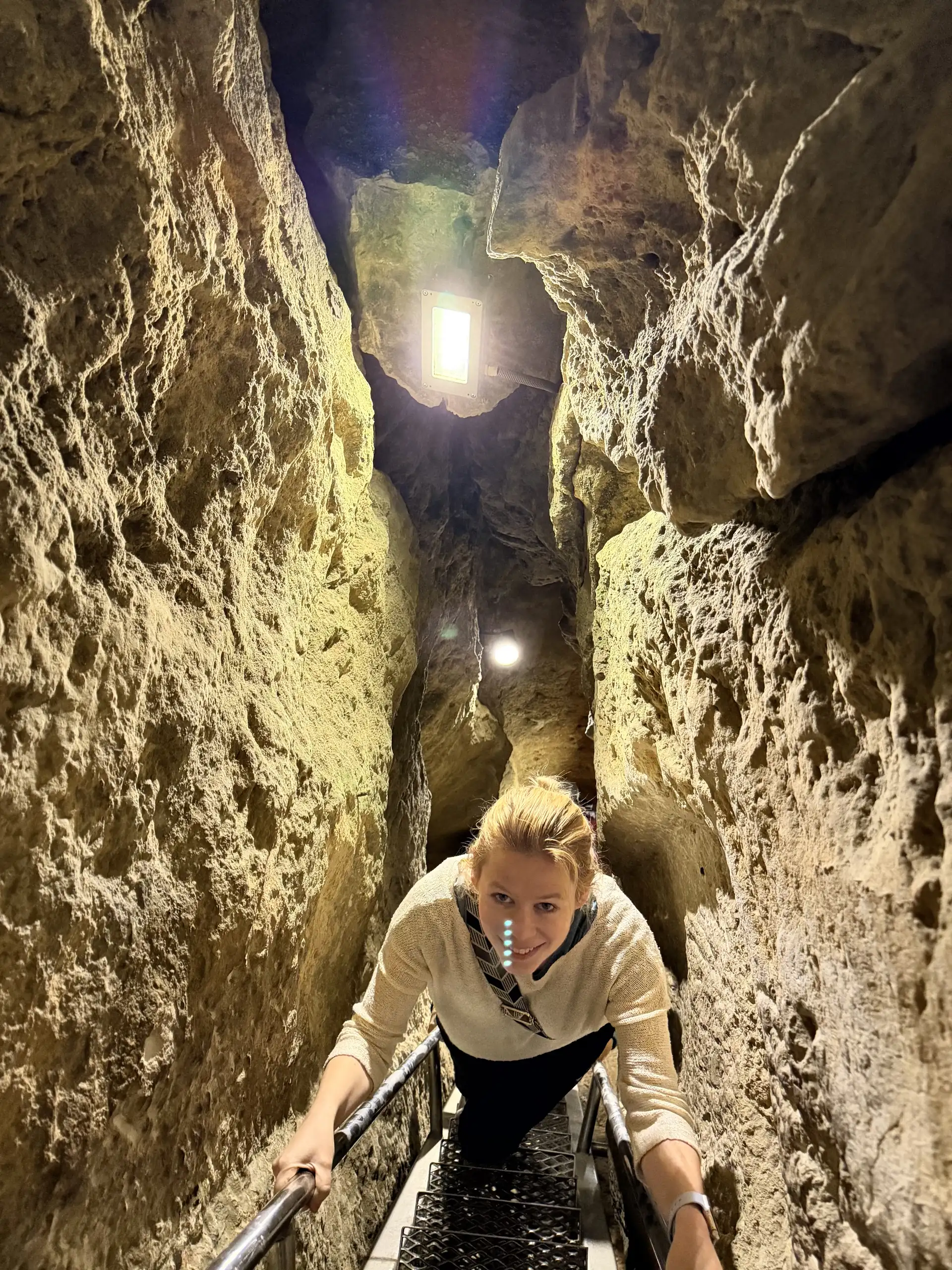
Pál-völgyi is a lot of stairs. Over 400 of them, plus one 7 m (23 ft) ladder, both with railings. There are passages where you turn sideways to fit, and there are places where you keep your hands to yourself. A guide will tell you that once, politely, and mean it permanently, and the reason is better than a rule for its own sake: the oils and acids on a human hand coat the crystal surface, water stops depositing minerals on that spot, and the formation stops growing there. These things build up drop by drop over thousands of years, so one careless hand is effectively permanent.
None of the descent is frightening, and the stairs are the whole of the difficulty. There was a woman in her mid-seventies on our tour who did all of it, slower than the rest of us and without stopping. At that pace it is not tiring for an ordinary adult. It is pleasant, and the fact that the steps are slightly slippery is part of the appeal rather than a problem.
The one thing that actually bothered me was the handrail. It is 11 °C down there and the metal has been 11 °C for a very long time. You hold on, and your hands stay cold for the rest of the hour.
The cave was found in 1904, in a working limestone quarry, which is the part of the story that matters here: an industrial hole in the ground turned out to be something else entirely, and that is more or less the recurring plot of everything under this city.
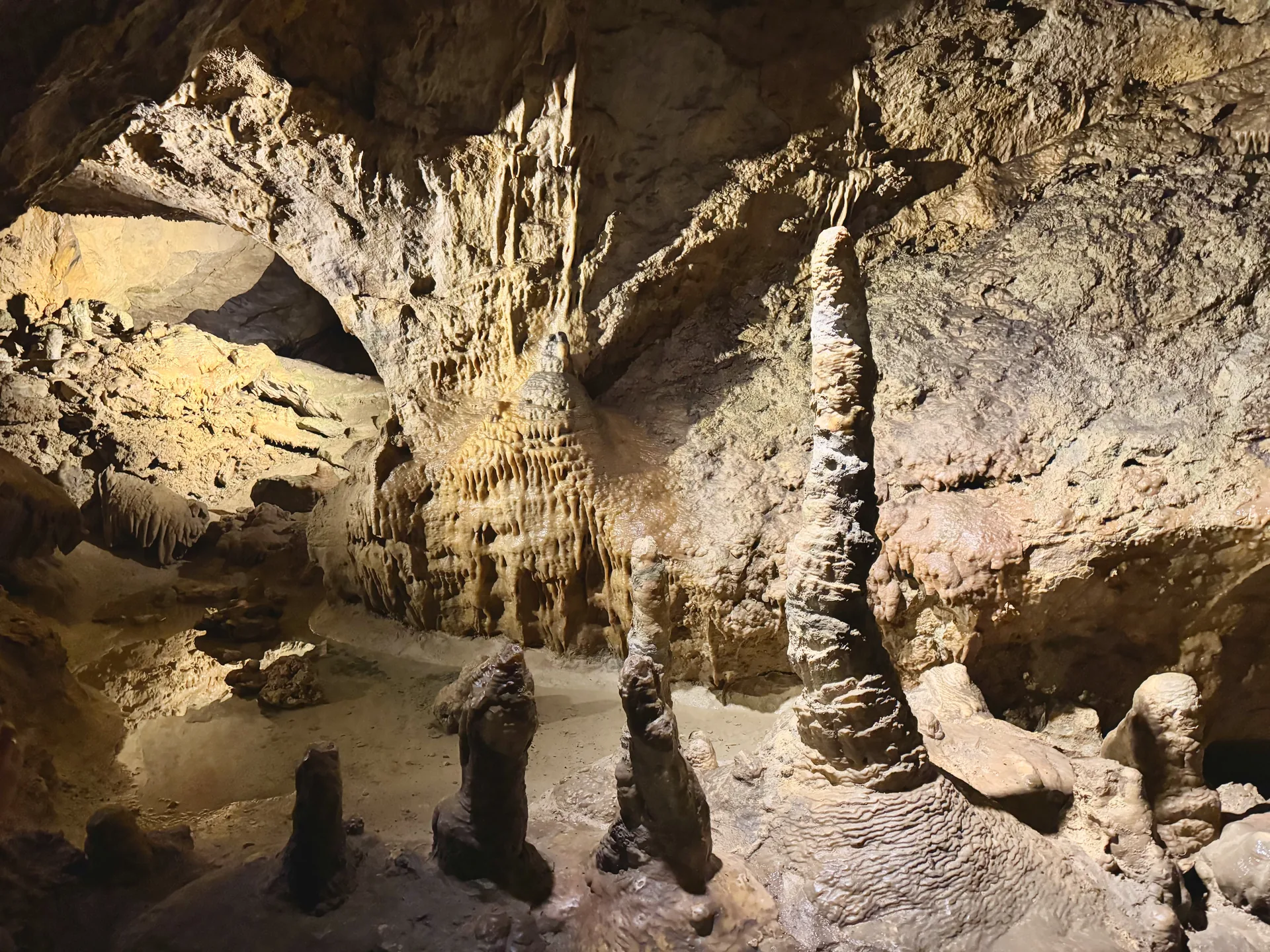
The walls are full of the evidence. Shells, snails, corals and nummulites, single-celled organisms the size of a coin, sitting in the rock at eye level, from a sea that was here about 40 million years ago.
And then there are the names. The guides have had 120 years to name things and it shows. The Witch’s Kitchen, where spherical erosion pockets hang off the ceiling like cooking pots. The Theatre Hall, the largest chamber, with broken stalactite curtains. The Sword of Damocles, a wedged block that, according to the guides, only falls on the unfaithful. Fairyland, where the shapes read as Snow White and the seven dwarfs, Red Riding Hood and the wolf, if you are willing to meet them halfway.
The other thing living down there is bats. Pál-völgyi has a natural entrance, which means it has animals, and the national park runs dedicated bat-watching tours in winter on the strength of it. On the ordinary tour you may or may not get lucky.
We got lucky on both counts. One went past us in the passage, right beside us, and a little later the children in the group spotted the rest of them through a grate in the floor, which stopped the whole tour for a few minutes while everyone crouched over it in turn. They are very small, they are genuinely interesting to watch, and there is nothing frightening about them whatever you may have assumed. The whole group was delighted.
The witch is the running joke of both caves, and the guides tell the same story in each of them: she has moved out of the Witch’s Kitchen and gone over to Szemlő-hegyi, where there is indeed an iron-nosed witch waiting in one of the passages, and you are invited to shout across and check.
Whatever the weather is doing outside, bring a layer with sleeves and wear shoes with grip. It is 11 °C down there and the steps are wet. And if you are carrying a camera, bring a cloth: going from a 35 °C street into an 11 °C cave and back out fogs the lens both ways.
The walk between them: 1.2 km, and two streets named after what is under them
The two caves look close together on a map, about 800 m apart in a straight line. On foot it is 1.2 km and roughly 18 to 20 minutes, down about 27 m and then back up about 17 m.
The route is Szépvölgyi út, Zöldmáli lejtő, Felső Zöldmáli út, then Barlang utca and Karszt utca. Cave Street and Karst Street. The surface has been quietly naming what is underneath it this whole time.
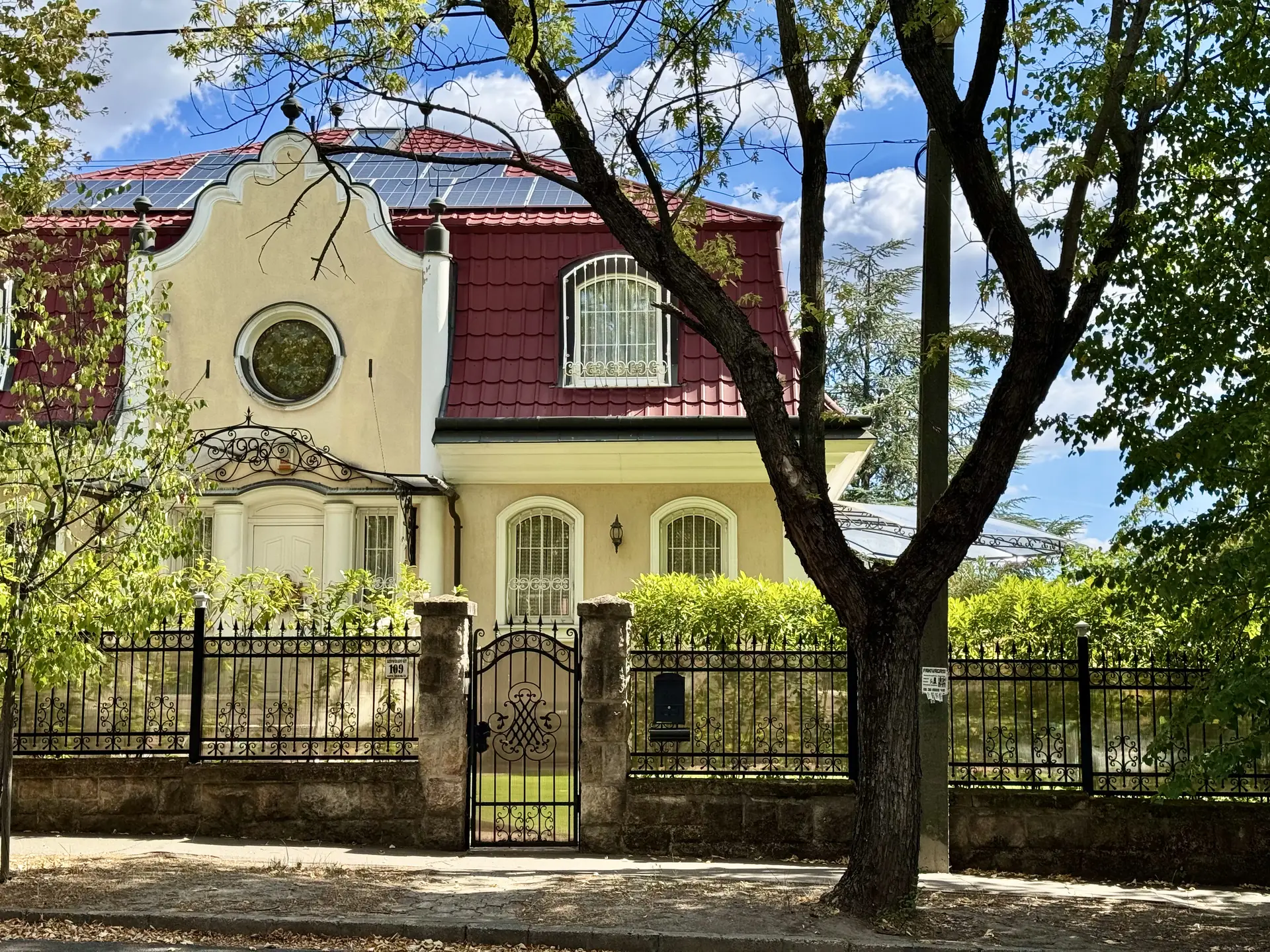
It is a good walk in its own right. Quiet interwar villa district, gardens, the kind of Budapest that does not appear in anybody’s three-day itinerary.
One caveat that matters: Szemlő-hegyi is fully wheelchair accessible, and this walk is not. It has gradients and patchy pavements. If step-free is the requirement, take bus 65 back to Kolosy tér and bus 29 up, or go straight to Szemlő-hegyi and skip Pál-völgyi entirely.
We did not stop anywhere. We walked, and I photographed a house I liked.
Szemlő-hegyi: the one that explains the other one
Szemlő-hegyi is 40 minutes, flat, and the only one of the two you can do with a stroller or a wheelchair. There are ramps, a lift and an induction loop in the cinema, and the park also lists Braille route summaries to borrow at the desk and tactile guidance for visitors with limited sight. A genuinely step-free show cave is a rare thing, and this is one, which is worth saying plainly rather than burying in a list of facilities.
There is no natural entrance, which is why, unlike Pál-völgyi half an hour’s walk away, nothing lives in it.
The cave was found in 1930, during quarrying on the hillside, and the first people down, Kessler Hubert, Futó András and Sebős Károly, had to widen a hole and drop through a shaft. What they found past a clay squeeze was nearly a kilometer of passage with, in the phrase the Hungarian sources keep reusing, unbelievable crystal richness.
Our guide added a detail the written sources do not carry: that the hole appeared during construction work, that somebody tried to plug it, and that the plugging failed because there was no bottom to reach. The sources say quarrying rather than construction, on the land of a pharmacist named Miklóssy Géza. The two versions have been running alongside each other for most of a century and we are not going to settle them here.
The narrow squeeze is still there, and it is called the Tű foka, the Eye of the Needle. The first person through it, in 1930, was a caver named Szekula Mária, and the hall on the far side carries her name. You are not asked to repeat the feat: when the visitor route was built they opened a way underneath, so you pass below it and look up at it instead.
Past that, the passages open out. Where Pál-völgyi is a corridor system you squeeze along, Szemlő-hegyi is wide, tall and smooth, and the two make more sense seen back to back than either does alone.
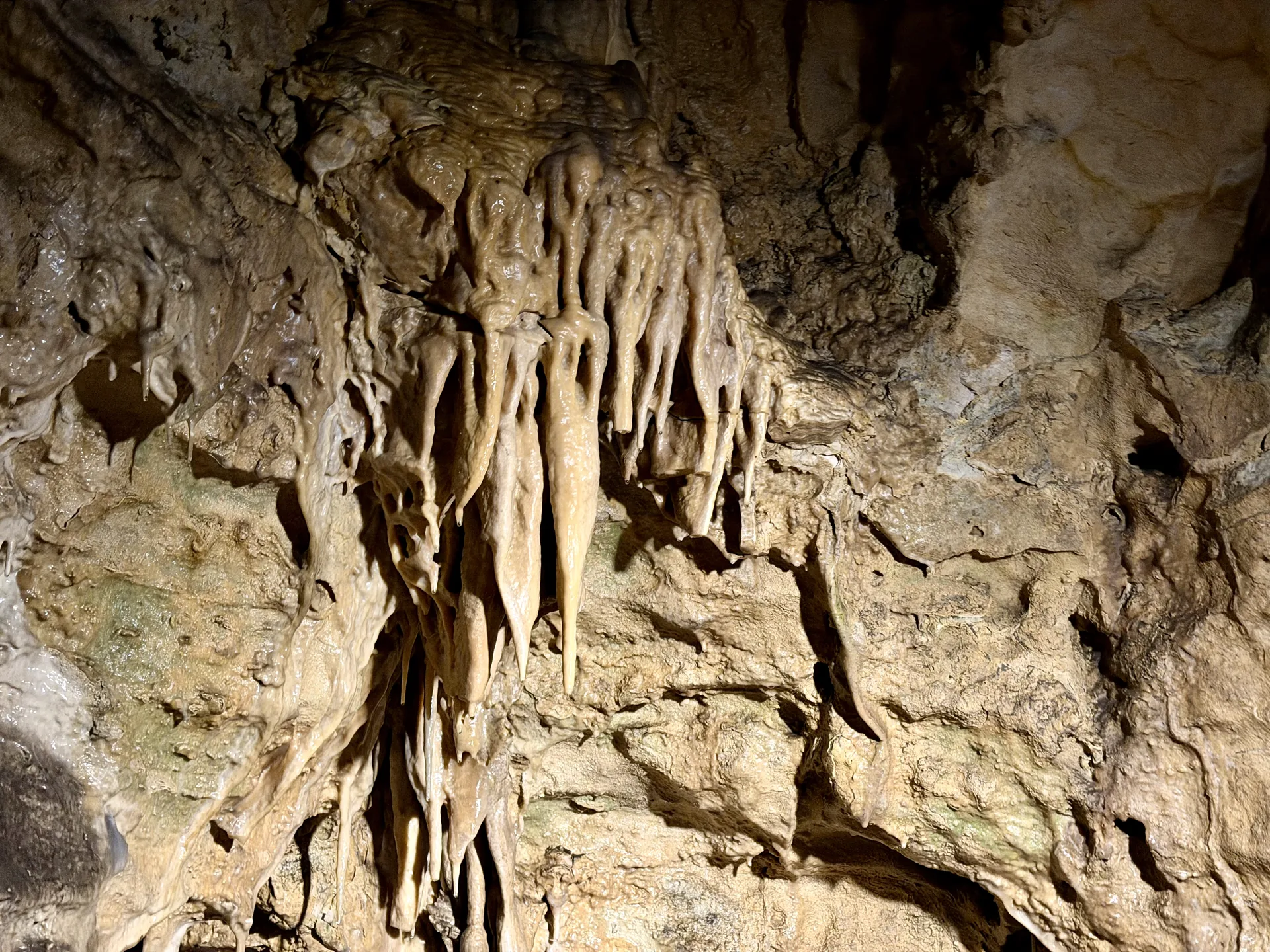
The formations are the reason to come, and none of them are stalactites. Pea-stone is a knobbly aragonite crust that bulges off the wall in clusters, cauliflower stone is the same process gone bigger and more ridiculous, and both precipitated out of standing warm water rather than dripping from a ceiling. Along the Long Corridor there are calcite plates stacked against the walls, formed at the surface of water that filled these passages for long stretches and then left behind as it drained, and they do genuinely look like sheets of pasta someone put out to dry.
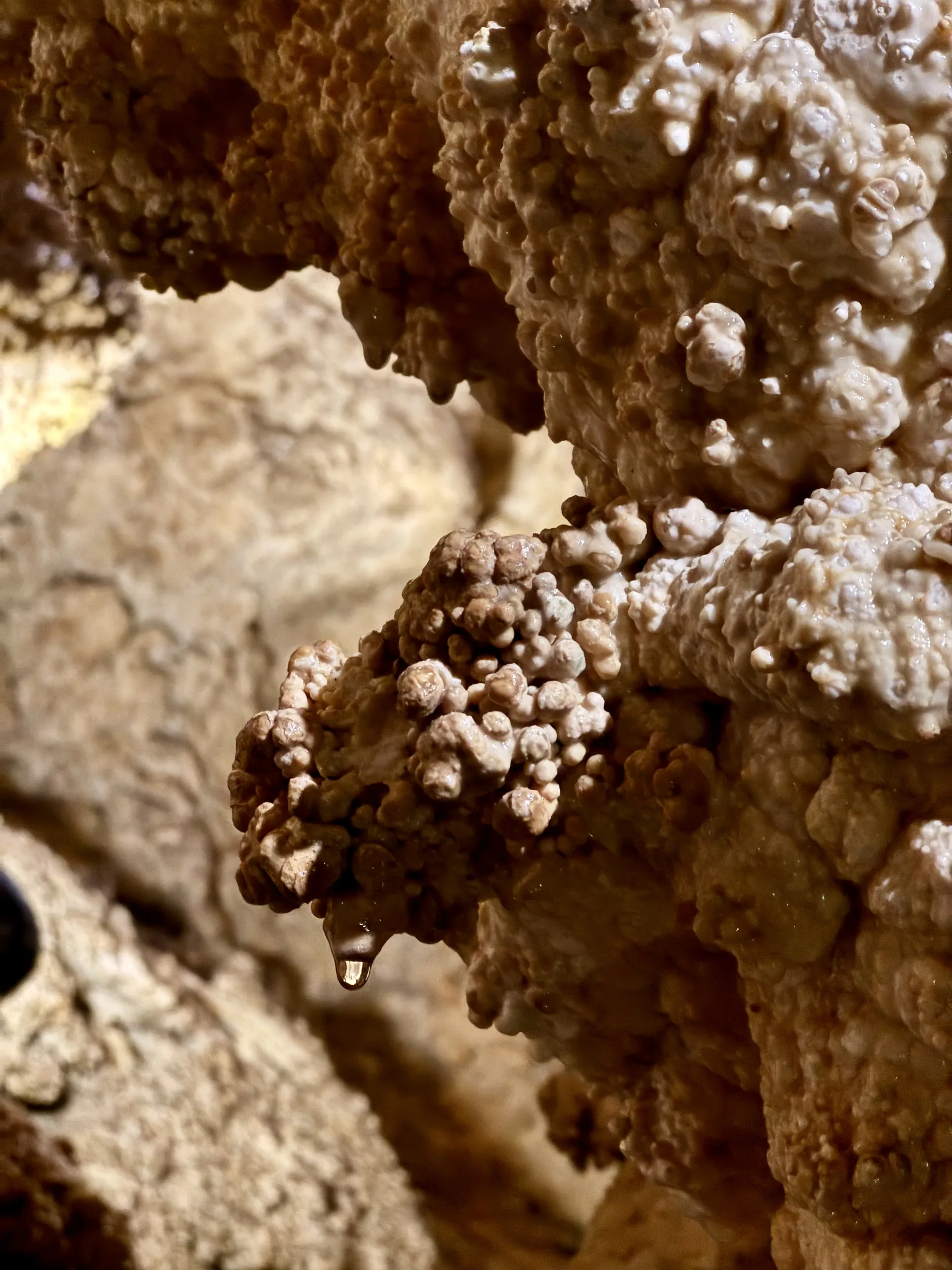
The pea-stone is at its best where the path turns and puts you in front of a wall so thickly covered in the stuff that the cave’s nickname, Budapest’s underground flower garden, stops sounding like marketing. That section is called the Flower Garden, and for once the name is a description rather than a flourish.
There is also the shaft. Fifty meters, vertical, dug for a lift that was never installed, and now used by the Hungarian Cave Rescue Service for training. It is also the best echo in the place, and you are allowed to test it.
The lights go out
At some point on the tour, in both caves, the guide switches everything off, and this is the part that stays with you afterwards. Not dimmed down to a glow, which is roughly what you brace for, but off completely, in a way nothing above ground manages even on the darkest night you have ever stood in.
It lasts twenty or thirty seconds, and the interesting part is not the dark itself but what your brain starts doing with it once there is nothing coming in. Wave your hand in front of your face during it and you will be entirely certain you can see it moving. You cannot.
Above ground there is an exhibition, a 3D film, a geological trail through eight Hungarian building stones, and a playground, which is more than the usual show-cave afterthought and the reason this is the one to do with children.
It is also where you are allowed to touch. Nobody can be let loose on the pea-stone underground, so samples are set out up here to be handled instead, which is a considerably better answer to the urge than another sign telling you not to.
If two lit walkways are not enough: adventure caving in Budapest
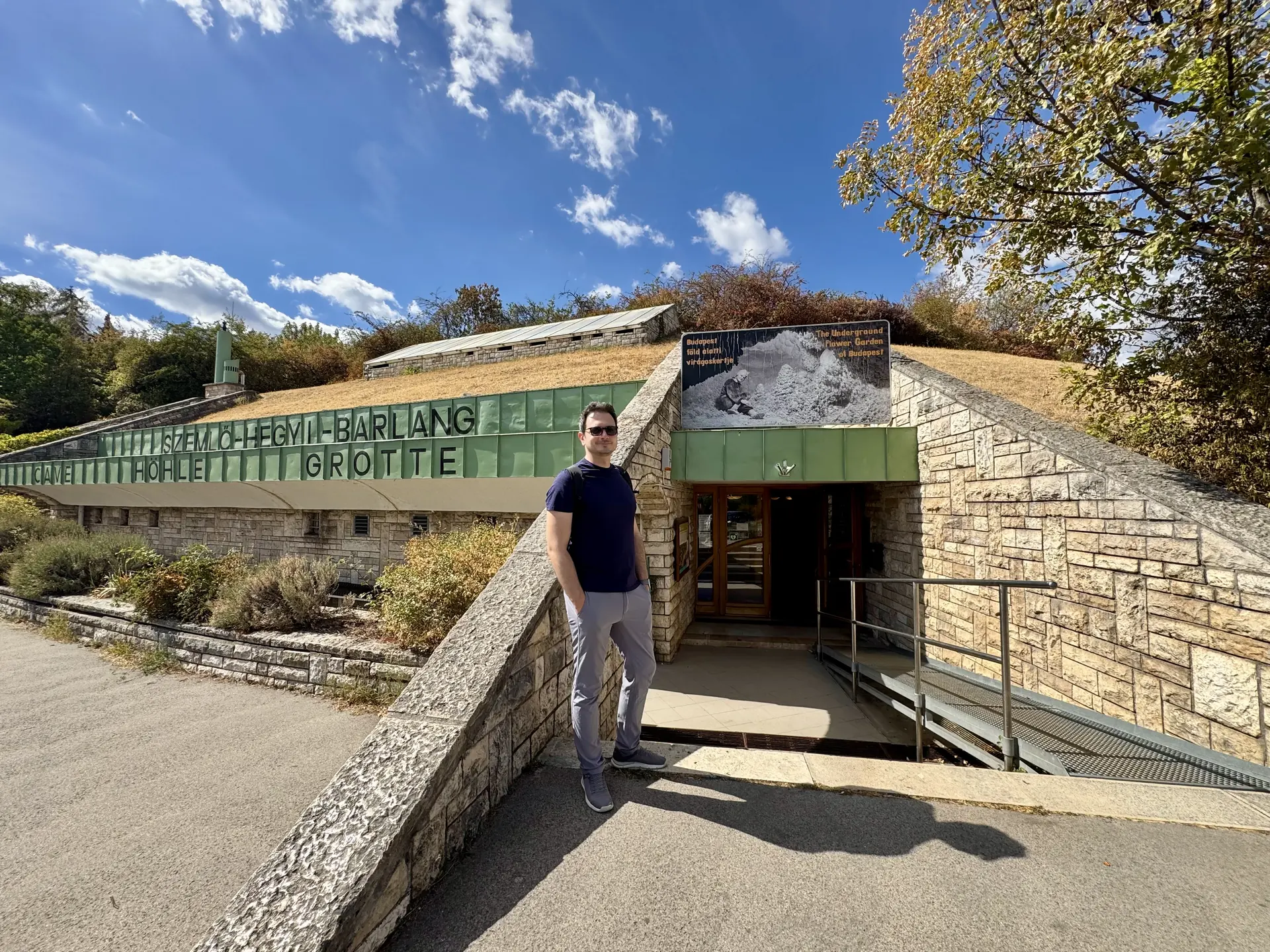
Both show caves are lit, railed and done in street clothes. If that sounds like a museum, the same limestone offers the other version, and the banner on the wall at the entrance advertises it by name: adventure caving. It means a guided tour through the unbuilt part of the cave system, in an overall with a helmet and a headlamp, where there is no walkway and you get through the original passages on your hands and knees.
The one to book is the Mátyás-hegyi cave, the unlit continuation of the same system as Pál-völgyi. The park’s own wording is that there is no constructed route and that you will repeatedly be on all fours or sliding on your stomach, but that no previous experience is needed, only a sporty disposition. It runs 2.5 to 3 hours, and what the park says you come away with is not only how these caves and their formations and fossils were made, but how a group looks after each other underground. School age upward, minimum height 120 cm.
What the Mátyás-hegyi cave tour costs and how to book it
14,700 Ft (~$46.7 USD) full price and 9,000 Ft (~$28.6 USD) reduced, plus a 200 Ft registration fee per person. Groups of ten or more from a school pay 7,500 Ft (~$23.8 USD) a head. The reduced rate wants a student card, so bring it. There is also an extreme version, three hours, 19,900 Ft (~$63.3 USD), from age 14.
So the basic tour is roughly four times the price of walking through Pál-völgyi on a handrail, and the difference is that nobody has built you a handrail.
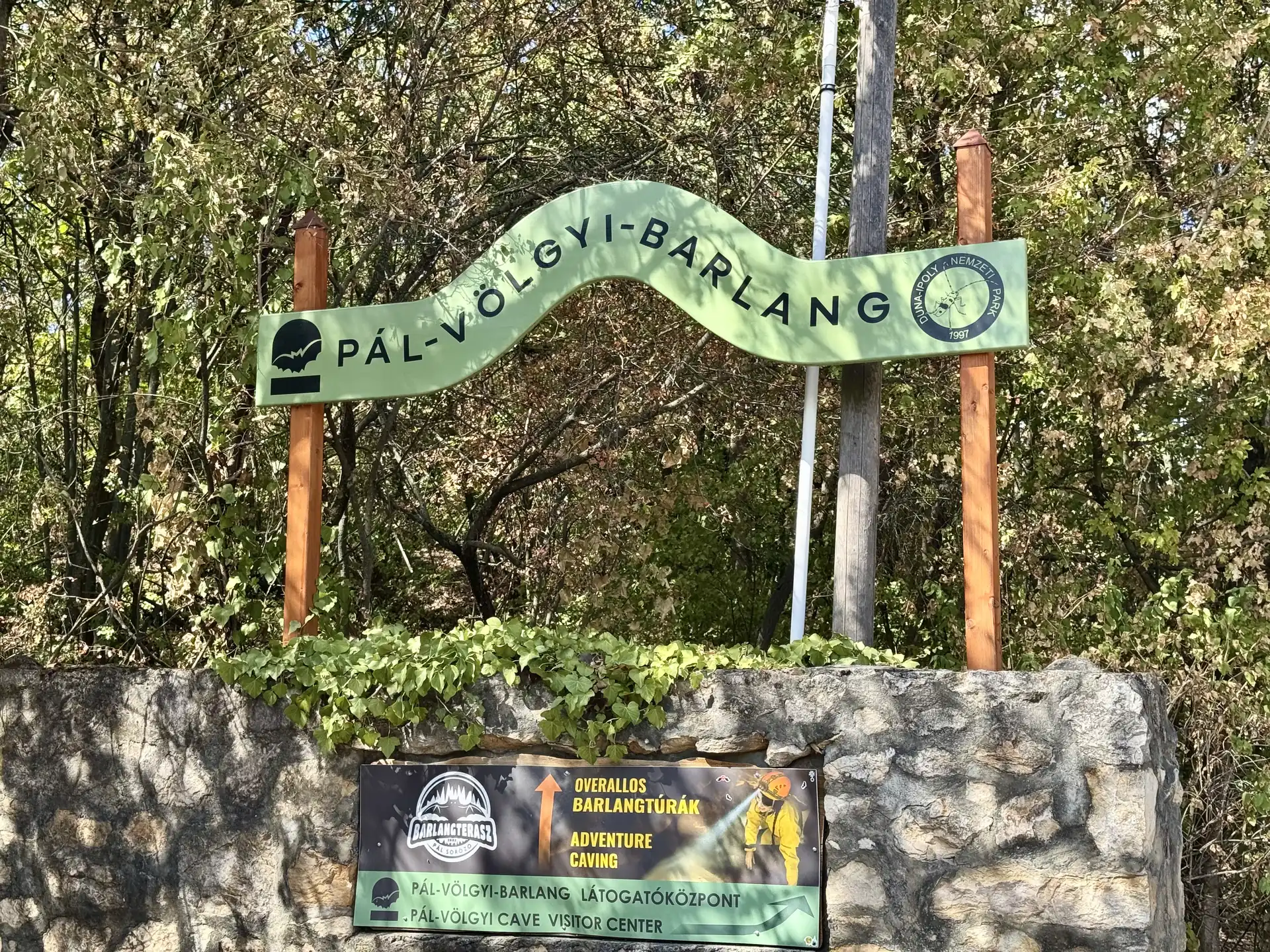
It runs all year and has to be booked in advance, through barlangaszat.hu. You meet at Szépvölgyi út 162, the lower building at the Pál-völgyi visitor center, which is the same bus 65 stop from Kolosy tér that gets you to the show cave.
We have not done this one ourselves, which is why this section is shorter than the two above it.
Caves elsewhere in Hungary
None of this is the best cave in the country, and it is worth saying so. The Baradla at Aggtelek is Hungary’s only natural World Heritage site, a 25.5 km system running under the Slovak border and about three hours away by car. Tapolca near Balaton is the one you row through in a boat. Abaliget near Pécs is quieter and plainer, with a bat museum next door. Miskolctapolca is the odd one out, because it is not a cave you walk through at all. It is a thermal bath you swim in, in natural cave passages, and it reopened in August 2026 after a fire had closed it for nearly two years.
All of those are day trips or overnights rather than a morning, and they are a different article. If what you have is a free morning in Budapest, the two caves above are what is actually within reach.
So which cave is for you?
If you want one easy hour and nothing strenuous: Szemlő-hegyi. Forty minutes underground, flat the whole way, the better formations, the exhibition and the playground. The only one that works with a stroller, a wheelchair, a small child or knees that have opinions.
If you have a morning and stairs are not a problem: do what we did. Pál-völgyi at 10:15, walk down through Barlang utca and Karszt utca, Szemlő-hegyi at noon, out by half past. Buy the combined ticket. It is the better version of both caves, because each one answers a question the other leaves open.
If you want the adventure: the Mátyás-hegyi tour in an overall. Three hours, crawling, proper caving with a guide, in the unlit part of the same system you just walked through on a handrail.
If you only want the water: that is the same system too. Go to the Lukács and think about what is underneath you.
And the wider point is that this works in any weather, which is more than most of Budapest manages. It is 11 °C down there in August and 11 °C down there in January, so on a 35 °C day it is the coldest public space in the city, and on a gray afternoon in February it is warmer underground than it is on the street. It is two buses from the middle of town, and you are back above ground in time for lunch.
Would I go back? Not next year, and probably not for several, although that is less of a judgment than it sounds like. Caving is not something anybody does weekly, and if I did work up the nerve to go again it would not be to walk a lit handrail a second time, it would be to put on an overall and crawl. If the question is simply whether we enjoyed the morning, the answer is yes.
Caving in Budapest: practical questions
Can you actually go caving in Budapest?
Yes, and in three different registers. Two lit show caves you can walk in street clothes (Pál-völgyi and Szemlő-hegyi), a guided caving tour in overalls through the unlit part of the same system (Mátyás-hegyi), and cave diving in Molnár János for people with the certification.
Which Budapest cave is the best one to visit?
Szemlő-hegyi has the better formations and is far easier. Pál-völgyi has the bigger spectacle and the harder walk. If you can only do one and you want to be impressed without working for it, go to Szemlő-hegyi. If you want the two-cave day, start with Pál-völgyi.
How cold are the caves in Budapest?
Pál-völgyi is a constant 11 °C (52 °F), Szemlő-hegyi 12 °C (54 °F), all year. That is the appeal in a heatwave and the reason to bring sleeves in any season.
Are the Budapest caves suitable for children?
Szemlő-hegyi, yes, at any age, with a stroller if you need one, and there is a playground and a 3D film above ground. Pál-völgyi has a minimum age of 5 and a minimum height of 115 cm, and 400 steps. The Mátyás-hegyi caving tour takes children from 6 and 120 cm, but it is three hours of crawling.
Do you need to book a Budapest cave tour in advance?
Not for the two show caves as an individual visitor. Tours run to a fixed timetable and you buy at the desk, at least 10 minutes before departure. There is a cap of 35 people per tour at Pál-völgyi, but a September Sunday was nowhere near it. Both of our tours ran with twelve to fifteen people, which is a comfortable number in a passage that narrow. The Mátyás-hegyi caving tour has to be booked ahead.
Are the cave tours in English?
The guided tour is in Hungarian. There is a free audioguide app in eight languages including English, and the guide will give the safety briefing in English and usually take questions. A real English-speaking guide is a private booking at both caves, three days ahead and priced per group. The Buda Castle Cave is the one that sells English tours per person.
What should you wear?
Closed shoes with grip, because the steps are wet, and a layer with sleeves, because it is 11 to 12 °C down there whatever the month is doing above ground. For the overall tours you get the overall, helmet and lamp, and you wear leggings or joggers and a long-sleeved top underneath.