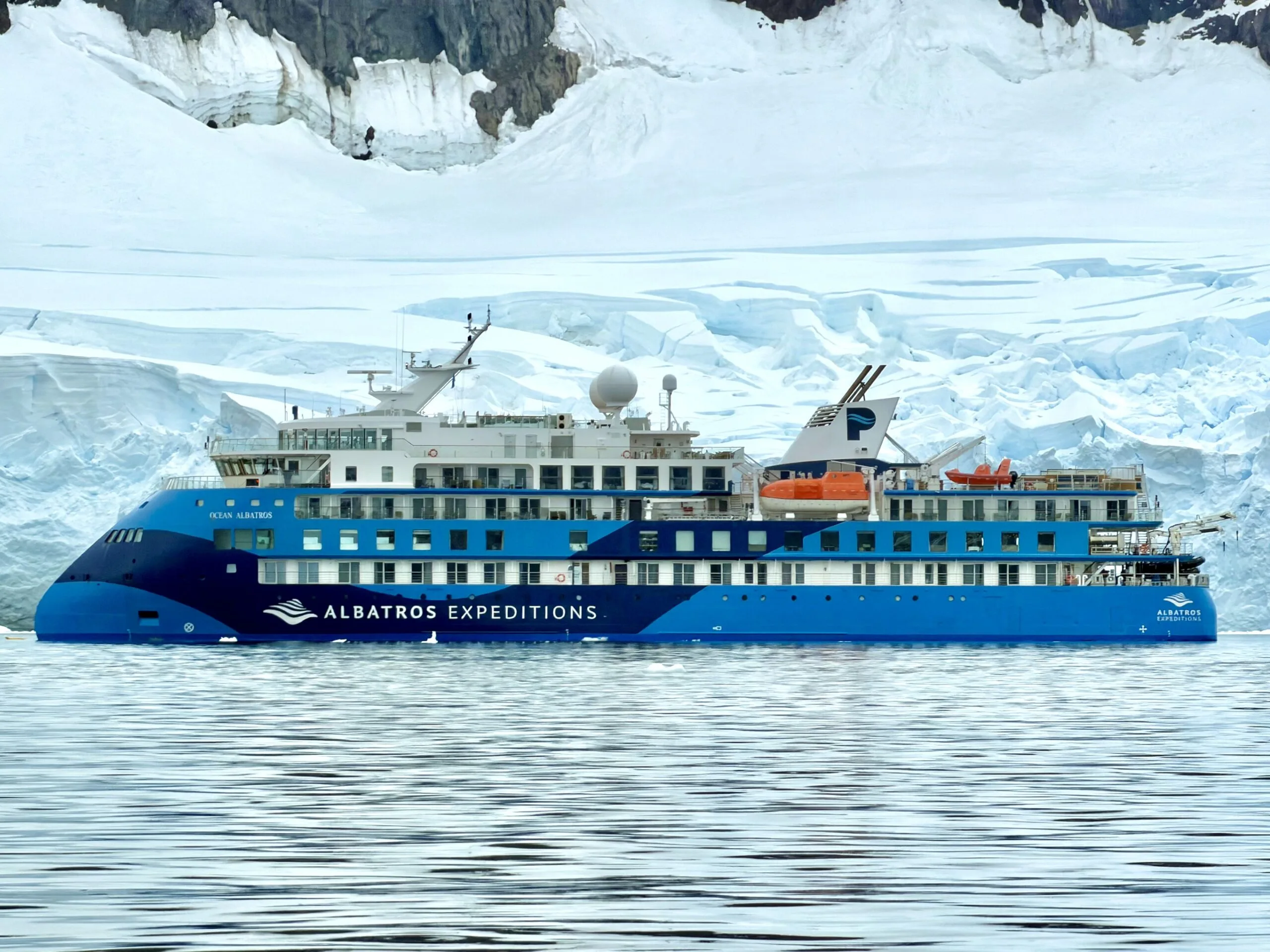
Before our Antarctic voyage, the longest boat trip I had ever taken was an overnight cruise in Vietnam’s Ha Long Bay – which is to say, I had absolutely zero cruising experience when we stepped aboard the Ocean Albatros. (However Andrea had been on a cruise ship before in the Caribbean.) That turned out to be a non-issue. For one thing, roughly half our fellow passengers were in the same boat (pun very much intended). For another, the expedition team made it clear almost immediately: this is not a cruise – this is an expedition. What that actually means in practice is something we’ll get into shortly.
This article is here to walk you through what a typical day looks like on an Antarctic expedition ship, how things work on board, and what you can realistically expect – beyond, of course, being part of one of the most extraordinary experiences of your life. Our firsthand experience is specifically with the Ocean Albatros, operated by Polar Latitudes (formerly Albatros Expeditions), so that’s what we’ll focus on. That said, most ships of a similar size and category operate in much the same way, so you’ll find plenty of useful information here even if you’re sailing on a different vessel. And if you are joining the Ocean Albatros to explore the seventh continent – you’ve come to exactly the right place.
If you’re still in the planning stages of your Antarctic trip, check out our complete planning guide and our full Patagonia and Antarctica itinerary. And for a deep dive into how to pack for Antarctica and Patagonia with just a single carry-on bag, head over to our one-bag packing list.
A Quick Introduction to the Ocean Albatros
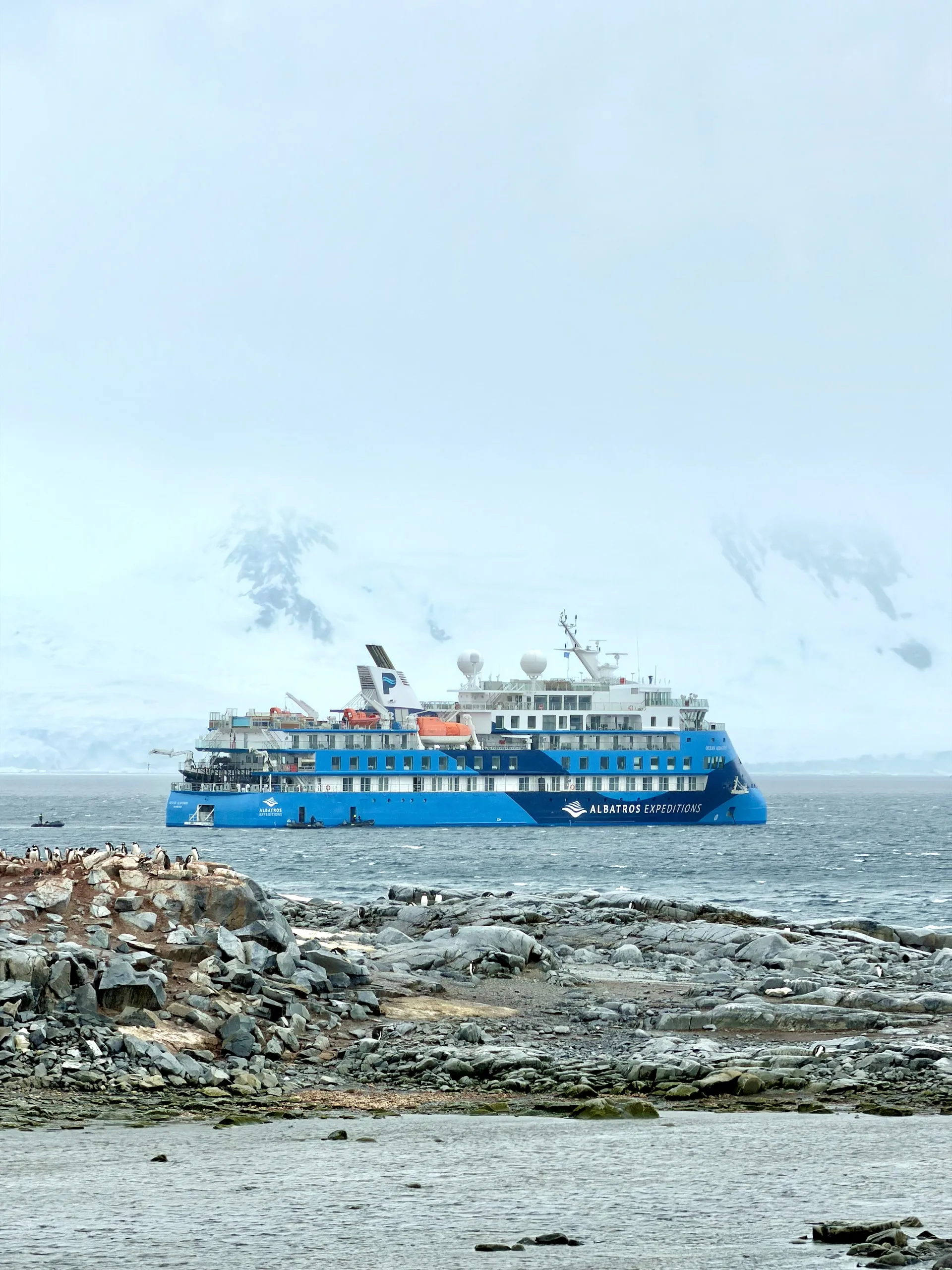
The Ocean Albatros is a relatively new ship – she was built in 2022 and entered service in June 2023. Designed by the Norwegian marine engineering firm Ulstein and constructed at the China Merchants Heavy Industry (CMHI) shipyard in Haimen, China, she’s the sister ship of the Ocean Victory. When we booked our trip, the ship was still operated by Albatros Expeditions, a Danish company that was subsequently acquired by Polar Latitudes – so that’s who runs the show now.
The ship accommodates around 160-180 passengers in 95 staterooms and suites, with a crew of roughly 100. That crew is made up of three distinct groups: the hotel staff, the nautical team (engineers, officers, the captain), and the expedition team – the scientists, photographers, and guides who are the heart and soul of the Antarctic experience.
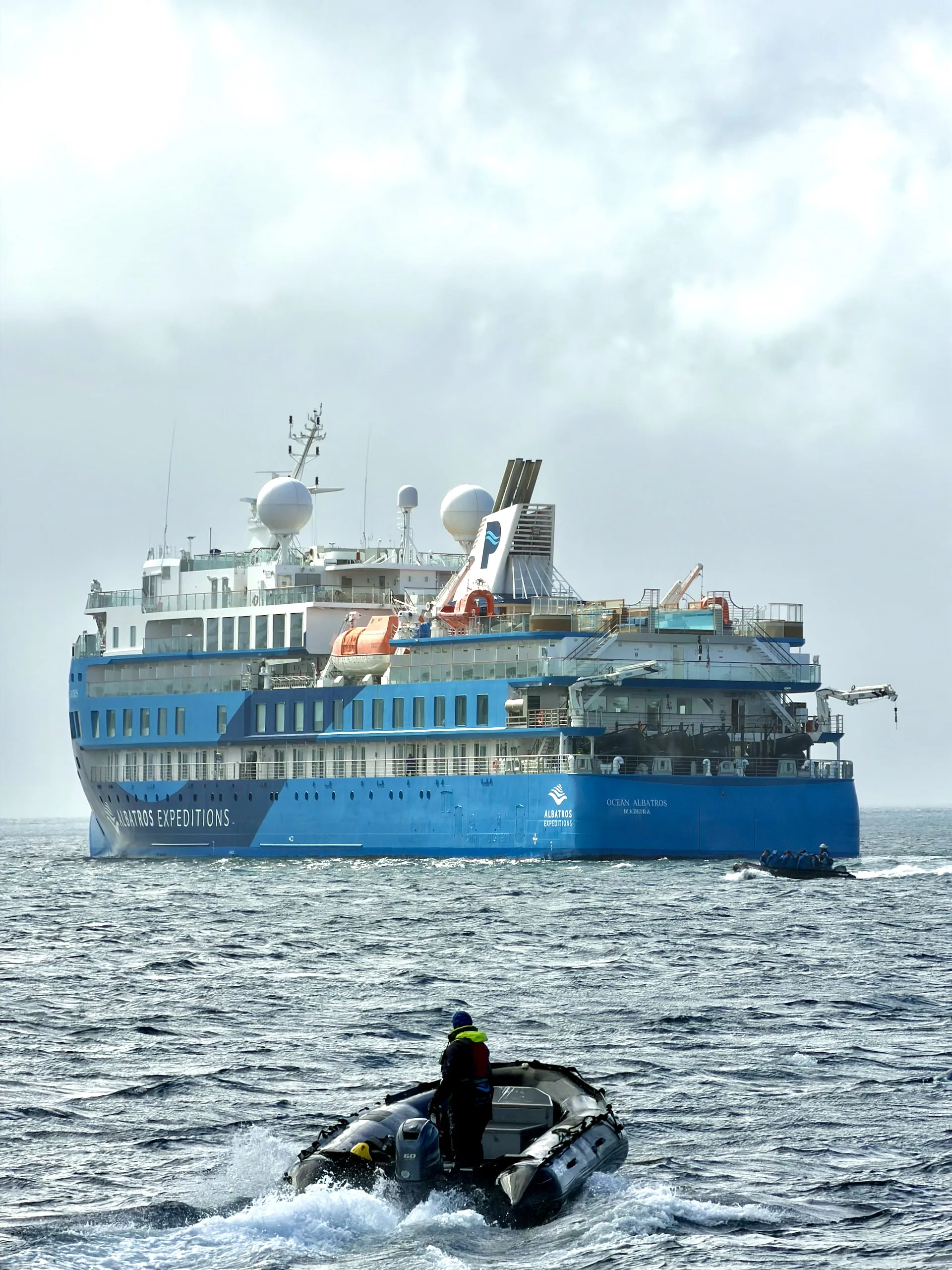
What makes the Ocean Albatros immediately recognizable is her distinctive bow. Instead of the traditional pointed shape, she features the patented Ulstein X-BOW design – an inverted, wave-piercing hull that’s supposed to provide exceptional stability in rough seas. Whether it lives up to that promise is something we’ll address later (spoiler: the Drake Passage has opinions). She holds an Ice Class 1A / Polar Code 6 rating, making her one of the more capable ice-strengthened vessels operating in Antarctic waters, and her carbon footprint is reportedly around 50% lower than traditional expedition ships.
Embarkation Day: Your First Hours on Board
We arrived in Ushuaia the day before departure, as we strongly recommend in our planning guide – flights get canceled, connections get missed, and the ship will not wait for you.
The embarkation process started in the morning with luggage drop-off at a designated collection point in town, where the crew took our larger bags and transported them directly to the ship. We received our bus assignment and were told when and where to board. The buses departed in the afternoon – embarkation was around 4 PM, with the ship setting sail at 6:10 PM. Since Ushuaia is tiny, the ride from town to the port took all of five minutes.
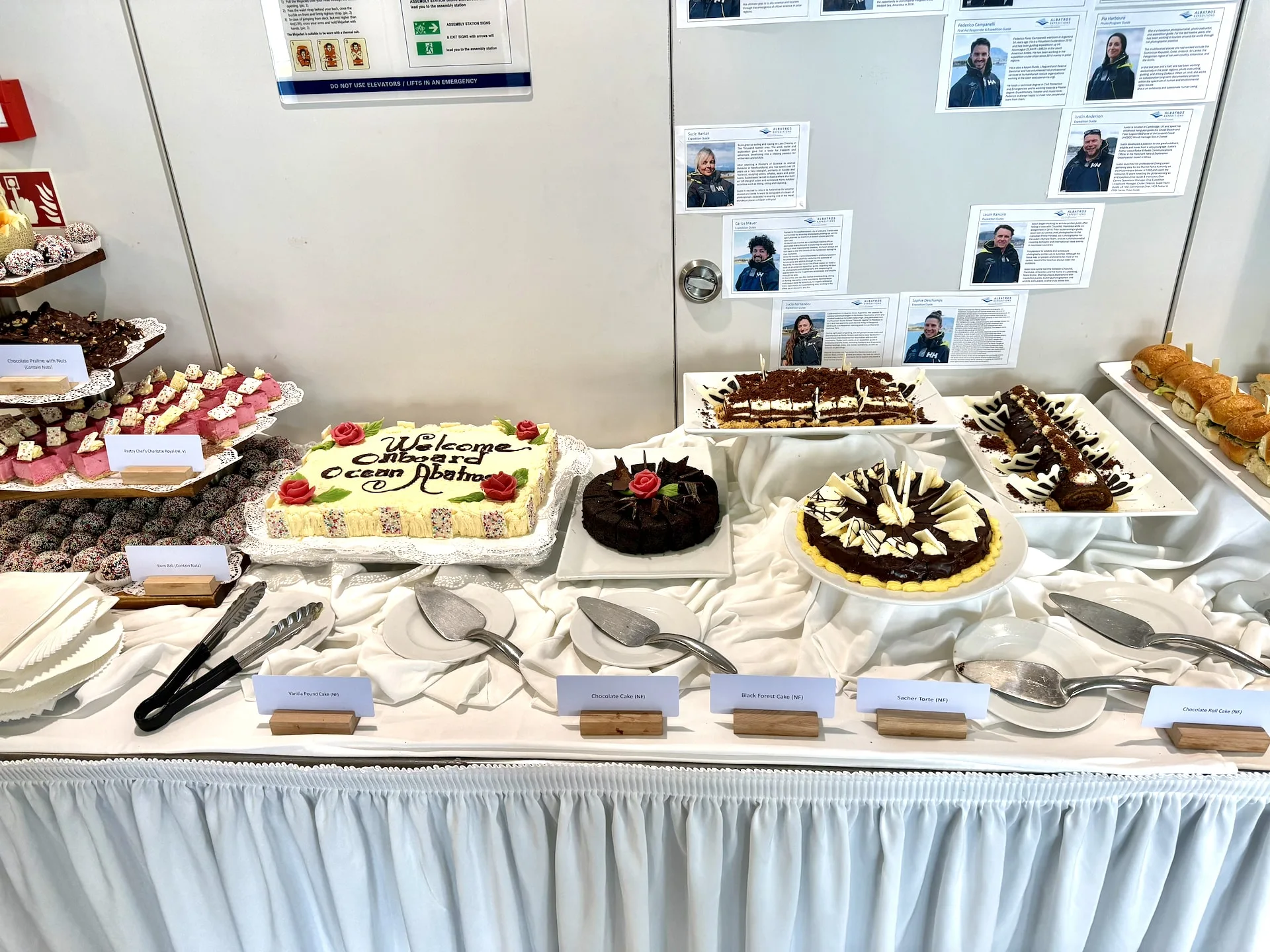
Boarding was fast. With only around 170 passengers, this isn’t one of those 4,000-person megaships where embarkation takes half the day. Everyone was on board within the hour. There was a welcome cocktail with snacks – a nice touch that set a relaxed tone right away.
Once on board, we registered at the reception desk, handed over our passports, and received our cruise cards. These cards are your identity on the ship: they open your cabin door, they’re scanned every time you leave the ship for a landing, and they should be on your person at all times.
Our bags were already waiting in the cabin when we arrived – along with our cabin steward, Ramón, who introduced himself and gave us a quick orientation. There’s a bit of time to settle in and unpack before the first order of business: the mandatory safety drill.
Unlike some modern cruise ships where the safety briefing is just a video you watch in your cabin, the Ocean Albatros does this the old-fashioned way. The alarm sounds, you grab your life jacket from the cabin, head to the muster station (which doubles as the lecture room), and then proceed to the deck in groups to locate your assigned lifeboat. The whole evacuation procedure is walked through step by step.
Next comes the parka distribution. You can pre-select your size before the trip, but there are plenty on hand in large boxes if you need to swap. A word of advice: the parka will look oversized at first. I normally fall between M and L, went with L, and thought it was too big – but it wasn’t. The M would have been too snug once I layered up underneath. Trust the sizing.
Before reaching Antarctic waters, there’s a mandatory IAATO biosecurity briefing. This covers wildlife distance rules (at least 5 meters / 16 ft from penguins and other animals), designated walking paths during landings, and the all-important biosecurity protocol. Every piece of gear you plan to take ashore – backpacks, dry bags, waterproof pants, hats – needs to be inspected and vacuumed. New items straight out of the packaging are exempt, but anything previously worn gets scrutinized. Staff use tweezers to pick out seeds, soil, or organic matter, and they track which cabins have completed the process. They take this seriously – avian influenza has been a significant problem in recent years, and human visitors are a potential vector.
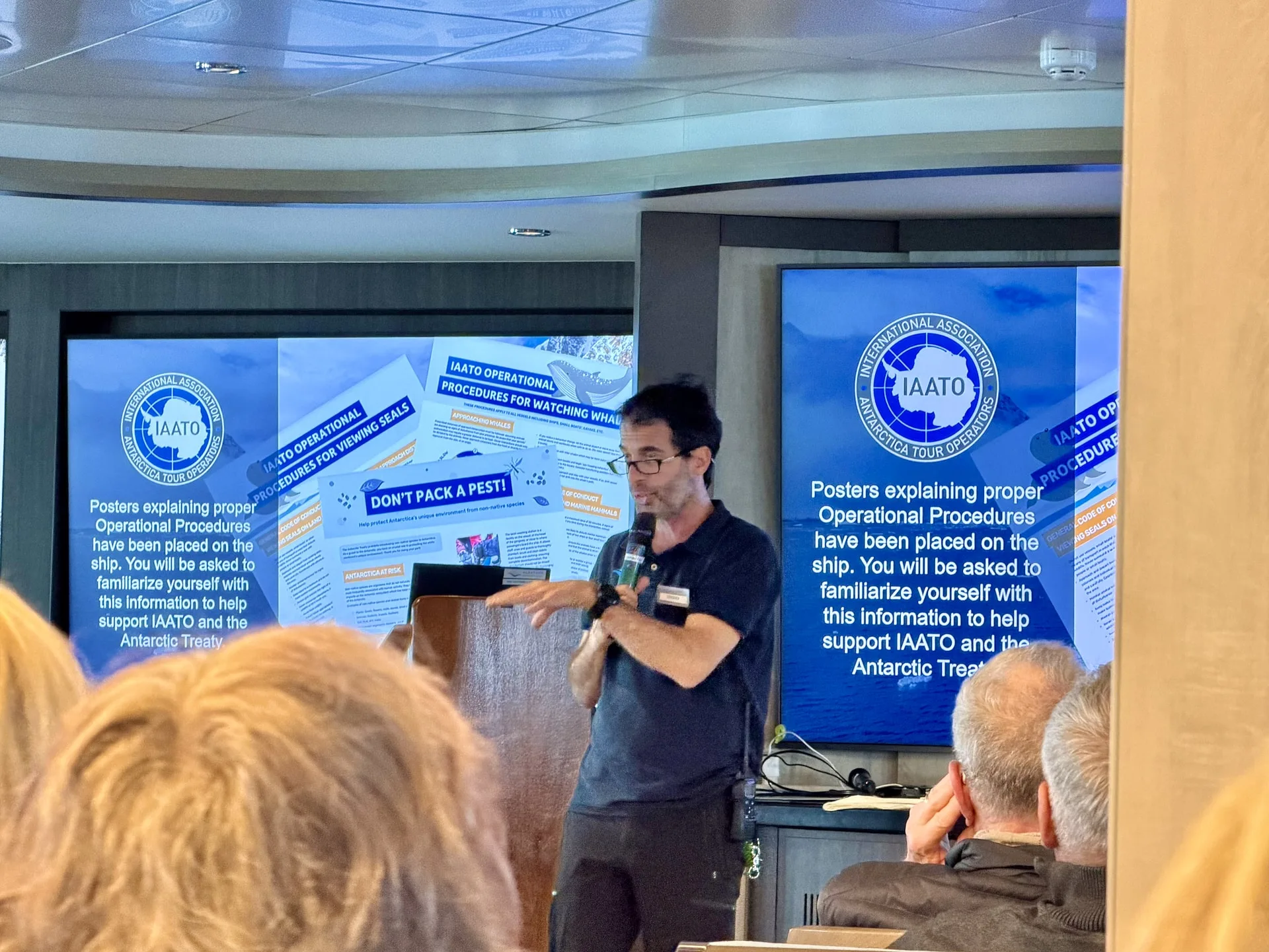
The expedition team also introduces itself on embarkation day. Our expedition leader, Diego Punta Fernández, walked everyone through the daily routine, how to reach the team, and what to expect in the days ahead. The captain popped in for a two-minute hello. And then – you’re off, gliding through the Beagle Channel toward the Drake Passage, with your first dinner waiting.
A Typical Day on an Antarctic Expedition Ship
Every morning on the Ocean Albatros starts the same way: the expedition leader’s voice comes over the intercom in every cabin and public space. This isn’t just a wake-up call, but also a briefing. Diego would tell us the day’s planned program, the current weather conditions, and our exact position. The ship’s TV also showed a live GPS map of our location (think airplane flight tracker, but for a ship) and the day’s schedule, which was additionally posted on printed boards near the elevators on every deck.
Wake-up was typically around 7:00 or 7:30 AM, occasionally as early as 6:30 depending on weather and the day’s program. Nobody sleeps in on an expedition ship – there’s simply too much to see and do. Breakfast follows immediately, served in the Jens Munk Restaurant on Deck 5. For the truly early risers, a smaller early-bird breakfast is available in the Bistro on Deck 8 before the main service starts – though we never felt compelled to test that option.
The morning program kicks off around 8:00 or 9:00 AM – either a shore landing, a Zodiac cruise, or (on sea days) an educational lecture. After the morning activity, lunch is served, usually between 12:30 and 2:00 PM. During one of our lunches, a special BBQ was planned for the outdoor grill on Deck 7 – but the weather had other ideas, so it was moved indoors.
The window between lunch time and the afternoon program is slim – roughly 30 minutes, most of which is prep time. During lunch, the ship repositions to the afternoon’s location, so by the time you’re heading back to the mudroom, you’re at a completely different site.
The afternoon program wraps up in time for the highlight of every single evening: the recap and briefing session. This is where the expedition leader summarizes the day – what you saw, what happened, what wildlife was spotted – and then lays out the plan for tomorrow. Where the ship is headed, what landings or Zodiac cruises are on the schedule, what conditions to expect. Various expedition team members also present short talks during the recap, each speaking about their specialty. One evening, a guide explained and demonstrated how they assess crevasse depth on avalanche-prone landing sites. Another gave a mini-lecture on whale behavior. These sessions are genuinely fascinating, and they consistently felt like the communal heartbeat of the trip.
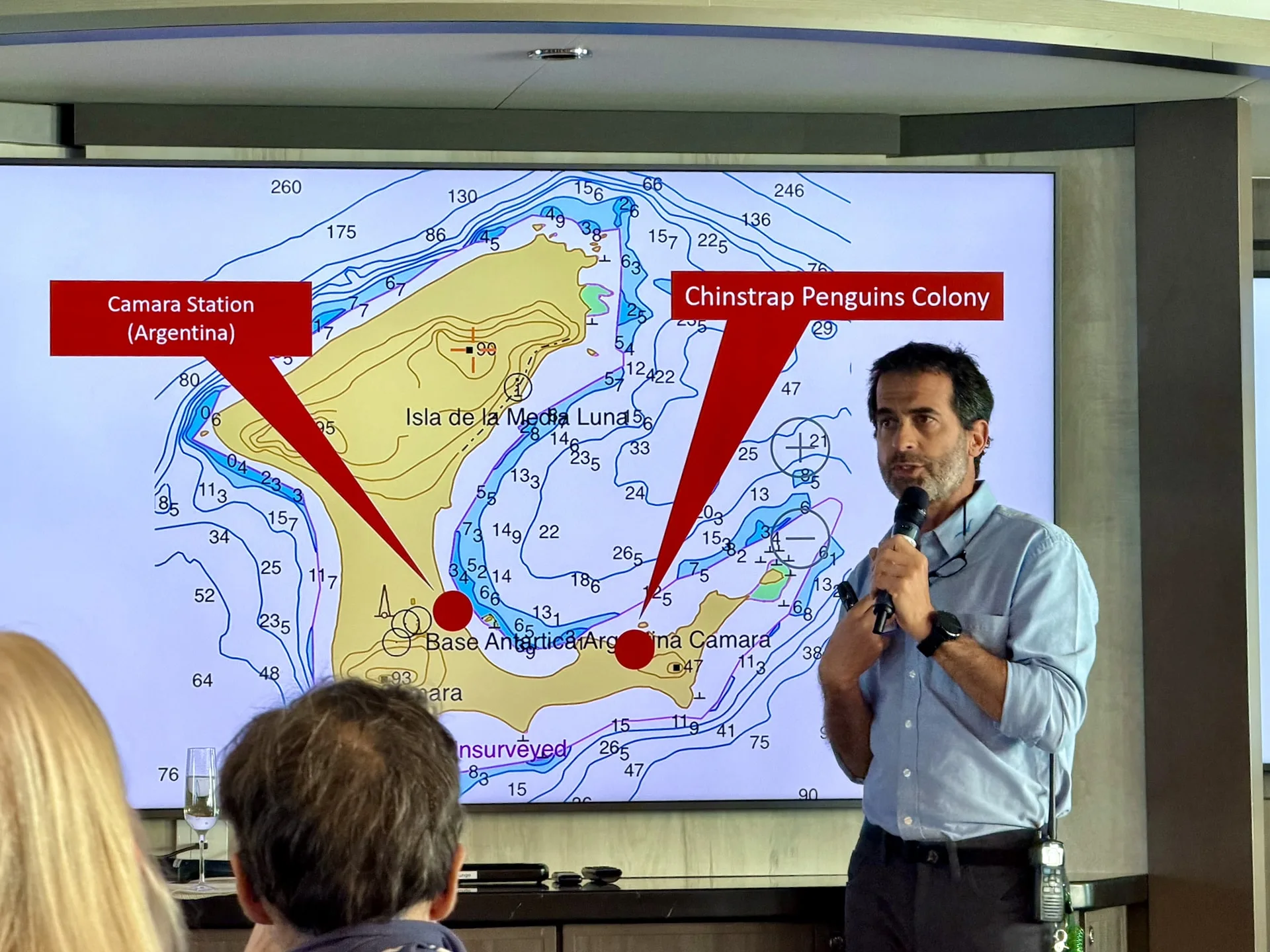
There’s also a question box where passengers can submit questions throughout the voyage, and the team answers a selection each evening during the recap. My personal favorite submitted question: “How old is the captain?” – I assumed this was a uniquely Hungarian joke, but apparently the curiosity is international.
Dinner follows the recap. After that, there’s usually an evening program. These varied widely on our voyage: one night was a talk-show-style Q&A with expedition guides sharing personal stories, another was a screening of The Thing (the classic Antarctic horror film introduced as a “documentary” – a very on-brand choice), and there was even a karaoke night. For anyone too tired or feeling unwell, every briefing, lecture, and program is broadcast live to cabin TVs via an onboard camera.
One thing that makes the Antarctic days truly special is the “open door” policy for wildlife sightings. If whales, dolphins, or anything remarkable appear near the ship – day or night – the expedition team announces it over the intercom, telling everyone which side of the ship to look from. You quickly learn to keep your camera or phone within arm’s reach at all times.
If you did not do it when booking the trip, book optional activities like kayaking and camping on the very first day aboard – spots fill up fast, and popular programs like kayaking may even involve a lottery if demand exceeds capacity.
Sea Days and Bad Weather: When You Can’t Go Ashore
On a 10-day voyage, you’ll realistically get about four to four-and-a-half days of actual landings and Zodiac cruises. The rest is spent at sea – primarily crossing the Drake Passage (roughly two days each way), plus any time lost to Antarctica’s notoriously unpredictable weather.
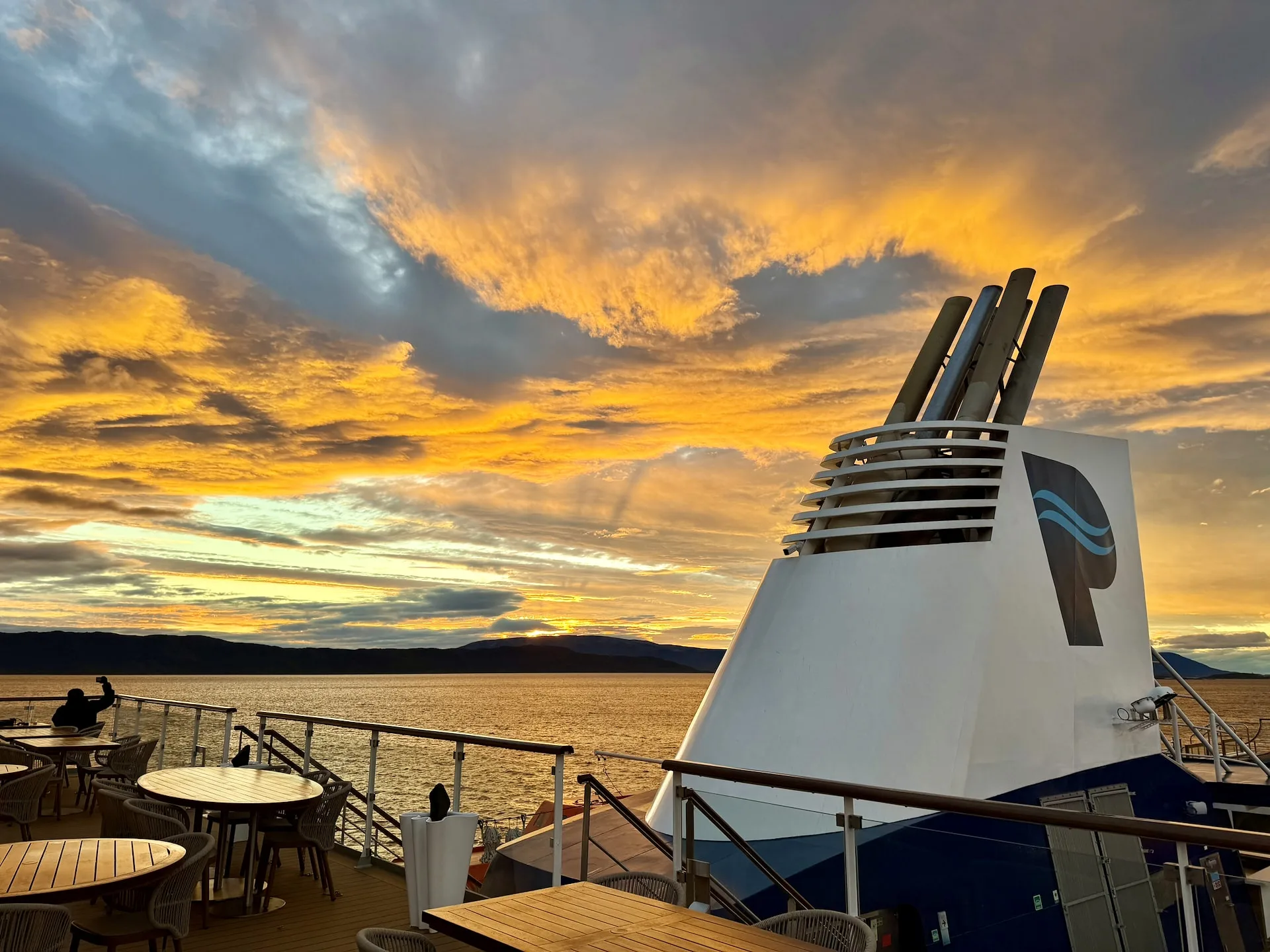
The ship departed Ushuaia in the early evening and spent the first few hours cruising through the Beagle Channel – calm, scenic, and deceptively peaceful. The Drake Passage properly began around 9 PM that first night, and the crew gave advance warning so that those prone to seasickness could medicate in time.
Let me use my own experience to illustrate what the Drake can be like. I’m fairly susceptible to motion sickness – our whale watching trip in the Dominican Republic already proved that much. I took medication on the first night and had no nausea or vomiting, but the ship moved so much that Andrea and I spent the night convinced we were about to roll out of bed. Restful sleep was not on the menu. The next morning at breakfast, I asked one of the expedition guides how the sea had been. “About a two out of ten,” she said casually. “We had a really good Drake Lake.”
For the uninitiated: sailors distinguish between a “Drake Lake” (calm) and a “Drake Shake” (rough). Our “really good” Drake Lake meant four-meter (13 ft) waves. The return crossing was worse – we never got the exact rating, but waves were breaking over the balcony of our Deck 6 cabin, so draw your own conclusions. By the way, I managed the return trip without medication – proof that you do adapt.
The good news is that once you reach the South Shetland Islands and the Antarctic Peninsula, the waters calm dramatically. It’s essentially smooth sailing between landing sites, and we had zero issues with seasickness during the actual Antarctic portion of the voyage. The X-BOW hull design does seem to help with stability – at least relative to what the Drake might feel like on a conventional hull. The ship also has zero-speed stabilizers that work even when stationary. But let’s be honest: no amount of engineering completely tames the Drake Passage.
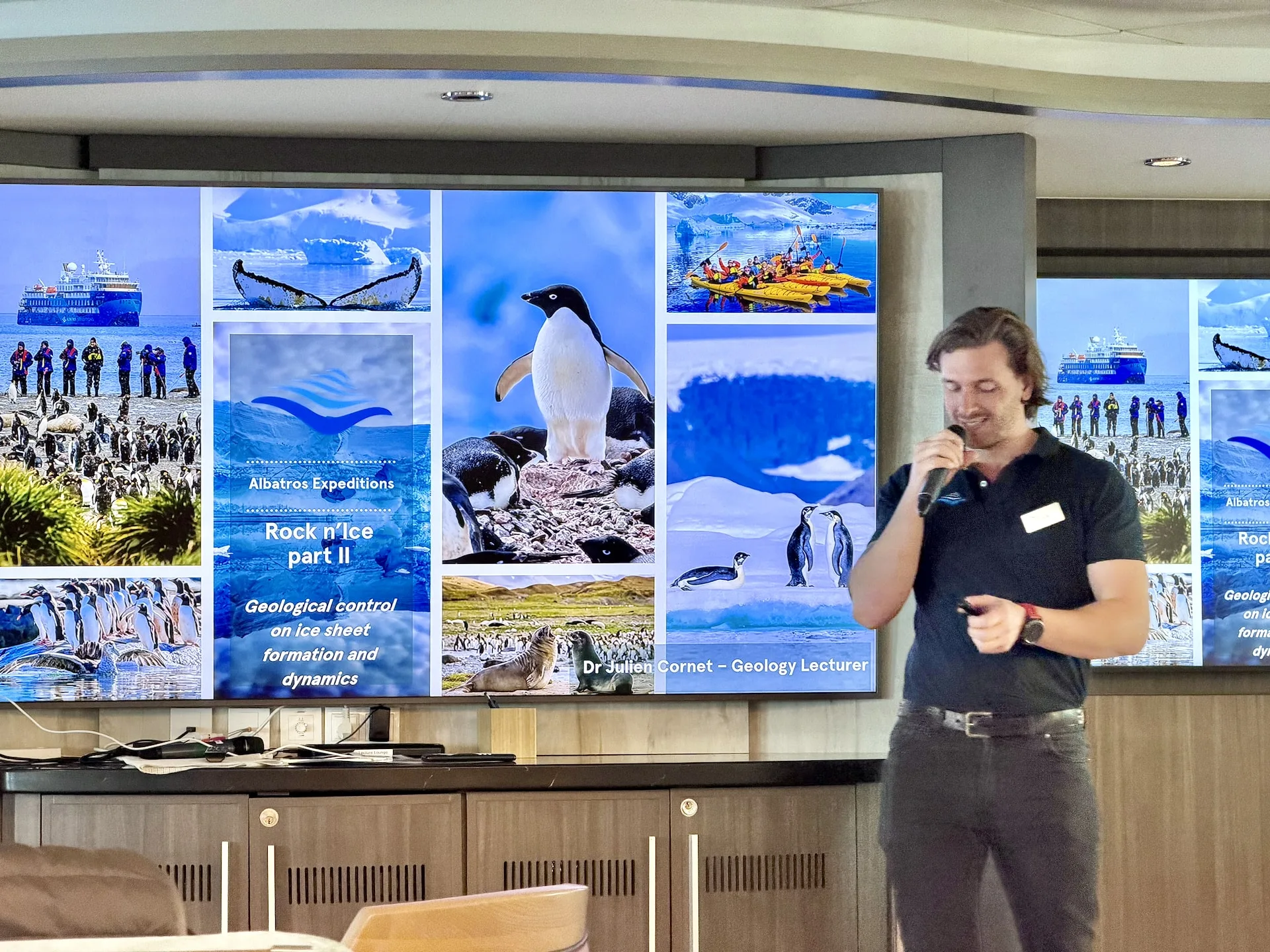
On sea days and during weather cancellations, the expedition team fills the schedule with lectures – and these are genuinely outstanding. The team isn’t made up of tour guides reading from scripts. These are working scientists, researchers, biologists, geologists, historians, and photographers for whom the polar regions are a lifelong passion. Julien, a French geologist with a PhD, gave riveting talks on Antarctic geology and plate tectonics. Will brought polar exploration history to life with stories that read like adventure novels. Franziska could identify any bird on the horizon and made ornithology genuinely exciting. Their presentations go well beyond anything you’d find on Wikipedia or even in specialized books – they’re peppered with personal anecdotes, field stories, and the kind of insights that only come from years spent in these environments.
When you’re not in lectures (though we’d strongly recommend attending every one), the Ocean Albatros offers plenty to keep you occupied: the panorama sauna on Deck 7 (a feature unique to the Ocean Albatros among its sister ships), the gym, two outdoor jacuzzis – closed only during the Drake crossing – the library, the Albatros Nordic Bar on Deck 5, and the Albatros Polar Spa (spa treatments are paid; everything else is free). The jacuzzis deserve a special mention: they’re on the open deck, exposed to the Antarctic air, but the water is warm – which made them enormously popular on any day the weather cooperated.
Zodiac Landings and Zodiac Cruises: How Going Ashore Works
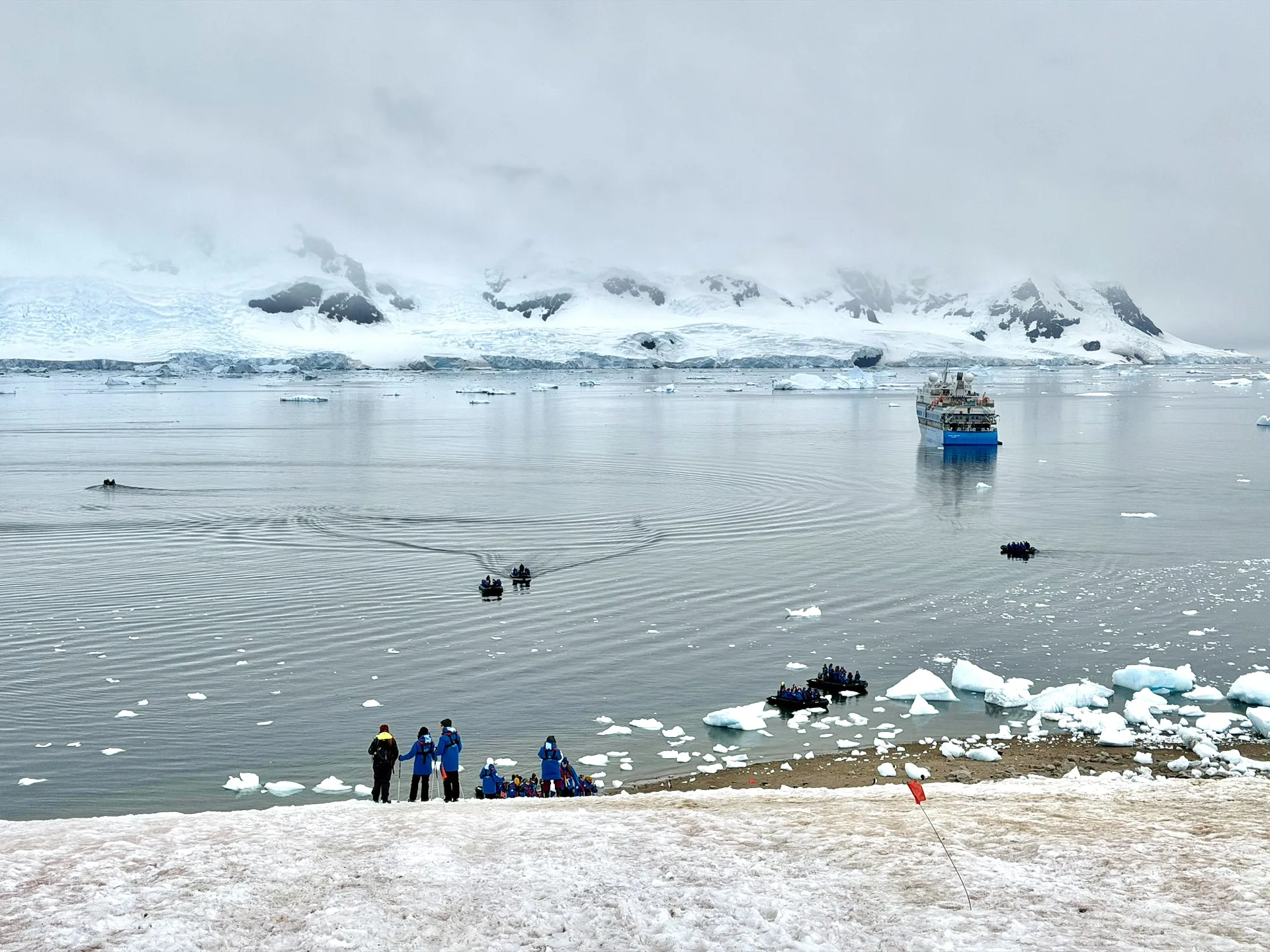
This is the reason you’re here. This is why you chose an expedition ship over a big cruise liner. Zodiac cruises and shore landings are the core of the Antarctic experience – and the logistics behind them are more elaborate than you might expect.
Before You Even Get the Call
Before the first group is summoned to the mudroom, the expedition team has already been at work. One or two Zodiacs go out ahead to scout the landing site. They check for signs of avian influenza among the penguin colonies – if they find evidence of sick birds, the landing is called off. They assess terrain conditions: avalanche risk, dangerous crevasses, ice stability. They flag the safe walking routes with markers. And they deploy emergency supplies on shore – blankets, food, water – in case a group gets stranded.
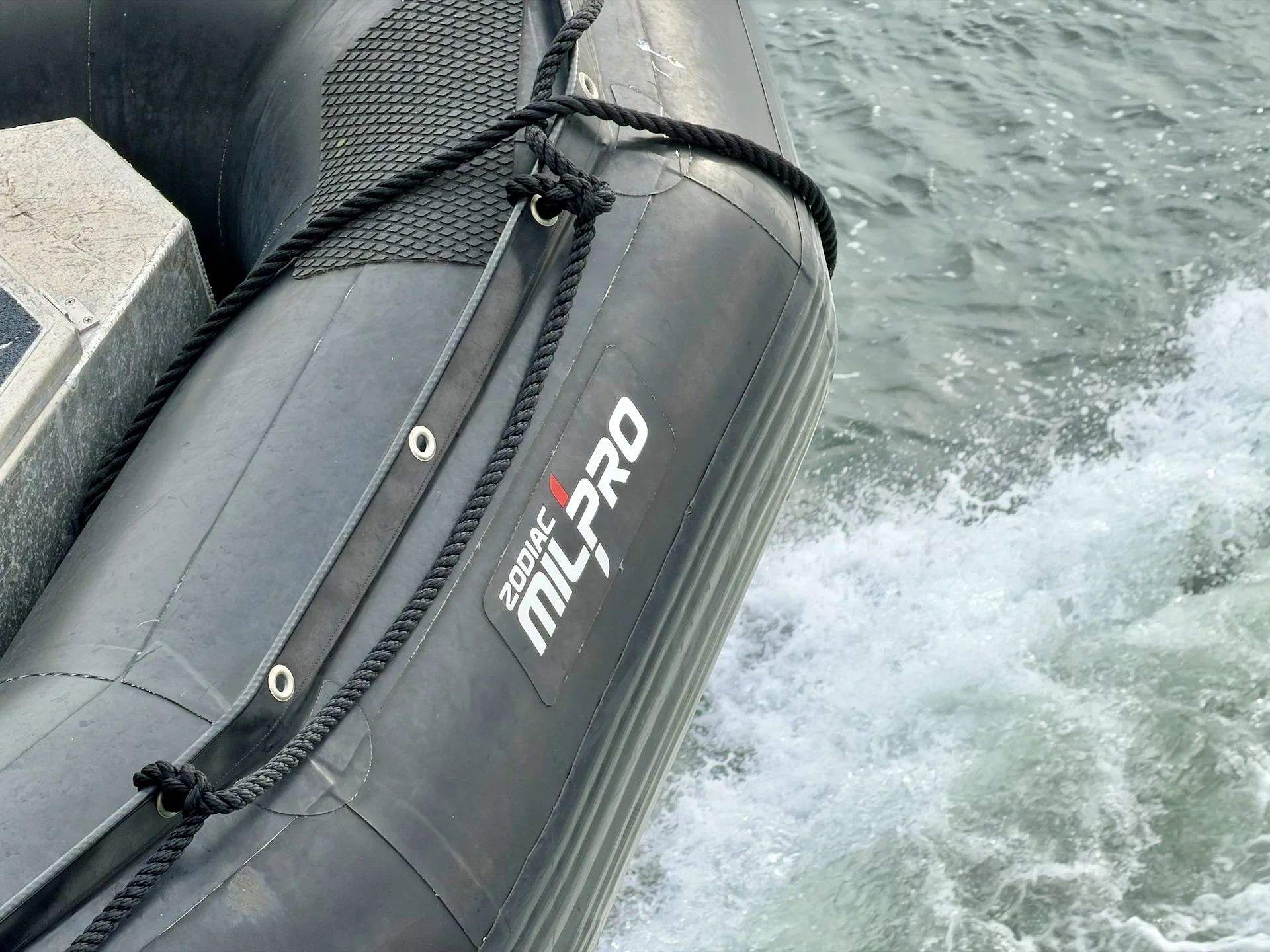
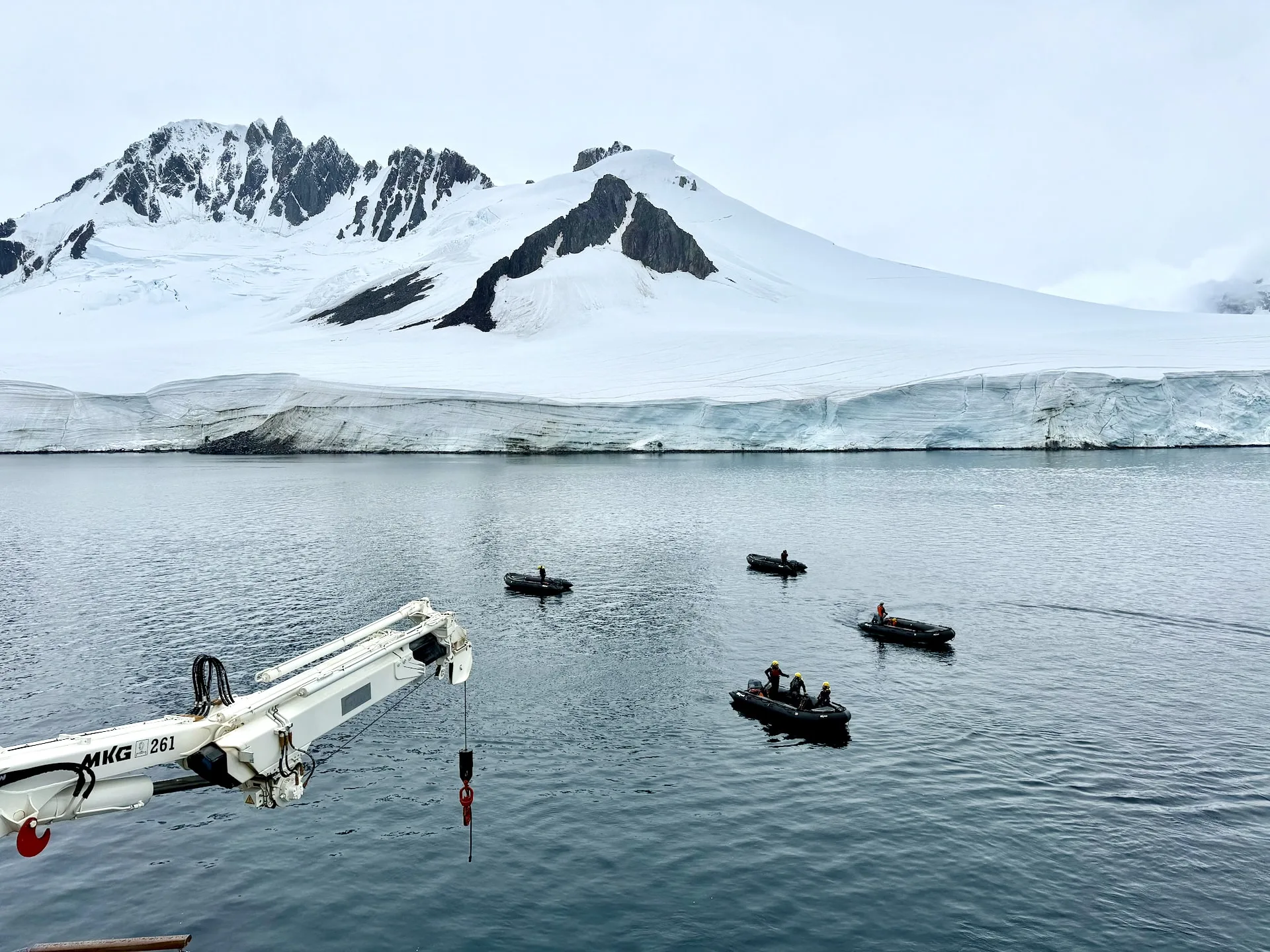
The Ocean Albatros carries a fleet of 18 Zodiacs (Zodiac MILPro models – essentially military-grade inflatable boats built for extreme conditions) and is equipped with two davit cranes, meaning the crew can launch Zodiacs two at a time. The whole scouting and preparation process takes roughly 30 minutes, after which the actual boarding begins.
The Color-Coded Group System
Passengers are divided into color-coded groups – in our case, four groups (blue, red, green, yellow) plus a separate photography group. The groups appear to be distributed so that cabins from different parts of the ship are mixed, preventing bottlenecks in corridors and stairwells.
The rotation order changes every single day. If blue goes first today, they might go last tomorrow. Everyone gets their turn at the front and back of the line – it’s scrupulously fair. The photo group, however, always boards first: they’re a smaller group who get extra time on shore, and their priority access is one of the perks of signing up for the photography program. Needless to say, the Blue Group is the best group. (We may be biased.)
Getting Dressed and Getting Down to the Mudroom
You’ll know when your group is coming up because the schedule is posted everywhere – on the daily program sheets by the elevators, on the cabin TV, and of course, from the previous evening’s briefing. When the group before yours is called, it’s time to start getting ready. We developed a system: put on base layers and warm socks in the cabin ahead of time, then add the warmer mid-layer (fleece, hiking pants) when it was nearly our turn. Once the call comes, head down briskly to the mudroom on Deck 3.
At the mudroom entrance, your cruise card gets scanned – this tracks who’s on the ship and who’s on shore. Each cabin has a dedicated locker in the mudroom where you store boots, life jackets, and outerwear. We quickly figured out it was worth storing our waterproof pants there too, to save time during the scramble – and it’s not fun bringing them back to the cabin, if they are really wet after rough sea conditions.
Then it’s boots on, waterproof pants on, parka on, neck buff, hat, gloves, phone lanyard – and finally, the life jacket. This is an auto-inflating model: a sensor detects water contact, and the vest inflates automatically after a few seconds of submersion. It’s not bulky or particularly heavy. If you’re traveling with a partner, help each other with straps and zippers – it speeds things up considerably.
One of our prouder moments: an expedition guide at the mudroom entrance jokingly asked us if we were firefighters, because the Blue Group was ready so far ahead of schedule that the previous group hadn’t even finished boarding.
Boarding the Zodiac
Before stepping onto the embarkation platform, you dip your boots into a disinfectant basin – biosecurity never takes a day off. The ship has boarding platforms on both sides; which one is active depends on the ship’s position and the direction of the landing site.
During the Drake crossing, well before the first landing, the expedition team gives a dedicated presentation on Zodiac boarding procedures. This is thorough to the point of specifying which foot to step with, which hand to extend to the crew member in the boat, how to sit, where to place your backpack, and how to hold on. It sounds over-the-top, but it works – the process feels almost natural by the time you actually do it.
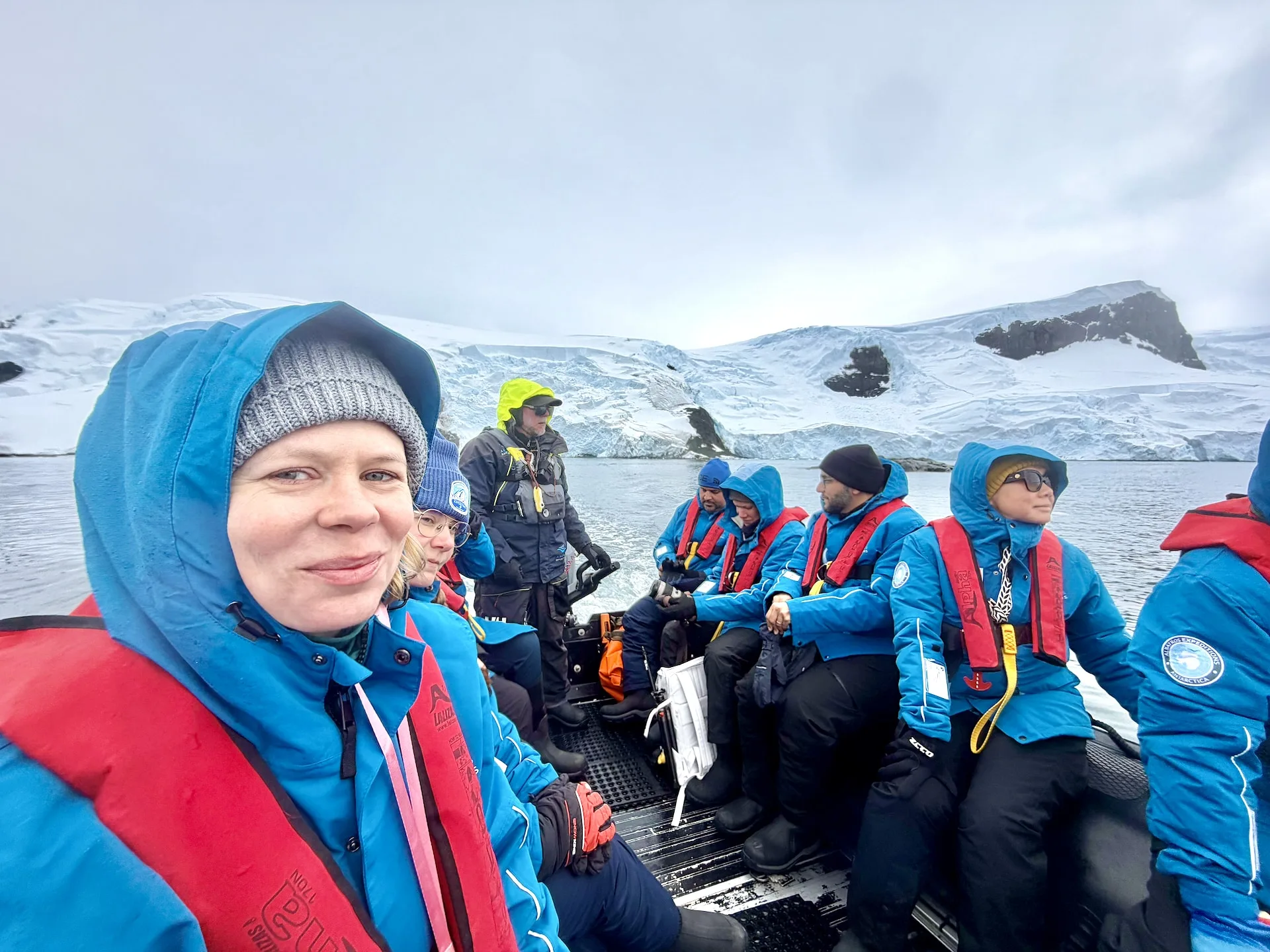
Each Zodiac seats about 10 passengers comfortably, however occasionally an additional person can squeeze in.
On Shore: Wet Landings, Walking Routes, and IAATO Rules
Because IAATO regulations limit shore landings to 100 people at any one site at a time, the system on a ship with more than 100 passengers works like this: two color groups go ashore while the other two do a Zodiac cruise. At the halfway point, they switch. This means you get roughly one hour on land and one hour on a Zodiac cruise during each morning or afternoon session – with about three hours total including transit and preparation.
Most landings are wet landings, meaning the Zodiac noses up to the shore and you step into calf-deep water. You shuffle forward to the bow, swing your legs over the side, and splash down. This is precisely why every single thing below your waist needs to be waterproof.
The walking routes on shore are flagged by the advance team, and expedition guides are stationed along them to offer guidance, answer questions, share knowledge – and keep you safe. On our last landing, the routes were somewhat more free-form, but on most sites the paths were clearly defined.
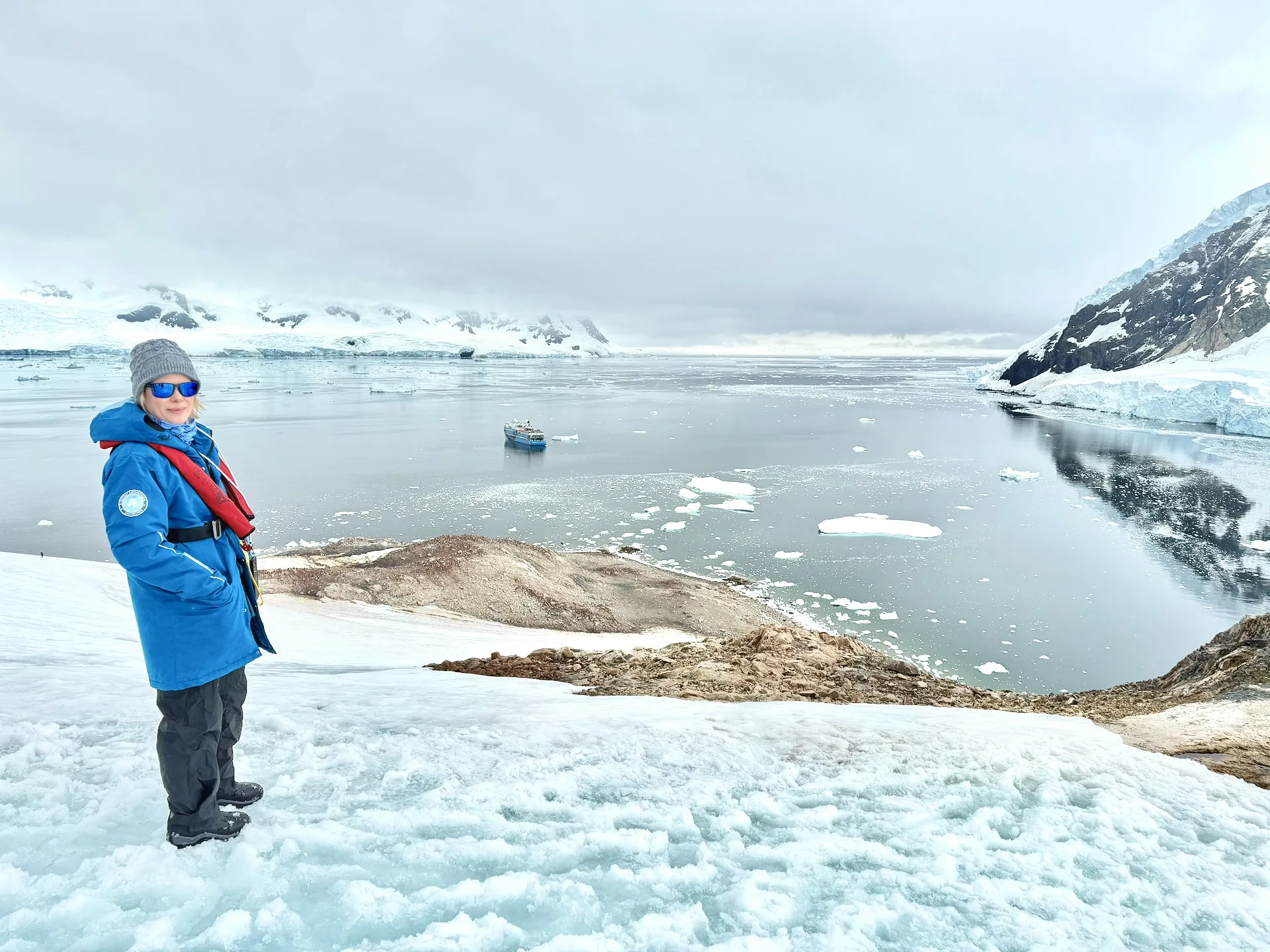
You can cover surprising distance on these landings. I’d assumed we’d be confined to a tiny patch of beach, but even our first landing involved a solid walk between two sites. On later days, we climbed quite high on ice and snow – hiking poles are provided for every landing and are well worth using. I routinely logged over 10,000 steps on landing days, with averages well above 8,000. Even on Drake Passage sea days, I managed around 5,000 steps just walking around the ship.
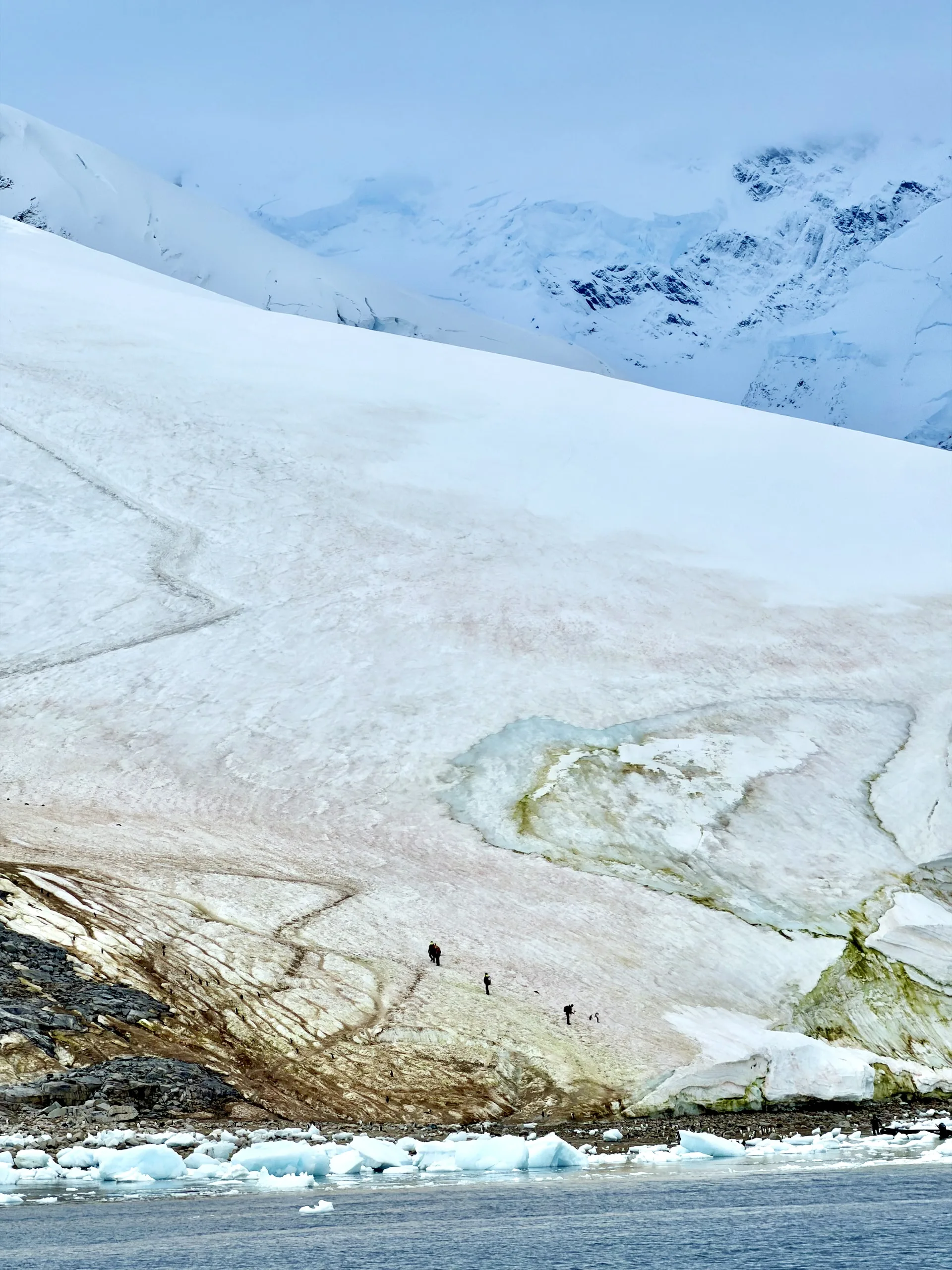
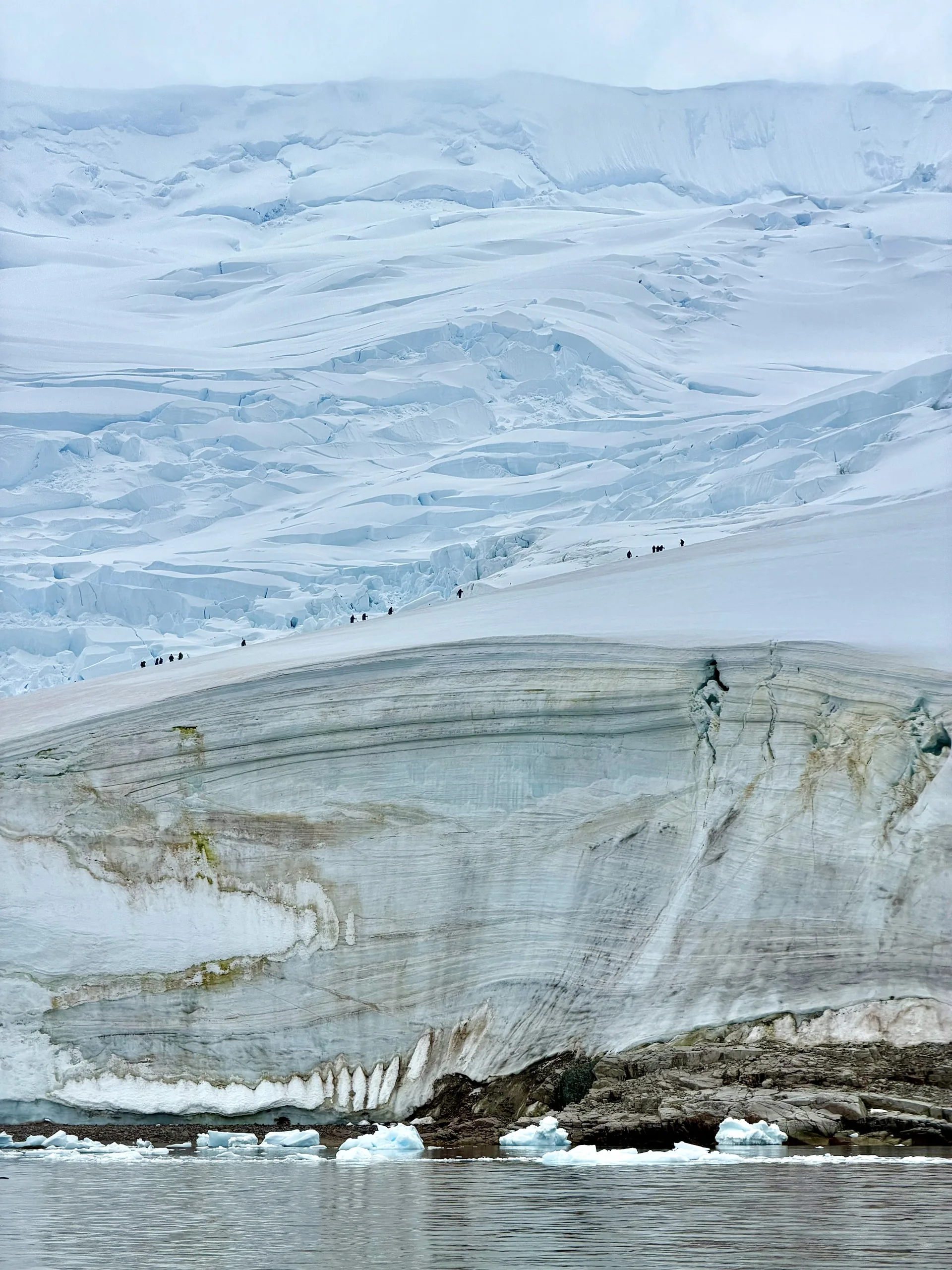
What caught us off guard was how physically tiring the landings are. The gear isn’t light, the terrain is uneven, and you’re moving in boots and a parka with a life jacket on top. If you’re also carrying a camera backpack, you’ll feel it. Layering is essential – there were moments when we needed to unzip the parka or switch to a thinner hat after climbing higher, because the exertion generated real heat.
Of course nothing is compulsory. Some older passengers (we had guests in their 80s) skipped certain landings or stayed near the shore on more demanding terrain. But for everything you can manage – go. You will not regret it.
Back on Board: The Biosecurity Gauntlet
Returning to the ship involves another round of biosecurity. At particularly guano-heavy sites, there’s a boot-scrubbing station right at the shore before you even board the Zodiac. Back at the ship, boots get disinfected again. If you feel sorry for yourself during the boot-scrubbing routine, consider this: several expedition team members told us that cleaning everyone’s boots in the mudroom each evening is the single least glamorous part of their job working in Antarctica.
After each landing, returning passengers are greeted with a hot drink (chai, tea, hot chocolate) and a warm towel – a small thing that felt enormous when your fingers were frozen.
Beyond Landings: Kayaking, Camping, and the Polar Plunge
Shore landings and Zodiac cruises are the core program, but the Ocean Albatros offers three additional off-ship experiences. We skipped kayaking and camping, so for those two we can only share what we observed – but the Polar Plunge? That one we did.
Kayaking
This was by far the most popular optional activity. Kayaking groups are organized so that each participant gets at least one outing, scheduled during one of the regular landing sessions. Around eight to ten kayaks go out at a time, accompanied by a safety Zodiac. The kayakers follow roughly the same routes as the Zodiac cruises, but the experience is entirely different: you’re lower to the water, you’re silent, and the wildlife responds accordingly. We watched from the ship as whales surfaced really close to the kayaking group – an experience that looked absolutely unforgettable. (Fortunately we also had our share of astonishing close encounters.)
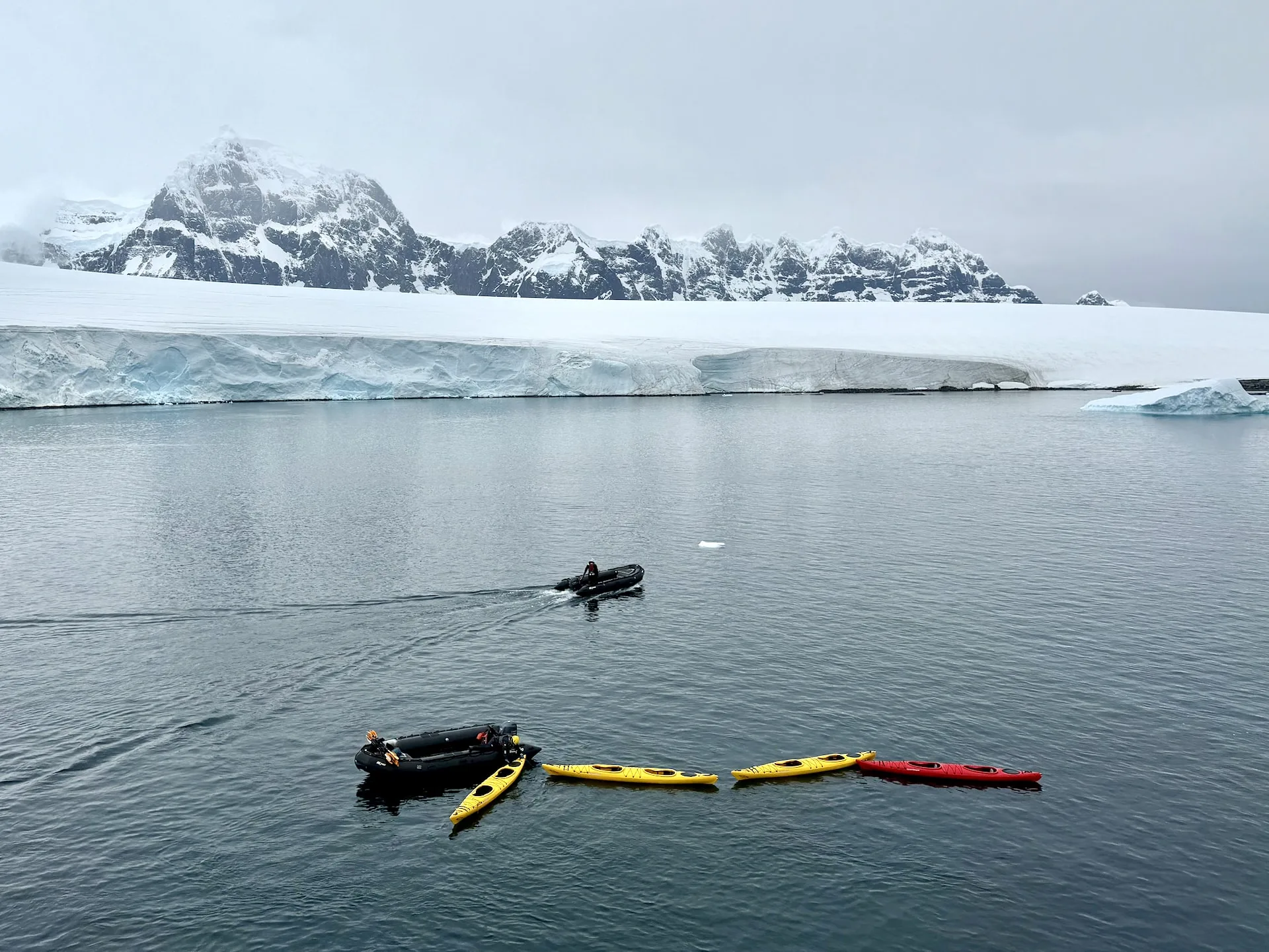
The pre-trip information does recommend prior kayaking experience, which felt like fair advice. We’ve paddled on calm waters before but didn’t feel confident enough for Antarctic conditions, so we sat this one out.
Because demand typically exceeds supply, there was a lottery system for remaining spots. If you’re serious about kayaking, sign up as early as possible – ideally when booking your trip, or at the very latest on embarkation day.
Camping
Camping in Antarctica means spending one night sleeping on the actual continent. On our ship, this was offered once during the voyage for a group of around 10 to 15 people. After dinner, the group heads to shore, digs out their own bivouac site in the snow, and sleeps in sleeping bags and bivy sacks.
The expedition team was refreshingly honest about what this involves: it is not comfortable, you will be cold, and you will be miserable. No food is allowed on shore (just water), so between dinner and breakfast, you’re fasting. There is a “toilet” – which in practice means a plastic bag in a bucket, set up at a respectful but not particularly private distance. The strong recommendation was to arrive with an iron bladder.
Quite a few passengers who initially signed up quietly withdrew after attending the pre-camping briefing. On our voyage, the camping was ultimately canceled due to weather – which is always a possibility. If conditions aren’t right (too windy, rain), it simply doesn’t happen, and the fee is refunded.
The Polar Plunge
And then there’s the famous Polar Plunge – jumping from the ship’s stern platform into the Southern Ocean at a water temperature hovering between 0 and 1 °C (32–34 °F). It sounds extreme, and it probably is, but well over half the passengers on our ship took the plunge – including us.
The logistics are similar to landings: you’re called by color group, make your way to the mudroom in a bathrobe and swimsuit, and jump from a Zodiac platform at the stern. Everyone is secured with a safety harness attached to the ship. A second Zodiac with photographers hovers nearby, and a third stands by with the medical team. It’s well-organized and safe – just very, very cold.
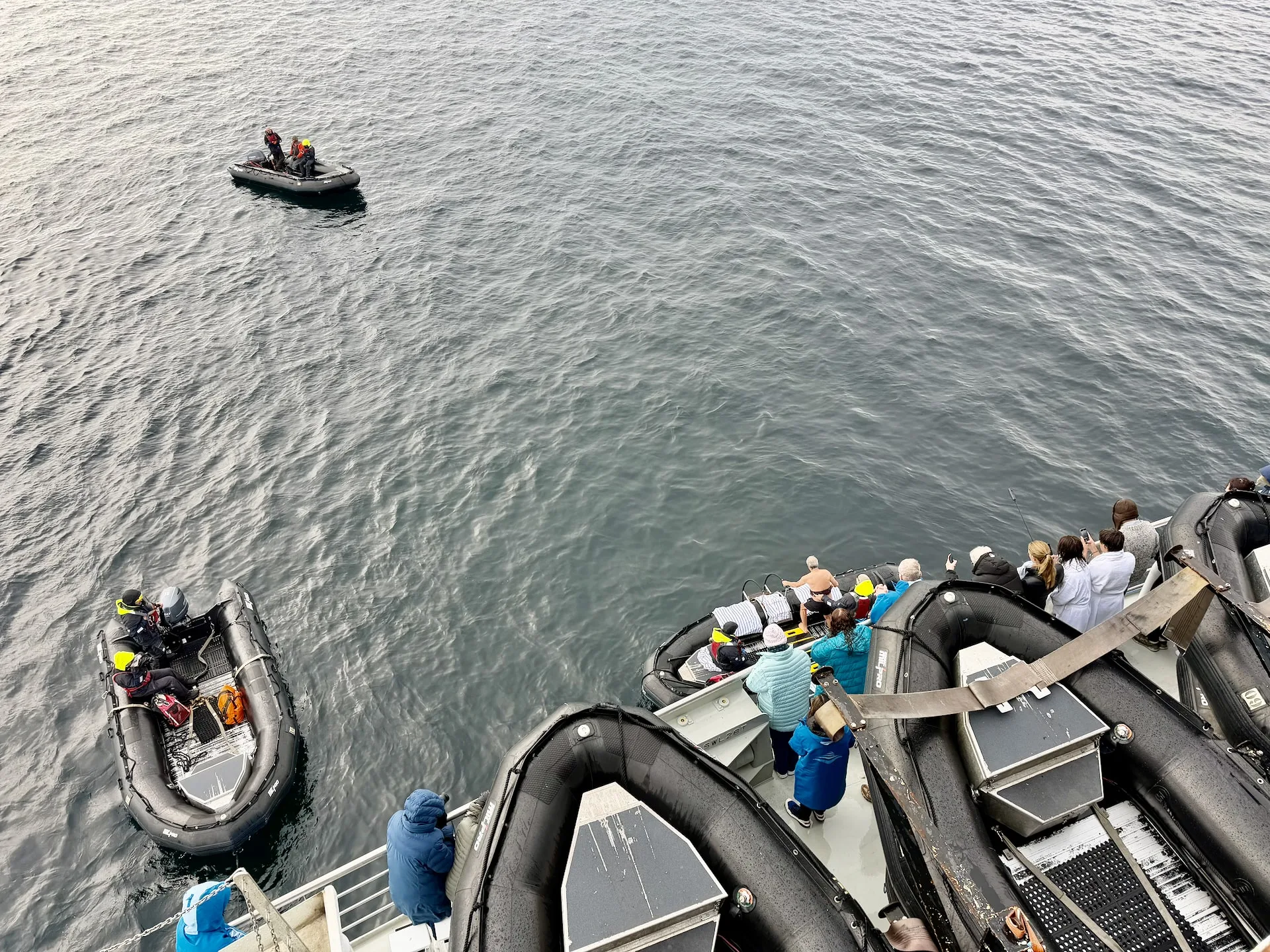
The Polar Plunge is weather-dependent (the ship needs to be able to hold position anchored) and was held on our last day in Antarctic waters. We’d been going back and forth about whether to do it for the entire trip, but when the day came and the conditions were right, it felt like one of those “when will you ever get this chance again?” moments. So we went for it – and it was genuinely fun. The anticipation standing on the platform in your bathrobe, the shock of the cold (coming out the water), the adrenaline rush when you surface, the cheering from everyone watching from the deck – it all adds up to an experience that’s over in seconds but stays with you. We’d do it again in a heartbeat, which is probably not what we expected to say about voluntarily jumping into near-freezing water.
The reward? Complimentary hot chocolate, chai – and a shot of vodka for your bravery. You’ll have earned all three.
Food and Dining on the Ocean Albatros
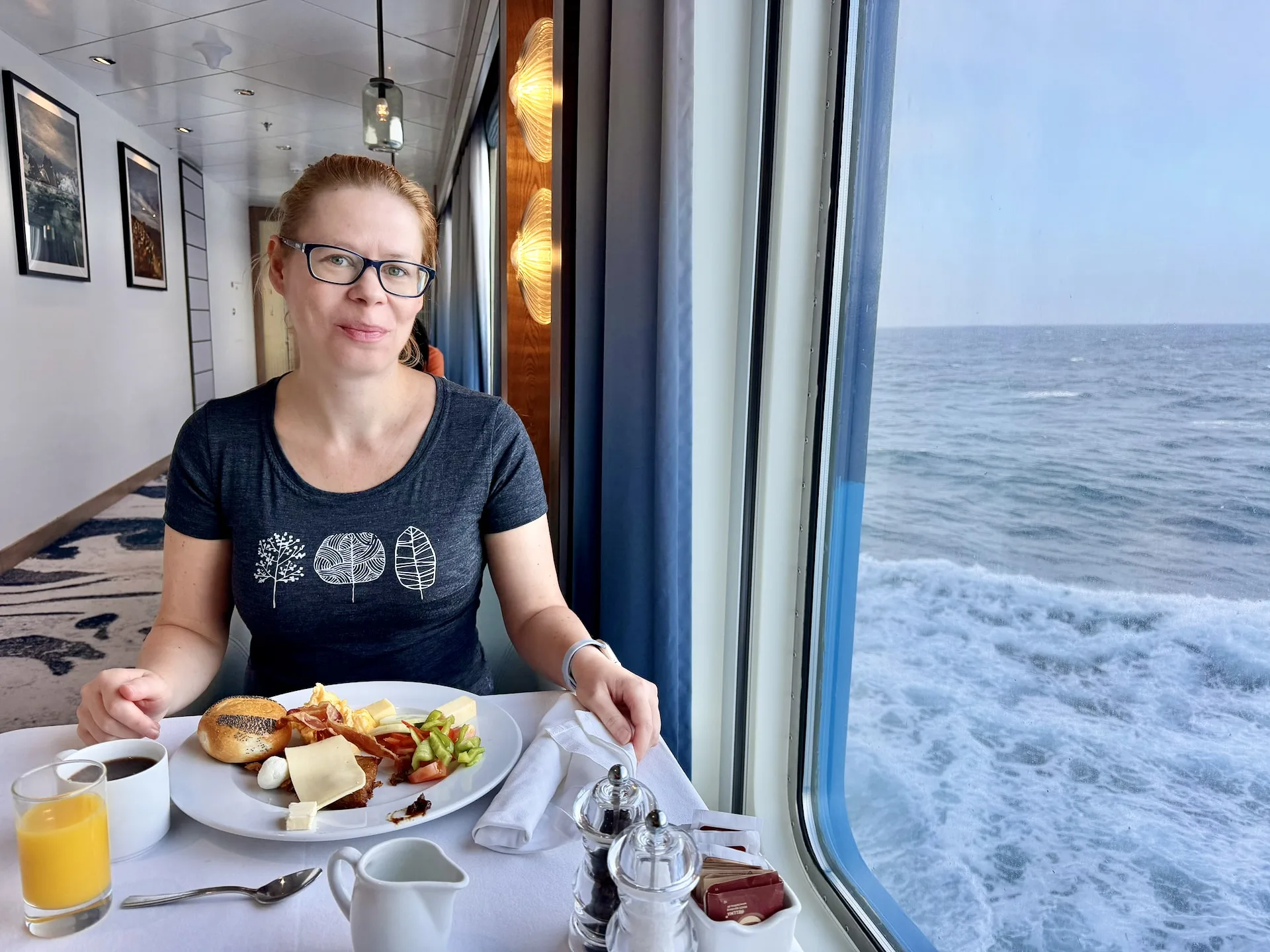
The food on the Ocean Albatros was, in both our opinions, excellent – genuinely good eating by any standard, not just “good for a ship.”
Three main meals are served daily. Breakfast and lunch are buffet-style, while dinner is à la carte (except boarding night). The ship has two restaurants: the Jens Munk Restaurant on Deck 5 is the main dining room with tables of various sizes, and the Bistro on Deck 8 is a smaller, more casual space that serves buffet dinners plus early-bird breakfast (closed during Drake crossings). The Bistro also stocks comfort food – burgers, hot dogs, pizza – that the main restaurant doesn’t.
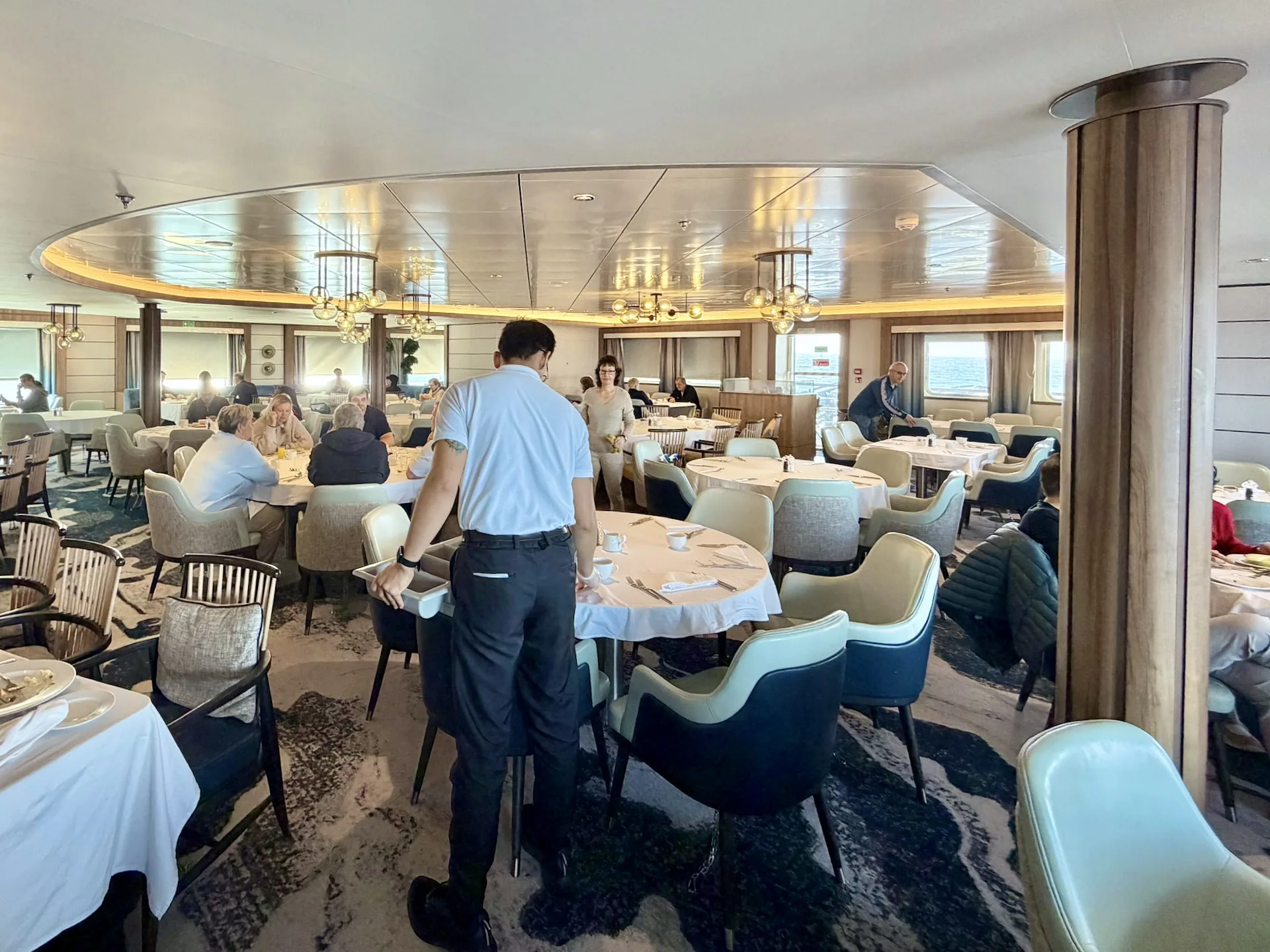
Two-person tables in the Jens Munk fill up quickly, so we ended up at shared tables most evenings. This isn’t normally our style, but it turned out to be one of the unexpected pleasures of the trip – the kind of people who travel to Antarctica tend to be interesting company. Expedition team members dine alongside passengers at both restaurants, sitting at regular tables and happy to chat. This accessibility – scientists and guides just sitting down with you over dinner – was one of the things that made the whole voyage feel like a shared adventure rather than a service.
One beer or wine, or a soft drink are included with dinner, and in practice the staff frequently offered refills without being asked. The Albatros Nordic Bar on Deck 5 serves cocktails ($9) and draft beer ($7). Free 24-hour tea and coffee stations are available on Deck 5 and Deck 8, and filtered drinking water dispensers are on every deck.
The kitchen crew received a standing ovation from the passengers at the end of the voyage – well-deserved. We put on a kilo or two despite the 8,000+ steps on landing days, which tells you everything about the portions and quality. Dietary requirements (vegetarian, vegan, gluten-free) can be flagged in advance and were consistently accommodated.
Cabins on the Ocean Albatros
The Ocean Albatros offers 11 cabin categories across 95 staterooms, ranging from 14 m² (151 sq ft) solo cabins with portholes on Deck 3 to a 50 m² (538 sq ft) two-bedroom family suite on Deck 7. The most common type is the Category C SP Superior Balcony Stateroom (22–25 m²), which makes up nearly half the ship’s capacity. Notably, the six single staterooms on Deck 3 come with no single supplement – a rarity in the expedition cruise world. For the full cabin breakdown with sizes and floor plans, check the Polar Latitudes ship page.
Our Cabin: Category C SP, Deck 6, Cabin 620
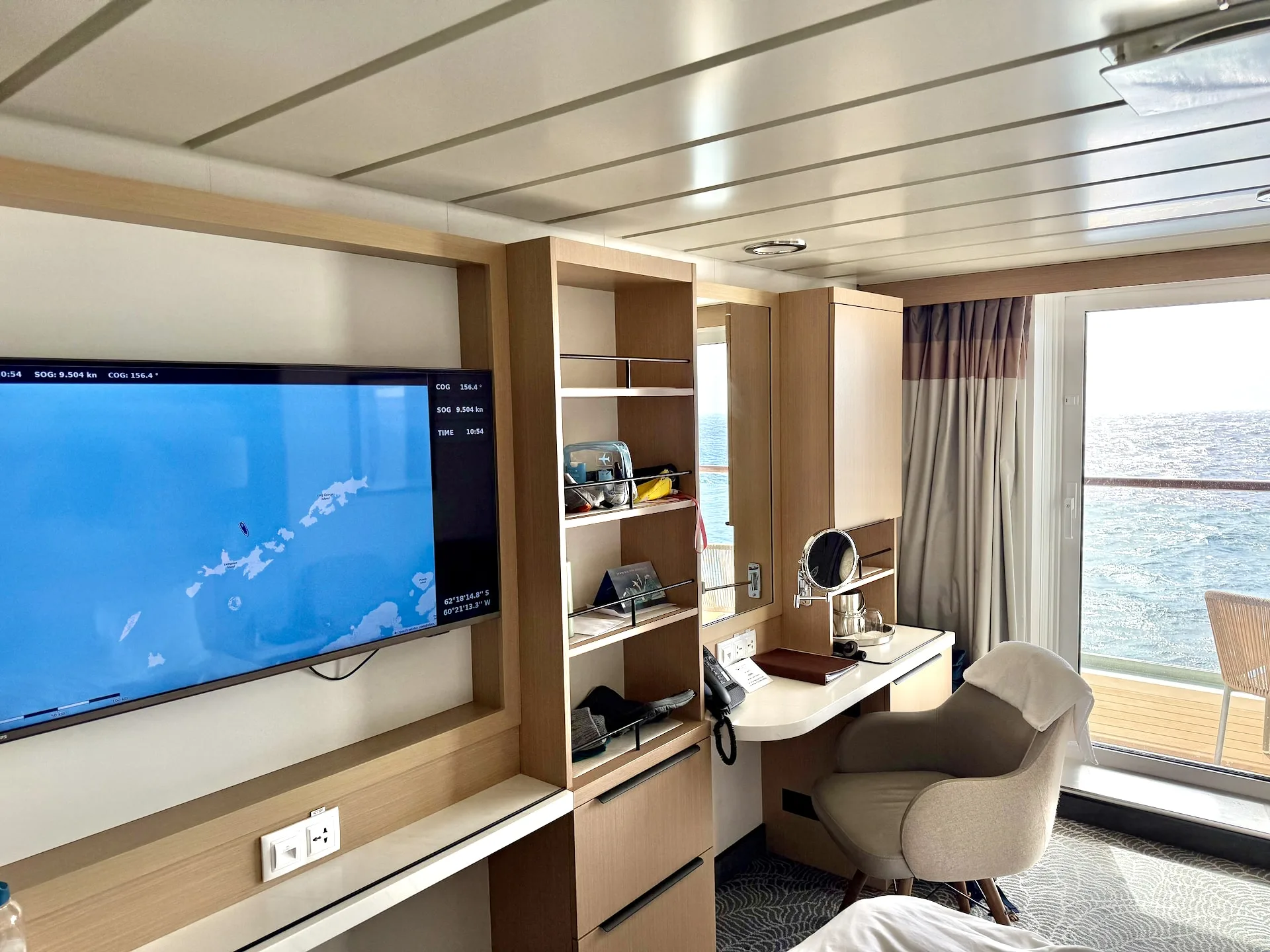
We originally booked a Category E French Balcony cabin on Deck 7 (14 m², floor-to-ceiling windows) and were delighted to discover upon boarding that we’d been upgraded to a Category C SP Superior Balcony Stateroom on Deck 6 – nearly 10 m² (107 sq ft) larger, with an actual step-out balcony. We were thrilled.
The cabin felt genuinely spacious. A large wardrobe plus several drawer units provided more storage than we could fill – with our modest one-bag setup, we used maybe half the available space. The bed was comfortable, flanked by nightstands with reading lights. A writing desk, a small coffee table, and a compact sofa rounded out the living area. The bathroom was a reasonable size with a walk-in shower and underfloor heating – a very welcome touch when you’re coming back from sub-zero landings.
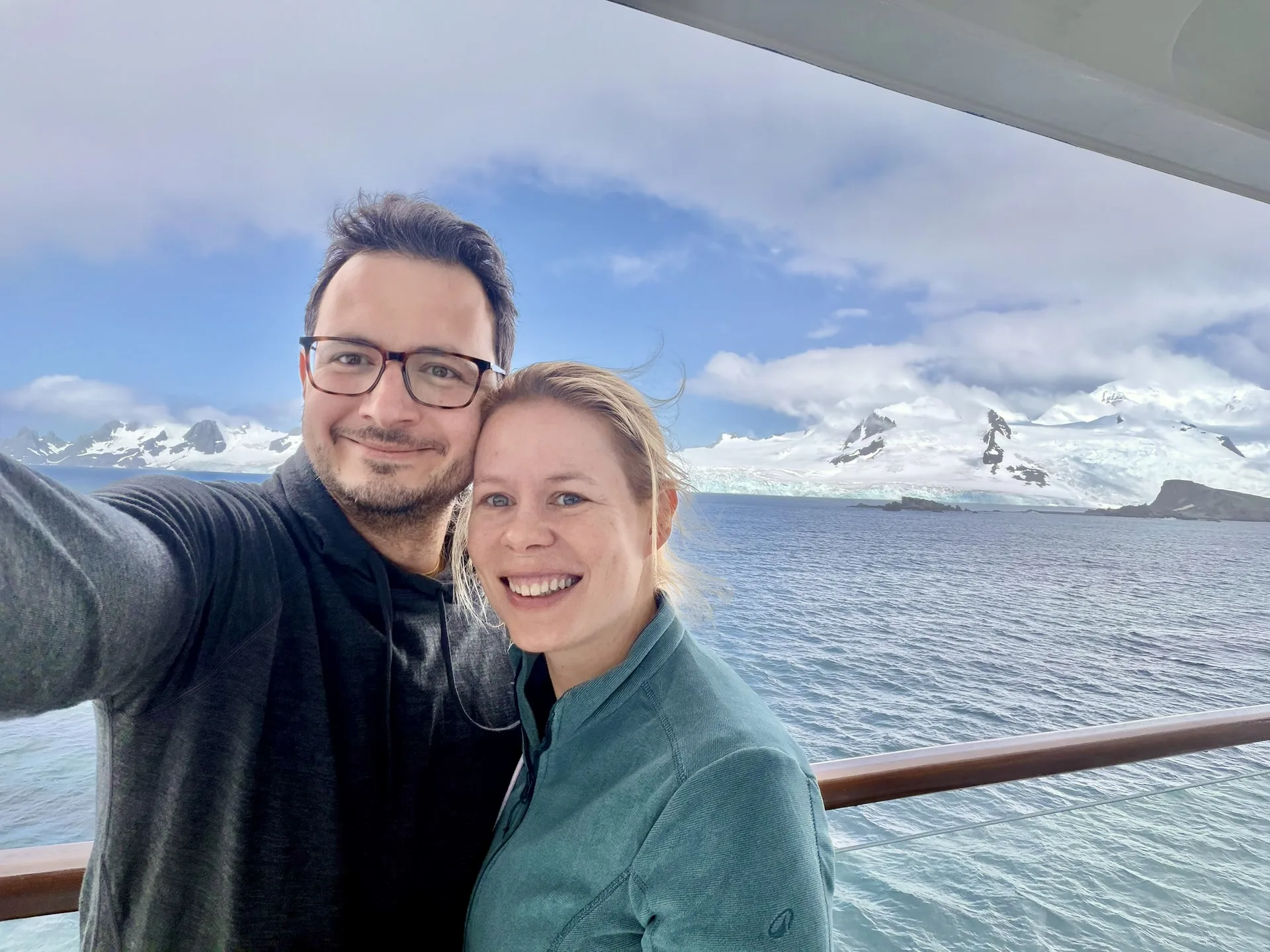
The balcony was a lovely bonus: a small table, two chairs, and enough room to stand and watch the ice drift by. The whole ship has a modern, Scandinavian-influenced design – clean lines, warm colors, inviting without being over-the-top. Everything was in pristine condition, which makes sense for a ship that’s only a few years old.
Standard amenities across all categories include a safe, flat-screen TV (for live-streamed lectures, the GPS map, daily program, and satellite news channels), a mini-fridge, 230V universal outlets and USB ports, bathrobes, slippers, toiletries, and a hairdryer.
Onboard Spaces Worth Knowing About
Rather than a deck-by-deck inventory (the deck plan covers that), here are the spaces and details you won’t find in the brochure.
The mudroom on Deck 3 is where every landing begins and ends. Each cabin gets a numbered locker for boots, life jackets, and outerwear. Four exterior doors (two per side) mean Zodiacs can board simultaneously from both sides of the ship – which cuts wait times significantly.
Deck 5 is the social heart of the ship: the Jens Munk Restaurant, the Albatros Nordic Bar, the Shackleton Lecture Room, the library, the Ocean Boutique, and the hotel reception are all here. The reception is also where you pick up seasickness medication – dried candied ginger and pills were always available, free for the taking.
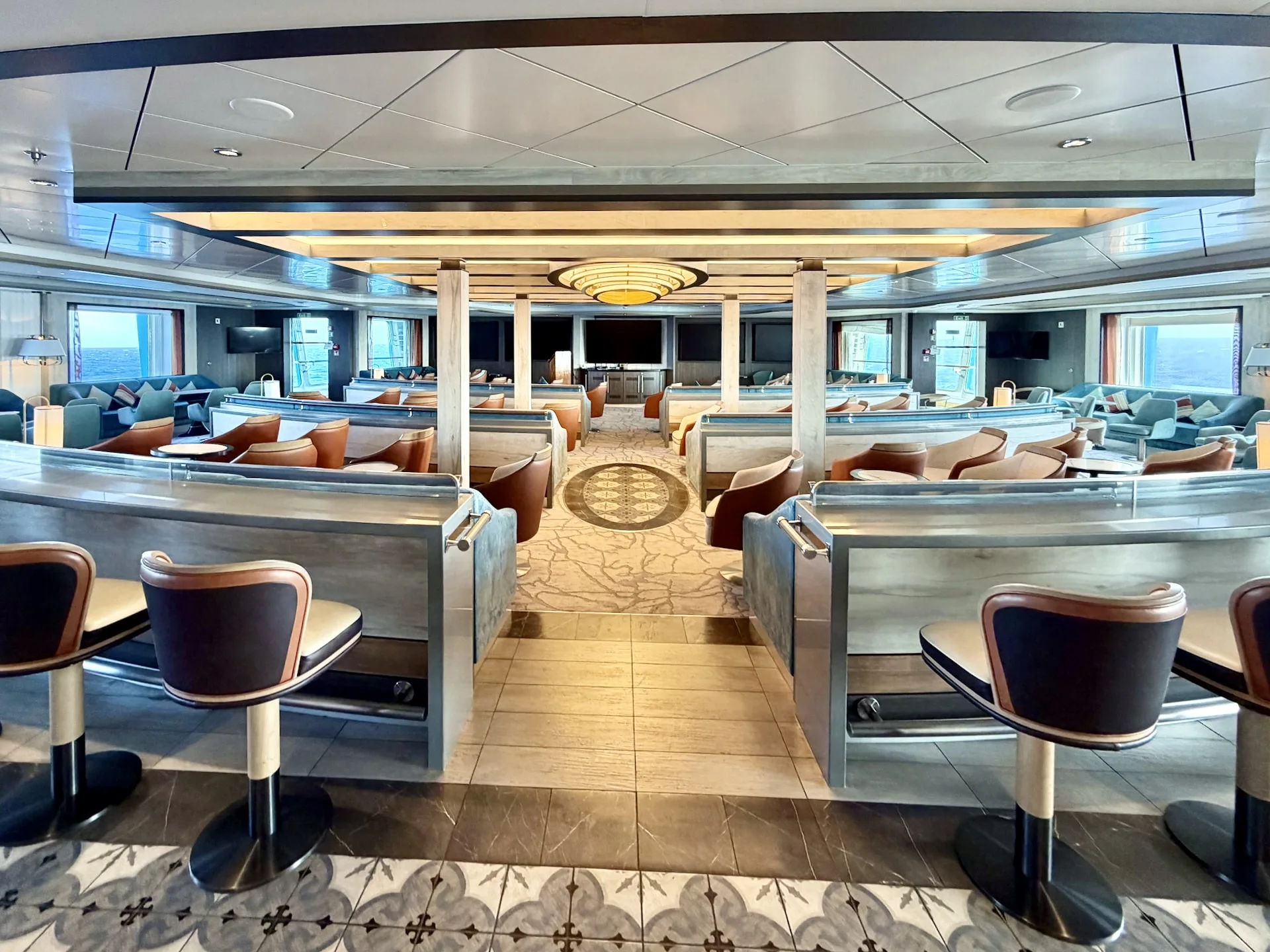
The Observation Lounge on Deck 8 is a panoramic indoor space with 180-degree views, armchairs, a bar counter, a 24-hour coffee station, and instant noodles for late-night cravings. At the bow of the same deck, the outdoor viewing area provides a dramatic forward-facing vantage point. We spotted our ornithologist Franziska eating dinner here most evenings – binoculars at the ready, scanning the horizon between bites.
A tip that took us a few days to discover: at the stern of Deck 6, there’s an outdoor platform that’s easily overlooked. It offers a great vantage point for watching the Zodiac cranes in action, and we almost never encountered another passenger there. If you want a quiet outdoor spot, this is it.
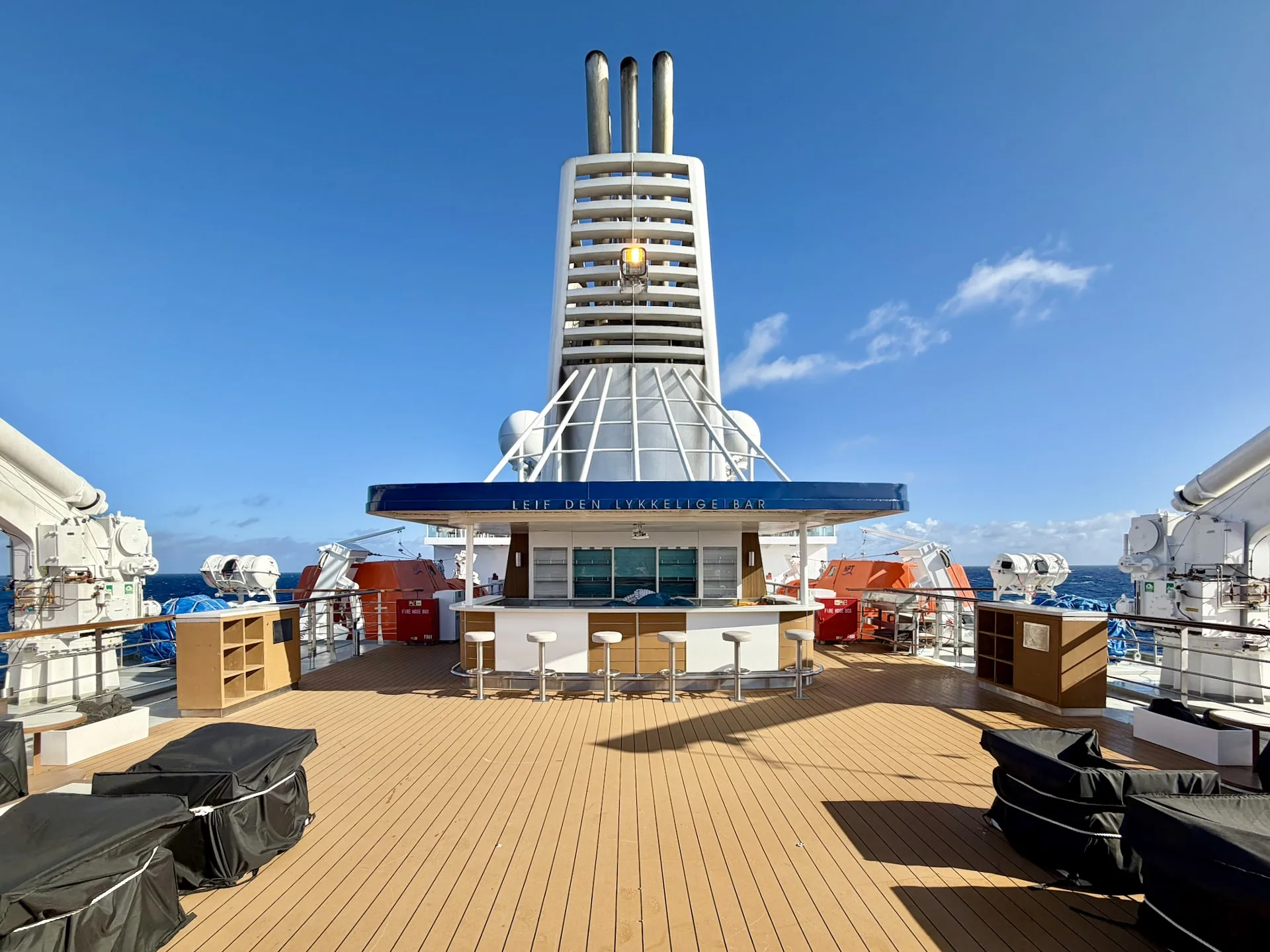
The panorama sauna on Deck 7 is a feature unique to the Ocean Albatros – you access it through the gym, and it’s tucked away enough that many passengers never found it. Andrea had the entire sauna to herself one afternoon and watched whales surfacing through the panoramic window – sitting in a sauna, alone, watching humpbacks breach against an Antarctic backdrop is not an experience many people can claim to have had. The two outdoor jacuzzis are on the pool deck at the stern of the same deck – open air, warm water, Antarctic cold. They were extremely popular on calmer days.
Good to Know: Practical Details
Internet: Starlink satellite internet was available and worked surprisingly well, even in the most remote locations. A basic free tier is included; paid upgrades are available at reasonable rates (we covered the specifics in our planning guide). We managed fine without paying and honestly, ten days mostly offline was one of the unexpected gifts of the trip.
Language: English is the working language. The expedition team is truly international – Argentine, Australian, Canadian, Brazilian, German team members, among others. All briefings and announcements are in English. A larger Polish group on our voyage brought their own interpreter, and one of the expedition guides, James, doubled as a Mandarin interpreter – so if English isn’t your strongest language, it’s worth checking with the operator whether language support is available for your voyage.
Cabin service: Twice daily – cleaning during breakfast, turndown during dinner.
Gratuities: An automatic nightly gratuity is added to your onboard account (opt-out available at reception). For details on the exact amount and a full breakdown of what we spent on board, see our planning guide.
Smoking: Only in designated outdoor areas on Deck 8.
Laundry: Available at hotel pricing per item. Suite guests get complimentary service.
Medical care: A licensed English-speaking physician and a medical facility are on Deck 3.
Accessibility: Wheelchair-accessible cabins are available, and an elevator serves five passenger decks.
Our Verdict
The Ocean Albatros delivered an experience that exceeded our expectations – I really didn’t expect everything to be so well organized and run so smoothly.
The expedition team was the single best aspect of the voyage. Their knowledge, passion, and accessibility elevated every part of the experience, from the lectures to the landings to the casual conversations over dinner. These aren’t seasonal workers going through the motions. They’re specialists who live for the polar regions, and it shows.
The crew and hotel staff were outstanding. Attentive, efficient, and genuinely warm – the kind of service where you never have to ask twice and frequently don’t have to ask at all.
Value for money is always relative when you’re spending five figures per person, but we felt we got what we paid for and then some – especially with the unexpected cabin upgrade. The food quality, the ship’s condition, the team’s caliber, and the operational efficiency all justified the price tag.
Who we’d recommend it to: Anyone who wants a genuine expedition experience with the comforts of a modern, well-run ship. You don’t need cruising experience. You don’t need to be an extreme adventurer. You do need to be comfortable with the idea that nature dictates the schedule – landings get canceled, plans change, the weather does what it wants. If you can embrace that uncertainty, this is one of the most rewarding trips you’ll ever take.
Who might want to look elsewhere: If you’re after a traditional cruise experience with structured entertainment, formal dining, and predictable schedules, this isn’t it. If you want maximum time in remote, rarely visited Antarctic waters and are willing to sacrifice comfort, a smaller converted research vessel might suit you better. And if your budget is very tight, there are more affordable ships and last-minute options that can get you to the seventh continent for less.
We didn’t sail on any other Antarctic ship, so we can’t offer a direct comparison – but based on conversations with fellow passengers and expedition team members who had, the Ocean Albatros consistently came up as one of the best in its class for the balance of comfort, expedition quality, and ship size.
Looking for the full story of what we saw and experienced day by day? Check out our upcoming Antarctic day-by-day trip diary – because describing an avalanche thundering down a mountainside into the ocean or a humpback whale diving under your Zodiac two meters away, close enough to touch its tail, is something that deserves its own article.