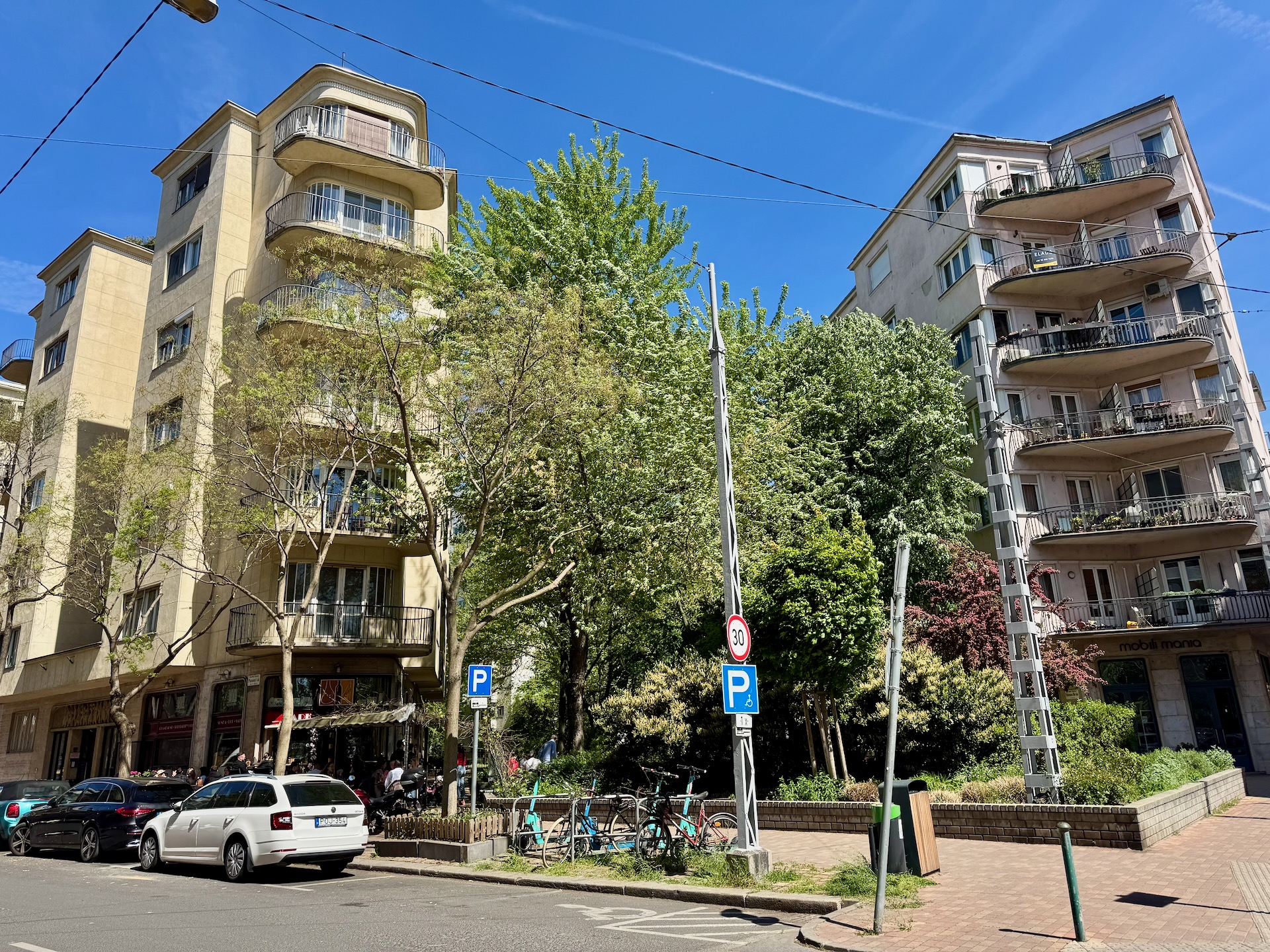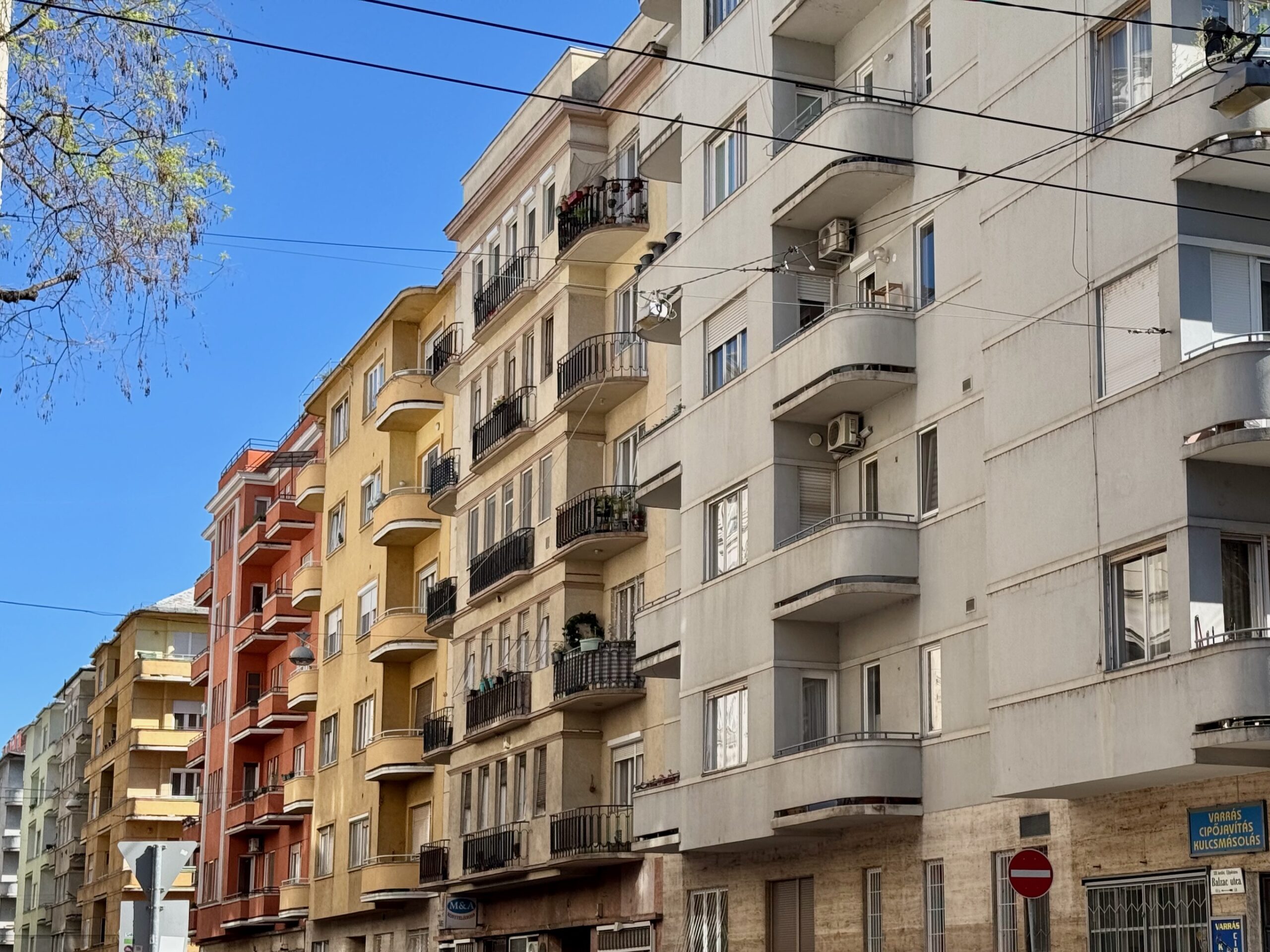
This self-guided walking tour covers Újlipótváros, Budapest’s most intact interwar neighborhood – and one of the few places in the city where architecture and WWII Jewish history occupy the same walls.
My grandmother came to Budapest in 1945 from a small village in Borsod county. She worked in a textile factory, and alongside that, as a live-in housekeeper for two siblings from the same Jewish family – one at Visegrádi utca 14, the other at Katona József utca 21, a few streets apart. My grandmother, grandfather, and mother lived with the first family, in the maid’s room next to the kitchen – the small chamber that Budapest’s interwar apartments included as standard, designed for someone else’s convenience. She looked after the second family too, a few streets away. When both families died out, with no heirs, both apartments passed to her – the woman who’d spent decades caring for them.
I grew up in Visegrádi utca 14. At eighteen, we moved to Katona József utca 21. We sold both apartments years ago. Now I come back to walk the streets.
This walk is about two things at once: the architecture, and what happened inside it.
Why Does Everything Look the Same?
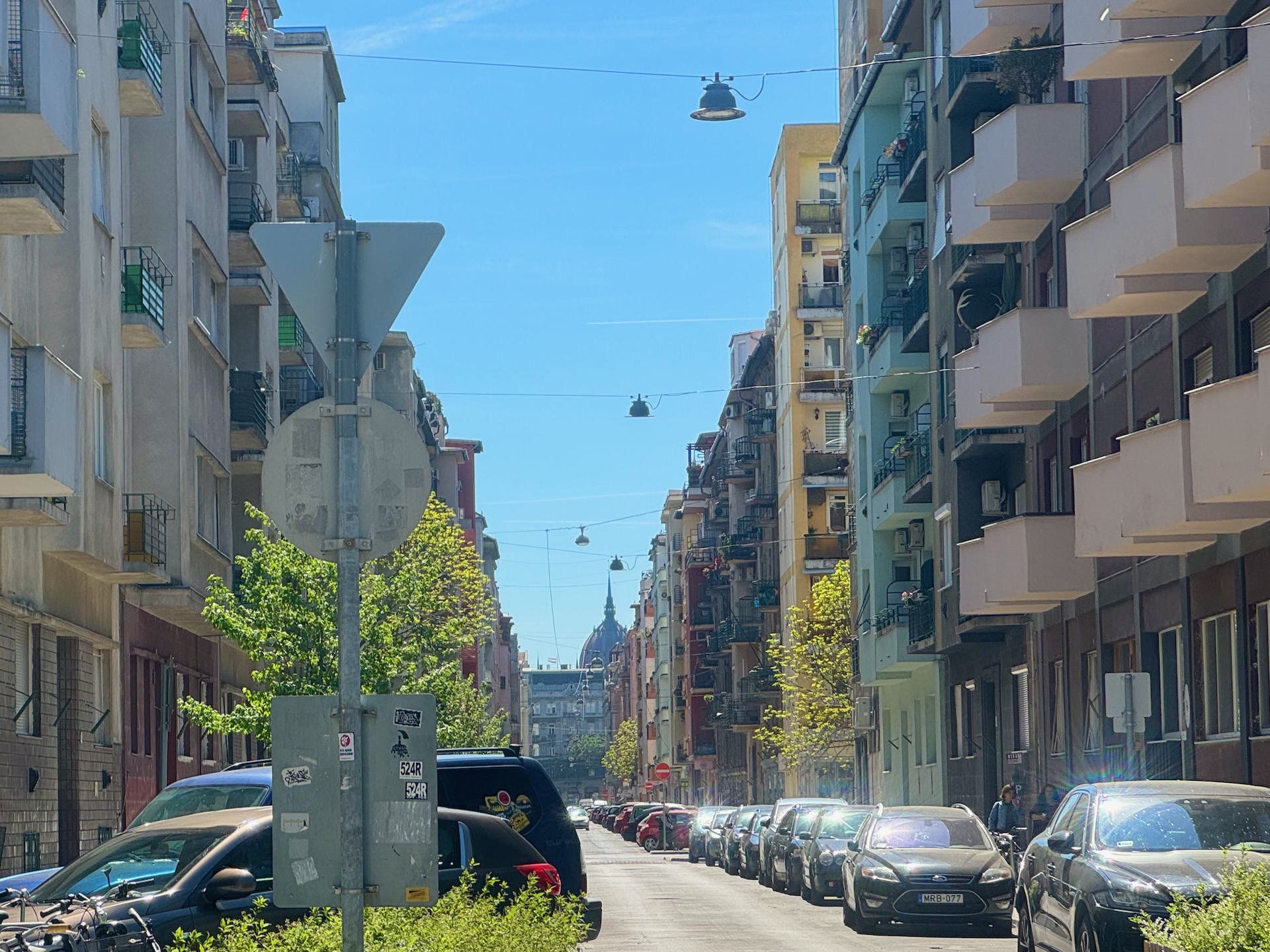
Before you set off, it helps to understand why Újlipótváros has that distinctive visual coherence – the feeling that someone built an entire neighborhood in one go, then stopped.
They basically did. Almost every building here went up between 1927 and 1944, under strict municipal regulations that required uniform 25-meter heights and a consistent street line. No medieval core, no baroque layer, no 19th-century eclecticism – just seventeen years of interwar architecture by some of the most accomplished Hungarian architects of the era, all working within the same constraints.
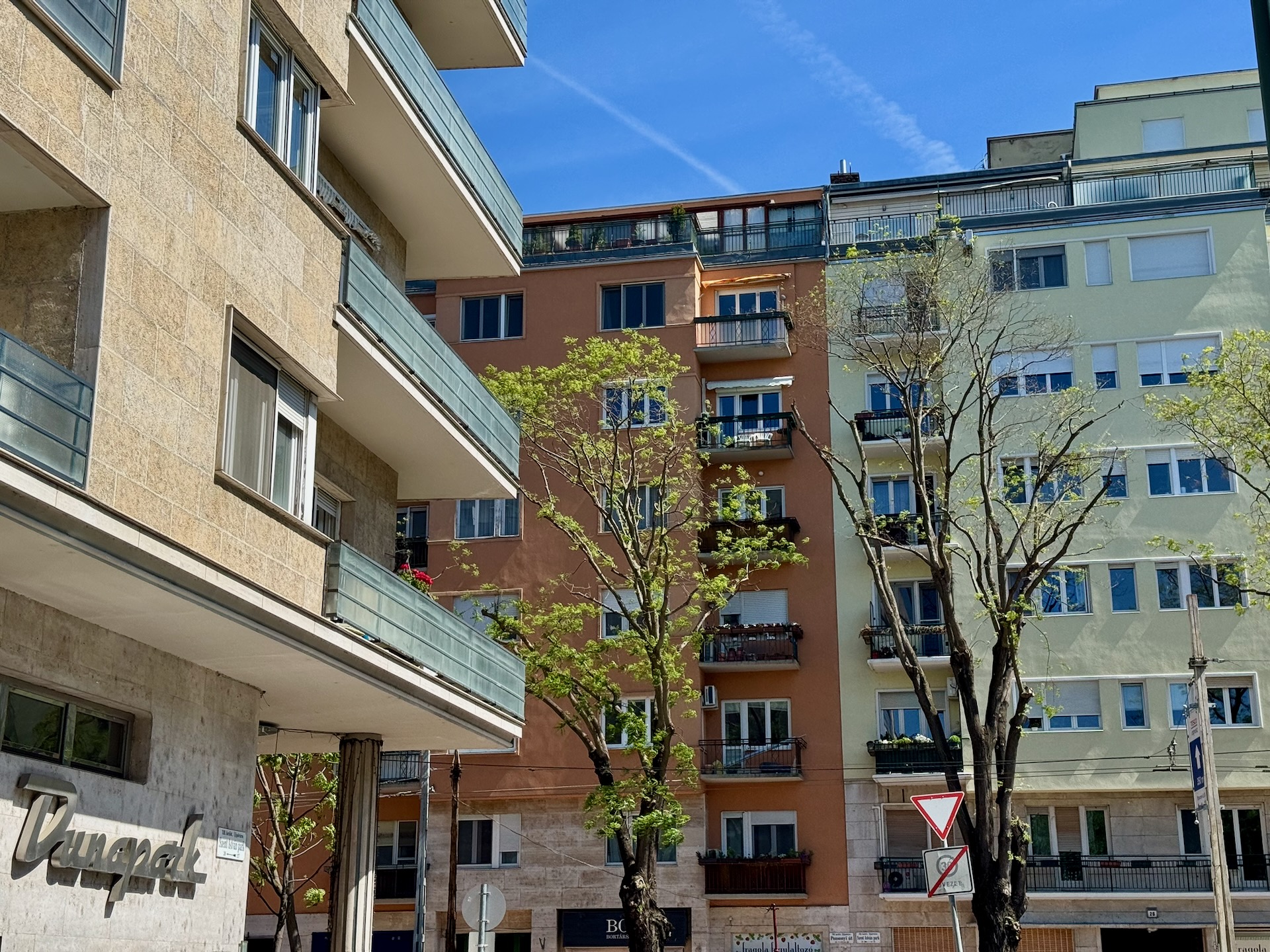
What the regulations didn’t prescribe was the detail. That’s where the buildings diverge: clinker brick here, curved glass stairwells there, Bauhaus-influenced geometry on one facade, Art Deco ornament on the next, pelican sculptures above this entrance, marble hall behind that one.
The neighborhood also sits within what was designated the international ghetto in late 1944 – roughly the area enclosed by Szent István körút, Pozsonyi út, the Danube, and Pannónia utca. Every building on this walk was inside that boundary.
Getting There
The most straightforward starting point is Jászai Mari tér, at the southern end of Pozsonyi út. You can get there on trams 4 or 6 (the main ring-road line), or on tram 2 along the Danube. If you need help with tickets or planning a route, see our guide to how to get around Budapest.
That said, the neighborhood is accessible from other directions too. If you’re coming from the M3 metro, Nyugati station drops you right at the edge of the neighborhood – once you cross the Grand Boulevard you’re already in it. Lehel tér is a reasonable entry point from the north, reachable by M3 or tram 14.
For this walk, we’re keeping it simple: start at Jászai Mari tér and head north.
Weekdays are quieter, but if you want to see Újlipótváros as it actually functions – terraces full, locals out with coffee and newspapers, the park properly occupied – come on a weekend, around midday. The buildings look better when there are people in front of them anyway.
The Walk
Start: Jászai Mari tér
The walk ends at Sarki Fűszeres on Pozsonyi út 53–55, roughly 1.5 kilometers north. Essentially a straight line up Pozsonyi út with two short detours east. Allow an hour at a relaxed pace, more if you stop to read the plaques – and you should stop to read the plaques. They’re in Hungarian, but names and dates speak for themselves, and a quick phone translation takes care of the rest.
These are private residential buildings with locked entrances. The Dunapark Café at number 38 is currently closed for renovation – check before you go. The facade is worth the stop either way.
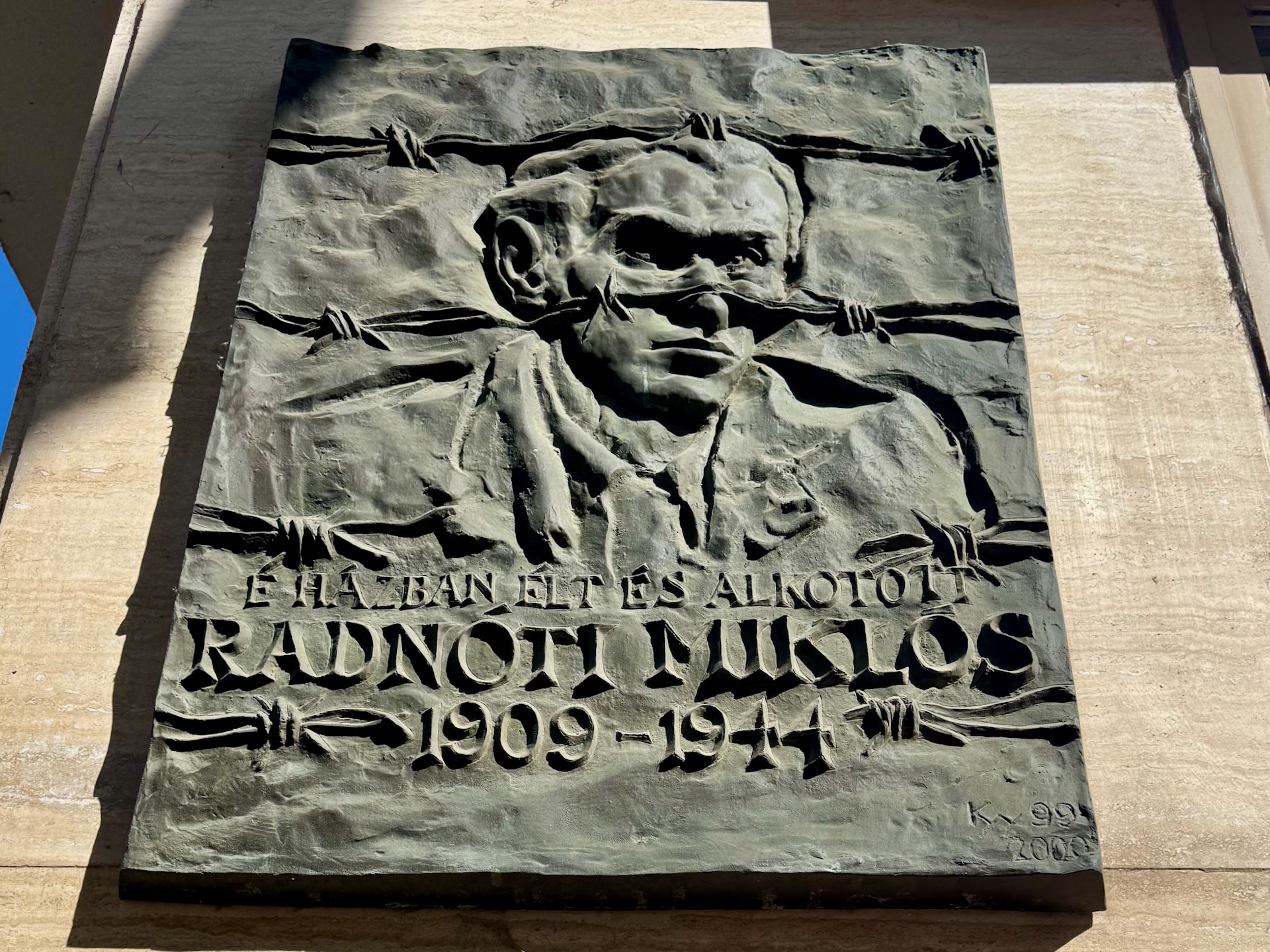
Stop 1: Radnóti Miklós Memorial Plaque (Pozsonyi út 1.)
The first thing you see stepping onto Pozsonyi út from Jászai Mari tér is a bronze relief on the corner building’s wall: a face behind barbed wire. This is Radnóti Miklós, one of the most important Hungarian poets of the 20th century. He lived in this building with his wife, was taken to forced labor service in 1944, and shot on a roadside in November of that year. His last manuscript – a notebook of final poems – was found in his coat pocket when his mass grave was exhumed after the war.
The plaque went up in 2000. The building was one of the Swedish protected houses in 1944. You are four steps onto the street, and already this is that kind of walk.
Stop 2: The Palatinus Houses (Pozsonyi út 1–7.)
Step back toward the Danube and look up. Built in 1910–11 by architect Vidor Emil, these were the first substantial buildings on what would become Pozsonyi út. The corner towers, dome-like cupolas, and richly detailed courtyards reflect Vidor’s studies in Munich and Berlin – Bauhaus in spirit, Art Nouveau in the ornamental details.
Each bathroom had thermal water piped directly from Margaret Island. A central vacuum system served the building. The apartments were built for Budapest’s aspiring upper-middle class, and they were not subtle about it. Kosztolányi Dezső, one of Hungary’s greatest writers, lived here briefly in 1911.
Stop 3: The Wallenberg Plaque (Corner of Pozsonyi út and Raoul Wallenberg utca)
The street named after Wallenberg crosses Pozsonyi út here, and on the corner building, a bronze portrait plaque shows him as a civilian: overcoat, hat, serious expression.
Wallenberg arrived in Budapest in July 1944 as a special envoy of the Swedish government. Over the following six months, he organized 31 buildings in Újlipótváros as Swedish protected houses, issued thousands of protective passports, and – in documented cases – physically pulled people off trains and buses headed for deportation.
Stop 4: A Protected House (Pozsonyi út 10.)
Look for the Védett Ház – Protected House – plaque on the facade. Number 10 appears explicitly in wartime records as one of the Swedish protected houses on Pozsonyi út.
The process: Wallenberg’s team would acquire or lease a building, register it as Swedish diplomatic property, attach the Swedish flag and emblem to the facade, and move Jewish families inside – sometimes hundreds per building, well beyond normal occupancy. Hungarian and German authorities were theoretically barred from entry. Arrow Cross militias ignored that theory on multiple occasions.
The plaques are small and easy to miss. That feels about right for a neighborhood that doesn’t announce its history.
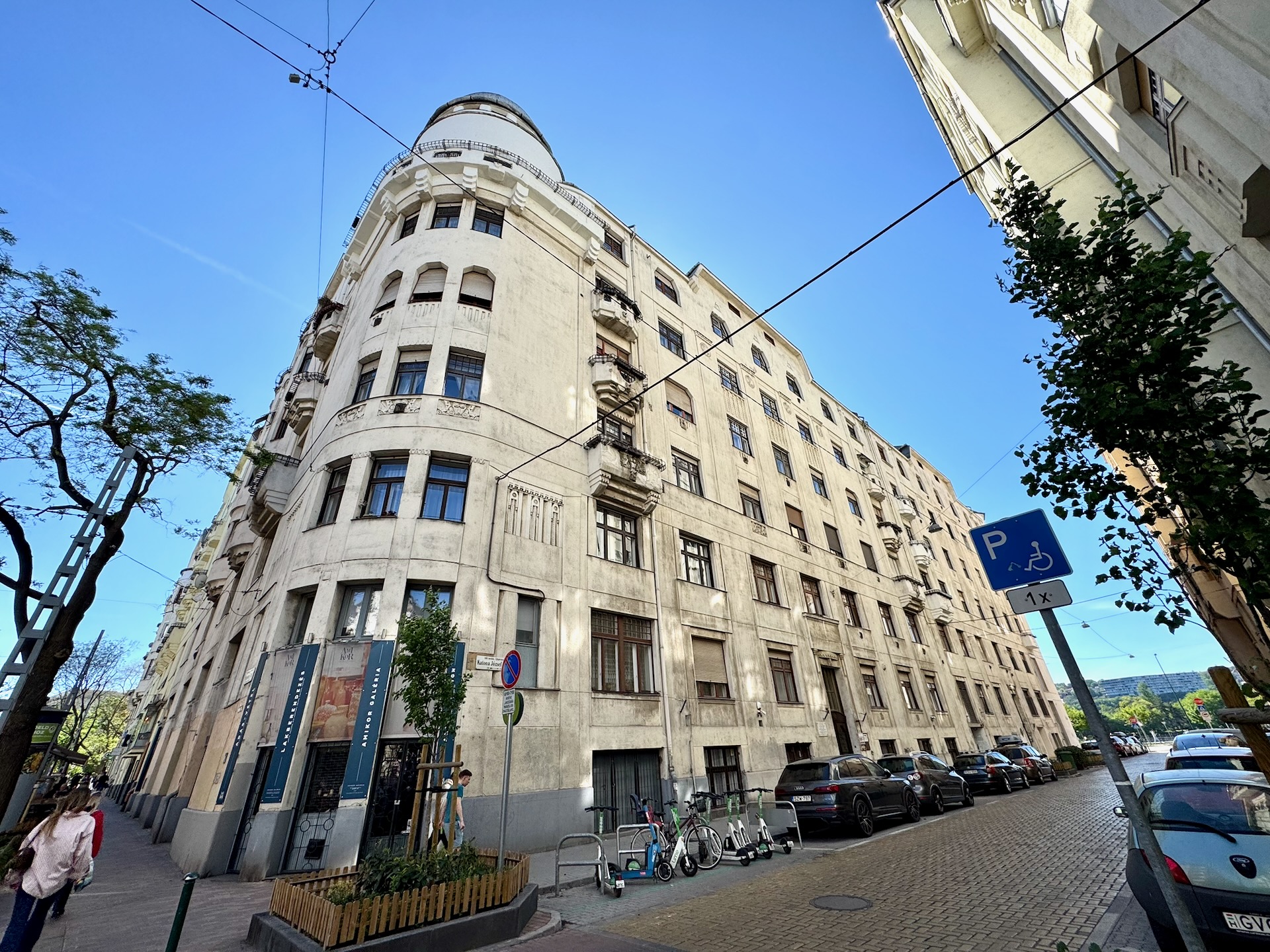
Stop 5: A House With Three Histories (Katona József utca 21.)
This short detour takes you to a building with more history per square meter than most museums.
This is where I lived from age eighteen. Before that, it was the home of the Jewish brother whose family my grandmother had worked for.
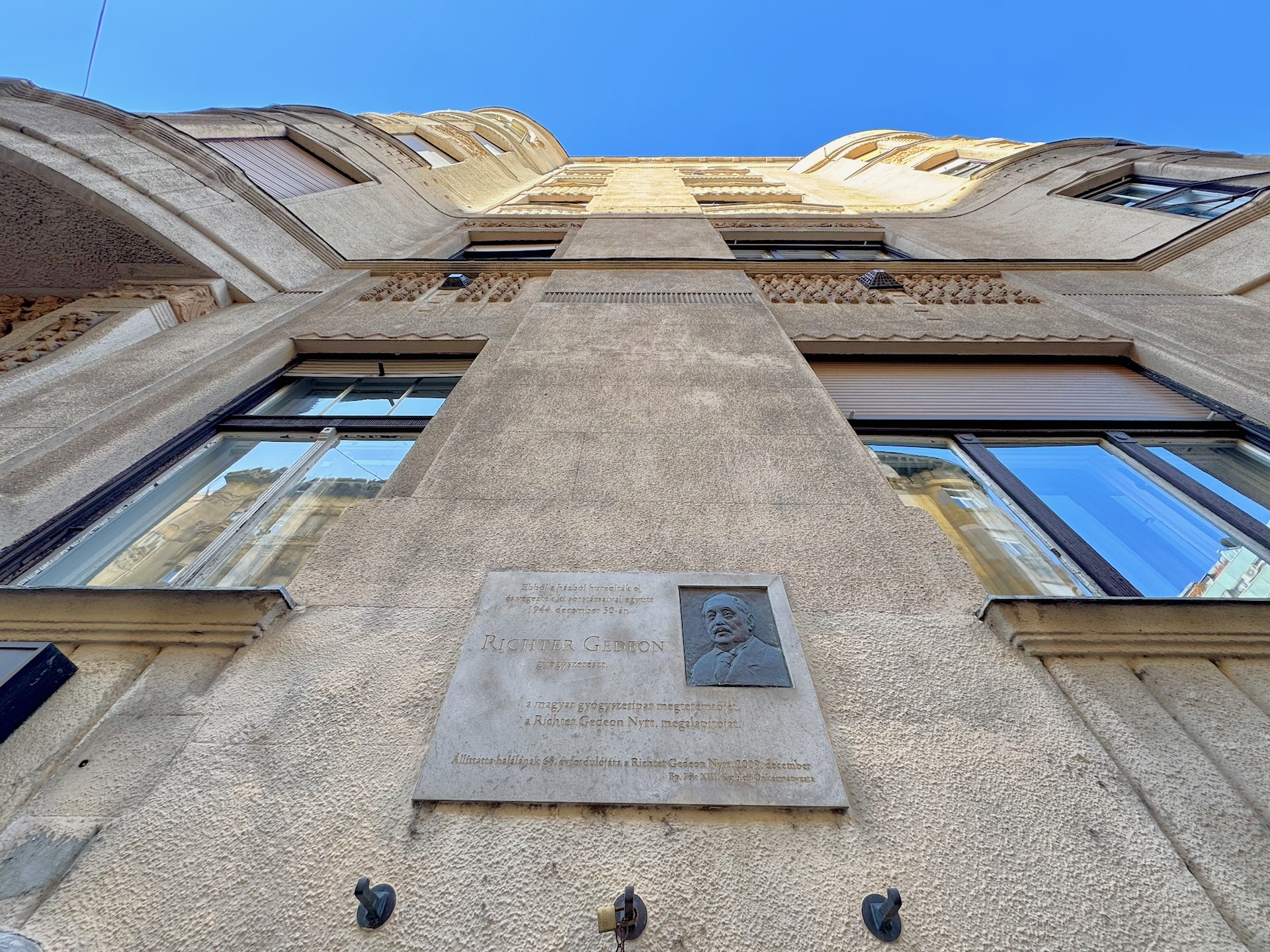
It’s also where Richter Gedeon spent his last days. After the Arrow Cross seized power in October 1944, Richter and his wife went into hiding. In early December, they moved here – designated as a Swedish-protected house. It didn’t save him. He was taken from the building and shot into the Danube on December 30, 1944. The pharmaceutical company he founded, Gedeon Richter Plc, is still one of Hungary’s largest. His brass plaque is on the wall.
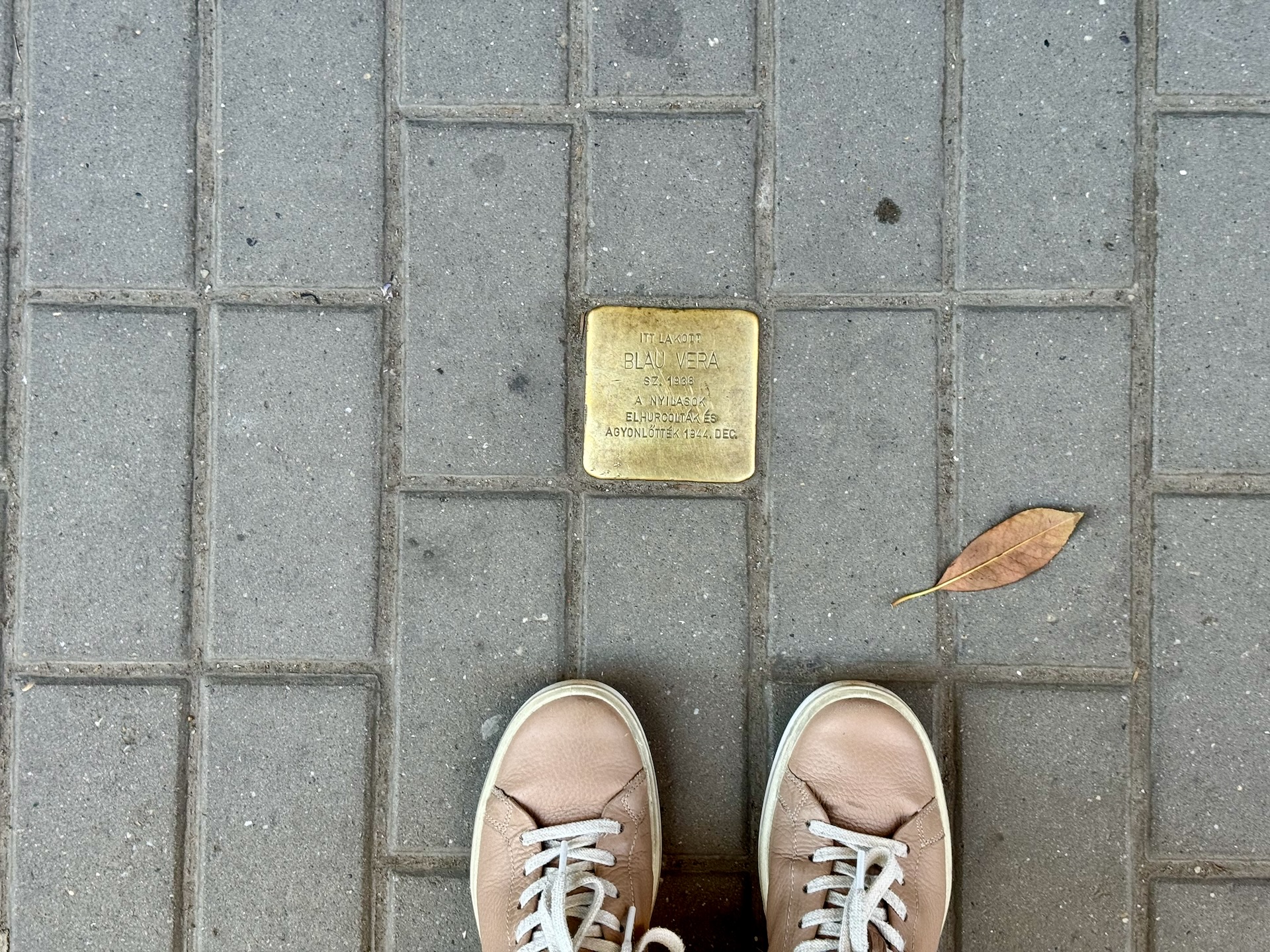
On the pavement outside: a Stolperstein, a small brass square set flush into the stone. Blau Vera. Taken by the Arrow Cross. Shot. December 1944. Same building, same month, same perpetrators.
The Stolpersteine project – created by German artist Gunter Demnig – places these markers at the last known addresses of Holocaust victims across Europe. In Budapest, the yellow-star house system was distinctive in the history of the Holocaust: almost 220,000 Jewish residents were legally required to relocate into designated buildings within days, each entrance marked with a yellow star.
Stop 6: The Rosenfeld House (Hegedűs Gyula utca 15.)
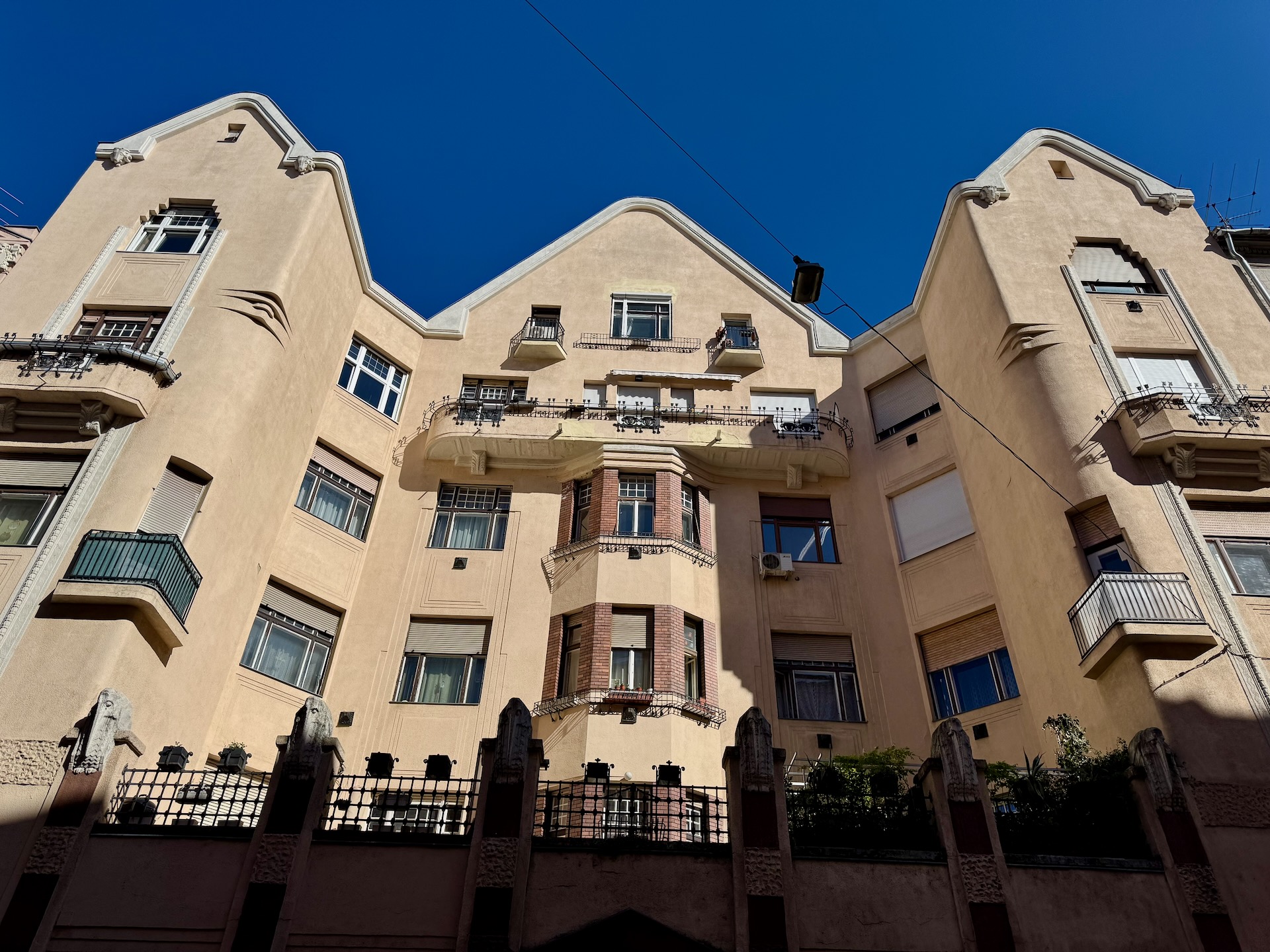
Before you reach the Phönix House, take a brief detour east onto Hegedűs Gyula utca. Number 15 is one of the neighborhood’s stranger discoveries.
Built in 1910–11 by Porgesz József – an architect who was equally an accomplished furniture designer, and it shows – the facade is decorated with six pelican sculptures. The pelican was a traditional symbol of protective sacrifice – though from certain angles, they look uncomfortably like plague doctors, which may or may not have been the point. Porgesz József was deported to a concentration camp in 1944.
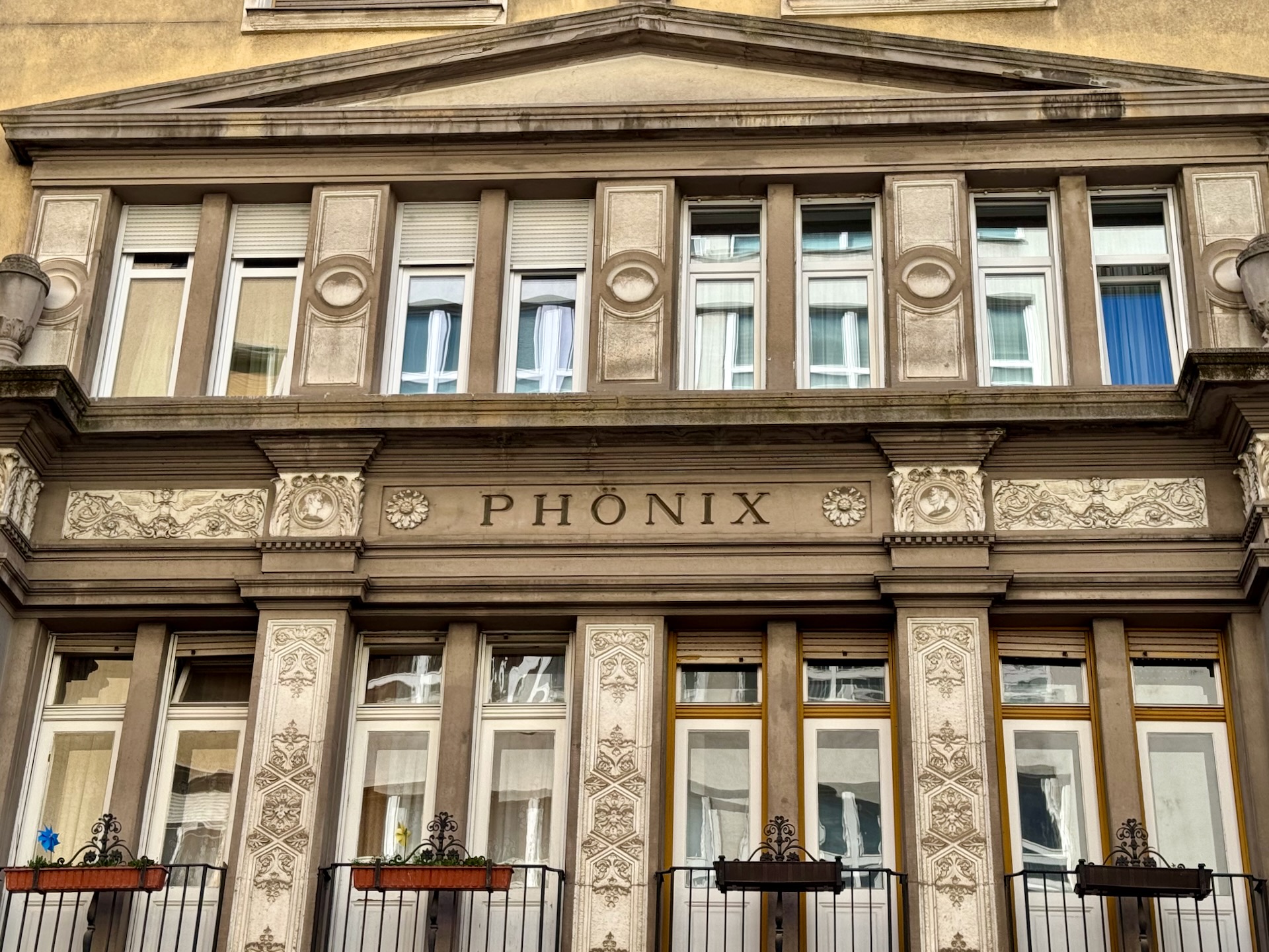
Stop 7: The Phönix House (Tátra utca 11.)
The building occupying the entire block to your east. Built in 1928 for the Phönix and Turul insurance companies, it’s a single interconnected complex – the Pannónia street entrance has the Phönix bird above it, the Tátra street entrance has the Turul (Hungary’s legendary raptor from mythology, emblem of the second company).
If the gate is open, go in. The inner courtyard garden was designed by Jonke Kálmán, the same landscape architect who worked on Margaret Island. The complex was a Swedish protected house in 1944–45.
Stop 8: The Art Deco High Point (Pannónia utca 19.)
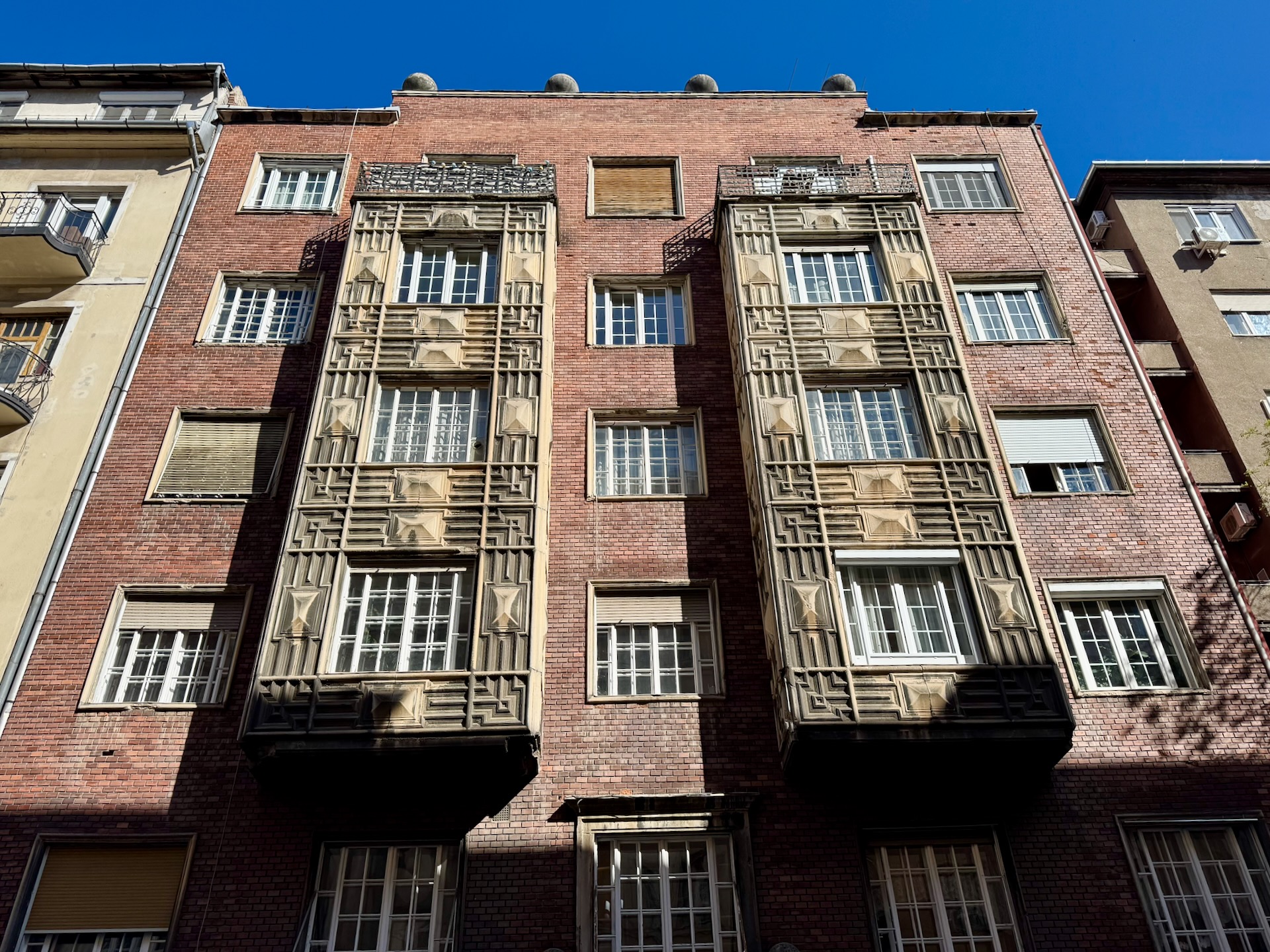
This is what many consider the clearest example of pure Art Deco in Újlipótváros. Designed by Spiegel Frigyes and completed in 1929, the clinker-brick facade is all projecting closed balconies – geometric, stripped of ornament, very deliberately so.
Earlier in his career, Spiegel was known for lavish organic detail: animal figures, gilded accents, botanical reliefs. By 1929, all of that was gone. What remained was line, plane, and proportion. Look at the small decorative elements between the windows: among them, swastikas – the ancient Sanskrit symbol Spiegel used as part of his engagement with Eastern ornament, years before the Nazis made it permanently impossible to use. The timing is uncomfortable to think about.
Stop 9: Walk and Look Up (Pozsonyi út 15-38.)
By this point you know how to read the street. This stretch has no single standout building – that’s almost the point. Notable addresses: Pozsonyi út 15–17, with its marble entrance hall and curved-glass concierge booth; Pozsonyi út 22, a Swedish protected house in 1944 that today houses a pizza counter. None of them announce themselves. That, by now, is the neighborhood’s established habit.
Stop 10: Szent István Park and the Wallenberg Memorial
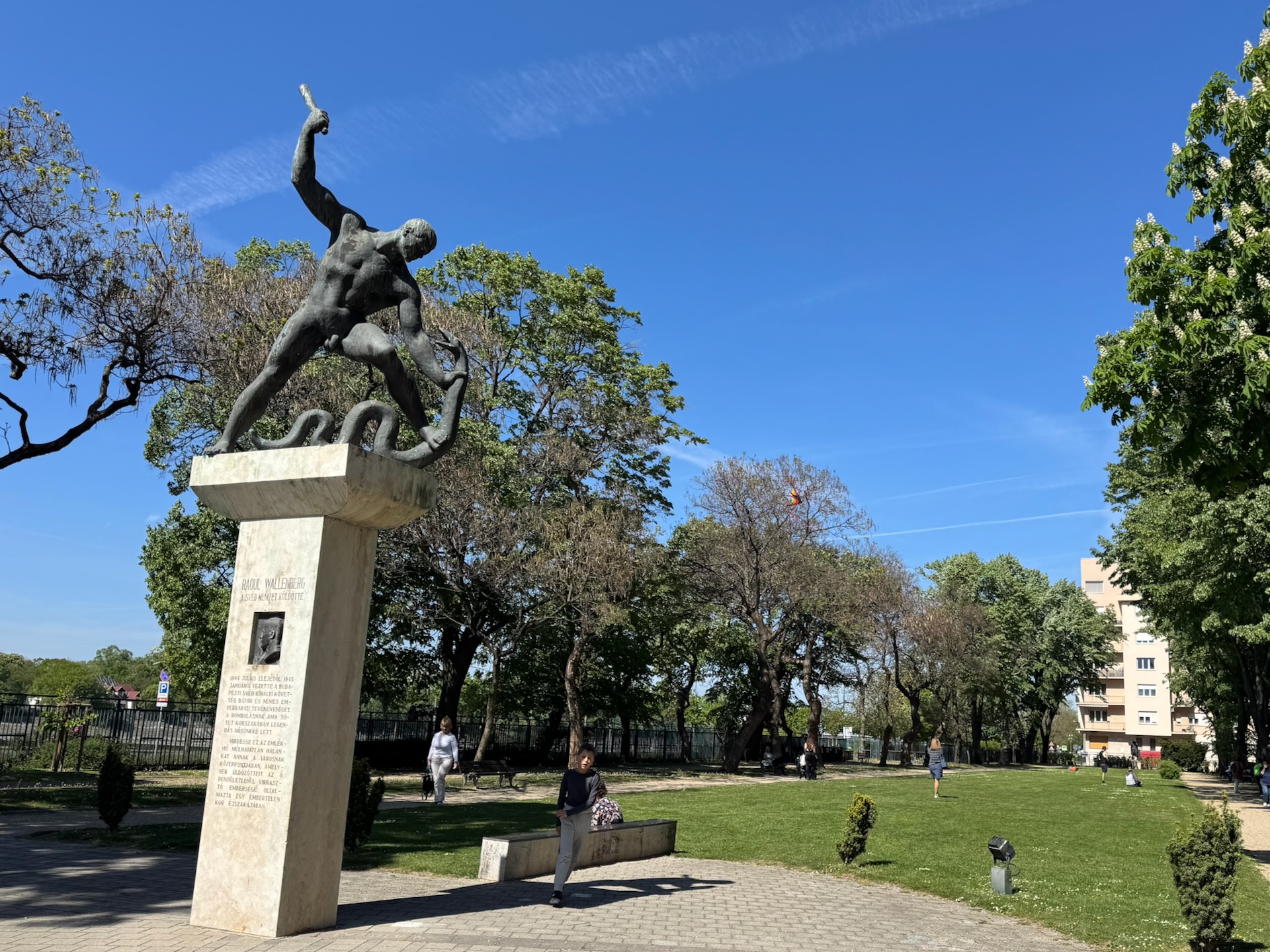
The park was laid out in 1936 on the site of a former parquet factory, modelled on French formal garden geometry – though nobody comes here for the geometry. People picnic on the grass, queue for ice cream, walk their dogs, and on at least one occasion, a rabbit. It’s that kind of park.
The bronze sculpture shows a male figure wrestling a serpent. The original was commissioned from sculptor Pátzay Pál in the late 1940s, funded by public donation – including a benefit concert by pianist Fischer Annie. It was scheduled for unveiling in April 1949. It was removed overnight before the ceremony, reportedly on Soviet orders. The current sculpture is a replica, reinstated by public fundraising decades later. The inscription reads: “He became our legendary hero.”
The park’s location isn’t coincidental. The buildings Wallenberg protected were clustered around this park. You’ve just walked through them.
Stop 11: The Dunapark House (Pozsonyi út 38–42.)
This is the neighborhood’s set piece. Designed by Hofstátter Béla and Domány Ferenc and completed in 1936 for the Alföldi Sugar Factory company, it was immediately regarded as Budapest’s most elegant apartment building. Six stories, three interconnected sections, two stairwells.
The silver Dunapark lettering refers to the café that has occupied the ground floor since 1937 – currently closed for renovation, expected to reopen in 2026. The facade is worth the stop: limestone cladding, precise proportions, the whole thing carrying itself with the quiet confidence of something that knows it’s good. If you ever get the chance to see inside, there’s a spiral staircase with marble finishes and custom blue-rubber floors. Worth waiting for a resident to open the door.
During the war, the two halves of the building had different fates. Number 38 was designated a yellow-star house. Number 40 received Swiss diplomatic protection. Same building, same stairwell system, different documents on the door. The writer Szép Ernő, who lived in the yellow-star section, described the experience in his memoir. The building’s designer, Hofstátter Béla, was shot into the Danube in 1944.
End: The Iron Building and Sarki Fűszeres (Pozsonyi út 53–55.)
The triangular plot – a sharp wedge where two street alignments collide – gave architect Hámor István no good options, so he designed around it. The result is a building shaped like a clothes iron, which is why the neighborhood calls it Vasalóház. Completed in 1941–42, it’s been handling the awkward corner with some dignity ever since.
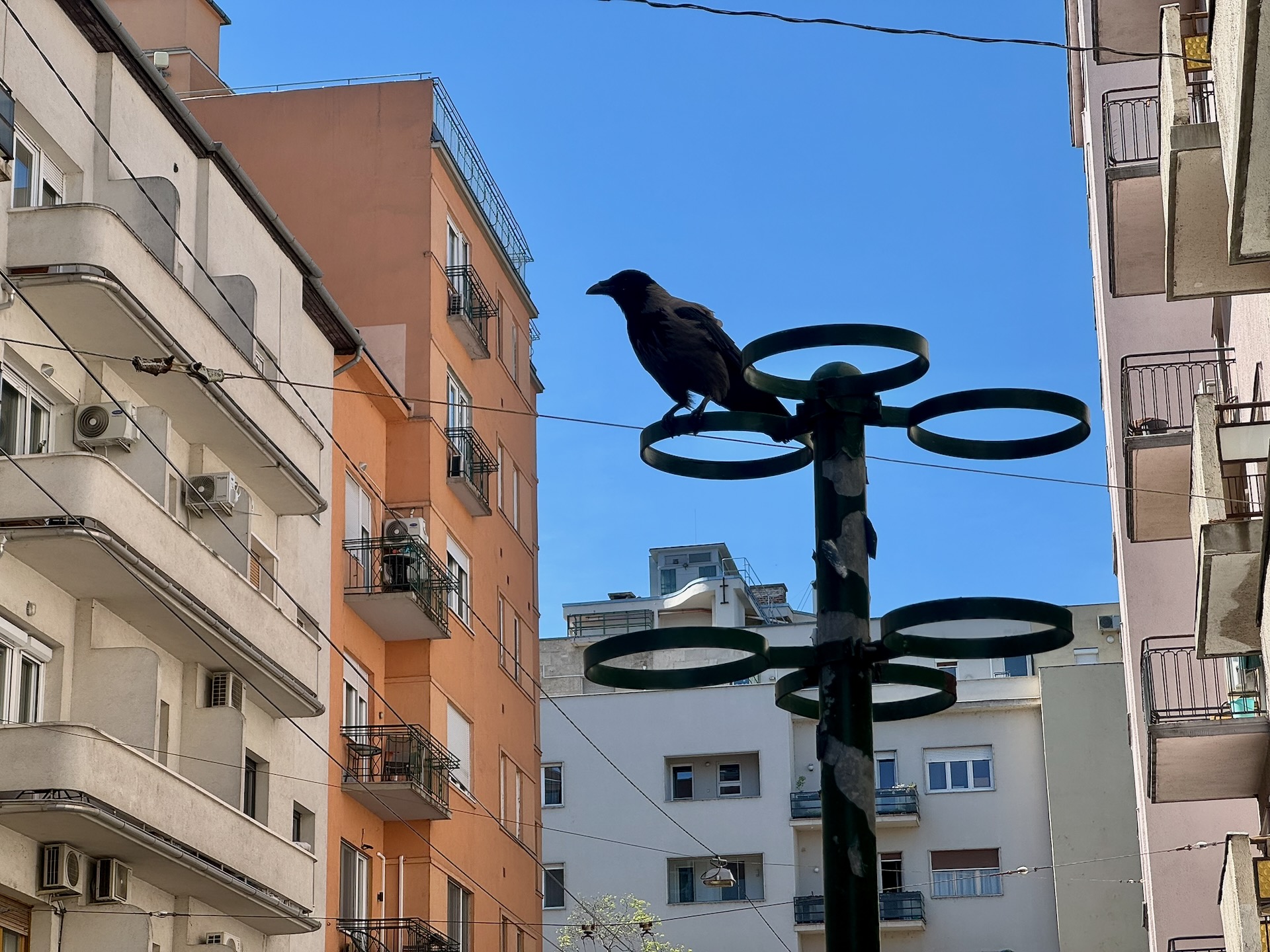
Sit down at Sarki Fűszeres with something cold and look back along the street you’ve just walked. One last thing though: watch your head, especially in spring. Every nesting season, the crows of Újlipótváros get noticeably more aggressive – there’s been no shortage of local coverage about pedestrians being dive-bombed along these streets. The district council tried to have the more territorial individuals relocated. The residents of the 13th district responded with a petition and a protest march. The crows stayed. So: enjoy the terrace, look back along the street you’ve just walked – and in spring, keep an eye on what’s above you.